The next Frontiers of Democracy conference will take place on June 23-25, 2016 at Tufts University’s downtown Boston campus. The conference schedule is taking shape, and we welcome proposals for concurrent sessions. We call the sessions “learning exchanges” because we do not accept papers or presentations. Instead, we are looking for moderated discussions, workshops, trainings, debates, or other interactive sessions that normally last 90 minutes each and involve up to 20 people. The special conference theme for this year is “Revolt Against the Mainstream?” (thinking not only about the US presidential election but many other examples of “revolts” from around the world.) Session ideas would be welcome that address that theme, but we are open to all kinds of topics related to civic engagement and democracy. Please use this form to submit ideas–for best consideration, by Feb. 29.
the Koch brothers network and the state of American parties
Kenneth Vogel reported recently in Politico that “[Charles] Koch and his brother David Koch have quietly assembled, piece by piece, a privatized political and policy advocacy operation like no other in American history that today includes hundreds of donors and employs 1,200 full-time, year-round staffers in 107 offices nationwide. That’s about 3½ times as many employees as the Republican National Committee and its congressional campaign arms had on their main payrolls last month.” Vogel adds that the Koch network will spend more than twice what the RNC spent in 2012, that it has more staff and funding in some key states than the state’s Republican party has, and that it is the leading provider of voter data and political training/coaching on the right today, supplanting the GOP.
Vogel and some of his quoted sources emphasize that this network is unprecedented in US history, which seems true. I would add that it appears unique in the world. The Varieties of Democracy (V-Dem) Project offers free data on the political systems of 173 countries. They ask so many questions about each country that the dataset includes 15 million data points. (I am one of many coders for the USA.) The V-Dem project asks about all kinds of ways in which political parties may be strong or weak; autonomous or co-opted; free, regulated or banned–but it doesn’t even pose questions about entities that perform the traditional functions of parties without being parties. That seems to be a novel contribution of the US since 2000.
The Koch network stands for an ideology and policies that I mostly disagree with, but that’s not the only reason to worry about this development–which could be replicated on the left. These are the main reasons:
- A standard political party is at least somewhat accountable, representative, and deliberative. Here are the extensive Rules of the Republican Party, which are mostly about intra-party elections, offices, procedures, and powers. They create a system in which each grassroots Republican has an independent voice and influence. To be sure, some parties have boasted of their authoritarian internal structures, but they have never been important in the US. More common are parties that fail to live up to their claims of responsiveness. In fact, Robert Michels’ “Iron Law of Oligarchy” (1911) was about the rigid tendency of even social-democratic parties to become internal oligarchies. That is a real worry, but there are limits to it. In competitive systems, parties that present themselves as democratic yet act oligarchically lose members and elections. Party elites are disciplined by voters–imperfectly but inevitably. There is no such mechanism within the Koch brothers’ network. It is officially and thoroughly oligarchical. The 1,200 paid staffers work for the people who pay them, not for voters or members.
- A party is also accountable to all the voters because it can obtain power and actually govern, and then the electorate can decide what they think of the results. But the Koch network doesn’t directly govern; it just influences some of the people who do. If the politicians they support turn out to be unpopular, the Koch network can pick new candidates for the next round. It cannot itself be voted out.
- A standard political party must be transparent if it seeks to attract and retain members. That’s why the GOP has published rules, leaders, and a platform. I am fully aware of the secrecy in US politics, but secrecy is checked by the need to compete for public support. As far as I can tell, the Koch network doesn’t even have an official name, let alone a set of binding rules that an outsider can assess, let alone a public budget.
- A standard political party includes both activists and interest groups and actual office-holders. The office-holders are responsible for performance in government and can’t just spout rhetoric. The activists, on the other hand, have some freedom to speak truth to power. The result is a healthy tension between aspirations and reality. But the Koch network is run by activists/interests groups who influence office-holders. It has no incentive to compromise or to support compromise.
- Power within the Koch network is proportional to money and is extraordinarily unequal. Michels taught that all parties are inequitable, even those most passionately committed to equality. Still, parties need citizens to vote and volunteer, and the capacity to do so is pretty evenly distributed across the population. The Koch network is purely and simply driven by money.
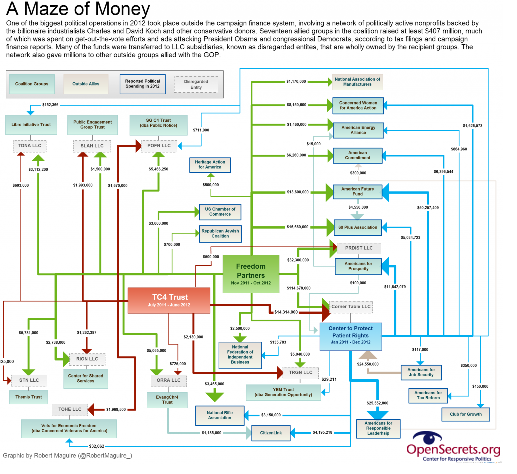
Below is the Koch network as depicted by my friends at the Center for Responsive Politics. It does not belong in a civics textbook, although a realistic textbook today should probably include it.
.
new book on communities using Positive Youth Development
Jonathan F. Zaff, Elizabeth Pufall Jones, Alice E. Donlan, and Sara Anderson have published their edited volume entitled Comprehensive Community Initiatives for Positive Youth Development (New York: Routledge, 2016). “Positive Youth Development” is a whole stance toward adolescents that involves supporting them to do positive things rather than preventing them from doing bad things. The preventative approach can be done in a caring and sympathetic way; it still tends to fail. Teenagers get too few opportunities to contribute, and they flourish much better when they have such opportunities. Many Positive Youth Development initiatives are programs: organized, named, defined activities that enlist certain kids for certain purposes, such as service, arts, or sports. But we can also intervene at the level of communities to increase the opportunities for all resident kids and to involve them in designing and allocating programs. Not much has been known empirically about “comprehensive community initiatives” for Positive Youth Development, but this book assembles the best available evidence and has roots in the practical work of the Center for Promise. One chapter is by Jodi Benenson, Kei Kawashima-Ginsberg, yours truly, and Felicia M. Sullivan: “Youth as Part of the Solution: Youth Engagement as a Core Strategy of Comprehensive Community Initiatives.”
European Institute of Civic Studies, 2016
Summer Institutes of Civic Studies have been held annually at Tufts University since 2009. They are open to applicants from all countries, and the 2016 version will take place from June 13-23. In 2015, Tanja Kloubert, Karol Soltan, and I also organized a version of the Institute in Chernivtsi, Ukraine. Thanks to support from the German Academic Exchange Service (DAAD), we will be able to repeat that European Institute in 2016. It is open to individuals from Ukraine, Belarus, Poland and Germany and will take place in Augsburg, Germany, from July, 25th to August 5th 2016 (at the Augsburg University).
What is the DAAD-supported Summer Institute of Civic Studies?
It is is an intensive, two-week, interdisciplinary seminar bringing together advanced graduate students, faculty, and practitioners from diverse fields of study
Who can apply?
Ukrainian scholars and practitioners are strongly encouraged to apply. We will also consider the applications from Germany, Belarus and Poland. We are especially interested in applicants who have a long term interest in developing the civic potential of Ukraine, and the region.
How to apply?
All application materials must be submitted in English. The application must include the following:
- A cover letter telling us why you want to participate in the summer institute and what you would contribute (maximum 2 pages)
- A curriculum vitae
All application materials can be sent as an email attachment in DOC or PDF format to tetyana.kloubert@phil.uni-augsburg.de.
Deadline: For best consideration apply by March 31, 2016.
Expenditures: The Summer Institute of Civic Studies is being funded by the DAAD (German Academic Exchange Service). Selected participants will be provided with travel costs, visa expenses, accommodation, meals and full event access.
Contact: For more information about the Summer Institute of Civic Studies please contact tetyana.kloubert@phil.uni-augsburg.de
when is cultural appropriation good or bad?
The Oberlin College Cultural Appropriation Controversy is almost certainly getting more attention than it deserves because it reinforces critiques of political correctness in higher education. Nevertheless, it provides an interesting case to consider the general questions: What is cultural appropriation, and when is it bad?
Some Oberlin students criticized Oberlin’s dining hall’s bánh mì and General Tso’s chicken as cultural appropriations. These are wonderfully ironic cases. Bánh mì is a French baguette sandwich with ingredients popular in Vietnam. It is a direct result of French colonialism, a perfect example of a creole or hybrid cultural product. Without cultural appropriation, there could be no bánh mì in the first place. General Tso’s chicken has obscure origins but is most widely thought to have been invented in New York City by chefs of Chinese origin.
I start with the assumption that there is no such thing as cultural purity. We are all creoles, all the way down. We have been in contact with each other all along, naturally and inevitably borrowing, sharing, and stealing. Even supposedly “uncontacted” peoples deep in the rain forest have actually been in close contact with others for thousands of years. Claims of cultural purity and authenticity are almost always problematic, morally as well as factually.
And yet the critical students at Oberlin were making some valid points. To borrow a cultural product is to enter a relationship with someone else. That can be done respectfully and gratefully or rudely and exploitatively. In other words, it involves ethics. Also, it can be done skillfully–so as to produce an excellent product (possibly one never seen before)–or else poorly. In other words, it involves aesthetics. The Oberlin students are saying that their college dining hall’s Asian food has been borrowed disrespectfully and also poorly.
Those can be fair points, but we don’t often conduct such conversations well—for two large and important reasons. Because of positivism, we are not good at talking about ethics. And because we accept deep social inequality, we tend to overlook the material conditions of fine culture.
To the first point: We live at a time when science has enormous prestige, and science cannot address value judgments except to recognize that human beings form them for various reasons. Science suggests that there are two buckets: facts and evidence go in one; values, emotions, preferences and tastes, and personal identities go in the other. To say that Oberlin’s bánh mì are bad is not a factual claim, so it must involve emotion, preferences, and identities. That means that we cannot reason deliberatively with people who might hold different views of Oberlin’s bánh mì or of culture more generally. We can only express opinions that have strong emotional charges and that are linked to our identities. So to take a position on either side is to harm emotionally people who have different identities.
I would not dismiss the significance of emotion or identity. We must be sensitive of both. But we can also deliberate about relatively subtle, charged, and complex questions like food and culture. More than one perspective is valid, and each position can be supported with arguments and reasons. Opinions can change; the group can learn. Expressing a view is not necessarily a threat to other people; it can be an opportunity to reason.
In a positivist and relativist culture, scholars in the humanities and cultural disciplines are basically taught to suppress value judgments–yet certain strong values break through that screen because they are irrepressible and because political movements stand behind them. So even though value judgments are deemed to be culturally relative, it is wrong to be sexist, racist, or colonialist. I agree that those attitudes are wrong, but I see them as just the tip of a submarine mountain of ethical issues, all complex and all deserving of analysis.
When I was writing my book about Dante, I first encountered the view held by certain scholars that cultural appropriation is intrinsically bad. For instance, it was intrinsically problematic that Byron appropriated Dante’s medieval Italian culture for liberal nationalism. My response was: let’s think about when and why various forms of cultural borrowing are good or bad for various people. That is to reason about ethics, which is countercultural for many scholars. (Aaron R. Hanlon has a good response to the Oberlin controversy, calling for a distinction between “appropriation,” which should be value-neutral, and “expropriation,” which is bad and requires a critical argument.)
The second issue is inequality and the material conditions of successful borrowing. The dining hall staff of Oberlin College may not have been given the support they would need to do a good job providing Asian food–or original, “fusion” food. That would take experience, support, and time. Absent those supports, it’s possible that they should stick to what they know best (which will not be culturally pure or authentic, but simply a list of recipes of miscellaneous origin that are familiar to them). Or it’s possible that someone should help them try new things. But it definitely takes resources to engage well with any unfamiliar culture.
In many a Yuppie household (such as mine), people frequently dine in fine restaurants that serve foods from around the world, occasionally travel to distant lands, attempt to learn other languages, and have rows of cookbooks from many cuisines that they use to cook their own food. For instance, we were able to spend the winter break in Guadeloupe, and last night I cooked Chicken Colombo, which is a Guadelopean fusion dish strongly influenced by South Asian indentured workers. Meanwhile, in many families, the adults cook what they learned from their own parents. I remember chatting with a bunch of working-class immigrant high school students from Hyattsville, MD who were amused (more than offended) that Yuppies cook food other than “their own.”
The differences between these two kinds of households may depend in part on personal tastes and proclivities and on local cultural norms. For instance, Mexican/Asian fusion cuisines are famously widespread in San Bernardino County, California. But there is also certainly a socioeconomic aspect of this difference. I cooked Chicken Colombo last night because we could afford to visit Guadeloupe. One reason we visited that island is that we have had opportunities to learn French. And we were comfortable eating food unfamiliar to us because our neighborhoods have long been full of diverse restaurants. These are forms of material support.
I don’t know anyone at Oberlin, but I can imagine two kinds of hypothetical characters: a Yuppie student who despises the college’s bánh mì because she grew up with better ones, and a working-class immigrant student who is offended that the college serves “someone else’s” cuisine because she hasn’t had an opportunity–yet–to sample and cook foods from around the world. Material inequality is relevant to both perspectives. Without sufficient resources, it is simply harder to make something ethical and creative out of a cultural interaction.