Clinton must not patronize Sanders voters

Hillary Clinton told Glenn Thrush last Friday: “There is a persistent, organized effort to misrepresent my record, and I don’t appreciate that, and I feel sorry for a lot of the young people who are fed this list of misrepresentations. … I know that Senator Sanders spends a lot of time attacking my husband, attacking President Obama. I rarely hear him say anything negative about George W. Bush, who I think wrecked our economy.’”

It is very strongly in Clinton’s interest to stop talking this way. Indeed, she should adopt almost exactly the opposite position. There is room to her left on the ideological spectrum. Sanders voters are in that space. Many of them happen to be young, but it’s their beliefs that line them up with the Sanders campaign. Clinton will need their votes in November. They will be weighing whether to vote for her–or stay home. She must communicate very clearly that she respects their positions, that they are the future of her party, that she has a different “theory of change” from theirs but is open to learning from them, and that the Democratic primary debate has been dignified, substantive, and valuable.

Instead, she is implies that they are naive and callow youth who would vote for her if they hadn’t been misled about her personal contributions by a cynical pol. It would be difficult to devise a message with more power to alienate a pivotal group of potential supporters.

cultural mixing and power

 Screen Shot 2016-04-04 at 9.20.51 PM

These two objects were juxtaposed during a wonderful Tisch Talk in the Humanities yesterday, with Maria Magdalena Campos-Pons from the School of the Museum of Fine Arts and Lisa Lowe from Tufts’ Department of English.

On the left, an 18th century desk made in colonial Mexico that’s now in the Boston Museum of Fine Arts. Lowe noted that the shape derives from the Northern European Renaissance. The geometric patterns on the outside are reminiscent of Moorish Spain. But, as Lee Lawrence writes, “With the desk flap lowered and the bookcase doors open, … the gold-on-red interior screams China—until, that is, you take a closer look. The artist has depicted a hacienda with palm trees and deer, not a landscape with willows and oxen, and the figures wear sombreros, not conical hats.” Some of the figures appear to be Africans, slaves or freemen.

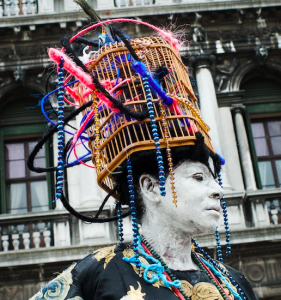
On the right is a photo of Campos-Pons in the Piazza San Marco, Venice. She is an Afro-Cuban artist with some Chinese-Cuban ancestry. She was responsible for the Cuban Pavilion at the 2013 Venice Biennale, a remarkable installation built partly of bird cages. Here she is dressed in an elaborate costume that has Cuban, Chinese, and Yoruba elements, claiming the piazza as a kind of town crier.

Both objects mix Chinese, New World, European, and African content. Both are made by Hispanic artists of color.

It might seem that power and agency is different in these two cases. Campos-Pons is an internationally recognized and successful artist. She makes images that mix specific cultural elements of her choice, and she is honored for the results. The anonymous (to us) artisans who made the desk combined a specific set of cultural elements because Spain had occupied Mexico and turned its indigenous people into subjects. The Empire also forcibly combined the decorative art of the conquered Mudéjars, Chinese porcelain (via the Manila-Acapulco galleon route), and the cultures of Africans who’d been transported as slaves.

But that contrast negates the creativity and agency behind the beautiful desk. Some person or group chose to make it look as it does. If a Spanish-descended patrón had a lot of say in the matter, he or she had vision and talent. And if a native artisan conceived the object, that person was highly creative and–for all I know–well rewarded. As for Campos-Pons, her ethnic and cultural heritage is due to the same Empire. And now she produces goods prized by powerful patrons: museums, collectors, and foundations. Her clients seek a cultural mix or synthesis, as did the original owner of the desk.

One can push the analogy too far, until it seems to make no difference whether an artist has political and economic rights. Campos-Pons faces different objective circumstances from the maker(s) of the desk, and it’s important to improve all people’s circumstances. Still, we can find agency and artistry everywhere, and often it’s by mixing disparate inheritances that we create the objects that represent us best.

See also: when is cultural appropriation good or bad? and upside-down Foucault

two theories of American political parties

Bernie Sanders and Donald Trump have almost nothing in common, except that each campaign is now struggling with its respective party over the rules for selecting and binding delegates. Google News finds these recent headlines: “Trump backers: ‘There will be war’ over disputed delegates,” “Superdelegate system favors Hillary Clinton, say Bernie Sanders voters”–and more than 100,000 more.

Many people will take a side in this argument depending on who they want to win the nomination. They don’t necessarily have an opinion about parties in general. But some Sanders and Trump voters may believe–as a general principle–that the major parties should play very limited roles. That stance is consistent with other aspects of their candidates’ general worldviews. In that case, they will have principled (not merely tactical) reasons to want to strip the parties of discretion.

There are at least two general and current theories of political parties in the US.

On the older view, a party is an association in civil society. It is entitled to organize itself according to its own rules, and people will join if they agree or can stay away if they don’t. Like all associations, a party should consider rules that empower its leaders and core members over casual participants. For one thing, associations want to reward dedicated service. One reason that Democrats have Superdelegates is to make sure that their most devoted members–the ones who have given lots of time to the party itself–can attend and vote at the Convention. Second, like other associations, a party can select individuals to be trustees of its long-term interests. In acting as trustees, the leaders are empowered to check majorities to protect what they consider the best interests of the association. So Republican Rules Committee members who block Trump can argue that they are protecting the GOP.

On the newer view, the parties simply manage the first stage of a two-stage electoral process. In the US, we could use nonpartisan general elections in which all qualified candidates appeared together on the ballot. But then, in most elections, no one would get a majority, and we’d either have to organize a run-off election for the two top vote-getters or allow a person with well under 50% of the vote to take office. Instead, we structure elections so that people first have to compete within one party, and then the parties’ nominees square off in November, producing (usually) a clear winner. Insofar as this is simply a mechanism for organizing a two-stage election, the parties are responsible to the whole public for managing an open, equitable process. The candidate with the most primary votes should always win each party’s primary, and probably the primary should be open to anyone regardless of party registration. That allows any citizen to exercise an equal right to vote in a two-stage election.

Note that the second theory would be appealing to anyone who holds the view of the American Framers or French republican revolutionaries–that parties are odious factions that shouldn’t really exist at all. If parties evolve into highly regulated means for managing two-stage elections, they will cease to be factions, in the bad sense. But then it would be odd that in addition to managing one stage of our election system, they are also expected to campaign for candidates and issues.

The theory of parties as voluntary associations sustained a heavy–and well-deserved–blow when the Supreme Court made a series of rulings against discriminatory practices within the Democratic Party. The Texas party, for instance, had restricted primary voting to whites on the basis that it was a private association devoted to white supremacy. Thurgood Marshall argued successfully against that rule in Smith v Allwright (1944), in which the Court found:

The United States is a constitutional democracy. Its organic law grants to all citizens a right to participate in the choice of elected officials without restriction by any state because of race.  This grant to the people of the opportunity for choice is not to be nullified by a state through casting its electoral process in a form which permits a private organization to practice racial discrimination in the election.

That was only one of a long series of cases, and I am not well informed about all the constitutional issues. However, I think that Smith v Allright is consistent with both theories of parties that I outlined above. One reading of the case is that parties are private associations that can make their own rules; they just cannot discriminate on the basis of race (or other constitutionally relevant characteristics that may arise in other cases). An alternative reading is that the parties now fulfill a state function in our “constitutional democracy,” and they must fully honor the equal rights of all voters. Then any rule or practice that stands in the way of open primaries and majority rule would be unconstitutional.

The courts have not gone so far as reach that second conclusion. What we have in practice is a hybrid. Parties are voluntary associations in civil society that are allowed to protect their own interests and favor their core members. Yet they are seen as performing an essential function for the democracy as a whole and must honor democratic principles. That means there is room for constant debate about party rules, and the disagreement is not just about who should be nominated but also about what kind of thing a party should be.

See also my article from last week, “The waning influence of American political parties,” in The Conversation and in US News.

an article in The Conversation

(Albany, NY) In lieu of blog post here, I have an article in The Conversation today entitled “The Waning Influence of American Political Parties.” An excerpt:

According to the General Social Survey, fewer than one in 10 young adults actively participated in a party in 2004, and that proportion fell to one in 40 by 2014.

We can debate whether it would be desirable, constitutional or even possible to restore the parties’ importance, but as long as they don’t do much for young people, young people will naturally learn to ignore them.

This is a moment to express my enthusiasm for The Conversation. It’s a rapidly growing news site that has established portals in several countries. The tagline “academic rigor, journalistic flair” summarizes its ambition: to publish scholarly articles that are edited and curated by professional journalists so that they are accessible, brief, and timely. The Conversation responds to two huge problems. On one hand, a third fewer people are employed as reporters compared to ten years ago. With traditional reporting in crisis, there is much less careful, fact-based journalism, and fewer professionals are involved in identifying interesting research and bringing it to public attention. On the other hand, academia produces a vast amount of valuable information and insight, but academics are not trained, supported, or rewarded for bringing their work to the public. The Conversation fills the gap.

See also: reform the university to meet the public’s knowledge needs in an age of information overload (a video); Five Strategies to Revive Civic Communication; and how a university “covers” the world.

does focusing philosophy on how to live broaden or narrow it?

Pierre Hadot (1922-2010) built a quietly devoted following and influenced many others indirectly, via Michel Foucault. A classicist, Hadot interpreted the Hellenistic philosophical schools (Stoicism, Epicureanism, Skepticism, and Neoplatonism) as communities of people devoted to improving themselves by employing a range of mental techniques. Argumentation was just one of their exercises, along with meditation, introspection, confession, renunciation and so on. These schools were similar to classical Indian and Chinese movements, but unlike (say) Kantianism or British empiricism, which are mainly structures of arguments.

Hadot thought that the Hellenistic tradition of “philosophy as a way of life” still echoed in the work of certain post-medieval thinkers: Montaigne, Spinoza, Goethe, Nietzsche, and Wittgenstein, among others. But it had become marginal by the 20th century, because philosophy had turned into an academic discipline, dispassionate and purely intellectual.

Hadot blamed that situation on Christianity, which–he argued–had divided the heritage of Hellenistic thought into two distinct parts. The arts of the self (meditation, confession, and the like) had been assigned to the monasteries, while abstract argumentation went to the universities. Hadot had first trained as a priest and was a learned student of early Christianity, but perhaps he had the critical bias of an ex-believer. None of Hadot’s major positive examples were Christian thinkers.

In any case, Hadot suggested a choice. “Philosophy” can mean argumentation united with mental discipline to produce communities devoted to moral improvement; or it can mean the dispassionate and often individual pursuit of truth. One can see these alternatives oscillate over time. The grand theoretical edifices of Plato and Aristotle give way to the Hellenistic Schools and their focus on self-improvement. Medieval scholasticism yields to humanistic writers like Montaigne and Erasmus, who are more concerned with particular inner lives. German idealism fades in favor of Nietzsche, Emerson, and other practitioners of philosophy as a way of life.

That is a provocative framework, but not the only available one. In The Rise of Western Christendom, Peter Brown describes how a generation of great converts to Christianity–Jerome, Augustine, and their contemporaries–debated the relevance of classical thought and “often took up extreme poses against the pagan classics.” But

such a narrowing down of culture (drastic as it was) [was not] an altogether unique event in the long history of the ancient world. It did not necessarily betray a moment of irreparable breakdown. Rather, the history of Greek and Roman civilization had always been marked by a characteristic pendulum swing. Moments of exuberant creativity were repeatedly followed by long periods of retrenchment. And this pendulum swing was marked by constant alternation between periods of creativity in literature and in speculative philosophy followed by long periods of single-minded preoccupation with ethical problems. How educated persons should groom themselves; how they should conquer their weaknesses; how they should overcome pain and console themselves in moments of grief; how they should stand in relation to their fellows and to the gods: these were issues pursued  by ancient philosophers, for centuries on end, with remarkable singlemindedness. [A footnote to Hadot follows a paragraph later.]

In Brown’s framework, moments when abstract thinkers predominate–like 5th century Athens and perhaps Vedic India, 12th century Paris, or 18th century Germany–are exuberantly creative and expansive, but they are followed “by long periods of retrenchment” in which the focus narrows to how to live, including such trivial matters as “how educated persons should groom themselves.” In Hadot’s framework, periods of disconnected, abstract, “academic” thought alternate with times when rigorous argument unites with spiritual practices to produce people who can live “in the service of the human community.”

They could both the right, because intellectual history is vast and complicated. I am left with a sense that there are two risks for any kind of thinking that we call “philosophy.” It can degenerate into mental hygiene, focused on how to live everyday life to the exclusion of challenging questions about nature and reality. Or it can turn strictly theoretical, disconnected from questions about how to live (or–worse–influenced by unexamined assumptions about the good life).

See also on philosophy as a way of lifemy notes on Pierre Hadot; and Hannah Arendt and philosophy as a way of life