- People hold many morally relevant opinions, some concrete and particular, some abstract and general, some tentative and others categorical.
- People see connections–usually logical or empirical relationships–between some pairs of their own opinions and can link all of their opinions into one network. (Note: these first two theses are empirical, in that I have now “mapped” several dozen students’ or colleagues’ moral worldviews, and each person has connected all of his or her numerous moral ideas into a single, connected network. However, this is a smallish number of people who hardly reflect the world’s diversity.)
- Explicit moral argumentation takes the form of citing relevant moral ideas and explaining the links among them.
- The network structure of a person’s moral ideas is important. For instance, some ideas may be particularly central to the network or distant from each other. These properties affect our conclusions and behaviors. (Note: this is an empirical thesis for which I do not yet have adequate data. There are at least two rival theses. If people reason like classical utilitarians or rather simplistic Kantians, then they consistently apply one algorithm in all cases, and network analysis is irrelevant. Network analysis is also irrelevant if people make moral judgments because of unconscious assumptions and then rationalize them post hoc by inventing reasons.)
- Not all of our ideas are clearly defined, and many of the connections that we see among our ideas are not logically or empirically rigorous arguments. They are loose empirical generalizations or rough implications.
- It is better to have a large, complex map than a simple one that would meet stricter tests of logical and empirical rigor and clarity. It is better to preserve most of a typical person’s network because each idea and connection captures valid experiences and serves as a hedge against self-interest and fanaticism. The emergent social world is so complex that human beings, with our cognitive limits, cannot develop adequate networks of moral ideas that are clear and rigorous.
- Our ideas are not individual; they are relational. We hold ideas and make connections because of what others have proposed, asked, made salient, or provoked from us. A person’s moral map at a given moment is a piece of a community’s constantly evolving map.
- We begin with the moral ideas and connections that we are taught by our community and culture. We cannot be blamed (or praised) for their content. But we are responsible for interacting responsively with people who have had different experiences. Therefore, discursive virtues are paramount.
- Discursive virtues can be defined in network terms. For instance, a person whose network is centralized around one nonnegotiable idea cannot deliberate, and neither can a person whose ideas are disconnected. If two people interact but their networks remain unchanged, that is a sign of unresponsiveness.
- It is a worthwhile exercise to map one’s own current moral ideas as a network, reflect on both its content and its form, and interact with others who do the same.
setback in North Carolina
Leave a reply
Federal Judge Judge Thomas D. Schroeder has upheld a whole series of voting laws in North Carolina that, in my view, create barriers to participation. The plaintiffs included the NAACP, the League of Women Voters, and the United States Department of Justice. My colleague Kei Kawashima-Ginsberg and I submitted expert testimony about the impact of the laws on youth. We were both deposed in the case, and I testified in federal court last summer. I don’t have an informed comment on the judge’s decision, much of which concerns matters of constitutional interpretation on which I do not claim any expertise. It’s a disappointing result, but the struggle for equitable and accessible voting continues.
college application Bingo
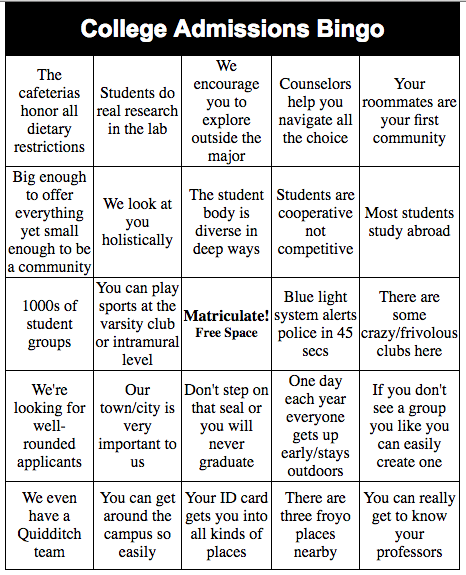
We spent last week visiting prospective colleges with my daughter, which is why I was offline. The information sessions and tours are very well done but they do tend to blur because of institutional isomorphism. If you’re getting sleepy on your umpteenth tour, try playing this Bingo game:
An admissions officer who wanted to command our attention could try saying this instead …
“We have simplified our admissions criteria to two numbers: your combined SAT score and your family’s net worth. If the multiple of those figures exceeds 16 billion, you are in. If it is between 160 million and 16 billion, you’re on the wait list, and we will work our way down until the budget is balanced. Below that, we’ll bank your application fee.
“Because we use these two very different metrics, we admit a diverse student body. Some students are rich but not too bright. Others have awesome standardized test scores but are merely middle class. Once they enroll, these two groups are completely isolated and mutually disdainful. We’d love to find some students who could bridge our two subcultures and promote interaction, but we can’t seem to get any rich geniuses to attend.
“You pay up front for each semester, so it’s in our interest for you to drop out. Most courses are vast lectures with arbitrarily difficult exams meant to weed out the untalented or the merely unfortunate. Since a small number of oppressed junior professors teach huge numbers of students, the rest of the faculty is free to wander around at will.
“Majors are assigned randomly on the first day of freshman year, and all credits must be in the major. Students are encouraged to study abroad, at other US colleges, or indeed anywhere they like, as long as they continue to pay our tuition in full, on time, and in cash. Extensive information about our loan program, interest rates, late fees, and penalties are contained in the prospectus, pp. 1-73.
“You may find that you learn and grow the most by exchanging ideas with your peers in informal settings. Go for it. We don’t really need to hear about it.
“We care about our host community. You can find out the name of it from Google Maps. The townies live on the other side of that barbed wire perimeter.
“Choosing a college is a very personal matter, as each student is utterly unique and unprecedentedly wonderful. For our faculty and administrators, however, you are basically an undifferentiated mass. You pay us and leave us alone; we don’t bother you. It’s all part of our extremely special and deeply considered educational philosophy, which has sustained us for 375 years and made our brand the envy of the world. Thanks so much and please leave your tips in the dish on your way out.”
the Chicago police and NY State prison scandals reinforce the need for countervailing power
The past week has seen scathing reports of pervasive brutality in New York State prisons and the Chicago Police Department. Racism is clearly a factor, but I would like to highlight a different one. We must count on human beings to have bad motives. Racial animus and supremacy are important examples, but even in a racially homogeneous context, people cannot be trusted. Nor does it matter which principles we adopt or even sincerely espouse. It matters whether we are checked and limited by other people.
For example, no entity in the history of the world has had a stronger stated commitment to equality–or as much power and scope to expand equality–as the Chinese Communist Party under Chairman Mao. And yet that same Party is now an active proponent of the most rapacious and predatory forms of capitalism and is closely associated with billionaires. Why? Because it is in the interest of a ruling group to capture a lot of money, and a party without any rivals or limitations can do so–utterly regardless of its mission and philosophy.
In general, I am a fan of labor unions. They have several important advantages, one of which is countervailing power. In a unionized workforce, there is no longer just one institutional power (the owner); there are two. Gov. Scott Walker is trying to break the public employees’ unions in Wisconsin because they bring countervailing power against him.
But a public sector union that closely collaborates with a state government can obtain somewhat troubling monopoly power. Give the members of that union guns and handcuffs, and the dangers increase. Sentence individuals to live completely under the control of that group, insulated from public view, and the threat becomes alarming. In the US context, the specific content of the injustice may be racism, but a case like China reminds us that even in a racially homogeneous society, armed monopoly power never works out well.
Thus it is crucial to the New York case that the “New York State Department of Corrections and Community Supervision … has long been seen as subservient to the union,” and “the union is a formidable political force, protected in the Legislature, primarily by upstate lawmakers in districts where prisons are the biggest employers.” And the Chicago report, after citing racism and ends-justifying-the-means as two causes of police violence, cites a third: a lack of external accountability. “The collective bargaining agreements provide an unfair advantage to officers, and the investigating agencies—IPRA and CPD’s Bureau of Internal Affairs—are under-resourced, lack true independence and are not held accountable for their work.”
Note that both New York State corrections officers and Chicago police officers work for democratically elected governments. That is a check but an insufficient one because it isn’t pluralist. One government is one power with interests of its own. To the extent that we see progress in either case, it’s because of the countervailing power of other levels of government, the press, and social movements.
I support deliberative democracy. It is a much higher ideal than simple majoritarianism. I still don’t want everything governed by one big conversation, no matter how fair, free, and informed the discussion may be. We need organizations and groups that are impervious to public opinion, even reasonable and fair public opinion. I would also vote for social democracy, at least in a European context, but only on the proviso that it is shorthand for a mixed economy with multiple power centers, including autonomous firms. One Big Anything scares me, and our prisons and police forces just reinforce that fear.
a great day for the Jonathan M. Tisch College of Civic Life
Taylor McNeil writes:
As the nation continues to engage in increasingly fractious political discourse, it’s more important than ever to develop a community of leaders who are able to rise above the fray and bring positive change to the public sphere. Fostering such change has been a cornerstone of Tisch College, and now, with a $15 million gift from Lizzie and Jonathan Tisch, A76, and a new name that more clearly describes its mission, the Jonathan M. Tisch College of Civic Life is poised to extend its reach, both on campus and in the world.
The Tisches’ gift, announced on April 14, will endow professorships in the emerging field of civic studies, which examines why people get involved in causes and what happens when they do; support ongoing research on youth voting and political engagement, among other topics; and expand opportunities for students from all socioeconomic backgrounds to participate in service learning and leadership development programs as well as internships.
…
The new professorships that will be created through the Tisches’ philanthropy are part of an ongoing effort to advance Tisch College as a national leader in civic studies. Faculty in these positions will hold joint appointments in Tisch College and in another school at Tufts.
The Tisch research program, including the Center for Information and Research on Civic Learning (CIRCLE), the nation’s leading center on youth voting and political engagement, and the Institute for Democracy and Higher Education, which is conducting a first-of-its-kind national study of college voting rates at 800 participating institutions, “is on a growth trajectory,” says Peter Levine, the college’s associate dean of research. “We have 10 social scientists on staff doing research. We have an agenda of trying to change civic life in America.”
And Daniel Nelson writes:
[the] recent gift will be used to grow Tisch College’s programs, including further developing its research and academic initiatives. Tisch College is home to the Center for Information and Research on Civic Learning and Engagement (CIRCLE), which is “the leading source of authoritative research on the civic and political engagement of young Americans,” according to the program’s website.
“The research is really an area of huge new interest,” Solomont said. “It’s a real expansion.”
He explained that the gift will help Tisch College and CIRCLE expand its research of young voters, a voting bloc he believes could be extremely powerful so long as it engages in its civic duties.
“You could change the political landscape dramatically,” he said, referring to eligible voters between the ages of 18 and 29. “But you’re not showing up to vote.”
Tisch College’s current research initiatives investigate what drives the influential youth voting bloc to the polls, and how to better engage young voters in the overall civic system, Solomont said.
“What we’re seeing here at Tufts is that young people today want to be engaged,” Jonathan Tisch explained in the press release. “They want to make a difference. Hopefully they will bring the experience and knowledge from Tisch College with them as they work with others to create an even better world.”
A portion of the gift will also go towards the Tisch College’s establishing of professorial endowments “in the emerging field of civic studies,” according to the press release. These endowments will help Tisch College, provide opportunities in civic engagement across all seven of schools at Tufts, Solomont said.