Anson Burlingame and the duel that never happened

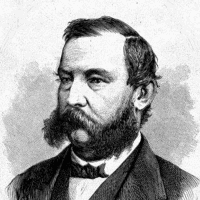
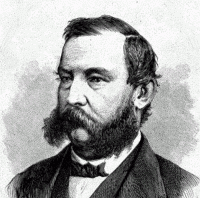
Anson Burlingame (R-MA)

As residents of Massachusetts’ 5th district, we are proud to be represented by Rep. Katherine Clark. But I write today about her predecessor from 1855-61, Mr. Anson Burlingame.

The “Caning of Sumner” is a famous episode from American history. Massachusetts Senator Charles Sumner was a fierce abolitionist who denounced pro-slavery politicians by name, deliberately lacing his speeches with sexual imagery that evoked the slaveholders’ sexual predations. One target was Sen Andrew Butler of South Carolina, whose cousin, Rep. Preston Brooks, also served in Congress. Brooks contemplated challenging Sumner to a duel but decided that an equal fight would convey that his enemy held the status of a gentleman. Instead, he surprised Sumner on the floor of the Senate and beat him with a gutta-percha cane, soaking the Senate’s carpet with Sumner’s blood, blinding his victim, rendering him unconscious, and all but killing him. After he’d broken his cane, he continued to assault Sumner with the handle; he even required medical attention because he had injured himself with a backswing.

Shortly thereafter, Mr. Burlingame of Massachusetts denounced Brooks on the House floor as “the vilest sort of coward.” This insult was calculated to incite Brooks to challenge him to a duel. Brooks complied but seems to have been “dismayed by both Burlingame’s unexpectedly enthusiastic acceptance and his reputation as a crack shot.” Burlingame named the place for the duel–the Canadian side of Niagara Falls, to avoid the reach of US law–and the weapon: rifles. He would get the first shot and seemed to relish the opportunity to put a bullet in Mr. Brooks’ chest. The South Carolina congressman called it off, claiming–rather dubiously–that it would be too dangerous for him to traverse the Northern States to reach Niagara Falls.

Later, President Lincoln named Burlingame to represent the US at the court of the Austro-Hungarian empire, but the Empire rejected him because he had favored revolution. Burlingame served instead as ambassador to Imperial China, where he seems to have opposed European colonialism so vigorously that the Chinese named him “envoy extraordinary and minister plenipotentiary to head a Chinese diplomatic mission to the United States and the principal European nations” to defend the country’s sovereignty. Burlingame died on a diplomatic mission to Russia in 1870.

aphorisms, proverbs, maxims, and the purpose of this blog

If you search the Internet for “aphorisms,” you’ll find a mix of authors, from Lao Tze to Jean Baudrillard.

Some are literary figures who are eminently quotable–good at writing short, memorable passages that stand on their own even if they were originally composed for longer poems or continuous narratives. Oscar Wilde, Dorthy Parker, and Emerson are just a few examples of people called “aphorists” because they are pithy and witty.

Other books of aphorisms are lists of sentences or very short passages that are intended to be serious and wise. The biblical books of Proverbs and Ecclesiastes, the Greek collections of accumulated sayings attributed to Pythagoras and the Delphic Oracle, and the sutras of the Hindu tradition are examples. When these statements take the form of imperative sentences (“Enter not into the path of the wicked, and go not in the way of evil men”), they can be called maxims. When they sound more like generalizations about the world (“To every thing there is a season, and a time to every purpose under the heaven”), they are better named proverbs.

A philosophy professor friend of mine once disclosed his profession to the person sitting next to him on an airplane. “Oh, you are a philosopher,” the neighbor said. “What are your sayings?” He was thinking of traditions in which philosophy means explicit wisdom, and wisdom is succinct and quotable. Needless to say, that is not what professional philosophy is today.

Once collections of short, pithy sayings are treasured as wisdom (a thesaurus means a “treasury”), it becomes possible to write collections that look like proverbs but are more idiosyncratic, personal, and perhaps ironic or subversive. La Rochefoucauld exploits the subversive potential of the genre when he writes in the format of the biblical Book of Proverbs but gives advice like, “If we had no faults we should not take so much pleasure in noting those of others.”  Erasmus collects real wisdom in some of his books (Adagia, Apophthegmata), but he puts strings of quotable falsehoods in the mouth of the Fool in the Praise of Folly. It is never clear where the author stands. James Geary collects current examples of aphoristic writers in this tradition.

By the way, the root of “aphorism” is the Greek verb for dividing, defining, or setting limits (ultimately from horos, boundary). In the New Testament, the verb aphorizo is used for dividing the damned from the saved and for excommunicating sinners. I think “aphorism” means division because each one is disconnected from the next (not because their content is necessarily about distinctions). In contrast, the Sanskrit word sutra means “string” or “thread.” Both traditions refer to distinct fragments of text that are loosely strung together without explicit transitions. The Greek word emphasizes the distinction among these items; the Sanskrit stresses their connectedness.

Francis Bacon and Friedrich Nietzsche epitomize a different tradition. They are highly critical empiricists who use the aphoristic form to shake their readers’ assumptions and demand their readers’ creative attention.

Bacon begins his book Novum Organum (“or, true suggestions for the interpretation of nature”) by decrying two categories of thinkers. On one hand, some have “presumed to dogmatize on Nature,” inventing or borrowing a theory, trying to explain everything in terms of that theory, and “bringing others to their [preconceived] opinion.” On the other hand, some have succumbed to the “despair of skepticism” and are known only for their “complaints and indignation at the difficulty of inquiry.” The third course is to observe and experiment with nature, one piece at a time, striving always to challenge our prior assumptions. Having proposed that course, Bacon then offers a series of numbered “Aphorisms on the Interpretation of Nature and the Empire of Man.”

Why aphorisms? Arguably, because Bacon is highly suspicious of grand theories that organize everything neatly and prevent us from noticing what is actually happening. So he is suspicious of the logical connective tissue that would turn individual propositions into larger arguments. He prefers to list specific propositions and encourage the reader to consider each one on its merits and to put them together only tentatively. We must stop to think about the logical relationship, if any, among Bacon’s thoughts. The form thus befits its substance.

Nietzsche’s earliest works are essays distinguished by their highly quotable passages yet also connected into rhetorically powerful wholes, with beginnings, transitions, and conclusions. With Human All Too Human (1878) Nietzsche shifts to a new genre that then occupies almost all of his energy for the rest of his life: collections of aphorisms. Like all his later books except ZarathustraHuman All Too Human is a set of numbered passages that range from a single sentence to a few pages in length.

Although Nietzsche’s style is influenced by aphoristic authors after Bacon (La Rochefoucauld, whom he cites in aphorism #35; Pascal; Lichtenberg, and others), the opening of Human, All Too Human takes us back to Bacon. Nietzsche, too, wants to shake his readers out of their “habitual opinions and approved customs.” He too is fascinated by people’s cognitive biases and limitations and suspicious of generalizations. In the very first aphorism of his first aphoristic volume, Nietzsche writes: “in fact, I myself do not believe that anybody ever looked into the world with a distrust as deep as mine.” I think he is hinting why his book will not offer a connected argument. A string of distinct ideas avoids the pretentiousness or naïveté implied by a larger whole.

Here Nietzsche almost sounds like one of the skeptics whom Bacon decries for dropping the effort to understand nature because they understand our limits all too well. But they are just complainers. Nietzsche, echoing the distinctions of Novum Organum, insists that he takes “pleasure in externals, superficialities, the near, the accessible, in all things possessed of color, skin and seeming.” That is not the same as Bacon’s path–striving to understand the phenomena–but Nietzsche sees it as the next step. He is moving beyond Baconian empirical science into his own “gay science.” (And in Ecce Homo, Nietzsche insists, “We do not know half enough about Lord Bacon—the first realist in all the highest sense of the word—to know what he did, what he willed and what he experienced in his inmost soul.”)

A final tradition consists of authors who have left collections of numbered and loosely connected passages–string-like sutras–because death or some other contingency prevented them from pulling these fragments into more coherent works. An inspiration for Bacon may have been Hippocrates, the ancient physician who called for close observation. Hippocrates’ writings (other than the Hippocratic Oath) read like aphorisms for a contingent reason: he didn’t write them. They are collections of fragmentary Greek texts about medicine wrongly attributed to him.

I am not sure to what degree Novalis wanted to write connected arguments, but we have his fragmentary notes in the condition that he left them when he died of consumption; both his tragic youthful death and his aphoristic style seem to match the content of his thought. A century later, Kafka also died of TB, leaving 109 aphorisms on philosophical topics.

And then there’s Wittgenstein, all of whose major works consist of short numbered passages without explicit connections. After he died, Elizabeth Anscombe and Georg Henrik von Wright published

a collection of fragments made by Wittgenstein himself and left by him in a box-file. They were for the most part cut from extensive typescripts of his, other copes of which still exist …

Often fragments on the same topic were clipped together; but there were also a large number lying loose in the box. …

We … came to the the conclusion that this box contained remarks which Wittgenstein regarded as particularly useful and intended to weave into finished work if places for them should appear. Now we know that his method of composition was in part to make an arrangement of such short, almost independent pieces as, in the enormous quantity that he wrote, he was fairly satisfied with.

They published this book under the title Zettel, which I think it an unpretentious work for snippet or cutting. But a cutting is also what an aphorism is. A clipped-together packet of snippings from typescript also bears a distant resemblance to a string of beads, a sutra. 

The word “cutting” could also have a more organic sense. In his 1948 poem “Cuttings,” Theodore Roethke evokes their generative potential:

Sticks-in-a-drowse over sugary loam,
Their intricate stem-fur dries;
But still the delicate slips keep coaxing up water;
The small cells bulge;

One nub of growth
Nudges a sand-crumb loose,
Pokes through a musty sheath
Its pale tendrilous horn.

To be sure, Roethke wrote a much darker second poem with the same title, emphasizing the pain of growth and rebirth. April is the cruelest month, and all. But I’d like to stress the latent promise of things that are clipped and piled together in conditions favorable to regeneration. In fact, that hope explains why I have been moved to write 3,123 posts on this blog (which is yet another word to compare with aphorism, sutra, maxim, and the others cited here). If I believe anything, it’s that we are too strongly influenced by grand conceptions that simplify and block our progress, yet we do need ambitious ideas. So let’s let them emerge from close, responsive, joyful engagement with people and their creations, taken one at a time.
the most educated Americans are liberal but not egalitarian (2)

On Friday, I argued that the most educated Americans may be the most “liberal,” but liberalism is being defined by a whole set of opinions that cover cultural and international issues as well as economic policies. The most educated Americans are the people with the greatest economic advantages, and they are less economically egalitarian than other people, not more so.

This means that we do not have a “What’s the Matter with Kansas”-style situation, in which the least advantaged have forgotten their own interests, nor a situation in which tenured radicals are turning bourgeois students into socialists. Rather, we have a very standard situation in which the most advantaged people are the least enthusiastic about equality. They just qualify as “liberal” because of opinions on other matters.

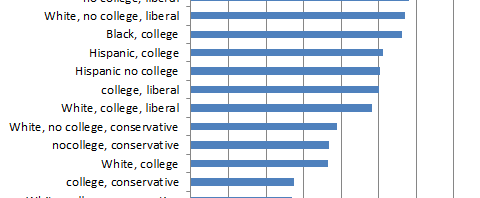
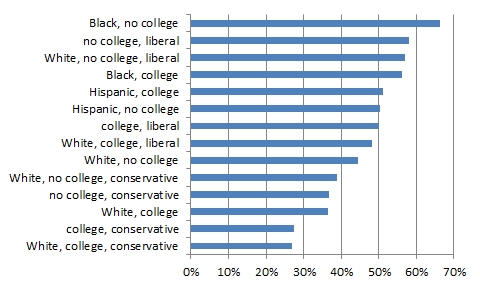
Here is an additional graph using 2012 American National Election Study data. The question is “Do you agree strongly that society should make sure everyone has equal opportunity?” I show all the breakdowns for education, race, and ideology that have sufficient samples, in descending order of egalitarianism.
inequality3
The general pattern is that you’re less likely to support equal opportunity if you’re White, college-educated, or conservative. Individuals in all three categories are the least supportive of all. But note than less than half of liberals who are White and have college degrees strongly favor equality of opportunity.

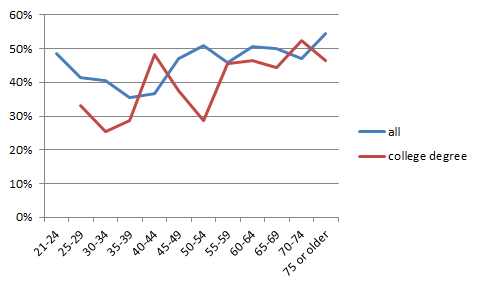
I also looked at the pattern by age, prompted in part by the phenomenon of young White college students who feel the Bern. But it’s important not to confuse 2 million young Sanders voters with their whole generation. Below are the percentages of all Americans–and Americans who hold college degrees–who strongly favor equality of opportunity, by age. The sample sizes for each point are between 38 and 96 (i.e., smallish), so I wouldn’t pay attention to the specific zigs and zags. The overall pattern is that young adults are more enthusiastic about equality than those in their 20s and 30s, but college grads are less so than their contemporaries, and their elders (50+) are more concerned than they are.
inequality4

the most educated Americans are liberal but not egalitarian

Pew reports: “Highly educated adults – particularly those who have attended graduate school – are far more likely than those with less education to take predominantly liberal positions across a range of political values. And these differences have increased over the past two decades.” Indeed, “more than half of those with postgraduate experience (54%) have either consistently liberal political values (31%) or mostly liberal values (23%).”

Based on that finding, one might assume that the most educated Americans stand the furthest left on our political spectrum. And, based on that premise, one might conclude that …

  • The people who would benefit most from left-of-center policies don’t support those policies, and the people who do support those policies don’t benefit from them–which is a paradox. OR …
  • Liberal programs are special-interest subsidies for people with advanced educations (like lawyers, physicians, and teachers), and that is why they vote for them.
  • Progressives tend to be smug or condescending because we tend to be highly educated and convinced that we support policies that are better for other people–and this is an unattractive attitude that loses votes.
  • Colleges and graduate schools are moving people left (either because they have ideological agendas or because “reality has a liberal bias”).

I’d actually propose a different view from any of the above. Pew does not find that highly educated people are the furthest left. Rather, people with the most schooling consistently give answers that are labeled liberal on a set of 10 items that range over economic, foreign, and social policies. None of the survey questions offers a radical opinion as an option. So Pew is measuring consistency, not radicalism.

Ideological consistency is correlated with education, but not necessarily for a good reason. More book-learning makes you more aware of the partisan implications of adopting a stance on any particular issue. So, for instance, conservatives are more likely to disbelieve in global warming if they have more education–because their education helps them (as it helps everyone) to see the ideological valence of this issue.

Many of the most educated Americans endorse a certain basket of political ideas that are associated with the mainstream Democratic Party. They have learned to recognize these policies as the best ones, and the policies are designed to appeal to them. All of the positions are labeled “liberal,” so the most educated are deemed liberals. Yet the most educated are not the most committed to equality. Instead, they are quite comfortable with their advantages, even as they endorse positions that Pew calls liberal.

To test that hypothesis, I wanted to look at a survey question about equality that has been asked over a long time period with large samples. The best I found was this American National Election Study question: Do you agree that society should make sure everyone has equal opportunity? This is not an ideal measure, because support for equal opportunity is not the most egalitarian possible position. If you are very committed to equality, you may prefer equal outcomes. Still, the question provides useful comparative data.

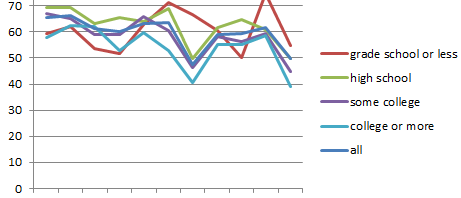
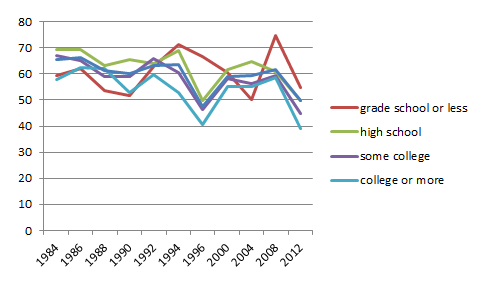
In 2012, the more education you had, the less likely you were to favor equality of opportunity. The whole population was less supportive than they’d been in 2008 and less supportive than at any time in the 1980s. But the least educated were the least supportive of equality during the Reagan years, and now they are the most concerned about it.inequality2

As of 2012, the most educated Americans are the least egalitarian, even though they are consistently “liberal.” Less than half of them strongly favored equality of opportunity.

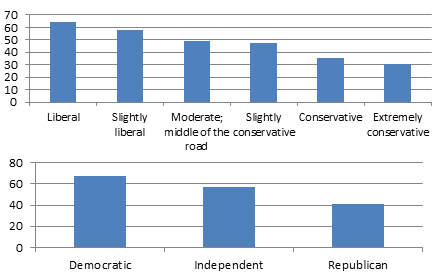
It’s true that Democrats and liberals are (as of 2012) more likely to support equal opportunity than Republicans and conservatives are–and that the highly educated are the most liberal. However, the correlations between egalitarianism and partisanship or ideology are not tight. Forty percent of Republicans strongly agree that society should make sure everyone has equal opportunity, as do 30 percent of extreme conservatives. This is partly because conservatives also have an equal opportunity agenda, and partly because the liberal-to-conservative scale is defined by a whole basket of issues. It’s quite possible to be a strong liberal and yet not believe strongly in equality. And I think that is a common view among the most educated Americans–who are also the most advantaged.

inequality

new article: “Join a club! Or a team – both can make good citizens”

This new article explores reasons that k-12 athletics may boost civic engagement, as well as some important differences between sports and civic life. Student associations in general teach civic skills, and sports are best understood as examples of associations. Indeed, high school teams should be more like standard school clubs, in which participation is voluntary and the students are primarily responsible for managing the group.

Citation: Peter Levine, “Join a club! Or a team – both can make good citizens,” Phi Delta Kappan, vol. 97, no. 8 (May 2016), pp 24-27