the nerds and the community organizers

(Amtrak) I’m on my way home from a meeting with my friends at Cities of Service and their network of mayors and city officials. I’m struck by how many of these people are uniting two traditionally opposite strands of government reform, not only in their important work with Cities of Service but in their other projects as well.

One strand is all about efficiency, transparency, measurement, and data. It goes back to the Progressive Era and agencies like New York City’s Bureau of Municipal Research, founded in 1907. Its ambition is to bring science and/or business practices into municipal government. That basic impulse has been constant for a century, but the tools and techniques have grown more sophisticated.

When you consider how much good you can do for people and the environment by measuring and tracking, it’s clear that this agenda remains essential. For instance, we heard a great presentation by Syracuse Mayor Stephanie Minor about my hometown’s use of remote sensors to identify where water is leaking and pipes are about to break, thus saving the city millions. Searching for her work, I instead came across a 1922 article entitled “Measurement of Water Supply by the Pitot Tube in Syracuse, NY.” The author, a Mr Starbird, begins by lamenting the failure to install measurement tools in the city’s intake pipes, which would allow Syracuse “quickly to detect any considerable loss that might occur in the conduits between these points.” Nearly a century later, Syracuse is dropping censors into water pipes and sending the data into “the cloud.” The agenda is the same; the need remains urgent.

The other strand of municipal reform is more populist, little-“d” democratic, and concerned with diversity. It begins with the recognition that many of the people who are most affected by city government and urban issues aren’t asked what they think about these issues, let alone empowered to address them. Teenagers struggling in high school, seniors in retirement communities, and homeless mothers are just some of the groups who lack voice and power. So the municipal reformer seeks to consult them, or better, to engage and empower them.

These two strands tend to appeal to different kinds of people. Metrics sound exciting to nerdy people who often have backgrounds in business or science, who are comfortable with math and technology, and who typically have attained advanced education. Popular engagement sounds good to community organizers, grassroots leaders, and some elected politicians who have roots in the marginalized neighborhoods of a city.

But the two impulses can go together. The great populist, democratic educator Jane Addams was also responsible for Hull-House Maps and Papers, a compendium of rigorous, plot-level data, subtitled “a presentation of nationalities and wages in a congested district of Chicago, together with comments and essays on problems growing out of the social conditions.” According to the title page, the authors of the book were “Residents of Hull-House.” Maps and Papers was a sophisticated presentation of data produced by, as well as for, the poor residents of a 19th century slum in partnership with some college-educated women who lived with them.

Indeed, these two impulses must go together. Efficient, data-driven management will do little good unless the public supports the city’s use of data. Municipal governments can’t solve problems unless they get help from other organizations and from active citizens. Data can help autonomous organizations in civil society to coordinate their efforts.

Besides, all data is value-laden, and people have the right to make judgments about what to measure and how to interpret the results. Data also confers power, and unless you trust the government implicitly and permanently, you should want diverse citizens to produce and use data so that they share power over it.

At the same time, because data is power, grassroots organizers and networks need it. They can’t afford not to be efficient, effective, responsive, and cognizant of precise costs and benefits. Strengthening democracy is not about replacing data and businesslike practices with raw popular voice. It’s rather about sharing the power of data.

See also this post on “smart water“; the rise of an expert class and its implications for democracywhat would Jane Addams say?empowering citizens to make sure the stimulus is well spent

seeing like a citizen

(New York City)

How a state sees: A state establishes a boundary around its jurisdiction and counts and classifies the land, people, and property within that bound. The Lord tells Moses: “Take ye the sum of all the congregation of the children of Israel, after their families, by the house of their fathers, with the number of their names, every male by their polls” (Numbers 1:2). Near the beginning of Luke, we are told, “And it came to pass in those days, that there went out a decree from Caesar Augustus that all the world should be taxed.” The emperor needed information, and the people complied: “All went to be taxed, every one into his own city” (Luke 2:1-3). And not long after William the Conqueror seized England, he “sent his men over all England, into every shire, and caused them to ascertain how many hundred hides of land it contained, and what lands the king possessed therein, what cattle there were in the several counties, and how much revenue he ought to receive yearly from each” (Giles 1914, A1085).

What is counted and categorized can be taxed and regulated–ideally, in the public interest rather than the self-interest of the state. In order for people to determine how their government acts, they too must be counted and categorized: as voters or non-voters, office-holders or independent citizens. Thus the state sees the people as data.

How a market sees: Objects have prices. So does an hour of a person’s time; and since time is the material of a life, life too is priced. Everything with a price is fungible. Anything without a price is invisible. Value is nothing but price, which is a function of several factors, including what people subjectively value or demand. Ultimately there is just one global market, although moving things across borders may have costs.

How a citizen sees: A citizen is someone who–to any degree–seeks to leave the world greater and more beautiful than she found it, to paraphrase the Athenian oath. That involves constantly judging the value of things, organizations, rules, and people. The citizen’s values are heavily influenced by what other people have taught her. But the list of her own judgments is unique, and she has the capacity to shift her own values. She also decides with whom to associate and what issues to address. At any given moment, her current interaction is likely to be bilateral (e.g., she’s reading an email from one person), but everyone has many bilateral relationships, producing a network in which the citizen sits. So her perspective is out into a network of which she is the center. In her vision, the state and the market tend to dissolve into actual people or groups who make decisions.

The citizen is committed to affecting the world. Some important phenomena may be beyond her grasp, so that she sees them but sees no way of changing them. But she is drawn to levers she can pull, handles she can grab onto. To choose an action, she combines value-judgments, factual beliefs, and tactical predictions into a single thought: “It is good for me to do this.”

an alternative to Moral Foundations Theory

Jonathan Haidt’s Moral Foundations Theory is one of the most influential current approaches to moral psychology and it exemplifies certain assumptions that are pervasive in psychology more generally. I have been working lately with 18 friends and colleagues to “map” their moral views in a very different way, driven by different assumptions. As part of this small pilot project, I gave the 18 participants Haidt et al’s, Moral Foundations Questionnaire. Although my sample is small and non-representative, I am interested in the contrasting results that the two methods yield.

Haidt’s underlying assumptions are that people form judgments about moral issues, but these are often gut reactions. The reasons that people give for their judgments are post-hoc rationalizations (Haidt 2012, pp. 27-51; Swidler 2001, pp. 147-8; Thiele 2006). “Individuals are often unable to access the causes of their moral judgments” (Graham, Nosek, Haidt, Iyer, Koleva, & Ditto 2011, p. 368). Hence moral psychologists are most interested in unobserved mental phenomena that can explain our observable statements and actions.

Haidt et al ask their research subjects multiple-choice questions about moral topics. Once they have collected responses from many subjects, they use factor analysis to find latent variables that can explain the variance in the answers. (Latent variables have been “so useful … that they pervade … psychology and the social sciences” [Bollen, 2002, p. 606]). The variables that are thereby revealed are treated as real psychological phenomena, even though the research subjects may not be aware of them. Haidt and colleagues consider whether each factor names a psychological instinct or emotion that 1) would have value for evolving homo sapiens, so that our ancestors would have developed an inborn tendency to embrace it, and 2) are found in many cultures around the world. Now bearing names like “care” and “fairness,” these factors become candidates for moral “foundations.”

Because Haidt’s method generates a small number of factors, he concludes that people can be classified into large moral groups (such as American liberals and conservatives) whose shared premises determine their opinions about concrete matters like abortion and smoking. “Each matrix provides a complete, unified, and emotionally compelling worldview” (Haidt 2012, p. 107). In this respect, Haidt’s Moral Foundations theory bears a striking similarity to Rawls’ notion of a “comprehensive doctrine” that “organizes and characterizes recognized values to that they are compatible with each other and express an intelligible view of the world.”

In contrast, I have followed these steps:

  1. I recruited people I knew. These relationships, although various, probably influenced the results. I don’t entirely see that as a limitation.
  2. I asked each participant to answer three open-ended questions: “Please briefly state principles that you aspire to live by.” “Please briefly state truths about life or the world that you believe and that relate to your important choices in life.” “Please briefly state methods that you believe are important and valid for making moral or ethical decisions.”
  3. I interviewed them, one at time. I began by showing each respondent her own responses to the the survey, distributed randomly as dots on a plane. I asked them to link ideas that seemed closely related. When they made links, I asked them to explain the connections, which often (not always) took the form of reasons: “I believe this because of that.” As we talked, I encouraged them to add ideas that had come up during their explanations. I also gently asked whether some of their ideas implied others yet unstated; but I encouraged them to resist my suggestions, and often they did. The result was a network map for each participant with a mean of 20.7 ideas, almost all of which they had chosen to connect together, rather than leaving ideas isolated.
  4. We jointly moved the nodes of these networks around so that they clustered in meaningful ways. Often the clusters would be about topics like intimate relationships, views of social justice, or limitations and constraints.
  5. I put all their network maps on one plane and encouraged them to link to each others’ ideas if they saw connections. That process continues right now, but the total number of links proposed by my 18 participants has now reached 1,283.
  6. I have loosely classified their ideas under 30 headings (Autonomy, Authenticity/ integrity/purpose, Balance/tradeoffs, Everyone’s different but everyone contributes, Community, Context, Creativity/making meaning, Deliberative values, Difficulty of being good, Don’t hurt others, Emotion, Family, Fairness/equity, Flexibility, God, Intrinsic value of life, Justice, Life is limited, Maturity/experience, Modesty, No God, Optimism, Peace/stability, Rationality/critical thinking, Serve/help others, Relationships, Skepticism/human cognitive limitations, Striving, Tradition, Virtues). Note that some of these categories resemble Moral Foundations, but several do not. The ones that don’t tend to be more “meta”–about how to form moral opinions.

My assumptions are that people can say interesting and meaningful things in response to open-ended questions about moral philosophy; that much is lost if you try to categorize these ideas too quickly, because the subtleties matter; and that a person not only has separate beliefs but also explicit reasons that connect these beliefs into larger structures.

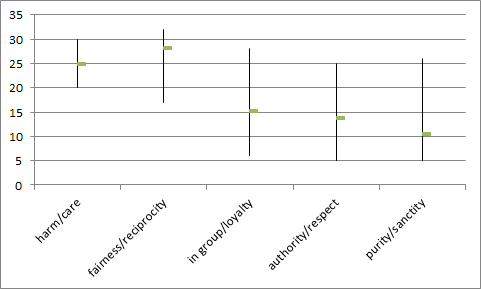
Since I also gave participants the Moral Foundations Questionnaire, I am able to say some things about the group from that perspective. This graph shows the group means and the range for their scores on the five Moral Foundations scales. For comparison, the average responses of politically moderate Americans are 20.2, 20.5, 16.0, 16.5, and 12.6. That means that my group is more concerned about harm/care and fairness/reciprocity than most Americans, and not far from average on other Foundations. But there is also a lot of diversity within the group. Two of my respondents scored 5 out of 35 on the purity scale, and two scored 20 or higher. The range was likewise from 6 to 28 on the in-group/loyalty scale.
MoralFoundations

You might think that this diversity would somehow be reflected in the respondents’ maps of their own explicit moral ideas and connections. But I see no particular relationships. For instance, one of the people who rated purity considerations as important–a self-described liberal Catholic–produced a map that clustered around virtues of moral curiosity and openness, friendship and love, and a central cluster about justice in institutions. She volunteered no thoughts about purity at all.

This respondent scored 20 on the purity scale. A different person (self described as an atheist liberal) scored 9 on that scale. But they chose to connect their respective networks through shared ideas about humility, deliberation, and justice.

The whole group did not divide into clusters with distinct worldviews but overlapped a great deal. To preserve privacy, I show an intentionally tiny picture of the current group’s map that reveals its general shape. There are no signs of separate blocs, even though respondents did vary a lot on some of the “Foundations” scales.
moralmap

A single-word node that appears in five different people’s networks is “humility.” It also ranks fourth out 375 ideas in closeness and betweenness centrality (two different measures of importance in a network). It is an example of a unifying idea for this group.

Many of the ideas that people proposed have to do with deliberative values: interacting with other people, learning from them, forming relationships, and trying to improve yourself in relation to others. Those are not really options on the Moral Foundations Questionnaire. They are important virtues if we hold explicit moral ideas and reasons and can improve them. They are not important virtues, however, if we are driven by unrecognized latent factors.

One way to compare the two methods would be to ask which one is better able to predict human behavior. That is an empirical question, but a complex one because many different kinds of behavior might be treated as outcomes. In any case, it’s not the only way to compare the two methods. They also have different purposes. Moral Foundations is descriptive and perhaps diagnostic–helping us to understand why we disagree. The method that I am developing is more therapeutic, in the original sense: designed to help us to reflect on our own ideas with other people we know, so that we can improve.

[References: Bollen, Kenneth A. 2002. Latent Variables in Psychology and the Social Sciences. Annual Review of Psychology, vol. 53, 605-634; Graham, Jesse, Nosek, Brian A., Haidt, Jonathan, Iyer, Ravi, Koleva. Spassena, & Ditto, Peter H. 2011. Mapping the Moral Domain. Journal of Personality and Social Psychology, 101:2; Haidt, Jonathan. 2012. The Righteous Mind: Why Good People Are Divided by Politics and Religion. New York: Vintage; Swidler, Ann. 2001. Talk of Love: How Culture Matters. Chicago: University of Chicago Press; Thiele, Leslie Paul. 2006. The Heart of Judgment: Practical Wisdom, Neuroscience, and Narrative Cambridge University Press.]
job openings in civic renewal (11)

This is the eleventh in an occasional series.

Ford Foundation:

The overall goal of Ford’s Civic Engagement and Government (CEG) thematic area is to make civic engagement more powerful and strategic, and government more representative, responsive and accountable.

We seek one CEG Program Officer (United States) to inform work on expanding participation—promoting increased and greater representation in elections and agendas which reflect the public interest– particularly to develop a body of work focused on promoting voting rights and other aspects of non-partisan democratic practice in the US—registering voters, increased participation/debate in primaries, connecting voting to issues people care about– and contributing to efforts on to reduce the undue influence of money in politics; and develop/test/demonstrate models of powerful civic engagement with governments in the US.

We seek a second CEG Program Officer (Global) to inform work on encouraging development of more progressive tax and budget systems; advancing fairer frameworks/specific proposals for reducing global tax avoidance; and building legitimacy of civil society in communities globally and testing models of powerful civic engagement with government.  The Global CEG Program Officer will also help link the CEG work of Ford’s eleven offices globally and engage in relevant global platforms in a manner which draws in voices and perspectives from the Global South. See www.fordfoundation.org/careers

Everyday Democracy:

Everyday Democracy, a national leader in civic participation and community change, works to strengthen democracy in neighborhoods, towns, cities, states and the United States. We have more than 25 years of experience working with grass-roots organizers and public officials to bring people together to talk about and work on critical public issues, using a racial equity lens.

We are seeking a full-time Associate for the Evaluation and Learning Unit. This position works closely with the Director of Evaluation and Learning to implement the primary functions of the Evaluation and Learning unit. This person contributes high level evaluation thinking and skills to the team in support of the organization’s mission and goal. Job description here.

Street Law, Inc.

Street Law is now seeking qualified applicants for a Program Director to implement our Legal Diversity Pipeline Programs with law firms and corporate legal departments.

The Florida Joint Center for Citizenship

The FJCC is looking for an Action Civics Coordinator!

The Lou Frey Institute at the University of Central Florida is recruiting a fulltime instructional specialist in civics education. The individual in this position will be based in the institute’s Orlando office and will coordinate and support action civics programs for the Florida Joint Center for Citizenship (FJCC) – a
Lou Frey Institute/Bob Graham Center partnership. The action civics coordinator will be responsible for working with K-12 districts, schools and teachers throughout Florida to implement service learning and other active civic learning initiatives. This position will also manage the institute’s partnership with Kids Voting and will support statewide mock elections. The individual in this position will work as part of a team to design and deliver professional development that supports classroom implementation of a wide range of active civic learning strategies. Long-term outreach and support for
individual schools – including low performing schools – may be required.

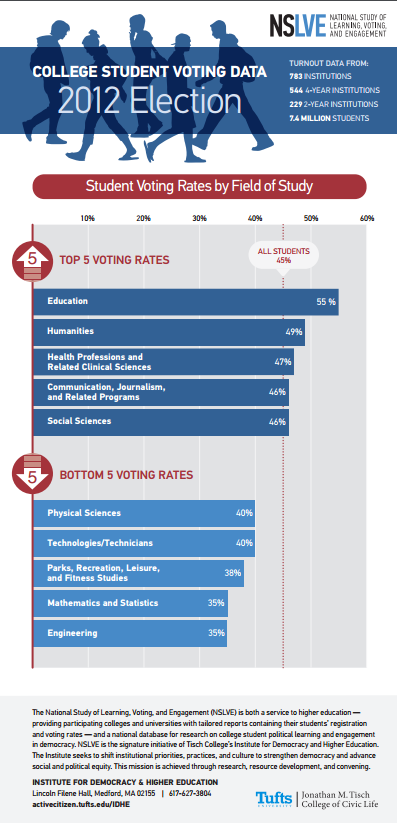
education, humanities, social science majors vote more than students in STEM fields

Medford/Somerville, MA – The National Study of Learning, Voting, and Engagement (NSLVE) at Tufts University’s Jonathan M. Tisch College of Civic Life today released an analysis of the voting patterns of millions of college students, examining voter rates by region of the country, field of study, and type of institution.

These findings, based on a first-of-its kind study of the voting records of 7.4 million students at 783 higher education institutions, could inform opportunities for political learning and outreach on campuses in 2016 and beyond.

Major research findings from this study include:

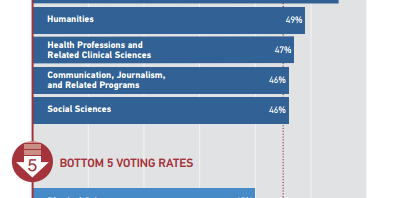
  • Among all fields of study, education/teaching majors voted at the highest rate in 2012 (55%), surpassing the overall average rate of 45% among all students.
  • Students studying the humanities (49%) and the health professions (47%) also voted above the average rate.
  • Voting rates among students in the STEM fields lagged other disciplines by as much as a 20-point margin. Students in the engineering and mathematics/statistics fields voted at the lowest rate: 35%.
  • Among participating institutions, turnout varied considerably by region of the U.S., ranging from a low of 39% in the Southwest (AZ, NM, OK & TX) to a high of 55% in the Plains (IA, KS, MN, MO, NE, ND & SD). See this infographic for the geographical analysis.
  • Overall in 2012, student voting rates at 4-year institutions were slightly higher than at 2-year institutions, though there was essentially no difference between private and public colleges and universities.

NSLVE

“These findings suggest considerable disparities across disciplines, and university leaders should take notice,” says Nancy Thomas, Director of the Institute for Democracy & Higher Education at Tufts University’s Tisch College, which runs the NSLVE study. “The fact that education and humanities majors vote at significantly higher rates than their peers in the STEM disciplines has both policy and political implications. We know that young people who engage in civic life early on develop lifelong habits. Regardless of their chosen field, all college and university students should be educated for democracy.”

A previous NSLVE data analysis showed that college students voted at a rate of 45% in 2012, with those eligible to vote for the first time voting at a lower rate of 40%. Women voted at higher rates than men. Among all racial/ethnic groups, Black students voted at the highest rate (55%). Among Black students, women voted at a rate of 61%, while men voted at 44%, which was similar to the voting rate of white men (45%).

The Institute for Democracy & Higher Education will be using NSLVE data to examine important factors in campus political learning and voting during the 2016 election and beyond.