time for civil courage

Post-War Germany teaches the ideal of Zivilcourage, civil courage. The acid test is whether you would stand up to a tyrant rather than standing by as he takes over. Even when a literal tyranny is not imminent, civil courage means holding sacred ground.

It’s what we need today. And that means, please, no jokes about moving to Canada. No thoughts about giving up on the nation you belong to, even if its majority and its institutions anger you. No opting out. You may have suffered grievous injustices at the hands of the United States: many have. In that case, you owe no gratitude or service to the republic. But you have more leverage over the US government than the billions who live beyond our borders and yet face the consequences of our policies. You owe it to them to stand up: here, now.

It may seem that the large, official institutions of the United States are remote and unresponsive to our actions, yours and mine. But the fundamental premise of my whole career is that our formal institutions reflect the ways that we talk and work together in everyday life. My first job out of graduate school was at Common Cause, helping to lobby Congress for institutional reform. But while I worked there (1991-3), the organization’s membership rolls were in steep and prolonged decline. Common Cause evolved from a grassroots movement for good government (solely dependent on 250,000 members in local and state chapters) into a nonprofit organization that employs talented experts and relies heavily on grants and large gifts. As such, it has lost political influence. I began to think that we can’t have decent political institutions without a base of active, responsible, organized citizens. Robert Putnam’s 1995 “Bowling Alone” article struck a chord for that reason, and everything I’ve worked on since then has been in the service of civic renewal.

This means that you are showing civil courage if you are working to strengthen the associations and networks that connect us as fellow citizens. This theory is also a source of optimism. Despite some deterioration, we have a far better civil society than Italy had in 1922, or Germany in 1932. For just that reason, actual tyranny is highly unlikely here. (Radical Paul Ryanesque neoliberalism is much more of a threat.) But our associations and networks are only as robust as we make them.

By the way, the networks and associations that we build must include Trump voters. This is not a matter of showing empathy to them or trying to achieve reconciliation. Instead, a cold, hard look at the situation tells me that Trump voters are unrepresented by accountable organizations, and that makes them dangerous. If they had organizations, I’d be on the opposite side from them on most issues, but we could negotiate. Absent a functioning civil society, they have opted for a celebrity who will give them nothing, even as he harms others.

Speaking of cold, hard analysis: we should be critical, but avoid anger. There’s plenty of blame to go around, and it’s fine to apportion responsibility if that helps to improve the situation. We can critically assess Clinton and her campaign, the Democratic establishment and its ideology, consultants and pollsters, the media, the FBI, Ted Cruz, Bernie Sanders, white voters, old voters, rural voters, men, and anyone else you like. But not in anger, because anger clouds judgment and promotes error. The situation is complex; nothing but a clear-headed, subtle, multifaceted analysis will suffice.
recent commentary by our team

I am not sure I have anything new to offer to the cacophony of Election Day, but I’ll cite some recent summary articles by our team or by reporters who have delved deeply into our research:

Kei Kawashima-Ginsberg, “Climate change could be a unifying cause of millennials, but will they vote?,” The Conversation, Nov. 7.

Peter Levine with Abby Kiesa, “Why American Urgently Needs to Improve K-12 Civic Education,The Conversation, Oct 30, 2016

Noorya Hayat and Felicia Sullivan, “Civic Learning and Primary Sources,” The School Library Connection, Nov. 7.

Peter Levine, “Teach Civic Responsibility to High School Students,” The New York Times (“Room for Debate” feature), Oct. 17, 2016

In the Parent Toolkit, “One Week Away: Why You Should Talk to Your Kid About the Election

Zachary Crockett, “The Case for Allowing 16-Year-Olds to Vote,” Vox, Nov. 7.

Asma Khalid, “Here’s Why Hillary Clinton’s Troubles Aren’t Millennials’ Fault,” NPR News, Nov. 4.

Catherine Rampell, “Parallel Universes, Even Among the Young,” The Washington Post, Oct. 28.

Joseph Schumpeter and the 2016 election

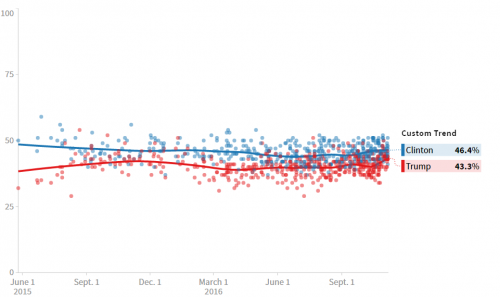
The graph below depicts the 2016 campaign as I see it. When all the polls are displayed on a graph with a y-axis from 0-100% and a fairly strong “smoothing” algorithm is applied, it becomes evident that hardly anything has changed for 18 months. Hillary Clinton has been ahead of Donald Trump by about 4-5 points nationally all along, and she leads by a mean of exactly four points in the major final polls released by this point on the last Monday. The ups and downs revealed by zooming in are best understood as temporary responses to news that may influence who participates in surveys–or who feels enthusiastic on a given day–but very few people have actually changed their minds; and most of those switches have been random and have canceled each other out.

2016-2

I think this means that Clinton is likely to win the national popular vote by about 4 points, although GOTV operations could change result that (in either direction).

It’s hard to know whether different nominees would have performed differently. A reasonable guess is that if both parties had nominated politicians with typical levels of popularity who used typical methods of campaigning, the Republican would have an edge. That implies that Trump v. Clinton costs the GOP maybe 4-6 points, net–but that is not much more than a guess.

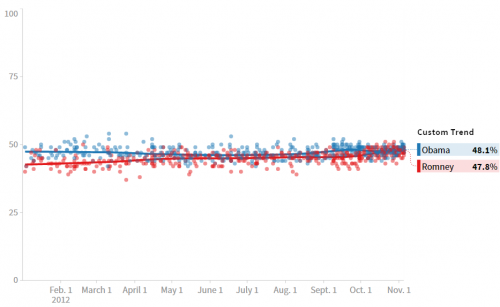
By the way, 2012 looks about the same, except Romney ran closer to Obama all the way along.

2012

But 2008 was different: McCain was ahead at first but slipped behind Obama to lose pretty badly.

For me, the interesting question is what this means about our civic culture and the purpose of campaigns and elections. The presidential candidates have raised about $1.3 billion so far and spent most of that on such activities as advertising, canvassing, and events. The press has spent untold billions on campaign coverage and commentary. All kinds of remarkable events have occurred. As all that has played out, citizens have been exhorted to pay attention and to change their opinions in response to arguments and information. But it looks as if almost everyone already had enough data 18 months ago to make up their minds. That includes me: nothing has transpired since June 2015 that has altered the probability of my voting for Clinton versus Trump by even one thousandth of a percentage point.

I used to subscribe to the view that the actions of candidates and campaigns matter, but they usually cancel each other out because all presidential nominees of major parties are effective campaigners. This year, we have one truly incompetent candidate, yet the trend remains flat. Unless you think that Clinton’s weaknesses cancel out Trump’s incompetence, it looks as if campaigns hardly matter at all. Once citizens know the candidates’ party labels, demographics, and basic facts about their biographies, they are ready to vote.

Perhaps Joseph Schumpeter was right, at least about presidential politics. It’s all about rendering a verdict on the status quo and choosing either the incumbent elites or an outsider. Schumpeter adds:

The reduced sense of responsibility and the absence of effective volition in turn explain the ordinary citizen’s ignorance and lack of judgment in matters of domestic and foreign policy which are if anything more shocking in the case of educated people and of people who are successfully active in non-political walks of life than it is with uneducated people in humble stations. Information is plentiful and readily available. But this does not seem to make any difference. Nor should we wonder at it. … Without the initiative that comes from immediate responsibility, ignorance will persist in the face of masses of information however complete and correct. It persists even in the face of the meritorious efforts that are being made to go beyond presenting information and to teach the use of it by means of lectures, classes, discussion groups. Results are not zero. But they are small. People cannot be carried up the ladder. …

Thus the typical citizen drops down to a lower level of mental performance as soon as he enters the political field. He argues and analyzes in a way which he would readily recognize as infantile within the sphere of his real interests. He becomes a primitive again. His thinking becomes associative and affective.

Since Schumpeter’s view of democracy is unattractive, we must either reform presidential politics or (if that seems impossible) write it off and focus on other aspects of our political system, where more people can show more “immediate responsibility” for collective decisions.

new professorship in health and civic life

The Tufts University Medical School’s Department of Public Health & Community Medicine and the Tisch College of Civic Life seek an Associate Professor or Professor.

We invite applications for a full-time, 12-month joint faculty appointment at the level of Associate Professor or Full Professor.  We seek a candidate with distinguished scholarship on (or highly relevant to) “civic life,” a broad category that encompasses civic engagement, public participation, social capital, civil society, citizenship, the public sphere, and related topics.  The successful candidate is expected to enhance current teaching and mentoring activities at both the masters and doctoral level, as well as develop an independent research program and participate in community and professional service appropriate to a university faculty member.

A successful candidate must also demonstrate a strong record of scholarship within a discipline (medicine, environment, nutrition, etc.) that has a clear public health framing and must emphasize the translation of research into policy and practice. Candidates with research interests and approaches that include community engaged or community based participatory research (CEnR/CBPR); public/community/stakeholder engagement in public health policy; the impacts of civic engagement on health; or the influence of social movements on public health policy; civic life in racial and ethnic minority communities or populations and/or low-income populations are particularly encouraged to apply.  Because Tisch College seeks to strengthen Tufts’ interdisciplinary intellectual community focused on civic life, we will prefer applicants who demonstrate an interest in fundamental questions about civic life that cross disciplinary boundaries, such as the nature of good citizenship or the appropriate role of the public in policymaking.

More information and the application portal is here.

state policies for civics: it’s all about implementation

Just published: Peter Levine & Kei Kawashima-Ginsberg, “State Policies for Civic Education,” in Esther Thorson, Mitchell S. McKinney, and Dhavan Shah, eds., Political Socialization in a Media-Saturated World (New York: Peter Lang, 2016), pp. 113-24.

Abstract: Several large cross-sectional surveys confirm the same patterns: high-quality forms of school-based civic education (such as moderated discussion of controversial current topics) are related to students’ civic knowledge and engagement, but state policies that mandate various forms of civics are not related to civic knowledge or engagement for their young adult populations. We explore the possibilities that: 1) the existing state policies are not satisfactory, 2) state policies cannot reliably influence educational practices, or 3) support for implementation is essential.

I think the last point is most important, and that’s why we have been working closely with Florida Partnership for Civic Learning and the Illinois Civic Mission Coalition to support local stakeholders (district leaders, academics and teacher educators, nonprofits, and state officials) to implement their respective states’ policies for k12 civics. A good law may be necessary, but it is insufficient without continuous attention to implementation: producing a good test every year, supporting current and future civics teachers, selecting and recommending materials, analyzing data from tests, surveys, and interviews to learn what’s working, and using the resulting insights to improve standards, tests, materials, and professional development–in a continuous cycle.