new postdoc in civic studies

Jonathan M. Tisch College of Civic Life Postdoctoral Fellowship in Philosophy or Political Theory

Tufts University’s Tisch College, in collaboration with the departments of Philosophy and of Political Science, will award a Jonathan M. Tisch College of Civic Life Postdoctoral Fellowship in the 2017-18 academic year to a junior scholar with a PhD in the field of philosophy or political theory who is not yet tenured. Candidates should submit a research proposal for scholarly work related to civic studies. Civic studies is an emerging interdisciplinary field that develops ideas and ways of thinking helpful to citizens, understood as co-creators of their worlds. Because civic studies emphasizes the agency of people and groups, it combines ethics, empirical work, strategies, and institutions. Tufts will hold a social ontology conference in 2018, and therefore applicants with interests in social ontology or collective agency are particularly encouraged.

Scholars are required to spend the year (September–May) in residence at Tufts University. For the 2017-18 academic year the Fellowship carries a stipend of $55,000, health insurance, and a $3,000 research fund. The Fellow will be expected to support capstone experiences with Tufts undergraduates and to teach one academic course in addition to conducting their research. The fellow will also be expected to deliver a public lecture at Tufts on the topic of their research at some point during the fellowship year.

Qualifications

Junior scholar with a PhD in the field of philosophy or political theory who is not yet tenured. Candidates should submit a research proposal for scholarly work related to civic studies.

Application Instructions

Applications must include: a cover letter, CV, writing sample, two-page research proposal, and three letters of recommendation. Applications should be submitted to: https://apply.interfolio.com/40979

Application deadline: April 15, 2017. Notification of award: May 8, 2017.

Questions about the position should be addressed to Tisch College Associate Dean of Research Peter Levine at Peter.Levine@tufts.edu.

what it means that people prefer a businessman to a politician for president

The contrast between Donald Trump the businessman and Hillary Clinton the politician has been underplayed (although not entirely overlooked) as an explanation of the 2016 election. I don’t interpret Americans’ admiration for business leaders as a preference for the market over the government, although that distinction might influence some people. Instead, evidence shows that many people dislike deliberation and compromise in politics. That stance is compatible with admiring a president who expands the government, as long as he acts like a private-sector boss.

In 1998 (when HRC was First Lady), John R. Hibbing and Elizabeth Theiss-Morse* found that most Americans didn’t rate their fellow citizens as informed or intelligent. They didn’t want to participate in government or politics, nor did they prefer a political system with much public involvement. They had few policy preferences, but they strongly disliked the people in charge of the government. They suspected political elites of selfish and greedy behavior. For instance, they thought that elected officials get rich from government service. They believed that the public had consensus on most issues, yet agreement was mysteriously absent in Congress. They interpreted elites’ disagreement as a sign of corruption. A majority of their respondents (about 70%) agreed with two or three of the following propositions, which qualified them as believers in what Hibbing and Theiss-Morse called “Stealth Democracy”:

  • “elected officials would help the country more if they would stop talking and just take action on important problems” (86% agree)
  • “what people call compromise in politics is really just selling out on one’s principles” (60%); and
  • “our government would run better if decisions were left up to nonelected, independent experts rather than politicians or the people” (31%) or “our government would run better if decisions were left up to successful business people” (32%)

Fifty percent wanted the government to be run more like a business. There was also considerable support for billionaires and technocratic experts, since neither could profit from their own decisions. In 1992 Harris Poll, 55% of respondents had agreed that Ross Perot wouldn’t be influenced by special interests because he was rich.

In their book, Hibbing and Theiss-Morse used a survey that’s now 19 years old. In 2009, Michael Neblo, Kevin Esterling, Ryan Kennedy, David Lazer, and Anand Sokhey challenged their findings empirically, but in 2015, Hibbing and Theiss-Morse repeated the analysis and connected it to the Trump campaign. Believers in what they called “Stealth Democracy” preferred Trump to Clinton by 38%-13%; people who disagreed with that view narrowly favored Clinton.

Trump is a perfect example of a leader who says he’ll “just take action,” in harmony with the consensus of all real Americans. Hillary Clinton exemplifies a politician who is good at compromise, who acknowledges disagreements and engages in debates–and who has become rich as a result of her political career.

I believe that people learn from experience that disagreement exists and compromise is necessary. They learn those truths by participating in diverse groups that can make consequential decisions. But the proportion of adult Americans who either attend weekly religious services or belong to a union has dropped by 21 points, from a majority of 55 percent in 1970 to a minority of 34 percent in 2012. The proportion of all Americans who serve on any local board had plummeted by 75% since the mid-1900s, due mostly to consolidation of governmental functions plus professionalization. Juries are also much less prevalent: 1 in 40 felony cases now goes to a jury trial, down from 1 in 12 as recently as the 1970s.

People still know how bosses operate in the private sector. But few know what it’s like to be democratic leaders, because few are allowed to play such roles locally. That’s a recipe for a rejection of democratic values.

*Stealth Democracy: Americans’ Beliefs about How Government Should Work (Cambridge University Press, 2002). I draw here from my own 2003 summary.

assessing the congressional town meeting protests, 2009 and 2017

In 2009, when Democratic House members went home to discuss the Affordable Care Act with their constituents, they faced disruptive questions and protests, often from people loosely affiliated with the Tea Party. The protesters cited such supposed evils as Death Panels. This year, when Republican House members go home to discuss repealing the same legislation, they face disruptive questions and protests from supporters of the ACA. In at least one case, a Member of Congress decried the Death Panels that are supposedly now in existence and was hooted down as a liar by his constituents. In both 2009 and 2017, many Members of Congress have decided not to hold so-called Town Meetings at all because of the prospect of protests that would be covered on mass media.

2009

2017


I was prone to lament the protests in 2009 but welcome them in 2017. That sounds like hypocrisy, but the comparison is more complicated. First, the same behavior can be appropriate or inappropriate depending on its purpose and content. Making such distinctions requires judgment, but judgment is essential in politics and is not merely a form of bias. In other words, the right judgment may be that the protests of 2017 are helpful even though those of 2009 were harmful. One reason may be that the protesters of 2017 are speaking truth, and those of 2009 were repeating lies. I acknowledge that’s a simplification, but it may be roughly correct.

Second, if we treat a political act (such as organizing or disrupting a public meeting) as a general category, without reference to its purpose or outcome, we still must weigh several values. Disrupting a meeting is bad for civility but may enhance free speech and agency. Only a purist about civil dialogue would automatically oppose any form of disruption.

I took a somewhat unusual position in ’09. I argued that deliberation–i.e., genuinely listening and being open to changing one’s mind–plays an important role in a democracy. When protesters shut down events sponsored by Democrats, or when Democrats stopped holding open meetings in fear of protests, deliberation suffered. This was a shame because we are all badly limited, morally and cognitively, and we need opportunities to hear from the other side.

However, I said then, a major cause of the disruption was the design of these events. In a truly deliberative event, such as a classic New England Town Meeting, the participants make a collective decision that is not pre-determined by the organizer. To make such a discussion go well requires rules that give people and arguments equal time and organize the debate. An event that is billed as a “Town Meeting” is a fake deliberation if the politician-organizer has already made up his or her mind and just wants to persuade the audience. Giving members of the public a chance to react for a minute at the mic. is a recipe for angry responses. Such meetings are so predictably bad that they provide frequent moments of comedy on Parks & Rec:

The solution would be to reserve events that are billed as deliberative for genuine deliberations. Citizens would be invited to discuss and design solutions, and the organizers would be open to any outcomes. An example is our successful recent experiment with a Citizens Initiative Review in Massachusetts.

When, on the other hand, a representative already holds a position on an issue and wants to persuade the public, she or he is entitled to screen the audience, to talk only through the media, or otherwise to control the format. At the same time, opponents are entitled to exercise their rights of assembly and petition to argue the opposite position. If the politician chooses to speak in an open room, then she should expect disruptions. If the politician screens the audience, she should expect people outside with signs.

Several additional issues arise for me:

  1. What should matter to protesters is winning. You win if you get more than 50% of the public to support you actively, e.g., by voting in 2018. A protest that may inspire your side and even encourage more participation may also alienate the undecided. Everyone involved in a social movement should read Bayard Rustin’s 1965 article “From Protest to Politics” to remember the difference between moral purity and political effectiveness. Perhaps “What would the median voter think about this?” is not the only important question, but it is always one question to consider explicitly.
  2. The number of people who are present at these events is trivially small in a nation of almost 320 million. The protests matter because they are covered by mass and social media. Controversy and outrage are profitable for media companies. That means that moments of disruption will receive disproportionate attention, and most moments of actual dialogue will be lost. An effective protest may have at least two mediated audiences: supporters whom it inspires, and opponents whom it outrages. They will see the same event in different media contexts. Smart political activists think their way through to the media coverage in all channels.
  3. Listening is a political virtue, even if it’s not the only virtue. Speaking out of turn at a meeting, or drowning out the main speaker, may be the right thing to do. It allows other people to hear you and it honors your right to a voice. But it does have a cost: the audience can’t hear the person you have drowned out or preempted. It’s appropriate to reduce that cost by (for example) interrupting briefly and then yielding back the floor.
  4. Politicians who appear at open public meetings before hostile audiences to defend their settled positions are not strictly deliberating. They have made up their minds and they seek to use their influence to affect public opinion. However, by physically appearing before their critics, they demonstrate vulnerability. As Danielle Allen argues in Talking to Strangers, democracy requires vulnerability. It is a necessary (but not sufficient) condition for valuable interactions between people who are strong and weak. Therefore, Republican Members of Congress who continue to face protesters in open meetings deserve some credit–which takes nothing away from the protesters who challenge them.
  5. A protest is a moment of potential, but only if the protesters find other ways of acting together politically. In turn, that requires members of the protest movement to form durable relationships and to develop and extend their skills, usually in the context of organizations to which they belong. In a very important recent interview, Marshall Ganz says, “Many Democrats confuse messaging with educating, marketing with organizing. They think it is all about branding when it is really about relational work. You engage people with each other, creating collective capacity. That’s how you sustain and grow and get leadership.”

Dubai, Uganda, and today’s global political economy

My family and I are just back from visiting our daughter, who works in Uganda, with a two-day stop in Dubai, where there’s a change of flights en route from Boston to Entebbe. We chose these destinations for family reasons. But it’s significant that Emirates Airlines flies direct from Dubai to Uganda. Even though the United Arab Emirates is small, and these two countries lie far apart, the UAE is Uganda’s 4th-largest source of imports. Dubai, an “Alpha+ Global City,” is a hub in a network of financial and human capital for a vast hinterland that includes Uganda, where 84% of the population still depends on subsistence agriculture.

There is much to like in both places—and reasons to hope that their futures will be brighter. However, if the worst aspects of each state predominate, and if the world increasingly resembles this pair of nations, then the human future will be dystopian.

Two centuries ago, both the Buganda Kingdom north of Lake Victoria and the Sheikdom of Dubai were independent monarchies. If we assume that today’s basket of most desired goods (life expectancies above 70, individual freedom, security, etc.) define human development—a contested assumption—than both societies were poorly developed. But they had rich and complex cultures and social structures.

The British made both kingdoms into dependencies and then subsumed Buganda within a full-fledged colony. The period of colonialism must have been experienced as traumatic in both countries. There were important differences. For instance, most Ugandans–but virtually no Emiratis–converted to Christianity. But they also shared some experiences, such as in-migration from South Asia. (Indians and Pakistanis now far outnumber Arabs in Dubai.) Police departments, accounting firms, factories, and many other innovations that we might label “modern” or “Western” arrived in both places with the British.

They gained independence within ten years of each other, but their economic trajectories have split. Dubai, a city-state entrepôt on one of the world’s busiest shipping lanes, has become the 9th-wealthiest nation in the world, with a per capita GDP of nearly $70k. Uganda, a land-locked agricultural nation of 38 million, ranks 163 out of 188 countries on the Human Development Index and has a per capita annual GDP of $572 and a median individual income (my favorite summary statistic) of $2.50 per day. By definition, that means that half of Ugandans live on less than that much–at least as far as a cash economy is concerned–and one in five live below the poverty line of $1.90 per day.

Their political trajectories have also split. Dubai has been a stable absolute monarchy within the federal structure of the United Arab Emirates. Political rights are nonexistent; there is no legitimate public sphere, in the sense of a zone where citizens freely form public opinion and influence the state. The Ruler may choose to consult, but he decides. Most residents are not citizens in any sense; about 90% percent are expatriates.

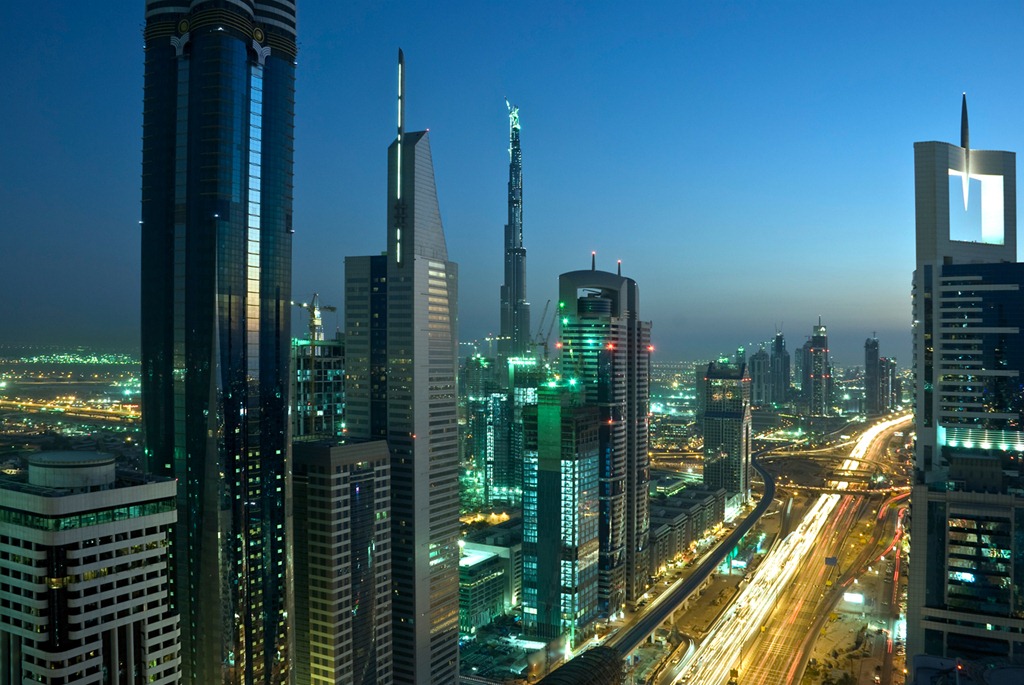
Albert O. Hirschman argued that two strategies are valuable when you don’t like how things are going: exit or voice. In Dubai, political voice is irrelevant or even illegal. But exit (along with entrance somewhere else) is prevalent. People shape Dubai by moving themselves and their assets there or away, whether they are construction or domestic workers from India or the Philippines or bankers or real estate developers from wealthy nations. With the exception of the most exploited workers, they can leave if they are dissatisfied. This means that Dubai has been created by its residents, not by the Ruler. It’s the residents who have thrust astounding numbers of postmodernist skyscrapers out of the desert or have withdrawn their capital when dissatisfied. But their influence is entirely individual and apolitical.

Uganda, meanwhile, has had a tumultuous history, with only three presidents (although four regimes) so far since independence, and still no peaceful transfer of power. We visited the underground cells behind Idi Amin’s former presidential palace where thousands were tortured and killed by electrocution; no one left those chambers alive. I don’t think I am naive about the limitations of the current democracy, as Yoweri Mouseveni spends his 31st year in the presidency. Yet Uganda is a democratic republic. The people govern through representative institutions, albeit with several dubious elections since 2001. The newspapers call Ugandans “citizens,” respecting them as the people who ultimately govern the republic and implicitly holding them responsible for doing so. (I think respect and responsibility are what define a republican form of government.)

Three democracy indices from V-Dem (not available for UAE)

The Ugandan press is vibrant and competitive. The standard journalistic style is a bit more stenographic than what we are accustomed to in the US. Many articles basically report what someone said, in the same order that he or she said it. But the perspectives captured in these stories are diverse and often sharply critical. There is a public sphere, even if the state is somewhat unresponsive to it.

If voice is more evident in Uganda than in Dubai, exit is rarer. Few Ugandans can afford to or want to leave, although remittances from emigrants are rapidly growing. The largest migration of people consists of refugees into the country from South Sudan; they lack both exit and voice.

In Dubai, the global consumer brands are pervasive, including the Trump brand, now attached to a huge new golf course. There is a preserved old quarter that represents traditional Emirati culture, but it is probably smaller than one Bulgari ad on the side of one high-rise office building. We saw at least four billboards for completely different products that used the same format: a White woman in fashionable Western clothes and an Emirati man in a traditional white dishdosh and headscarf are beaming at the same consumer good. Even though about 70% of the residents are Asians, rich Westerners and Arabs are the normative consumers.
In Uganda, despite a few ads for Coca-Cola and Pepsi, the global brands are rare. Almost all stores are one-story brick structures with a raised front wall that can display messages above the door. By my count, about 30% of the stores in the cities and along the paved intercity roads (but fewer on dirt back roads) display painted advertisements for a handful of local brands, mostly telecom service-providers, construction materials, and detergents. Another notable form of advertising consists of new mosques, ubiquitous next to the roads in this overwhelmingly Christian country, thanks to funding from Turkish and other Middle Eastern sources. Finally, one often sees the logos of aid agencies: national, multilateral, or nongovernmental. In one national park, a sign announced that the signage had been given by the “people of the United States” through USAID. Paying for the signs that carry our national logo seems a way to maximize the ratio of branding to actual benefit.

Language often offers insights into culture. I’m sure that individuals in each country have unique relationships to the languages they speak, but I’ll risk some generalizations about English in Uganda and in the UAE. Ugandan (or East African) English is a branch of the language, like the Queen’s English or my own. It is mutually intelligible with American English, yet highly distinctive, full of terms for local foods and activities, loan-words from Swahili, and idioms and rhythms that make it a vehicle for expressing a particular culture. You could learn to speak Ugandan English, and that would be a linguistic attainment, an addition to your repertoire.

The English of the UAE sounds to me like what one learns in a second-language course in a business college. It is error-prone but functional, jargon-filled, strictly pragmatic. It might offer possibilities for creativity and insight—but I doubt it. I’m guessing that most residents experience cultural depth and aesthetic satisfaction in their native tongues. In Joseph O’Neill’s wonderful novel set in Dubai, The Dog, the narrator says, “I have a real soft spot for the habitual accent of Arab speakers of good English, in whose mouths the language, imbued with grave trills, can seem weighted with the sagacity of the East. (See Alec Guinness in Lawrence of Arabia.)” That may be true, but only 12% of the UAE’s residents are Emirati, and not all of those speak good English. Purely functional English–plus math–is the code of business, and business is the culture that counts in Dubai.

Looking toward the future, one can imagine that Dubai adds political liberties and public deliberation to its market freedoms, and Uganda not only honors the true spirit of its republican constitution but also develops sufficiently so that all its people attain the core human capabilities. That would be a better world. To be even more utopian, we might hope that the relationships among Uganda, Dubai, and the inevitable third corner of the triangle–the OECD nations–becomes genuinely just, not just in the sense that human circumstances converge but also that the people of Uganda can make real claims on the people of Dubai or New York.

One can also imagine that Dubai continues to prosper without political freedom, much as Shanghai also does today. Absolute monarchies seem quaint, but arguably the real players in Dubai are the big corporate investors, and corporations are not democracies. Their influence could grow, not only in Dubai but in all the Global Cities. Indeed, as the world gets hotter, dryer, more postmodern, higher-tech, more racially intermingled, yet more culturally homogeneous, one could imagine that all the cities that dominate the global economy will look like Dubai today. Already, the man whose portrait hangs in every federal office building in the USA also has his name on the huge billboards for Dubai’s newest golf course.

Meanwhile, Uganda faces rapid population growth, a median age of 15, a worsening climate, unstable neighbors in several directions, and the risk of political instability once Mouseveni finally retires. One could imagine that Uganda will look much as it does today, only poorer and more violent, and that many other nations will look more like it. That is the dystopian future that haunts us.