Talloires Conference: “Social Responsibility and Human Dignity in Higher Education Engagement”

The Talloires Network Leaders Conference (TNLC) 2017 convenes 21-24 June 2017 at the Universidad Veracruzana in Xalapa, Mexico.

The conference will explore the theme, “Social Responsibility and Human Dignity in Higher Education Engagement.” Within this overarching theme, the conference will explore three sub-themes:

  • The right to education and the responsibility to be socially inclusive and to promote quality education to all
  • The right to leadership opportunities and economic mobility and the responsibility to create prosperous communities and societies
  • The right to a livelihood and the responsibility to prepare people for employment and entrepreneurship, and to contribute to economic development

The Conference Program is available here.

Featured speakers include rectors and chancellors from several countries, a former US ambassador to Mexico, and cultural figures. Register here. Veracruz travel logistics here. Conference materials en Espanol.

Trump v the judges: norms breaking down

I deeply oppose the Trump travel bans on two main grounds: 1) We should strive to admit refugees from the terrible war zones of the world, and 2) a policy that’s rhetorically linked to anti-Muslim motivations threatens the standing of Muslim citizens and residents of the US, as well as the religious equality and tolerance that should be important to all of us.

Nevertheless, I thought the revised travel ban was probably both legal and constitutional. One interpretation of the injunctions against the ban is that certain federal judges have overstepped their bounds because of objections to the policy (and the president) that I share, but that shouldn’t influence them in their judicial roles. I’d advance a different interpretation, however. These judges are relaxing some traditional norms and constraints because the Trump Administration has shed its commitment to norms that have constrained previous presidents. The resulting conflict is dangerous for the constitutional order but preferable to an alternative in which only the executive branch ignores key norms.

I’d have thought that the revised ban would be upheld for several reasons. First, Congress may regulate immigration by statute, but the law it has chosen to enact (8 U.S.C. § 1101) says:

Whenever the President finds that the entry of any aliens or of any class of aliens into the United States would be detrimental to the interests of the United States, he may by proclamation, and for such period as he shall deem necessary, suspend the entry of all aliens or any class of aliens as immigrants or nonimmigrants, or impose on the entry of aliens any restrictions he may deem to be appropriate.

Second, people who are neither citizens nor residents of the US are typically seen as having no rights under the US Constitution. Third, in a wide range of situations, courts don’t inquire into the motivations of policymakers when they assess legality and constitutionality. Finally, the argument that the revised order is a Muslim ban, and hence detrimental to US Muslims and every citizen’s religious liberties, could founder on the fact that of the ten countries with the largest Muslim populations in the world, only one (Iran) is on the banned list. The banned countries seem rather to be sources of refugees, and the president is not legally obliged to admit refugees, even if human rights and morality demands that.

Yet two federal judges have blocked the order, one with a nationwide injunction, and a Ninth Circuit panel has refused to reconsider its block of the earlier order.

Critics of the injunctions note that they seem to exceed precedents and they seem to rely on critiques of Trump as a person. Josh Blackman writes:

Judge [Leonie] Brinkema has applied a “forever taint” not to the executive order, but to Donald Trump himself. For example, the government defended the selection of the seven nations in the initial executive order because President Obama approved a law that singled out the same seven nations for “special scrutiny” under the visa waiver program. Judge Brinkema rejected this reasoning: “Absent the direct evidence of animus presented by the Commonwealth, singling out these countries for additional scrutiny might not raise Establishment Clause concerns; however, with that direct evidence, a different picture emerges.” That is, if Barack Obama selected these seven countries for extreme vetting, it would be lawful, because he lacks the animus. But because Donald Trump had that animus, it would be unlawful. … It will always a “Muslim ban” because of comments he made on the O’Reilly Factor in 2011, a policy he adopted in 2015, and abandoned after his lawyers told him it was illegal. She admits as much. “A person,” she writes, “is not made brand new simply by taking the oath of office.” Not the policy. The person. Trump.

Blackman thinks the courts are overstepping their bounds. See also David Frum on the “dangerous precedent” these injunctions could set. In his 9th Circuit Dissent, Judge Jay Bybee warns, “We cannot let our personal inclinations get ahead of important, overarching principles about who gets to make decisions in our democracy. For better or worse, every four years we hold a contested presidential election. We have all found ourselves disappointed with the election results in one election cycle or another. But it is the best of American traditions that we also understand and respect the consequences of our elections.”

Indeed, it’s worth worrying about what will happen if our courts start assessing individual presidents when they rule on legality and constitutionality. But this is my take (reminiscent of a piece by Benjamin Wittes and Quinta Jurecic):

The Constitution vests the various branches with powers and doesn’t say a lot about how they should be exercised. Like people playing a board game that has simple rules printed on the inside of the box, our officials have developed a long set of norms, some written as precedents and some unstated, to complement the basic rules. The board-game players know that no one will take an hour to decide on her move or start yelling insults during the game. Judges know that presidents will not single them out for abuse, deny the legitimacy of judicial review, blatantly lie and maintain their lies in the face of evidence, or say things–even informally–that undermine the basic principles of our republic, such as religious neutrality. Presidents, for their part, can count on judges to believe their assertions about national security and to read their executive orders charitably.

At least some judges believe that Trump is like a board-game player who is technically following the rules on the back of the box but violating the norms that make the game playable. So they are going to use their express powers under the basic rules to counter him and either force him to play by the norms or reduce his power. Even Judge Bybee (previously known to me only as an author of the “torture memos”), who dissented in the Ninth Circuit judgment, ended his dissent with a rather extraordinary coda:

Even as I dissent from our decision not to vacate the panel’s flawed opinion, I have the greatest respect for my colleagues. The personal attacks on the distinguished district judge and our colleagues were out of all bounds of civic and persuasive discourse—particularly when they came from the parties. It does no credit to the arguments of the parties to impugn the motives or the competence of the members of this court; ad hominem attacks are not a substitute for effective advocacy. Such personal attacks treat the court as though it were merely a political forum in which bargaining, compromise, and even intimidation are acceptable principles. The courts of law must be more than that, or we are not governed by law at all.

The prime danger is that Judge Bybee’s colleagues have judged Trump wrong and been biased by the abuse directed at them. But on balance, I think their response is for the best under these dire circumstances.
The “civic state of the union”

This is the video from the “Civic State of the Union” on March 7 at Tisch College. The participants are Mara Liasson, National Political Correspondent for NPR and contributor to Fox News; Robert D. Putnam, political scientist, Professor of Public Policy at the Kennedy School of Government, and author of numerous works, including Bowling Alone; Shirley Sagawa, President and CEO of the Service Year Alliance and a Visiting Senior Fellow at the Center for American Progress; and me. We talked about the civic condition of the United States and what to do about it.

on the Deep State, the administrative state, and the civil service

The last few days have seen several prominent articles about “the Deep State”: by David Remnick in the New Yorker, Marc Ambinder in The Washington Post, Julie Hirschfeld Davis in the New York Times, and Kevin Williamson in The National Review, among others. I’d been thinking of writing myself, and I think we need some definitions:

  • The Civil Service: a body of government employees who are protected against political patronage and dismissal without cause in return for embracing norms of nonpartisanship, public service, and professionalism.
  • The Administrative State: government agencies that make and enforce rules and regulations (in contrast to statutes enacted by legislatures) and/or directly manage public resources, such as land.
  • The National Security Apparatus: military and spy agencies as well as police agencies concerned with terrorism, foreign espionage, and subversion.
  • Bureaucracy: any large organization divided into specialized offices, each requiring appropriate training and having defined roles and responsibilities, the whole being organized hierarchically and aimed at achieving some predefined or externally defined end or purpose.
  • The Deep State: a group of people within any or all of the above who collude secretly to pursue their own shared agenda, which may reflect their self-interest or an ideological interest contrary to the goals of elected leaders.

Some observations based on those definitions:

Most of the above definitely exist. Whether the (or a) Deep State exists is a matter of conjecture. One reason that the answer is not obvious is that the National Security Apparatus is cloaked in considerable secrecy. But secrecy is necessary for the existence of such an apparatus at all, and is not indefensible. There are many things we would like our government to know yet not publicly disclose. State secrecy is a problem for a democracy but not necessarily an avoidable one.

If there is a Deep State, it would form within one or more bureaucracies yet would subvert them. That is because bureaucracies constrain their employees to carry out defined tasks, but people who collude for their own agendas are evading such constraints.

The Deep State could exist within the National Security Apparatus, the domestic civic service, or both. Americans in a large swath of the center-left and left tend to be critical of US foreign policy but supportive of regulation and the welfare state. Some of them have feared secret agendas in the National Security Apparatus while viewing officials in the domestic welfare and regulatory agencies as dedicated civil servants. Americans in a large swath of the right have been more supportive of foreign policy than of domestic policy, so they have been prone to see soldiers, police officers, and spies as public servants, and other federal employees as uncontrollable bureaucrats. However, the hard right has also been critical of foreign policy, so there have been Deep State narratives on the right at least since the McCarthy Era. Some on the hard left see the domestic policy apparatus as basically a Deep State devoted to disciplining the poor, but I hear less of that than I used to 20 years ago.

To the extent that we have a genuine civil service, it is designed to push back against elected officials and political appointees. That is not sign of a conspiracy but evidence that popular sovereignty conflicts with such values as scientific rigor and legal consistency. The civil service has a checks-and-balances relationship with elected politicians.

Finally, we do have a problem with the Administrative State, but it is not a conspiracy or anything wrong with the people who work in it. Theodore Lowi was a very fine political scientist whose death on Feb. 17 didn’t get enough attention. Lowi argued that liberals built the regulatory and administrative agencies to enact demanding values for which they had received popular support. But the agencies that liberals created do not have legitimacy to make value-judgments themselves. In lieu of making explicit value-judgments, they claim to make their decisions based on science, efficiency, precedent, or stakeholder negotiation. But they actually make value judgments every day. This creates a crisis of legitimacy that threatens the liberal project.

Another way to make Lowi’s argument is to note that the Administrative State is not envisioned in our Constitution (nor is a permanent National Security Apparatus). Agencies are widely understood as parts of the executive branch or as arms of Congress. (They even employ their own judges, which makes them resemble the judicial branch.) I think a better interpretation is that they represent a fourth branch altogether, which has developed since 1900. It should embody certain norms, such as impartiality, rigor, and predictability, and it should be designed to push and pull with the branches that reflect popular will (Congress and the presidency), deliberation (Congress), discretion and flexibility (the presidency), and law (the judiciary). We should expect tension between the president and the administrative agencies and improve our means of resolving those tensions.

As long as we do not regard the Administrative State as a branch with its own norms and standing, we should expect constant crises of legitimacy, because the existence of this branch has never been recognized by the American people. This is not to defend or rationalize Stephen K. Bannon’s attack on the administrative state. But there is a deeper and longer-term problem that will require attention sooner or later.

See also:  the Citizens United decision and the inadequate sociology of the US Constitutionthe public interest and why it matters;  problems with “stakeholders”; and on government versus governance, or the rule of law versus pragmatism.

Millennials’ political opinions: insights from the new CIRCLE poll

In November’s election, youth turnout seems to have been roughly on par with recent elections. Young voters preferred Clinton to Trump by 55% to 37%, but a majority of young whites chose Trump. See the full CIRCLE post-election report based on exit poll data.

Since then, there has been much political ferment among Americans in general, and specifically among Millennials. My colleagues at CIRCLE surveyed 1,608 young adults last October and recontacted 1,002 of them for a post-election survey released on March 7. The new CIRCLE report contains many insights about the election and the Trump era.  I’ll just mention two to give a flavor.

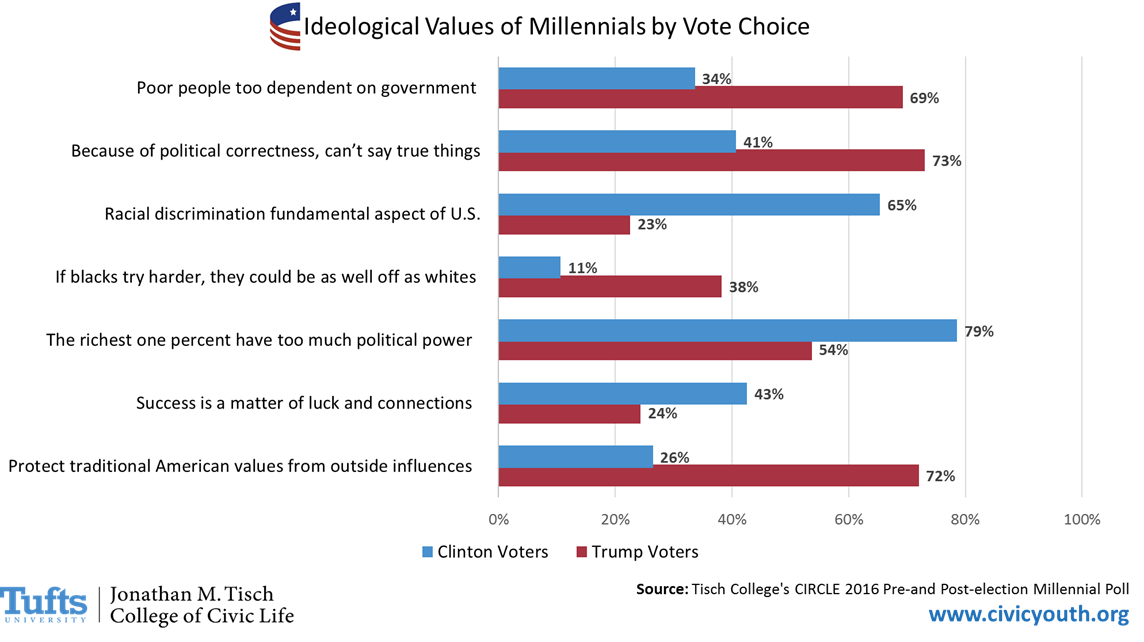
First, young people who voted for Clinton and Trump differed on many contested social issues, which is not surprising in itself. Young Trump voters were more likely to think poor people are too dependent on government, much less likely to be concerned about racial discrimination, and more critical of political correctness (although 43% of Clinton voters shared that view). Almost three quarters of Trump voters wanted to protect traditional American values from outside influences, a rare concern for Clinton voters. But a majority of Trump voters agreed with a larger majority of Clinton voters that the top 1% have too much political power.

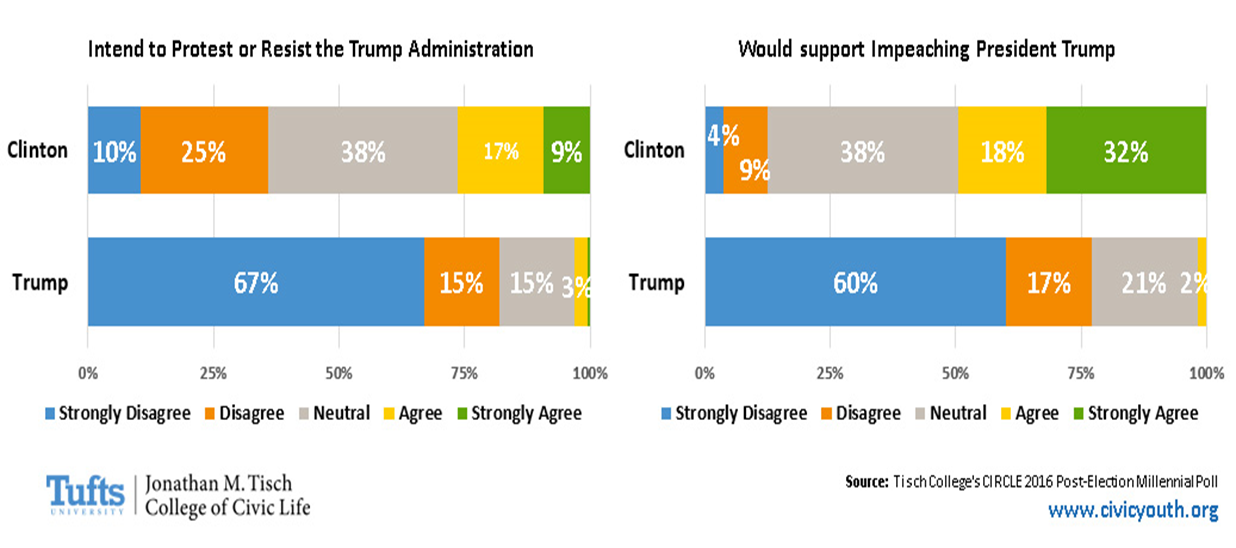
Second, even as early as January, CIRCLE found that most Millennials (whether voters or not) said they intended to protest or resist the Trump administration, and half were ready to support his impeachment. Of course, most Trump voters didn’t intend to protest or call for impeachment, but small minorities of his voters did seem to support the resistance, broadly defined.

Read the whole report here.