the Obama Foundation Fellowship

The Obama Foundation is recruiting their first cohort of Fellows. This inaugural class will have a special opportunity to shape the program for the future. The fellowship takes the form of four face-to-face gatherings over two years, plus a lot of opportunities for professional development. The Foundation is looking for a “diverse set of community-minded rising stars – organizers, inventors, artists, entrepreneurs, journalists, and more – who are altering the civic engagement landscape. By engaging their fellow citizens to work together in new and meaningful ways, Obama Foundation Fellows will model how any individual can become an active citizen in their community.” More here.

anxieties about American exceptionalism

In our century, a major fault line in US politics has been the question of “American exceptionalism,” meaning the unique excellence or mission of the USA–“the notion that America is freer and more democratic than any other nation, and for that reason, a model, vindicator, and at times the chief defender of ordered liberty and self-government in the world” (Stanley Kurtz).

As I observed in 2010, “Newt Gingrich, Sarah Palin, Mike Huckabee, Mitt Romney, and Rick Santorum agree: the president and his allies in Washington deny ‘American exceptionalism’ in a way that is unprecedented (Huckabee), ‘truly alarming’ (Gingrich), or ‘misguided and bankrupt’ (Romney).”

This was ironic, since Barack Obama had come to national attention with a riveting speech at the 2004 Democratic convention in defense of nothing other than … American exceptionalism. “Tonight,” Senator Obama had said, “we gather to affirm the greatness of our nation.” Throughout his presidency, he often spoke on the same theme. In 2014, he said, “I believe in American exceptionalism with every fiber of my being.” And yet accusing him of failing to understand–or of actively undermining–America’s unique excellence became a competitive sport on the right.

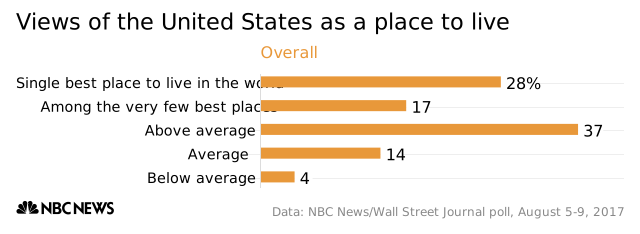
But there is an important group that doesn’t really believe in American exceptionalism: the American public. Here is a result from this week’s Wall Street Journal/NBC poll:

It looks as if most Americans think the US is above average as a place to live (I agree, by the way), but that just over a quarter think it’s the single best place in the world. Asked to rate the “national character,” the median respondent gives us a score of 5 out of 10, down from 6 out of 10 in 1998. This survey question makes no explicit mention of other countries, and it’s possible that people would rate every other nation’s character lower than ours–but that seems unlikely for the people who rate us 5 or lower.

The claim that America is “is freer and more democratic than any other nation” is empirical. It begs for comparative statistics. Freedom House rates the US 89 on freedom, a good score but 11 points below Sweden’s perfect 100. Maybe they’re wrong, but ranking the US number one in the world certainly requires evidence. It’s not a test of patriotism but a hypothesis about the world.

One might focus instead on prosperity and economic dynamism. But the enormous comparative advantages that we held as result of the Second World War have faded away, and we now represent just 4% of the population of a competitive world in which lots of nations, small and large, inevitably score economic successes.

This gap between a rhetoric of unique superiority and the facts seems to cause profound anxiety. In 2016, Trump positioned himself as the candidate who believed that the US should be better than every other nation but had lost that status due to feckless politicians. He often asserts that we are worse off today than anyone else–for example, that our tax rates are uniquely high, as if we were the socialist exception in a neoliberal world. Clinton took the view that we were “already great.”

Both positions could be seen as responses to anxiety. Valid criticisms of the American past (slavery and segregation, especially) have perhaps fueled this anxiety by suggesting that we were never exceptionally great to start with. That’s a raw point for people who think that our exceptionalism is threatened.

Three issues to think about:

  • To what extent is the US actually “exceptional”–not in the sense of better, but different? We are unusual (but not actually unique) in our degree of racial diversity. We have the oldest constitution in the world. We have no way to call an early election to end a failing administration. We have never had a socialist government, but our left has a robust alternative tradition of pluralist populism. We are the birthplace of the Civil Rights Movement and its philosophy of politics. We fought a civil war over the question of slavery in which 750,000 died. We tend to think of ourselves as a commercial republic instead of, for example, a social democracy, a social market economy, or a consensus model. We may once have had a high degree of economic mobility, but now we do not. We once had a very strong voluntary sector, but it, too, is now probably weaker than those in other nations. We are a Petri dish for new religions, some messianic in nature; and we are more religious than other advanced economies. These are just examples of ways that we are, or once were, unusual.
  • Underlying most claims of exceptionalism are normative positions: assertions that some aspects of our society are not just unusual, but valuable. What values that are plausibly associated with the US are worthy of praise? Should we be proud because we have a tradition of laissez-faire economic policies? Or because of the New Deal and its legacies?
  • What attitude should an American citizen hold toward the US Republic? Favoritism over other countries? An even-handed and detached stance toward the US as just one of many countries? For myself, I would say: a special, focused responsibility for awakening the better angels of our nature.

See also: the new history warsAmerican exceptionalismBritish exceptionalism: how the UK is different from Europeshould we teach patriotism?; and a palindrome (a poem on America).

Glendalough

St Kevin had the gift of talking with beasts.
It came naturally to him, a hermit,
Living amongst them in his hollow tree
In Glendalough, long vale of icy lakes.

But just because he and they could converse
Doesn’t mean that everything went smoothly.
“Let me milk you,” he said, “so that I can
Subsist on a diet of doe’s milk and sage.”

She sprang latterally up the heathered hill.
“Absolutely not; never. That’s invasive,
Embarrassing, probably painful, strange.
Find something else to drink, or go back to your kind.”

“Modesty forbids,” he said, “that I
Should apply the word to myself, yet ‘saintly,’
Surely, is the term that simple truth demands.
Didn’t you see how, when they’d gnawed bare the bones

And longed for more–my human multitude–
I had only to pray; then juicy meat reclothed
Each rib that they had stripped to white? I am
listened to; you’d be wise to do what I say.”

But she was gone, her dappled flanks just shimmers
In the fluttering lushness, the cool dampness,
The extravagant, multitudinous greenness
Of the breezy glen with its two clear lakes.

A red fox spoke up. “Large mammals are warned,”
Said he, “to be in their dens or burrows
By nightfall and to avoid all noises
That might disturb or fright the smaller kind.

“Also: no kindling fires or leaving picked bones
In piles, no uncovered waste, odd chanting,
Spitting in the loughs, marching right though nests,
Shouting, shooting, or walking on the grass.”

St Kevin understood where this was headed.
It wasn’t just his personal repute
He had to worry about. There was also
His ministry to pagans and sinners.

He gathered the wary beasts in a ring.
“I’ll live humbly in my hollow tree, making
No demands, restricting my human flock
To the upper vale and ringing their buildings

“With stone walls, as much to hem them in
As your kind out. Let’s just keep today amongst
Ourselves, shall we? Let the story be that Kevin,
Renouncing the world, spoke the tongues of beasts

In Glendalough, that broad, still vale, where leaves
Of every green tremble when the soft rain falls.”

(See also: the scholar and his dog ; for Gerard Manley Hopkins; and The Cliff-Top Monastery by A.B. Jackson)

Jonathan Strange, Mr Norrell, and the Industrial Revolution

I read Susanna Clarke’s Jonathan Strange & Mr Norrell a decade ago (blog post here) and recently watched the BBC adaptation. I’d agree with Kate Nepveu that the miniseries is worth watching even though the changes in plot make it less compelling and less politically trenchant than the book. The two main women and the major character of color, Stephen Black, become more passive and less impressive in the miniseries than they are in the novel.

I still have’t seen anyone else draw the parallel that struck me as obvious when I read the book in 2007. I shouldn’t have called it an “allegory” of the Industrial Revolution because that would imply a mechanical, one-to-one correspondence between magic in Jonathan Strange and industrialization in Britain ca. 1800. But I think that Clarke is playing with the similarities.

Essential components of the industrial economy, such as the spinning jenny (1770), the modern steam engine (1778), iron-rolling (1783), and the manufacture of sodium carbonate (1791) were typically invented by gentlemen-amateurs in Northern England or Lowland Scotland. These men won patents and drew attention for their small miracles of automation: making devices that moved on their own. They often formed clubs and societies. The Napoleonic Wars promoted industrialization: the first mass-produced components were pulley blocks for Royal Navy ships. But it was only as these wars ended that many small inventions came together to transform the world. Latent power was unleashed from under the earth, blackening the skies. New roads (made of iron rails) suddenly crisscrossed the land, allowing rapid movement. The people who understood and controlled these new powers and resources became the rulers of Britain, supplanting the old owners of ordinary land. And it all depended ultimately on the slave trade and the labor of Africans.

I won’t give away the plot, but it seems to me that magic follows the same trajectory in the world of Jonathan Strange. Northern gentlemen experimenters, the revelation of powers dormant underground, the influence of the Napoleonic Wars, rapid movement on the king’s new roads, a key role for a former slave, and the resulting social upheaval all resemble the Industrial Revolution. The main contrast is that magic in Clarke’s world is a medieval power rediscovered or revived by Mr Strange and Mr Norrell. Notwithstanding a scattered heritage of cottage industries and Cornish mining, industrial manufacturing was something truly new after 1770. The medieval background gives Clarke’s world an appealing spookiness, but I still think that industrial history is what interests her.

what is polarization and when is it bad?

We might say that people are polarized when …

  1. They hold opposing positions on issues that matter to them.
  2. They hold contrasting core values that drive their opinions about issues.
  3. They identify strongly and stably with parties or ideological groups or movements that compete.
  4. As a principle or guideline, they oppose compromise with the other side.
  5. They use partisan labels as heuristics to judge candidates or issues.
  6. They use partisan heuristics to make decisions not directly related to politics, e.g., which community to live in or whom to date.
  7. They don’t actually interact with people who disagree or with people who identify differently.
  8. They don’t want to interact with people who disagree or with people who identify differently.
  9. They select or filter news and opinion to match their partisan opinions.
  10. They hold different factual beliefs that support their values.

These are separate issues, and we may feel differently about each one. For instance, I think that #1 and #2 (disagreeing about issues and about underlying principles) are completely fine. It’s even possible that we should cultivate a wider range of views and air them more openly and extensively. If that means more “polarization,” so be it. Also, #3 (identifying stably with an ideology) seems fine as long as you are thoughtful about it.

Surveys ask people about #4: Do you want politicians to compromise or to stand on principle? I find this a somewhat frustrating question, because it typically mentions only two options. A person can refuse to budge in a negotiation, give ground in the face of an opposing power, choose to compromise in the interest of moving forward, favor compromise because it is fair for interests to be balanced, or actually learn from an opposing argument and change her mind. I’m for changing one’s mind when (but only when) the opposing arguments are good. I’m not necessarily for compromising or holding firm in a negotiation: that depends on the circumstances. I’m not sure how I would answer the standard survey questions about willingness to compromise.

Partisan heuristics (#5 and #6) are problematic. Indeed, heuristics of any kind are problematic; they are shortcuts that evade harder thinking. On the other hand, heuristics are necessary because our brains are limited and we have other things to think about besides politics. People who have strong partisan identifications are more likely to vote and otherwise participate than people who don’t know how to identify themselves politically. This suggests that partisan heuristics are resources that enable political action. As long as the available party labels stand for reasonably valuable options, and the major options are available, I am not overly worried about partisan heuristics.

Here’s a thought-provoking example: Between 2011 and the revelation of the “Access Hollywood” tape, White Evangelicals changed their minds about whether political leaders who act immorally in private can nevertheless “behave ethically and fulfill their duties in their public life.” In 2011, White Evangelicals were the group least likely to agree with that; now they are the most likely to agree–a rapid, 42-point change. It would seem that their support for Donald Trump (81% of them voted for him) drove their opinions about a broader and deeper issue. But was this a case of partisan heuristics overwhelming people’s judgments or of people learning from experience? Perhaps their assessment of Trump caused them to revise and complicate a prior assumption about private morality.

It seems worse to choose neighborhoods and friends based on party labels (#6) than to vote on the basis of partisan heuristics (#5). To be sure, it’s good to take politics seriously, and if you do, your political judgments may affect your everyday choices. But using party labels to choose friends and neighbors prevents exposure to a broader range of perspectives (#7 and #8).

Problems #7-9 are all about living in separate bubbles, whether by accident (#7) or by choice (#8); whether in real life (#7 and #8) or in the media environment (#9). The last issue, #10 (holding different factual beliefs) follows from #7-9. I am not certain these problems are worse than they were when the entire South was “solid” for the Democrats and the whole small-town North “waved the bloody flag” for the GOP. However, we have lost large mediating institutions, such as grassroots-based political parties and metropolitan daily newspapers, that once exposed people to alternative views. The trend has been toward massively disaggregated choice. You used to decide whether or not to subscribe to a daily newspaper. Now you decide which paragraph of which article to send to whom. Massively disaggregated choice has promoted balkanization, which manifests in #7-10.

See also: the hollowing out of US democracycivic education in a time of inequality and polarization; and don’t let the behavioral revolution make you fatalistic.