2018 European Summer Institute of Civic Studies

Call for Applications

We are happy to invite you to participate in the European Summer Institute of Civic Studies that will take place in Herrsching near Munich, Germany, from July 15th to July 28th 2018. The Summer Institute of Civic Studies is organized by a team from the University of Maryland (Prof. Karol Soltan) and the Catholic University Eichstätt-Ingolstadt/University of Augsburg (Prof. Tetyana Kloubert) with Tufts University’s Prof. Peter Levine, who will join for two days.

The total number of participants will be limited to 20. We will consider applications from Armenia, Azerbaijan, Belarus, Georgia, Germany, Kazakhstan, Kyrgyzstan, Moldova, Poland, Russian Federation, Turkmenistan, Ukraine and Uzbekistan. [Revised list, 1/15/18] We are especially interested in applicants who have a long-term interest in developing the civic potential of the region. If you are from elsewhere in the world, the Tisch College Summer Institute of Civic Studies at Tufts is a better fit.

Objectives and topics

The Summer Institute of Civic Studies is an intensive, two-week, interdisciplinary seminar bringing together advanced graduate students, faculty, and practitioners from diverse fields of study. It is part of an effort to build a new inter-disciplinary field of civic studies, aiming to develop ideas helpful to citizens. The notions of civic ideals, civic competence, civic society, and civic culture all capture in various ways the perspective of this emerging field.

Summer Institutes of Civic Studies have been annually organized by Peter Levine and Karol Soltan at Tufts University since 2009. The Tufts Summer Institutes has been organized around the theme of the interaction of theory and practice. They have aimed above all to establish civic studies as a theoretically serious field.

The European Summer Institute incorporates in addition distinctly European topics, such as the European Union. But within the European Summer Institute, with its roots in Eastern and Central Europe, we have also introduced a deeper second theme. We aim to develop the civic perspective in the shadow of past totalitarianism and its horrors. We look at modernity as a venue of civic work, with special attention to the fact that modernity also produced Lenin, Stalin and Hitler.

Civic Studies draws on examples from the practices of multiple civic society initiatives. Often the key question is strategic: What was practically possible and under what circumstances? For this purpose, examples from different international contexts are helpful, as they illuminate the possibilities and limitations of the establishment of civic perspectives. We seek to identify country-specific civic society projects, to search for a link between science and practice in the regional and international context and to promote intercultural encounters and intercultural learning.

The Summer Institute of Civic Studies deals with issues of development of civil society, the role of an individual/citizen in society, the role of education and the role of institutions in supporting, promoting and deepening democracy, and questions related to the ethical foundation of civic issues in a (democratic) society. These topics will be examined in international and comparative perspectives, considering European (especially German) and US-American civic traditions. International examples will be discussed in the context of consolidation of democracy in Eastern Europe, and in the context of the recent challenges of populism.

The Summer Institute of Civic Studies engages participants in challenging discussions such as:

  • What kinds of citizens (if any) do good regimes need?
  • What should such citizens know, believe, and do?
  • Should we reformulate the project of democracy in response to the challenge of populism, and if so, how?
  • What ought to be the relationships among empirical evidence, ethics, and strategy?

How to apply

All application materials must be submitted in English. The application must include the following:

  • A cover letter telling us why you want to participate in the summer institute and what you would contribute (maximum 2 pages)
  • A curriculum vitae

All application material can be sent as an email attachment in DOC or PDF format to tetyana.kloubert@ku.de.

Decisions will be announced in April 2018.

The working language of the Summer Institute will be English. Your mastery of the English language must be sufficient to read and understand complex texts from multiple disciplines, and to take part in a lively discussion.

Deadline

For best consideration apply by March 1, 2018.

Expenditures

The Summer Institute of Civic Studies is being funded by the DAAD (German Academic Exchange Service). All participants will be paid for their travel costs, accommodations, meals and full event access.

Contact

For more information about the Summer Institute of Civic Studies please contact tetyana.kloubert@ku.de

We encourage you to share this message with your networks of people who might be interested by the Summer Institute of Civic Studies.
Tisch College / Sociology Postdoc in Civic Studies

Tufts University Jonathan M. Tisch College of Civic Life & School of Arts & Sciences (Sociology) Postdoctoral Fellowship in Civic Studies

Tufts University’s Department of Sociology and the Jonathan M. Tisch College of Civic Life will award a Postdoctoral Fellowship in Civic Studies for the 2018-19 academic year to a scholar with a Ph.D. in Sociology who is not yet tenured. The Fellowship will begin July 1, 2018. We seek a sociologist whose research bears on civic engagement, broadly defined. Possible research topics include, but are not limited to, civil society, grassroots engagement, forms of citizenship, non-profits, social movements, democratic participation, and public sociology.

The Fellow will be expected to teach one academic course per semester in the Department of Sociology at the undergraduate level on topics related to civic life, in addition to conducting their research. In addition, the Fellow will be expected to deliver a public lecture at Tufts on the topic of their research, to contribute to the intellectual life of the university, and to participate in initiatives on campus concerning civic engagement as relevant. The Fellow will be housed in the Department of Sociology at Tufts University.

QUALIFICATIONS
Scholar with a Ph.D. in the field of Sociology who is not yet tenured.

APPLICATION INSTRUCTIONS
All applications must be submitted via Interfolio at: http://apply.interfolio.com/48127. Applications should include: (1) a cover letter which includes a description of your research goals during the fellowship year and the courses you would like to offer; (2) your CV; (3) one writing sample; (4) three letters of recommendation which should be uploaded by your recommenders to Interfolio directly; and (5) teaching course evaluations, if available.

Review of applications will begin February 1, 2018 and will continue until the position is filled.

Questions about the position should be addressed to Tisch College Associate Dean of Research Peter Levine at Peter.Levine@tufts.edu.

republican values in Uganda

Twice in 2017 (for family reasons), we visited Uganda with stops in Dubai. I posted a longer reflection on the two societies last February and would stand by those observations after a second visit. Having just returned, I would like to emphasize a point about Uganda’s being a genuine republic–and what that word means.

Uganda’s parliament recently voted to amend the constitution so that President Yoweri Museveni can run for a sixth term (while extending MPs’ terms from five to seven years). These are probably bad decisions–not that anyone would ask my opinion–but the debate reflects Uganda’s genuine republicanism.

Here I follow Philip Pettit in understanding a republic as a system without arbitrary command. In a republic, no citizen can tell another citizen “Because I said so.” To make a society a republic, neither equality nor freedom (in the sense of private choice) must necessarily be maximized. Instead, domination–anyone’s ability to dictate what others do–must be minimized. This ideal can be accomplished by a combination of rule of law, democratically accountable institutions, certain kinds of actual equality, and a civic culture in which dominating behavior is shunned and the respectful exchange of reasons is prized.

Note that this ideal has deep African roots. In exploring the value of consensus in traditional African societies, Kwasi Wiredu emphasizes that it doesn’t mean agreement. “It suffices that all parties are able to feel that adequate account has been taken of their points of view in any proposed scheme of future action or coexistence.” In a republic, some win and some lose–and some may even lose quite consistently–but everyone’s opinions are owed consideration and a response.

Uganda ranks 125th in the world in economic equality. It is also deeply poor, which means that everyone except the elite is very badly off. The UNDP estimates that “70.3 percent of the population …. are multidimensionally poor while an additional 20.6 percent live near multidimensional poverty.” This means that very few Ugandans have cooking fuel, toilets, water or electricity that comes near their homes, a floor, any accumulated assets, or any support for their children’s education. (The government spends $2.12 per student per year on education.)

The effects of deep poverty on both political voice and actual freedom cannot be overstated. You’re not free (in most senses of the word) if your survival depends on constant physical labor, good luck, and fair treatment by those who have more than you. Meanwhile, Uganda has a problematic democracy, dominated by the majority NRM party and its president and afflicted by corruption. These are real challenges, and being a republic doesn’t compensate for them.

Yet Uganda is a republic. The constitution guarantees right to citizens. The overwhelmingly powerful NRM can amend the constitution in its own interest but still feels compelled to offer citizens reasons for its actions. Courts still review the process. Citizens still respond with very active criticism. The press is full of passionate, concerned, critical voices. There’s huge turnout at MPs’ public meetings in their constituencies. Although preserving abstract, procedural rights would seem remote on Maslow’s hierarchy of needs–a luxury or “First World Problem”–Ugandans take changes to their constitution personally.

In turn, powerful Ugandans address their fellow countrypeople as citizens. That word is common in the pronouncements of politicians, clergy, and experts. Even President Museveni feels compelled (or moved?) to address his people as citizens. While we were there, he wrote a column in New Vision, one of the newspapers that struck me as more friendly to his government. It is a somewhat digressive piece, rather like an impromptu speech after a meal, that begins with his retelling a local folk tale. He writes, “I want to inform the reader that when I read the Nyabihoko story, I was reminded of what I normally observe from the helicopter the People of Uganda provided me as President for quick travel.” He then begins to discuss various waterways in the country. But notice that he feels the need to justify his helicopter and to thank The People for it. He doesn’t have a right to a helicopter because he is the president; he needs it and feels obliged to explain why he uses one.

Uganda’s republicanism is especially notable in contrast to Dubai, where human development is dramatically higher and most people enjoy considerable actual freedom in the form of an ability to choose what to do. Moreover, the dominant cultural style is that of mass consumer capitalism, which involves treating the customer or client respectfully and not saying, “Because I said so.” A visitor with cash–a mizungu, in East African parlance–could more easily dominate people in Uganda than in Dubai, because Ugandans very badly need a customer or a tip, whereas a shopkeeper in Dubai can wait for the next person on line. Still, underlying the whole system in Dubai is “domination” in Pettit’s sense: the Ruler can decide which freedoms to permit and owes no justification.

What to make of a combination of republican norms, deep poverty, and one-party dominance? One view would be this is not really a republic. Too many Ugandans are too economically vulnerable to be able to escape everyday domination, and the NRM has too many seats (293 out of 426) for its political power to be constrained. I’d be inclined to say, instead, that Uganda faces deep economic and political challenges but still has a genuine republic, and that is an achievement for which Ugandans deserve full credit.

See also: do we live in a republic or a democracy? avoiding arbitrary command and Dubai, Uganda, and today’s global political economy.

sorting out human welfare, equity and mobility

Here are three distinct goals that you might pursue if you see education as a means to improve a society. All three are plausible, but they can conflict, and I think we should sort out where we stand on them.

  1. Improving lives. What constitutes a better life is contested, as is the question of how a population’s welfare should be aggregated to produce a score for a whole society. The Human Development Index includes such components as mean life expectancy at birth and “mean of years of schooling for adults.” You might think that what counts is not these averages but the minima: how much life, education, safety, health (etc.) does the worst-off stratum get? Their circumstances can improve with balanced and humane economic development. Arguably, the worst-off 20 percent of Americans are better off than Queen Elizabeth I was in 1600, because you’d rather have clean running water in your house than any number of smelly and disease-carrying servants. But our minimum is still not very good, since some Americans sleep on grates or are warehoused in pretrial detention facilities because they can’t afford bail.
  2. Equity. By this I just mean the difference between the top and the bottom, e.g., the GINI coefficient, although one might consider more factors besides income. Algeria and Sweden have almost identical levels of equity (GINI coefficients of 27.2 and 27.6, respectively), but Sweden is much wealthier, with 3.3 times as much GNP per capita as Algeria has.
  3. Mobility. This means the chance that someone born at a relatively low level in the socioeconomic distribution will rise to a relatively high level. By definition, that means that someone else must fall. (Or one person could fall halfway as far, and a second person could fall the other half way, to make room for the person who rises all the way up.) By definition, mobility is zero-sum, being measured as the odds of moving up or down percentile ranks. If everyone moves up, that’s #1 (an increase in aggregate welfare), not a sign of mobility.

These three goals can come apart. For example, equity coincides with very poor human development when everyone is starving together. Sweden has high human development and high equity but not much mobility: Swedish families who had noble surnames in the 17th century still predominate among the top income percentiles. It’s just that it doesn’t matter as much that you’re at the bottom in Sweden, because the least off do OK there.

To be sure, the best-off countries in the world tend to be more equitable and prosperous, and there’s a long list of very poor countries that are also highly unequal and (I guess) have little mobility. That pattern could suggest that the path to higher development requires equity. But that’s a contingent, empirical hypothesis, unlikely to be true across the board, and the goals are not the same.

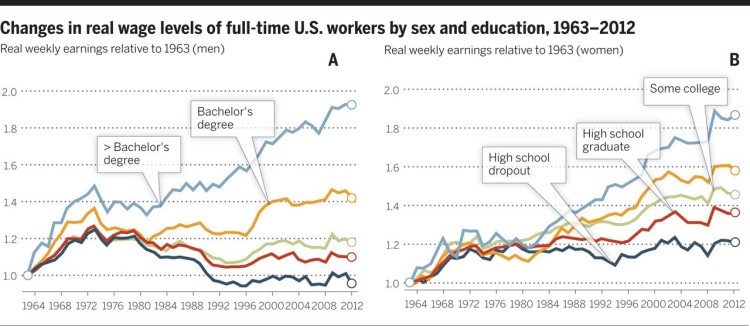
For proponents and analysts of education, the difference matters. Presume that you are concerned with improving human lives. One way to do that is to expand the availability of education. More people reach higher levels of education today than did in 1930–and more people lead safer, longer, lives. This strategy won’t produce equity, however. As educational attainment has risen in the United States, the most educated people have increased the wage gap.

Another way to enhance human welfare is to yield outputs that benefit everyone: skillful doctors and engineers who have great new technologies, medicines, training, etc. To get the best results, it might be smart to concentrate resources at very high-status institutions. The universities that produce the most scientific advances tend to be highly competitive institutions in inequitable systems like the US.

Presume that you want to promote mobility. Then you must reduce the correlation between parents’ and children’s educational attainment. That means admitting and advancing more students whose parents were disadvantaged. It also means, by definition, admitting fewer students from advantaged homes. Increasing the number of total slots is an inefficient way to enhance mobility. Mobility requires competitiveness: when people can compete better, newcomers can more easily knock off incumbents. When individuals are protected against failure, mobility is hampered.

Mobility also operates at the level of communities. In a system of Schumpeterian “creative destruction,” Detroit can fall while Phoenix rises. European countries intervene much more effectively than we do to protect their deindustrializing cities. That is better for human flourishing, but it may also hamper mobility.

Finally, presume that you really want to improve equity. One way to do that would be to improve the education of the least advantaged while holding the top constant. Another way would be to lower the quality and value of the education received by the top tier. Very few people would support doing that, even if it improved equity. That’s because most people think that welfare and mobility are at least as important as equity. (I leave aside liberty, although that is also a valid and important principle.)

Hybrid goals are possible. Perhaps what we want is to maximize the welfare of the least advantaged while not allowing inequality to get out of hand or mobility to vanish. That’s arguably the outcome in Denmark and Sweden. The US may under-perform regardless of how you weigh the three goals. We have vast inequality, limited mobility, and not much safety or health for a large swath of our people. But even if we can make progress on all three fronts at once, they are still different directions.

See also: to what extent can colleges promote upward mobility?when social advantage persists for millennia, and the Nordic model