talking about student activism on Under the Radar with Callie Crossley

I was on WGBH’s “Under the Radar” today with host Callie Crossley and an excellent student activist named Victoria Massey, who is a senior at Charlestown High School and a member of the Hyde Square Task Force community organizing group. The segment is entitled “Is Student-Led Activism A Driving Force For Change In America?” It airs on Sunday but is officially available for listening and sharing now. Here it is.

And here’s how the conversation was framed:

Alexander Hamilton wrote his first political pamphlet as a student at King’s College, now known as Columbia University. He was 17 years old. On February 1, 1960, The lunch-counter sit-ins in Greensboro, North Carolina, were started by four college freshmen started the lunch-counter sit-ins in Greensboro, N.C. Three years later, the “Children’s Crusade” in Birmingham, Alabama, involved kids as young as 7 in peaceful protests against segregation. And this weekend, a group of high school students who got the nation to say “Never Again” will lead  thousands at the March For Our Lives.

Student-led activism has always been a part of American culture. Could it be one of the country’s driving force for change?

should Democrats play constitutional hardball in 2019-20?

In How Democracies Die, Steven Levitsky and Daniel Ziblatt use comparative evidence to argue that democracies rely on two “soft guardrails”: constitutional forbearance and mutual toleration.* Forbearance means that political actors refrain from using all the powers that the written text of the constitution affords them. Regimes rarely survive once politicians routinely honor the letter but not the spirit of the rules. Toleration means explicitly acknowledging that the other side has a legitimate place in politics, a right to its views, and a right to govern if it wins elections.

We are perilously close to losing both constraints. This won’t be the first time in our history, but then again, our history has involved major breakdowns, like a Civil War that killed 620,000 Americans.

If Republicans beat expectations in 2018 and 2020, both parties’ behavior is predictable. Republicans will remain behind Trump because their base likes him and because the whole party will be winning under his banner. Democrats will resist as aggressively as possible, but with built-in limitations.

The choices for both sides will become much harder if the Democrats do well in 2018 and then 2020, capturing at least one house of Congress and then maybe the whole federal government. The Republicans’ choices will then be:

  1. The GOP stays Trumpian. This is what their base wants. Their losses will have been concentrated in swing districts and among independent-minded incumbents who tangled with the Trump base. The remaining party will be all-in for Trump. Since this scenario assumes that they lost ground in elections, they will be even more hostile to the political system, the media, and the Democrats, now seen as clearly rigging the system against real Republicans.
  2. Or the GOP turns into a principled conservative party that is skeptical of ambitious government, resistant to both taxation and public debt, and committed to constitutional restraint, including a restrained presidency. It presents that package as attractive to younger and more diverse voters and grows less demographically distinct from the Democrats.

Meanwhile …

  1. The Democrats play what Mark Tushnet calls Constitutional Hardball. Because they lost a Supreme Court seat when the Republicans wouldn’t even consider Merrick Garland, they return the favor and refuse Trump any new appointments. They launch aggressive investigations against Trump, his family, and his cabinet, focusing on potential financial crimes. They lay the predicate for impeachments and then prosecutions. They shut down the government over budget disputes, reckoning that Trump will send undisciplined tweets that will make him look at fault. If a Democratic presidential candidate wins in 2020, they drive through political reforms that advantage them in subsequent elections. In short, they decide not to be rolled, and also that their substantive policy goals require strong action.
  2. Or the Democrats try to restore mid-20th century norms of constitutional forbearance and partisan toleration. That doesn’t mean that they seat Trump’s Supreme Court nominees or refrain from investigations, but they try to follow the traditional procedures. For example, they bring Trump’s nominees up for votes but vote nay, and they make their investigations as focused and as bipartisan as possible. Democrats look to peel off independent-minded Republicans who are uncomfortable with Trump’s style and go out of their way to honor these colleagues.

Game theory is tailor-made for situations in which two players can make independent choices and the result is a single outcome. Here is a guess about how these choices would play out.

Democrats play “Constitutional Hardball” Democrats try to restore cooperative norms
Republicans stay Trumpian Democrats probably win on policy–increasingly so as the demographic trends favor them. Republicans retain 35% of the population that is overwhelmingly white and Christian and increasingly angry. The GOP still dominates some states and regions. Right-wingers give Democrats rationales for using increasingly hardball tactics. Political violence grows. Democrats are corrupted by the lack of legitimate checks. Democrats get rolled on policy. Possibly they expand their electoral power as a result of demographic trends plus a reputation for being responsible (if their forbearance is widely understood as such). Possibly they just look weak, and lose.
Republicans shift to principled conservatism Perhaps the Democrats prevail on policy and grow stronger due to demographics. Or perhaps they further erode confidence in government and thus strengthen principled conservatism, which wins elections and policy battles. The republic is safe. Democrats make incremental progress on policy, but Republicans offer a conservative alternative that sometimes prevails.

This is pretty close to a Prisoner’s Dilemma (PD), with the best option for all being the bottom-right, yet both sides have strong reasons to choose the other course. It’s a little more complicated than a pure PD because it plays out over time. The options and payoffs depend on the precise circumstances of the moment–say, in 2019 with a Democratic House and a narrowly Republican Senate, or in 2021 with (hypothetically) a newly inaugurated Democratic president. But versions of the choices arise at each stage, from congressional primaries today to legislative strategies in 2021.

*See pp. 7-8. However, my comments are based on hearing the authors speak, not having read their whole book yet.

how information relates to power, according to C.V. Wedgewood

C.V. (Veronica) Wedgewood’s The Thirty Years War is almost a century old, but it remains an inexhaustible source of insights. TaNahisi Coates loves it, too: “Take this for whatever it’s worth but she writes better than any historian I’ve ever read. Like all of my favorite writers she paints in all colors. … This is just a thrilling book. Sometimes it’s too pretty, and the details are too on point, but the insights are so thorough and the narrative so gripping that it’s hard to turn away.”

Here’s an example. Wedgewood asks how dynastic politics–births and marriages–could have been so influential. The Hapsburg Empire, for example, was the greatest power in Europe and it formed because of royal weddings. “The dynasty was, with few exceptions, more important in European diplomacy than the nation. Royal marriages were the rivets of international policy and the personal will of the sovereign or the interests of the family its motive forces. For all practical purposes France and Spain are misleading terms for the dynasties of Bourbon and Hapsburg.”

(Wedgewood doesn’t mention the Ottomans, but they were also a family, not a people. The Ottoman Empire was proudly multinational, not Turkish, and it was defined by the fact that the Sultan was the lineal descendant of Osman I [1258-1326]. In Topkapi, marriages weren’t relevant, but it mattered which heir obtained the throne.)

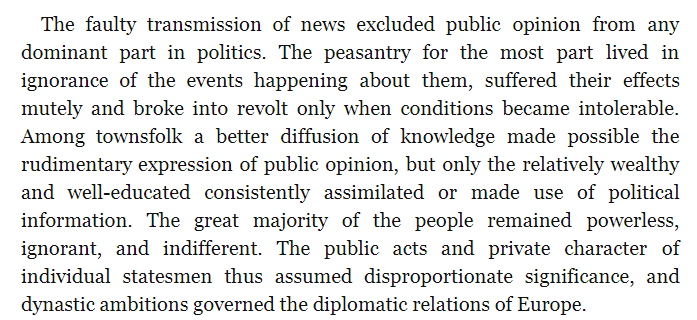
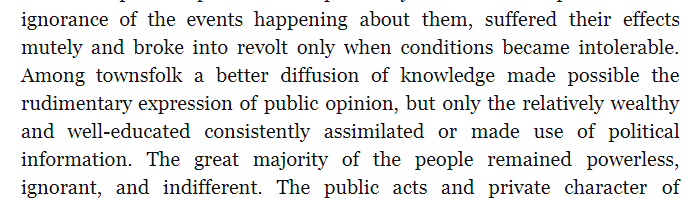
How could the fates of millions be determined by who married whom in a few families?Wedgewood thinks the reason is information:

This is an interesting explanatory thesis. Perhaps it could be restated thus: Everyone has political interests. But in order to act on their interests, people need information and the ability to coordinate. Without information, the peasants and most of the middle class were rendered powerless ca. 1600. That left the great aristocrats to govern, and they could best understand and use their own relationships to shape the world. (They presumably had poor information about things like economics and demographics.) Their relationships were transparent to the masses–for example, everyone knew when the king got married–so the most likely point for popular involvement was in supporting or blocking a dynastic union.

This thesis also raises questions about our own time. Today, we have information by the gibibyte. What we lack is the ability to focus attention on the important stuff. It’s easier to grasp Donald Trump’s marital and extramarital relations than to follow how HHS is undermining Obamacare. One dominant man holds extraordinary power–and celebrity–in China, Russia, India, Turkey, and many other countries. It’s conceivable that the 21st century will look more like the 16th than the 20th in this respect.

Nicole Doerr, Political Translation: How Social Movement Democracies Survive

A century ago, Robert Michels observed what he called the “Iron Law of Oligarchy” at work in the socialist and revolutionary labor parties and movements of Europe. He argued that these groups provided “the best field of observation” for the problem of oligarchy, because they were committed in principle to equality and democracy (p. 11). If even they turned into oligarchies, it was “probable that this cruel game will continue without end” (p. 408).

This was the pattern he observed:

Democracy is inconceivable without organization. [But] Organization implies the tendency to oligarchy. In every organization, whether it be a political party, a professional union, or any other association of the kind, the aristocratic tendency manifests itself very clearly. … As a result of organization, every party or professional union becomes divided into a minority of directors and a majority of directed. … All power thus proceeds in a natural cycle: issuing from the people, it ends by raising itself above the people (pp. 21, 32, 38).

Since about 2003, the University of Copenhagen Sociologist Nicole Doerr has been observing the successors of Michels’ socialist and revolutionary movements–the heterogeneous leftist organizations that have come together in contexts like the European Social Forum, the US Social Forum, and a low-income city in California. She observes many of the same specific dynamics that struck Michels, and she adds new ones.

For example, experienced, professional organizers tend to know one another and give each other much more attention than they give to newcomers (pp. 33-34). Representatives of “New Left” organizations that demand loose, horizontal interactions appear to union organizers to be “arrogant and upper-class” (p. 32). Questions that matter to marginalized people–such as whether the location of the next meeting will be accessible to them–get tabled as irrelevant (p. 56). Despite strong leftist convictions, leaders reveal unconscious bias against people unlike them, such as women from Turkey and Eastern Europe (pp. 54-5). Decisions laboriously reached in earlier meetings become sacrosanct, even though newcomers have reasons to object to them. The need to translate for–or to speak more slowly to–linguistic minorities is perceived as a mere nuisance (p. 39). Gatherings tend to grow more “ideologically homogeneous” over time (p. 54), as those who don’t agree drop out.

But Doerr also contributes a fascinating positive finding. She first noticed that a multilingual meeting was more equitable and deliberative than meetings in which translation was unnecessary (p. 25). That seemed paradoxical. One would assume that if some participants require simultaneous translation, a layer of inequality will be added.

But then she started noticing the translators. Although they were easily dismissed as providing a mere technical support service–and one that inconvenienced the speakers of the dominant languages–they also became involved in advocating for inclusion. They were professionally resistant to entering the discussion of substance, since their job was to translate for others. But they were also professionally committed to making sure that the people they served could be heard. Thus they often intervened on matters of process.

The translators suddenly took center stage when they went on strike during a Paris gathering, with the terse announcement, “we translators now collectively interrupt our linguistic service” (p. 42). Their demand was to change the list of official speakers so that more immigrants were included. They quickly prevailed, thanks to their leverage over the entire meeting.

At the US Social Forum in Atlanta, there were again linguistic translators. But by now, Doerr had begun using the term more broadly. Translators are people who enter a discussion without having substantive views of their own but with the goal of making sure that certain specific people, vulnerable to being ignored, are heard and understood. One of the activists in Atlanta “often intervened when established NGO staffers working on immigration reform had trouble not only understanding the language but also the content and importance of demands by undocumented immigrants.” She told Doerr, “What we did for the US Social Forum was translation … But it’s not just about linguistic translation. It’s also about emotion. It’s a translation of space, of class, of gender” (p. 59).

These translators–linguistic or otherwise–emerge for Doerr as a “third voice within deliberation” (p. 10), neither participants nor facilitators.

She recognizes that they have the power to advance their own interests (pp. 47-9). In the words of the old Italian pun, “traduttore, traditore” (translator = traitor). Their value is dependent on their motivations.  Doerr devotes a chapter to a California example in which bilingual elected officials favored their self-interests: “translation had turned into representation and domination” (p. 97). In meetings at city hall, these officials “repeatedly interrupted, disciplined, marginalized, and implicitly stigmatized residents,” especially those who spoke in Spanish.

But then a grassroots organizing group created community forums and invited the same city leaders to participate on its turf. Volunteer translators played essential roles in designing these forums, in preparing the city officials to be respectful at the meetings (pp. 102-3), and then intervening to demand that specific questions be answered (p. 110). While literally translating between Spanish and English, the organizers also explained technical matters in understandable terms. Although the votes at these community forums had no legal force, the city council made some concessions in response.

I’d like to emphasize four larger themes:

First, we are used to a dichotomy between direct and representative democracy. But translators (linguistic or otherwise) complicate that. They represent individuals in order to permit direct participation.

Second, the beneficial cases in Doer’s book depend on organized power. The translators in Paris struck, withholding their services all at once. The community organizers in the US case engaged sufficient numbers of voters that they could compel city officials to attend their meetings. It’s not just the act of translating that matters; it’s the translators’ connection to organizations. (At this point, Michels would ask how organized translators can avoid becoming a new oligarchy.)

Third, translators sometimes escape notice; their influence is unseen because all they seem to be doing is translating someone else’s words (p. 126). I imagine that listeners literally look at the original speakers, not the translators. This invisibility can be problematic if translators misuse their power. But it’s also a strategic asset, because they can get away with influencing the powerful when others would fail.

Finally, these acts of translation are classic examples of “public work,” in my friend Harry Boyte’s sense: “self-organized efforts by a mix of people who create goods, material or symbolic, whose civic value is determined through an ongoing process of deliberation” (Boyte and Scarnatti, p. 78.). Thinking of political translation as a form of work is helpful because it brings out the translators’ professional commitments and values and the craft-like skills that they contribute to make democracy work better.

References

  • Boyte, Harry C. & Scarnati, Blase. 2014. “Transforming Higher Education in a Larger Context: The Civic Politics of Public Work,” in Peter Levine and Karol Edward Soltan, eds., Civic Studies: Approaches to the Emerging Field. American Association of Colleges & Universities, 2014
  • Doerr, Nicole. 2018. Political Translation: How Social Movement Democracies Survive Cambridge: Cambridge University Press.
  • Michels, Robert. 1915. Political Parties: A Sociological Study of the Oligarchical Tendencies of Modern Democracy, trans. Eden and Cedar Paul. New York: Heart’s International Library
come work at CIRCLE (and two other great jobs involving civic engagement)

We are hiring a researcher for the CIRCLE team, which I supervise.

Researcher – Tisch College  (18001131)

The Researcher will work with CIRCLE (The Center for Information and Research on Civic Learning and Engagement), a research-based think tank that studies how young people in the United States develop knowledge, skills and dispositions for effective democratic engagement. CIRCLE’s work covers a broad range of disciplines and fields, from K-12 civic education, youth voting, youth organizing, youth and civic media, to community characteristics that promote civic development. CIRCLE currently works on major initiatives in partnership with organizations that focus on low-income youth. Although CIRCLE studies civic development and engagement of all youth, the central focus of its work is on expanding access to civic learning and engagement opportunities especially for marginalized youth from various backgrounds. CIRCLE is an influential force and a premier source of information —facts, trends, assessments, and practices—related to youth civic engagement. CIRCLE reaches both academic and practitioners audiences through both academic and popular media, including a large number of features in major news outlets. Founded in 2001, CIRCLE has been part of Tisch College since 2008 and CIRCLE staff are fully integrated into the organizational life of Tisch College and Tufts University, offering CIRCLE staff a number of opportunities to develop skills in and outside of research.

The Jonathan M. Tisch College of Civic Life prepares students in all fields of study for lifetimes of active citizenship, promotes new knowledge in the field, educates Tufts students and beyond for a life of active citizenship, and applies our research to evidence-based practice in our programs, community partnerships, and advocacy efforts. Tisch College’s work is central to Tufts University’s mission. Tisch College offers several opportunities to engage Tufts students in meaningful community building and other civic and political experiences, explore personal commitments to civic participation, and take on active and effective roles in public life and to engage faculty in expanded active citizenship research and teaching. Tisch College also seeks to influence higher education in the US and abroad to embrace active citizenship mainly through its work via Institute for Democracy in Higher Education.

The Researcher, in collaboration with a broad array of professionals, contributes to the development and execution of all phases of research & evaluation projects and technical assistance activities, including survey design, implementation, data preparation, analysis, data visualization and report preparation. The Researcher will work on multiple projects simultaneously and support CIRCLE’s overall operation, and will support management of project timelines and deliverables.

Basic Requirements:

  • 3 years of related experience.
  • Bachelor’s degree or demonstrated competencies in relevant skills.
  • Proficiency using a statistical software package such as: SPSS, SAS, or STATA, and Microsoft Office Suite.
  • Keen attention to details and ability to manage multiple project deliverables and timelines.
  • Passion for using research to achieve equity in civic learning opportunities through systemic changes.
  • Demonstrated ability to manage complex projects.
  • Knowledge of logic models, research design, statistical analysis (multivariate statistics), and qualitative and quantitative research methods.
  • Experience with graphic software, and in developing and maintaining data management systems.
  • Effective verbal, written and interpersonal skills.
  • Demonstrated ability to work on several projects simultaneously and meet demanding timelines.
  • Compose accurate and clearly written reports and documents.
  • Work independently within basic guidelines and parameters.
  • Gather and analyze available data and draw logical conclusions.
  • Establish and maintain effective collaborative working team relationships.
  • Engage in proactive problem solving and critical thinking/analysis.
  • Engage with diverse stakeholders of varied educational and professional backgrounds and perspectives.

Preferred Qualifications:

  • Expertise with data visualization software and/or website management.
  • Direct experience with community engagement through community organizing, national service, etc..
  • Direct experience with young people in diverse communities.

Apply here.

And here are two other good jobs:

Democracy Research & Writing Associate, Small Planet Institute

12 Eliot St., Cambridge, MA (In Harvard Sq. across from the Kennedy School)
Compensation: modest, based on qualifications
Hours: 8-10/week, flexible.

Description: The Associate will work collaboratively with author-and-institute principal Frances Moore Lappé to contribute to developing the Institute’s Democracy & Dignity Project, a messaging initiative building on her new book, coauthored with Adam Eichen, Daring Democracy.

Responsibilities include:

  1. keeping Lappé up to date on, and critically evaluating, developments in the Democracy Movement as well and in the ongoing assaults on democracy.
  2. helping to frame messages for, and assisting in the production of, op-eds, blogs, videos and radio interviews that challenge inaccurate frames and generate empowering ones. 3) becoming familiar with arguments in critical new books and other resources, brainstorming and researching specific topics, helping to shape arguments, and providing fact-checking and feedback on drafts.

Apply HERE

Graduate Research Assistant for a Project Involving Arts and Community

The Pao Arts Research Collaborative is a community-based research project looking at the relationship between arts, culture, and gentrification in Chinatown. Using the new Pao Arts Center as the field site, this research is looking at whether arts and culture helps to support and sustain social networks and social cohesion in a rapidly shifting neighborhood impacted by development and displacement.

We are looking for a graduate research assistant interested in working on this project. The research assistant will have the opportunity to be involved in a variety of research tasks including conducting the literature review, doing data entry, developing a survey, conducting qualitative interviews and performing qualitative and quantitative data analysis. There may also be opportunities for participating in manuscript writing in the future. We are looking for a research assistant who can work 5-8 hours/week and provide at least a 6 month commitment.

We are looking for someone who is interested in working on community health in Chinatown, is interested in community-based participatory research, is organized, flexible, and detail-oriented, and has either quantitative or qualitative research skills. Applicants should have completed an introductory research methods course in their respective field.

This research is a collaboration between the Boston Chinatown Neighborhood Center, Tufts University Department of Public Health and Community Medicine, Tisch College of Civic Life and the Drama Department at Tufts University. This research is funded by Art Place America.

I am involved, but please send a resume and letter of inquiry to Carolyn Rubin (Carolyn.Rubin@tufts.edu.) .