the I and the we: civic insights from Christian theology

Let’s assume that individuals have ethical responsibilities: each of us must strive to do what is right. However, our knowledge, self-discipline, and capacity to influence the world are all severely limited. Therefore, we are obliged to participate in groups that aggregate information, motivate their members, hold them accountable, and obtain collective power. Within groups, our individual responsibility shifts into an obligation to exercise either voice or exit. “Loyalty” means a commitment to the group; but it shades into “complicity” when the group does wrong.

This is a purely secular thesis, but it can draw on religious debates about similar issues. I’ll focus here on Christian views, mainly because I know them better than I know other traditions.

There are startling differences among Christian communities–from storefront charismatic churches and Quaker meeting houses to Orthodox monasteries and the global Catholic Church. However, it is a virtually unanimous Christian view that the soul is individual; it stands before God for separate judgment. Christians reject theories of a shared or universal soul. Thus all Christian theologians believe that it matters what each human person thinks and does.

At the same time, it is essential to Christianity that human beings are cognitively and motivationally limited–“fallen.” Thus all Christians see the benefits of being religious in groups that guide their members and speak and act collectively. Although the papal curia looks very different from a Jehovah’s Witness Kingdom Hall, both are groupings of morally responsible individuals.

Only a caricature of Catholicism portrays it as a papal dictatorship. The papacy has been stronger since Pius IX (1846–1878) than it ever was before, but even in this era of relative centralization, the teachings and actions of the Church result from the whole community; and all Catholics are obliged to exercise voice within the Church. But Catholics have a strong obligation of loyalty and not much of a moral right of exit. That is because mainstream Catholic thought emphasizes the special standing of the Church. It was instituted by Jesus when he called the apostles and gave the keys of the kingdom to Peter.

No one believes that the visible Church is pervasively infallible; it is a human institution. But Catholics hold that our mortal limitations make organization indispensable, and God has selected one organization to mediate for all individuals. (“Catholic” means universal.) Wrecked on a desert island, you should do your best, and God will understand. But if you can, you must participate in the global Church in order to be right with God. If, in your opinion, the Church errs, then your responsibility is to improve it by exercising voice.

Martin Luther broke from the Catholic Church because of his premise that conscience is logically inalienable. It’s not only wrong to try to delegate or share one’s moral responsibility; that is a contradiction. Responsibility always remains fully yours, by definition. In 1520, Luther wrote, “In fact, we are all consecrated priests through Baptism, as St. Peter in 1 Peter 2[:9] says, ‘You are a royal priesthood and a priestly kingdom,’ and Revelation [5:10], ‘Through your blood you have made us into priests and kings.'”

Why then do Lutherans have churches at all? (They even employ people in special garb who, at least in countries like Sweden and Finland, are called “Lutheran priests.”) Lutherans share with Catholics the assumption that the individual human being is too frail to believe or do right, and a group is necessary. They also agree that receiving spiritual help from other people does not negate personal moral responsibility. Their disagreement with Catholics is that they maintain a right of exit in cases of conflict between individual conscience and any particular group. That means that they are pluralists about groups, while Catholics are unitary.

Two other issues that are relevant to secular or “civic” groups are also emphasized in some Christian denominations. One is deliberation: the expression of personal views as part of a group’s search for shared truth. Making deliberation a transcendent value distinguishes Quakers from other Protestants, but it is present in all denominations to various degrees. Erasmus, for example, tried to make the consensus of believers a definitive feature of Catholicism.

The other issue is tradition: loyalty to the values and beliefs that have emerged over time, rather than those that are authored by any nameable human beings. Orthodoxy is particularly deferential to tradition. Whenever possible, the Orthodox prefer to acknowledge practices that have emerged, rather than make discretionary decisions. That practice is consistent with a very strong belief in individual cognitive limitations, combined with some faith in the ability of people to learn from accumulated experience.

All of these ideals–tradition, deliberation, plurality, unity, exit, voice, loyalty, conscience–are also available to secular groups; and often the best arguments for each principle have been developed by theologians.

See also: a typology of denominationssystem, organism, person, organization, institution: some definitionsfrom I to we: an outline of a theoryThe truth in Hayek; and what defines an organization? the case of the global sanghaSt. Margaret of Cortona and medieval populism

the politics of student debt

When Democratic political candidates are asked about “youth,” often the first issue that comes to their minds is college affordability. For example, when Hillary Clinton was asked during a Democratic primary debate about how she would reach Millennials, her whole answer was about student debt.

I agree that student debt is a problem, but it’s not nearly as widespread as politicians assume. Nearly half of the debt is held by families in the top quartile, and for less advantaged younger Americans, student debt is only one of many challenges. Therefore, a much broader policy agenda is needed to engage the younger generation as a whole.

According to Harvard’s Institute of Politics, 42% of Millennials say that they or anyone else in their household holds student debt. Pew reports that 37% of 18-29s hold student debt in their own names. That is a lot of people, but not a majority.

Forty percent of Millennials do not take any college courses at all (whether in community colleges or four-year institutions). They don’t have college debt, and their immediate economic problems may be quite different: the minimum wage, daycare, job training, GED options.

Another 38 percent enroll in college but don’t attain a BA. They have mixed experiences. Some of them incur debt but don’t hold degrees. However, according to Sandy Baum and Martha Johnson, 60% of graduates of public community colleges hold no student debt. They have Associates Degrees and are debt-free. Most of the people who borrow to obtain a 2-year degree attend for-profit institutions, and that’s a problem unto itself.

[Graph corrected on April 21]

The proportions of all adults who report holding student debt is pretty steady across all income levels. (Source: Caroline Ratcliffe and Signe-Mary McKernan for the Urban Institute.)

But the loans get bigger as you go up the income ladder. Ratcliffe and McKernan report that people in the top quartile are least worried about their ability to repay their debt, yet they hold almost half of the dollars owed.

Similarly, Pew reports, “About two-thirds of young college graduates with student loans (65%) live in families earning at least $50,000, compared with 40% of those without a bachelor’s degree.”

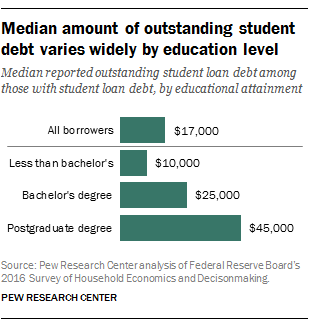
It should not be surprising that the more education you attain, the higher your debt. This also means that the people with the most debt are young adults in white-collar professions. They may be struggling, and I am fully sympathetic to them, but they represent the upper socio-economic stratum.
Median amount of outstanding student debt varies widely by education level

It would therefore be difficult to spend public money reducing debt without channeling most of the resources to upper-income young adults.

More youth regard debt as a problem than personally hold debt. Fifty-seven percent tell Pew that “student debt is a major problem for young people in the United States.” One reason may be that the prospect of debt deters people from pursuing college at all (or keeps them from pursuing more costly four-year and postgraduate degrees). In that case, college affordability and debt would be challenges for more than the 35%-40% of Millennials who actually hold debt.

But it’s a big assumption that the main reason people don’t pursue college degrees is the cost of tuition. About 41% of 31-year olds have no more than a high school diploma. The next step up the SES ladder for them would be an Associates Degree, and 60% of people who graduate from public community colleges have no debt. There may be many reasons 41% of young adults can’t get Associates Degrees–and they may not even want one–but tuition is not likely the main obstacle.

I’d be the last person to criticize reforms that make college more affordable. I just don’t think that this is the Rosetta Stone to the Millennial vote.

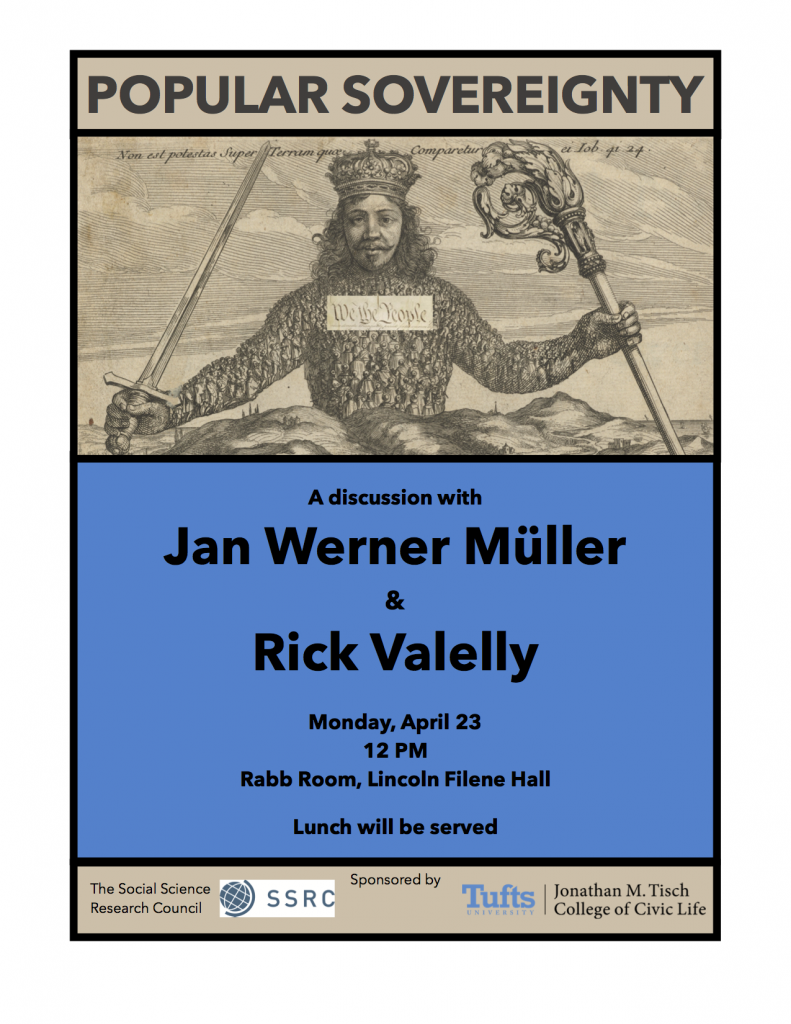
Jan-Werner Müller and Rick Valelly at Tisch College

Join Princeton’s Jan-Werner Müller (author, most recently, of What is Populism? which has been translated into more than 20 languages in two years) and Swarthmore’s Rick Valelly (author of The Two Reconstructions: The Struggle for Black Enfranchisement and many other books) for a discussion at Tisch College on Monday, April 23


the right to strike

Yesterday, Alexander Gourevitch from Brown University spoke on “The Right to Strike.” I won’t try to summarize (or scoop) the argument of his forthcoming paper, except to say that Gourevitch uses an account of oppression to give a strong defense of the right to strike, and he squarely addresses the hard issue. Successful strikes often require a degree of coercion in the form of picket lines, sit-ins, work-stoppages that close the firm, strong moral pressure on potential scabs, etc. Many liberal political theorists, American jurists, and European social democrats defend unions and acknowledge the right to strike but are squeamish about the coercive aspect. They either deny that coercion occurs or argue that strikes are only acceptable when free of all coercion. Gourevitch defends the coercive aspect of strikes–although not as an absolute right.

I would reach the same destination from a different starting point. I would begin with the premise that human beings have the right to create, design, and govern groups. Among the many types of groups that we design are governments (at all levels and scales), companies (privately held or publicly traded), and unions. Any of these three can allow or prevent an individual from working in a particular job. The government can regulate or legislate against the job or a category of workers, the firm can refuse to hire or fire an employee (or close the whole shop), and the union can strike. I begin with no assumption that any of these acts is more–or less–legitimate than the others. Governments, companies, and unions can be good or bad. They can do the right or the wrong thing. It all depends on the details.

In particular, it depends on how they are organized internally and what effects they have on outsiders (including natural systems as well as people). Assessing their internal structures and their consequences is controversial because it raises all the basic questions of justice.

For example, it you are a participatory democrat, you will value institutions just to the degree that they are internal democracies. Companies seem the least promising candidates, although democratic firms do exist. Both unions and governments range from highly democratic to highly authoritarian. Before you acknowledge the justice of a coercive strike, you will ask whether the union is democratic (and whether it is more or less democratic than the state that seeks to police it). You may embed in the definition of “democratic” some openness to outsiders, such as workers who are not already members of the union.

If, on the other hand, you are libertarian, you will value institutions just to the degree that the reflect individual, voluntary choice. Governments are the least promising, because very few citizens literally and actively consent to be governed. Governments are only legitimate to the degree that they create space for private agreements. Companies and unions are both potentially legitimate, but unions may be less so, to the extent that they coerce. Hayek claimed that unions “are the one institution where government has signally failed in its first task, that of preventing coercion of men by other men–and by coercion I do not mean primarily the coercion of employers but the coercion of workers by their fellow workers.”

For my own part, I am deeply pluralist. I believe in the value of maintaining a diverse set of institutional arrangements as checks against each other and as manifestations of human plurality and creativity. I am happy to see non-democratic institutions (e.g., the Catholic Church), strongly democratic ones, and many other forms. But I am not a relativist. I think that some organizations are better than others, and some combinations are more desirable than others. It’s just that an account of what makes organizations good must be nuanced and pluralist. One size doesn’t fit all.

On these grounds, I would defend unions as human creations that contribute to a pluralist public sphere. And I would accept that they will act coercively–within appropriate limits–when they strike. I am not positively enthusiastic about coercion, but I’d stress that states and companies also coerce. If you want (or need) to work, and a union has closed your workplace, then you have a complaint; but you also have a complaint if the company fires you arbitrarily or the state throws you in jail. Stronger unions make the second two forms of pervasive injustice less likely. A world with states, companies, and unions is more just than a world with just the first two.

See also my “The Legitimacy of Labor Unions” (2001), which is too moderate, China teaches the value of political pluralism, and should all institutions be democratic?

what if something is not your problem?

I frame a most of my research and teaching around the question, “What should we do?” I’d even define a citizen as someone who asks that question. In academic contexts, I argue that this question is complex and under-theorized: it raises difficult issues of loyalty, complicity, the definition of groups, dynamics within groups, problems of collective action, etc. These issues deserve attention along with the more typical questions of political theory: “What is justice?” and “Why do things happen as they do?” The citizen’s question is also central to our new Civic Studies major at Tufts.

However, insisting on this question may imply that everyone bears primary responsibility for addressing every issue. What if you are the victim of a social injustice that someone else has created or has the best opportunity to remedy? Then it is most important for them to decide what they are obliged to do to improve your situation. Not every problem is your problem.

Nevertheless, “What should we do?” remains an important question for virtually all of us. Even if the main moral responsibility lies with someone else, the only thing we can control is what we do.

We may decide that we should demand justice from another person or group, but making a demand is also a form of action that we choose to take. In fact, making demands on “target authorities” is the characteristic activity of social movements; and social movements are composed of people who ask “What should we do?” It’s just that their goal is to to compel other people to take more responsibility.

Finally, acting is not merely a price we must pay in order to improve the world. It can also be a benefit that we reap, since exercising agency can be an aspect of a good life. Although we should encourage–and sometimes even compel–other people to ask what they should do, it is also worth asking that question on our own behalf, regardless of our circumstances.

See also: a sketch of a theory of social movementswhat should we do?