why learn game theory? (a lesson plan that includes a game)

You may or may not be interested in games: playing them, designing them, or analyzing them with the tools of game theory. It is certainly understandable if games are not your thing. However, I believe that everyone should develop the skill of understanding interpersonal situations in terms of the choices and consequences that confront every actor, which is the essence of game theory.

This is a way of detecting problems that you might be able to fix. It is also a way to be more fair. Too often, we analyze situations in terms of the choices that confront us and the results that will befall us if we make any choice. We see other people as doing the right or the wrong thing, from our perspective. It is important to step away from that first-person view and assess the choices–and the costs and benefits–that confront everyone. Then their behavior may seem more reasonable, and the root of the problem may lie in the situation, not in the other people’s values.

When used as models of real life, games simplify and abstract. That is both a limitation and a huge advantage: a model can clarify important problems and patterns that may be hidden in the real world’s complexity.

Games do not presume that the players are selfish; in fact, altruists can get tangled up with coordination problems that games model well. Nor do games assume that people have full information or act rationally; uncertainty, randomness, and error can be built in.

Games do model situations in which people or other entities (e.g., animals, companies, nations) make separate choices, and the outcome results from the interaction of their decisions. Games are not very helpful for modeling other kinds of situations. One important form of civic action that they do not model well is a discussion about what is right (and why). Exchanging opinions and reasons isn’t well illuminated by a game. Therefore, I do not think that civic actors should only learn from games, yet game theory is a useful skill.

One way to introduce game theory is to play a game and reflect on how it works as a model.

Almost identical lesson plans can be found all over the Internet for a classroom game that models the Tragedy of the Commons using Goldfish crackers. I’m not sure who deserves the authorial credit for designing this lesson in the first place, but I have adopted it for several different classes and will share my current design.

Materials: goldfish crackers (“fish”); plastic bowls (“lakes”); and forks (as tools for fishing).

Each group of four people should sit in a circle around its lake, which contains nine fish to start. Players “fish” by removing the goldfish from the bowl with a fork. All groups fish for 15 seconds while the instructor keeps time. Then students put down their forks and the fish “reproduce”: each fish left in the lake produces two offspring, up to a total population of 16, which is the carrying capacity of the lake. Then you repeat fishing for another season until either the seasons are over or the fish run out.

I do not explain the goal or what counts as winning, because that will vary in interesting ways.

Each round has different rules.

  1. We play three seasons without talking at all.
  2. We play three seasons and may talk before the game begins and during it.
  3. Each group plays an unannounced number of seasons before I stop them. They may talk.
  4. We play three seasons silently, and each group rotates one fisher at a time. That person may spend as little or as much time as she likes. As long as she holds her fork, the others must wait.
  5. We play using game 2 rules, except students may take fish from any table.

I keep track of the largest number of fish collected by any individual in each game and the number of fish left in the whole room at the end of each game.

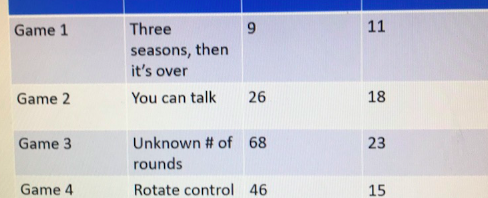
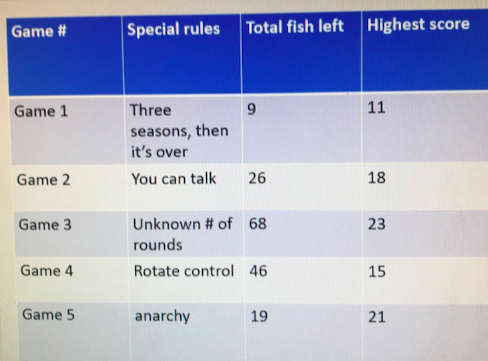
Below are the results from yesterday’s game, with 52 Tufts undergrads. Note that 68 fish were left when the number of seasons was unknown and students could talk. That is more than seven times more fish than survived in the first game, with a known number of seasons and no ability to communicate orally.
Questions for discussion:

  • Did we observe “tragedies,” or not?
  • When we did not, why not? What solutions did groups come up with?
  • What were individuals trying to achieve? (Responses will likely vary: obtaining the most fish, trying to be fair, trying to look like nice people, learning by experimenting with different tactics.)
  • Were your objectives affected by your perception of what other players were trying to achieve? (A norm can be understood as a shared sense of the goal.)
  • What is the optimal solution? (Students should consider: maximizing the number of fish consumed, or the number of fish preserved at the end, and/or equity among the players. Other proposals may also emerge.)
  • What parameters are included in the game? (Responses should include: attributes of the physical world; attributes of the community; official rules; and rules-in-use.)
  • How realistic is the scenario? What is it a realistic model of?
  • What assumptions does it make? How might those differ in reality? For instance, what if we played with $100 bills instead of Goldfish crackers?
  • Why did everyone follow the instructor’s rules? Why not just grab the Goldfish?
  • To what extent did additional rules emerge in practice? Is it realistic that people followed rules?
  • In general, is it helpful to model a society using games? What assumptions does a game model make? (Selfishness?) What might a game not model well?

See also: evolution, game theory, and the morality of modern human beingsthoughts about game theory; and game theory and the fiscal cliff (ii).
nonviolent civic work under conditions of extreme violence

My Tufts colleague Anjuli N. Fahlberg, a sociologist, has done extraordinary work in Rio de Janeiro’s City of God. Despite a staggering level of violence in that neighborhood, the residents have created a wide array of impressive initiatives that offer social services, education, and culture and promote social justice. Local activists are networked with peers in other communities they have been effective at the national level in Brazil.

Anjuli helps rebut the claim that “civic engagement” is only for privileged people. She also reveals interesting patterns that may generalize to other places. For example:

CBO [community-based organization] leaders had to monitor their activities and tactics closely so as not to conflict with the political and economic interests of the drug trade. They did this in several ways. For one, they decidedly avoided local politics, which meant avoiding any contact with political or community leaders known to be working for the drug trade and declining favors from local political candidates. … Since Solange and other CBOs refused to engage in violent governance, they found power in its opposite: moral governance. Moral governance emphasized transparency, fairness, equality, justice, and the use of resources for their stated activities. Notably, nearly all CBO leaders were women and thus offered a visual, embodied distinction from violent politics, which were controlled almost entirely by men.

This is from Anjuli N. Fahlberg, “Rethinking Favela Governance: Nonviolent Politics in Rio de Janeiro’s Gang Territories,” Politics & Society, September 11, 2018. Read the whole thing. You can also watch Anjuli’s talk at last year’s Frontiers of Democracy conference, here:

churchgoing and Trump

The Democracy Fund’s Voter Study Group has released an important new paper by Emily Ekins entitled, “Religious Trump Voters: How Faith Moderates Attitudes about Immigration, Race, and Identity.”

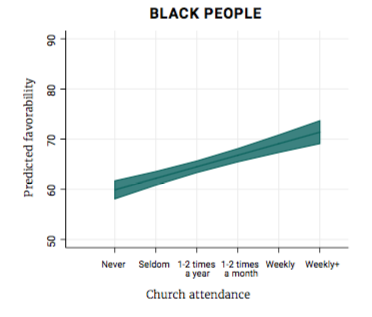
Ekins notes that Trump performed best in the 2016 GOP primaries among Republican voters who never attend church (getting 69% of their vote). Examining Trump voters during 2018, she finds correlations between regularity of church attendance and positive attitudes toward racial and religious minorities, acceptance of diversity, approval of immigration (and opposition to the border wall), and concern about poverty.

Here I illustrate that pattern with attitudes toward Black people as the dependent variable. The trend line controls for race, gender, income, education, and age. All the data come from Trump voters. Because the correlation between church attendance and racial attitudes among Trump voters holds with these controls, Ekins suggests that it is causal.

This might not be a case of cause-and-effect. A third factor might underlie both tolerance and church attendance. However, I posited a similar causal hypothesis early in 2017, after I’d met with a conservative Southern pastor who despised Trump’s leadership style and attitudes. This pastor blamed Trump’s support on coach-potato “Christians,” those for whom Christianity is an identity rather than an actual faith, those who get their ideas from Fox News or Breitbart, not from fellow congregants.

Some colleagues and I tried to test this hypothesis using survey data and failed to find it, which is a null result worth noting. Still, I’d like to think that Ekins is right—perhaps more so in 2018 than in 2016.

Why would this pattern hold?

First, Ekins shows that church-attending Trump supporters volunteer and trust other people much more than Trump supporters who rarely or never attend Church. It may be that people who help others and feel they can rely on others are less likely to despise and fear strangers. In turn, church-attendance may promote volunteering and trust, or it may manifest a broader form of social capital that explains both tolerance and church-attendance.

Robert Putnam introduced a distinction between “bridging” and “bonding” social capital. The bridging kind connects people who are diverse in some respects; the bonding kind may increase solidarity in opposition to outsiders. One could imagine that churches enhance bonding social capital. America is said to be most segregated on Sunday mornings, and churches distinguish insiders from outsiders. But volunteering and trusting generic others are measures of bridging, not bonding, social capital. Insofar as churches encourage volunteering, they are trying to create bridging social capital.

Another mechanism could be leadership. Real churches have leaders, both clergy and laypeople. Church leaders are expected to be responsive and responsible and to hold the group together. In contrast, Trump just says whatever comes into his mind, usually makes no effort to deliver what he promises, and is happy to divide. I have hypothesized that people who are familiar with real leadership in local voluntary associations would despise Trump’s style. Although we were unable to show that pattern using survey data, Ekins’ new results may suggest that it holds.

A third mechanism could be the content of the faith. I happen not to be religious, and I could criticize the specific content of many sermons and texts on ethical grounds. I am aware that there are mega-churches that show huge audiences jingoistic videos of American military might; there are clerics who praise Trump or cite Romans 13 to defend the administration’s policies. In my opinion, these examples are idolatrous as well as unjust, but my argument does not depend on romanticizing the content of religious expression.

I would argue, instead, that real faith is demanding. You can find passages and examples that reinforce bigotry, but you will also encounter texts that challenge you. Faith may be consistent with almost any policy position—as we can see from the enormous range of political opinions among clergy—yet participation in a deep and complex religious community is inconsistent with all simplistic attitudes about other people. Cable news and propagandistic websites reinforce what their audiences want to hear, but scripture is strange and demanding. Since religious texts are very hard to figure out by oneself, they require discussion and debate. In turn, the people in any given discussion usually turn out to have idiosyncratic and incompatible interpretations. This is why Martin Luther, despite his break with The Church, believed that we all need a church to keep us honest. Even if the content of preaching and liturgy doesn’t turn us into people who understand and care for others, the decision to attend a service may reflect a desire to become such a person.

In short, religion as a pure identity: bad. Religion as a community of people who struggle to address issues of moral and existential importance: good. Voters who actually attend church are more likely to experience the good form of religion, compared to those who identify as Christians without showing up on Sunday.

See also: the prospects for an evangelical turn against Trumpthe Hollowing Out of US Democracywhy Trump fans aren’t holding him accountable (yet); and why Trump fans aren’t holding him accountable (yet)

undergraduate Introduction to Civic Studies Course

PHIL-0020-01-Intro to Civic Studies at Tufts University (Fall 2018)

  • Ioannis D. Evrigenis, Professor of Political Science
  • Erin I. Kelly, Professor of Philosophy
  • Peter Levine, Lincoln-Filene Professor and Academic Dean, Tisch College

Civic Studies is an interdisciplinary field of study that focuses on critical reflection, ethical thinking, and action for social change. People who think and act together to improve society must address problems of collective action (how to get members to work together) and deliberation (how to reason together about contested values). They must understand how power is organized and how it operates within and between societies. They must grapple with social conflict, violence, and other obstacles to peaceful cooperation. When tensions arise within a group, people face questions of justice and fairness, and they must confront questions about appropriate relationships to outsiders of all types. This introductory course explores ethical, political, and theological frameworks for understanding how people can and should organize themselves to improve societies. Readings are drawn from philosophy and political theory, economics, the history of social movements, and other disciplines. This course provides theoretical grounding for Civic Studies majors and for other students interested in social change.

Continue reading

V.S. Naipaul’s view of culture

I read a lot of Naipaul in my youth and see value in his work. But Ian Buruma’s obituary profile reminds me of the main way in which I disagreed with him.

Naipaul believed there were “whole cultures”: comprehensive, harmonious, indigenous, and hermetic. Examples included classical India, England, and pre-colonial West Africa. A whole culture was “wounded” when it was mixed up with foreign elements, usually as a result of conquest or deferential imitation.

Naipaul was politically incorrect in three respects. He admired the “whole cultures” of Europe, such as England, and emphasized their indigenous roots. He saw many interventions as imperialistic–not just European conquests but, for example, the Islamic influence in India or the Arab influence on non-Arab Muslims. And he mocked people in the global South who made unsophisticated efforts to imitate the imperial centers: West Indians pretending to be British, or Malays pretending to be Arabs.

On the other hand, Naipaul was in sync with certain strains of post-colonial thought: he liked indigeneity and opposed cultural appropriation.

It’s true that “cosmopolitan” was a positive word in Naipaul’s lexicon, and he claimed to be cosmopolitan himself. But he insisted that a cosmopolitan was at home in more than one culture, truly understanding and living it. Lightly borrowing some elements of other cultures didn’t count:

[Satyajit] Ray was a Bengali intellectual and artist who was as much at home in European as in Indian culture. He loved Indian art and music as much as European classical music or literature, and had a deep knowledge of all these things. The fact that most of us eat American junk food, or watch Hollywood movies, doesn’t make us necessarily more cosmopolitan. To be cosmopolitan you need to feel at home in various different cultures, as Ray did, and few people do even now. As far as the shrinking world is concerned, this is easy to exaggerate.

For what it’s worth, I believe:

  1. There is no indigeneity. We have all migrated. Not only people but also ideas move constantly. Every group has been deeply influenced by other groups for as far back as we can see.
  2. There are no whole cultures. A culture is an assemblage of ideas about the world (defining both “ideas” and “world” broadly). Since everyone holds at least slightly different ideas, labeling people as members of a culture just means that most of them share some important ideas. It’s a statistical generalization about the beliefs of a population. Furthermore, the ideas that we happen to hold are always badly insufficient, and we are always looking for more. Because of our profound human limitations–cognitive and imaginative–every culture is drastically incomplete.
  3. Mixing is good. India, for example, is not a “wounded civilization” because the original Hindu whole has been rent by Muslims and Europeans. It is a fabulous quilt of diversity, and has been for three millennia. Even the Hindu aspect is massively diverse.
  4. Imitation is good, although you have to do it with creativity, respect, and taste. Some of Naipaul’s most effective criticism was aimed at poor efforts at imitation.
  5. Imperialism is bad. But that’s not because it disrupts indigeneity and cultural harmony or because it introduces ideas that should stay somewhere else. It’s bad because it involves forcibly seizing land and goods while usually also killing, exploiting, and (literally) raping people. The bad part is the violence and exploitation, not the mixing.

See also: what is cultural appropriation?notes on cultural appropriation after the royal wedding; and everyone unique, all connected.