Several political theories and ideologies are invested in distinguishing the state from the private sector (which may encompass the market, families and civil society):
- For libertarians, the state bears the badge of original sin because it alone claims a legitimate right to coerce violently. That doesn’t mean that we should abolish the state, which plays an essential role in protecting rights, but government requires special controls and constraints because it could not exist without its ultimate power to kill.
- For strong popular democrats and European-style social democrats, the state alone reflects the people’s will, so it is free from the corrupt influences of money that infect the market and that often spill over into nonprofits. That doesn’t mean abolishing markets, but states should hold the commanding heights and be shielded as much as possible from market influence.
- For many American constitutional lawyers, the state must be distinguished from voluntary associations because the state alone should be constrained by the First Amendment and committed to neutrality about matters like religion. In contrast, the First Amendment gives voluntary associations the right not to be neutral in their own domains. A university, for instance, may discriminate pervasively in favor of high-quality expression and against poor speech and writing. No one has a First Amendment right to tenure. This constitutional argument fits with certain versions of philosophical liberalism, such as John Rawls’ and Ronald Dworkin’s.
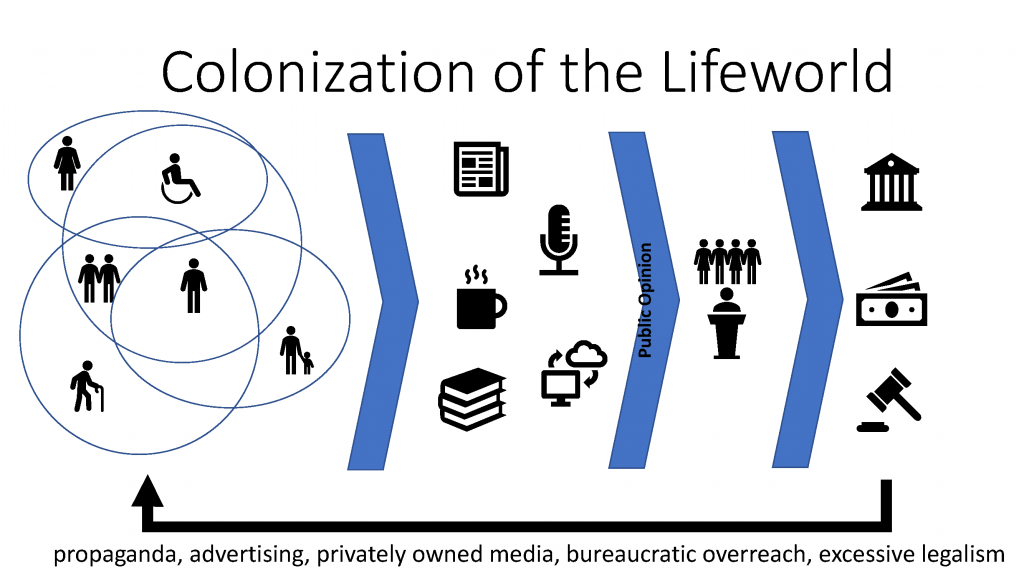
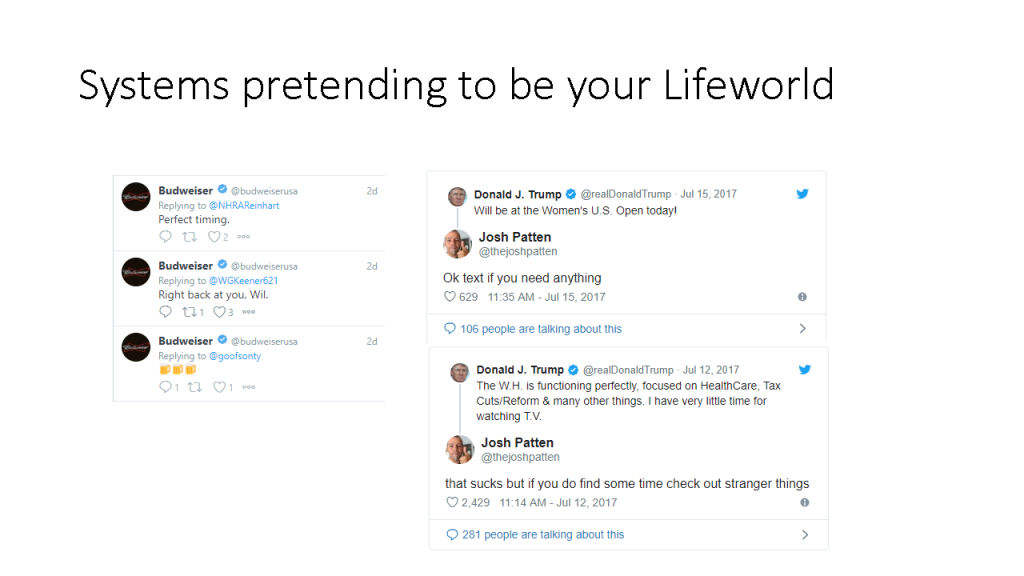
Here is my objection. I don’t think that people experience actual institutions differently depending on whether they belong to the state or the private sector. Phenomenologically, the political and the civil are not sharply distinct.
I had that realization a year or so ago when I was with classical liberals/libertarians in the conference hotel of Michigan State University. I wondered idly whether that was a public or private space. It was not easy to tell, given the complex relationships between a state, its university, and the university’s hotel. But I realized that I had no reason to care. The distinction would make no difference to how I was treated.
I had the same thought again recently in New Haven, the city where I first became politically active three decades ago. We were discussing Ian Shapiro’s fine recent book, Politics Without Domination. I agree with much in it, but not with this distinction on p. 31:
Political institutions are centrally concerned with power. This differentiates them from civil institutions, which, though invariably suffused with power dynamics, are ultimately geared to the pursuit of other goals. … Governments should stay out [of the affairs of civil institutions] unless people’s basic interests are at stake, and even when they are, it is best to seek the least intrusive available means to protect them. But political institutions are different because politics is about power through and through.
Compare a classroom in Shapiro’s university, Yale, with a street nearby in New Haven, and think of the various people who populate these spaces: students, workers, shoppers, professors, salespeople, bosses and administrators in various roles. To students, I think Yale will feel the most like a government, with its centralized authority and formidable power to judge, exclude and punish. New Haven will generally feel more permissive and informal.
If they are activists, students may find themselves working voluntarily with New Haven municipal employees on common goals, like making the city more beautiful or safer. The city employees and the students wear different hats, but they all have complex lives and multiple attachments. A city official is also a parent; a student is also a shopper. The official normally has very limited scope to compel but may have tax dollars to allocate. Those dollars work just the same as the money that students might generate from a fundraiser. Students, other citizens, and workers all contribute to making the city with their bodies, their voices, their purchases, and their choices to stay or to exit.
If we start with a fundamental distinction between the state (with its monopoly on the legitimate use of force) and voluntary civil associations (with their non-political purposes), then we will strive to disentangle hybrid cases–a Yale police officer who carries a gun as a sworn peace officer but gets her paycheck from a private institution; a lab that is funded by the NIH but employs Yale students; a university disciplinary hearing the enforces Title IX; a campus/community event that is funded by the city and philanthropy.
I think such hybridity is not the exception but the norm, because all institutions are composed of people who have multiple identities and objectives. The state is not made up of human beings “centrally concerned with power” but is composed of teachers, accountants, counselors, office managers–just as Yale is. A government or state is not one thing, a leviathan that derives all its powers from its ultimate ability to compel. It is rather a bunch of schools, parks, military units, prisons, welfare offices, scientific labs, deliberative fora, authoritarian fiefdoms, secret agencies, purchasing offices, etc., etc. It is pervasively related to various “private” entities that have similar functions. In New Haven, the Alders have what passes for state sovereignty, but all of them are also mainly other things: business owners, activists, teachers, and one Yale undergrad. When they define and address problems, they probably don’t sharply distinguish their roles.
As Shapiro argues (p. 21), Foucault went too far in seeing every space as equally suffused with domination. A prison is different from a classroom or a clinic. But Shapiro draws the distinction too sharply. A classroom may be no easier to escape than a prison, even if it’s in a private school. Yale may dominate much more thoroughly than New Haven does, and Yale may dominate because of its function as a gatekeeper to a corporate sector that determines what the US government does.
I would propose this alternative view. People are involved with “politics” at all scales, in all sectors, and in a vast variety of forms. “Politics” does mean domination and exclusion, but also deliberation, problem-solving, and co-creation. These are the two sides of the coin, as powerfully illustrated by the Book of Nehemiah.
The venues of politics constantly influence each other, and often those agencies that are officially arms of the state are not the most influential or the most likely to dominate.
We are all subject to domination, prone to dominate others, and capable of improving our shared condition. Our degree of power and vulnerability varies with our social position; to be a just person requires attention to those differences. But there is room for everyone to combat domination, everywhere. And how we manage that task in smaller settings may affect what happens at larger scales. The Tocquevillian argument for the importance of civic culture is that citizens who learn to deliberate, cooperate, and respect each other in associations may be more likely to choose national leaders who do the same.
Elinor Ostrom concluded her presidential address to the American Political Science Association (1996) with a call for a different approach to civic education:
All too many of our textbooks focus exclusively on leaders and, worse, only national-level leaders. Students completing an introductory course on American government, or political science more generally, will not learn that they play an essential role in sustaining democracy. Citizen participation is presented as contacting leaders, organizing interest group and parties, and voting. That citizens need additional skills and knowledge to resolve the social dilemmas they face is left unaddressed. Their moral decisions are not discussed. … It is ordinary persons and citizens who craft and sustain the workability of the institutions of everyday life. We owe an obligation to the next generation to carry forward the best of our knowledge about how individuals solve the multiplicity of social dilemmas- large and small-that they face.
See also polycentricity: the case for a (very) mixed economy; from classical liberalism to a civic perspective; against state-centric political theory; is our constitutional order doomed?; the Citizens United decision and the inadequate sociology of the US Constitution; and free speech at a university.