marginalizing views in a time of polarization

I recently posted “marginalizing odious views: a strategy,” which was about a powerful and sometimes valuable tool for self-governance. When communities define specific perspectives as beyond consideration, they uphold norms without needing formal censorship. This is good when it happens to Nazis (for instance), but problematic when it’s used to block serious consideration of minority views.

I assume that marginalization is a perennial strategy. Its advantages and risks–especially as compared to a strategy of engagement–are also perennial. But the context does make a difference.

When most Americans got their news from three rather similar TV networks plus a metropolitan daily newspaper that had from zero to three local competitors, marginalization depended on the mass media. You could try to marginalize a position that you considered odious, or create space for a currently marginalized view, but your success would depend on what Walter Cronkite and his ilk thought. If a position wasn’t marginalized on the network news, it wasn’t marginalized. And if a view never got aired in the mass media, then it was pretty marginal even if you and your friends believed in it.

At the same time, the two major parties had overlapping national elites with similar educational pedigrees who, while disagreeing about some important matters of policy, still tended to agree about what was marginal. Along with the mass media, they adjudicated what belonged on the national agenda. Thus the terms of the game were clearly defined, even if the rules were problematic because they gave too much power to homogeneous elites.

Now that the media landscape is highly fractured, we live in many separate epistemic communities. What is mainstream in one setting can be effectively marginalized in another. Just to name one example, the phrase “illegal immigrants” is pretty much marginalized in both my city and my university, but it is the standard phrase across large swaths of America.

The fact that our national discourse is polarized and balkanized has been widely noted, but I want to emphasize the consequences for a strategy of marginalization:

  1. It is now virtually impossible to marginalize across the society as a whole. Given any opinion, some people are comfortably expressing it right now in public (online) to their fellow believers.
  2. It is now much easier to marginalize within a community in which you in are the mainstream. The temptation to say, “We don’t say that here” is very high when that can be so successful.
  3. There is also a constant temptation to demonstrate that each community is biased by forcing it to confront views that it is trying to marginalize. That makes the community look intolerant to external audiences. For instance, if a university seems pervasively liberal, invite Milo, watch the reaction, and cry “Censorship!”
  4. Since being marginalized feels like being censored, more people have the experience of censorship in various specific settings where their own views are unpopular. In fact, almost everyone would be marginalized somewhere.
  5. The same statements often have a double effect. For their proponents, they reinforce shared norms. For their opponents, they serve as examples of what must be marginalized. For instance, Rush Limbaugh clearly has two audiences: conservatives who like what he says and liberals who are appalled by quotes that circulate in their networks. (Both reactions benefit Limbaugh by bolstering his prominence.)
  6. The strategy that is furthest from marginalization–trying to learn from other people while sharing your opinions with them–is harder than ever, because we all hide in homogeneous communities.

I continue to think that marginalization has a place in politics. Not every opinion deserves respectful consideration. Communities gain coherence and value by drawing limits around what they will consider. However, I suspect that a fractured media system makes marginalization too tempting and persuasion too difficult, with costs for democracy.
the Civic Studies Wikipedia page

There is a new page on Wikipedia about Civic Studies. It’s not about civic education* but about the developing “interdisciplinary field that empirically investigates civic engagement, civic education, and civil society.” Civic Studies also strives to “influence the social sciences and humanities in general to take the perspective of intentional human actors–people who reason and work together to improve their worlds–in addition to institutions and impersonal social forces.”

I wrote all the text that’s on this page so far, but I’m hoping it will be a living document to which others will contribute.

*For civic education, you could consider the Stanford Encyclopedia of Philosophy entry by Jack Crittenden and me.

marginalizing odious views: a strategy

If you looked out at the National Mall on any Inauguration Day from 1944 to 2012, you might conclude that Nazism had been effectively marginalized in the USA. The president who was being sworn in might be leading a war against actual Nazis (Roosevelt) or might be a veteran of such a war. The growing array of monuments, memorials, and museums along the Mall included explicit repudiations of Nazism (the United States Holocaust Museum, the WWII Memorial), and lots of images and statements at odds with Nazi ideology. Even a white-supremacist like Jefferson was represented–selectively but not falsely–as a proponent of values antithetical to Nazism. And certainly no one would feel the need to explain why no Nazis were invited to this party.

As further evidence that Nazism was marginalized in the USA between 1941 and 2017, consider that:

  • No censorship was required to keep Nazi materials off respectable shelves, except sometimes as historical evidence of evil.
  • The word “Nazi” was an epithet, not requiring an explanation as to why it was bad.
  • People who shared a lot of beliefs with Nazis remained prevalent, but they denied that they were Nazis or resembled Nazis.
  • The word got misapplied as an insult to people who didn’t deserve it. The debate was not about whether it was OK to be a Nazi but whether it was OK to call someone that.
  • The word gained a penumbra of moral seriousness and shame. Joking about it was generally off-color, although it did produce some brilliant satire.
  • [We did still read Heidegger and Carl Schmitt, which shows either that the marginalization was incomplete or that it’s possible to make judicious exceptions.]

Marginalizing Nazism was an achievement. It was a form of self-governance, the imposition of values on a population by the population. Even if you’re not a purist about First Amendment principles, you might still agree that successful marginalization of an odious view is more effective than state censorship. It is also in some respects safer, because states that censor may easily abuse that power. (And censorship is ultimately backed by the gun.)

Although marginalization need not employ state censorship, it does make heavy use of authoritative rhetoric, rituals, social norms, selective invitations to speak, and refusals to listen. It is incompatible with engaging alternative views, listening to learn, being open to changing one’s mind, seeing the good in everyone, etc. It explicitly repudiates dialogue. We can either engage in dialogue or we can marginalize; we can’t do both to the same target.

As such, marginalization can be misused. For instance, socialism hasn’t been fully marginalized in the US since the Palmer Raids of ca. 1919–but close. Many people who share views with actual social democrats or democratic socialists deny that they do. In many circles, the term “socialist” suffices as a critique and doesn’t need an argument–it functions as an epithet.

Again, the marginalization of socialism has never been complete. There have always been socialists in the US with significant influence and secure positions. Just lately, we are seeing a real resurgence. Still, the degree of marginalization has been sufficient to distort the public debate. I happen to be mildly skeptical of socialism on several grounds, yet it seems obvious that the policies employed in thriving countries like Norway and Germany deserve consideration in the USA–and are, in fact, sometimes employed here. Marginalizing the word that best describes those policies prevents the public from considering them on their merits.

The temptation to marginalize is felt across the spectrum. For instance, neoliberalism is perhaps the reigning orthodoxy of our era. Yet no one calls himself a “neoliberal.” The word is almost always used in circles where people oppose market capitalism, as an epithet. It substitutes for an argument. It is hard to define “neoliberalism” in a way that (a) accurately describes the views of the alleged proponents, and (b) is actually bad. A commitment to personal freedom is something that alleged neoliberals would acknowledge but that also seems attractive. A preference for corporations over people is something that they would deny. Once you propose a precise and accurate definition of neoliberalism, you are engaged in an argument rather than marginalizing anyone–but you risk losing the argument. Now you are no longer just charging opponents with being neoliberals but considering whether choice and competition might be helpful under specific circumstances.

To the target, marginalization feels like censorship. When a university refuses to invite a certain kind of speaker to give a formal talk, or disinvites someone who was invited, that is not–in an important, technical sense–censorship. The university has a right and even a responsibility to invite selectively. However, when the university is part of a larger movement to marginalize a given view, then holders of that view face what feels like censorship when they are not invited. If those people are Nazis, then their marginalization is an achievement. But if they are merely out of step with dominant views on college campuses, then they may have a legitimate complaint.

In short: marginalization is a powerful and appropriate strategy when the target deserves it. The power to marginalize is a political resource. It is a form or aspect of governance. But its power is so tempting that we must be careful not to abuse it. One reason not to marginalize any given view is that we may then fail to learn from it.

See also responsiveness as a virtue; civility, humility, tolerance, empathy, or what?; civility: not too much, not too little; and (from 2009) a theory of free speech on campus.

views of abortion by gender

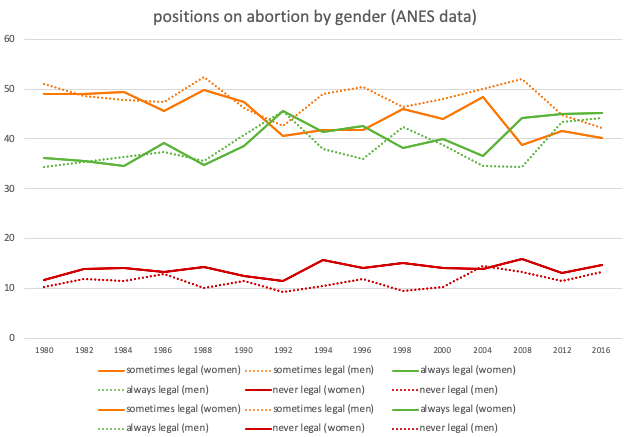
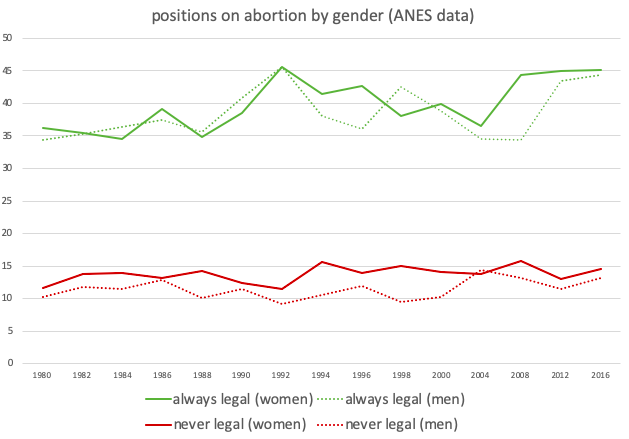
I didn’t know how women and men differ in their views of abortion or how opinions have changed over time. So I ran the numbers using American National Election Study data since 1980.

Here are the strong pro-choice and anti-abortion views by gender:

More people favor always allowing rather than never allowing abortion. Differences by gender are small and not significant, but women are currently just a bit more likely to take both the strongest pro- and anti- positions. The trend over time is slightly favorable to choice.

The graph is noisier if we add a middle view as defined by the ANES (abortion should be legal in cases of rape, incest, or medical risk to the mother):

Making abortion sometimes legal is the most popular position, and men are somewhat more likely than women to adopt it, but again, the gender difference is small.

some notes on receiving tenure

This week, the Tufts Trustees voted to grant me tenure and make me a full professor. I am very grateful to them, the Political Science Department (which is my tenure home), the Tisch College of Civic Life (which will remain my main base) and its dean, Alan Solomont, and the other people–known and anonymous to me–who were involved in advancing and reviewing my case.

I have been working full-time in universities (Maryland and then Tufts) since 1993. However, I don’t believe I should have held tenure until now. Tenure means job security for teaching. It’s a way of protecting instructors’ intellectual freedom. Until now, I have never held a teaching position. More years than not, I’ve taught at least one credit-bearing college course, but not as part of my paid employment. Instead, my salary has come from external sources (philanthropy, contracts, and–in the early years–a state appropriation). These funds have supported me and my colleagues to serve external constituencies with research and organizing. That kind of work must be contingent on funding and performance or it would turn into a sinecure.

So really the big change in my life is that I will be teaching virtually full time, starting in 2019-20. One motivation is our new Civic Studies major at Tufts, which is a major commitment of mine. This major is also part of a more general strategy of making the study of civic life a core academic focus at Tufts, which is another personal commitment for me and a key strategy for Tisch College. At the same time, I am looking forward to the role of a teacher/individual scholar, because that should allow me to explore certain topics more deeply than I have so far–mainly, topics in political theory.

My career is unfolding in backwards order. My degree is in a humanities field, philosophy. Humanists usually start by teaching alone and doing single-authored research: in short, reading, writing, and presenting. Some of them gradually begin leading departments, serving on committees, planning conferences, conducting collaborative and interdisciplinary research projects, and interacting with publics.

I started in an externally-funded center within a state school of public policy, where our work was applied, interdisciplinary, collaborative, and done in public. From an early age, I was heavily involved in working with other people. I was rarely in a classroom but almost constantly on the phone or email, communicating with peers. My most significant publications were co-authored; the Civic Mission of Schools report lists 60 authors.

I will not give up that kind of work but I do plan to spend more time teaching and conducting individual research. If this backwards order makes any sense intellectually, the advantages will be: 1) Breadth–I never sought tenure in a discipline that would have expected me to demonstrate deep specialization, but I had to learn a bit about a lot of things, and 2) Experience in how knowledge, power, money, networks, and organizations relate to each other in the 21st century. I’m hoping to make that second topic a focus of my research.

The immediate plan is to keep doing the collaborative work that I’m doing now (so don’t be alarmed if you are a collaborator) while developing several new courses in 2019-20. I have completed a book manuscript that is under review, so if that goes reasonably smoothly, I will feel free to focus a lot of attention on curriculum and pedagogy during the next academic year. I also have a sabbatical coming up, and I plan to spend that time learning network science and continuing to collect network data of different kinds, toward one or two books on networks and political/moral thinking.

It’s very rare for someone to switch to the tenure track after 26 years in the business. It’s like lifting a heavy locomotive and putting it down on different rails. Tufts has been tremendously supportive, flexible, welcoming, and creative in making this possible in my case. I feel a deep sense of gratitude and loyalty to this institution and my colleagues and students.