translations from Kuruntokai

Kuruntokai (The Short Collection) is an anthology of classical Tamil verse collected by Pooriko Nachinarkiniyar in the sixth or the seventh century CE. The poems are lyrics of love and longing. Apparently they offer layers of religious symbolism. Here are two translations of #36, giving some sense of the original:

Poem from the purple-flowered hills

Talaivi says to her friend—

He swore “my heart is true.
I’ll never leave you.”

My lover from the hills,
where the manai creepers
sometimes mount the shoulders of elephants
asleep among the boulders,
promised this on that day
when he embraced my shoulders, making love to me.

Why cry, my dear friend?

Paranar, Kuruntokai, verse 36, translated by A. Anupama
She Said

On his hills,
 the ma:nai creeper that usually sprawls
 on large round stones
 sometimes takes to a sleeping elephant.

At parting,
 his arms twined with mine
 he gave me inviolable guarantees
 that he would live in my heart
 without parting.

Friends, why do you think 
 that is any reason for grieving? 

 Paranar (Kuruntokai 36), translated by A.K. Ramanujan

Or #46 …

Poem from the fertile fields and fragrant trees

Talaivi says—

Don’t you think they have sparrows
wherever he has gone, with wings like faded water lilies,
bathing in the dung dust in the village streets
before pecking grain from the yards
and returning to their chicks in the eaves,
common as evening loneliness?

Mamalatan, Kuruntokai, verse 46, translated by A. Anupama
She Said

Don't they really have
in the land where he has gone
such things
as house sparrows

dense-feathered, the color of fading water lilies,
pecking at grain drying on yards,
playing with the scatter of the fine dust
of the street's manure
and living with their nestlings
in the angles of the penthouse

and miserable evenings,

and loneliness? 

 Ma:mala:tan (Kuruntokai 46), translated by A.K. Ramanujan

I’ll try a reply:

We used to watch sparrows like this one.
They'd look up at her, at me, hopeful,
Head tilted: crumbs? fly away?

Now it's only me. This one flutters up
To hunch under an eve and wait.
When the rain stops, maybe it will find a bite.

See also: when the lotus bloomed, nostalgia for now, voices

Syllabus of Introduction to Civic Studies, fall 2019

Fall 19 Civic Studies 0020-01 Intro to Civic Studies

Instructors: Peter Levine, Brian Schaffner. TA: Gene Corbin

Sept 4: Introduction

Introduction to the course and the instructors.

In class exercise: “The “Christmas Tree Crisis” at Sea-­?Tac Airport” (handout in class)

Sept 9: Problems of collective action

(In class, we will simulate a collective action problem.)

Sept 11: Elinor Ostrom’s solutions to the Tragedy of the Commons

Sept 16: Ostrom continued

Sept 18: Ostrom Continued

Sept 23: Social capital as part of the solution

Sept 25: Why do people voluntarily participate?

Sept 30: Discussing good ends and means

Reading assignment: the Harvard Pluralism Project’s case entitled A Call to Prayer (Links to an external site.).  In the discussion sessions this week, students will deliberate what the people of Hamtramck, MI should do. In the class session on Sept 30, additional discussion of deliberation (what it is, what it can accomplish, and what else is needed for good decision-making).

Oct 2: Habermas and Deliberative Democracy

Oct 7: Does deliberation work?

Oct 9: Other forms of discourse: 1) testimony and empathy

[Oct 14: vacation day]

Oct 15 (Tuesday): Other forms of discourse: 2) dissent

  • Tommie Shelby, “Impure Dissent” from Dark Ghettoes: Injustice, Dissent and Reform (2016)

Oct 16:  How can we design for deliberation?

Oct 21: Midterm in class

Oct 23: Exclusion and Identity

Oct 28: What happens when people experience diversity?

Oct 30 Guest lecture on political hobbyism (Eitan Hersch) 

Social Movements 

Nov 4: Identity and the Common Good

Nov 6: Social Movements 

(Nov 11: no class)

Nov 13: Community Organizing

Nov 18: Nonviolent Campaigns

Nov 20:  Gandhi 

Nov 25: Gandhi continued

  • Gandhi, Notes, May 22, 1924 – August 15, 1924, in The Collected Works of Mahatma Gandhi (Electronic Book), New Delhi, Publications Division Government of India, 1999, 98 volumes, vol. 28, pp. 307-310

[Nov 27: no class]

Dec 2: Does nonviolence work? Does violence work?

Dec. 4: Student presentations in class

Dec 9: Student presentations in class

Dec 17: Final exam (3:30-5:30 in the Rabb Room)

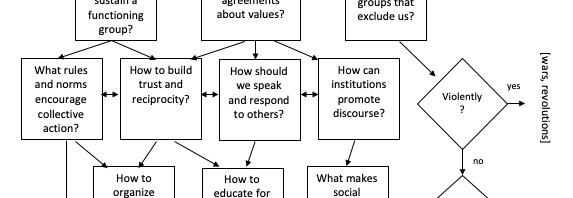
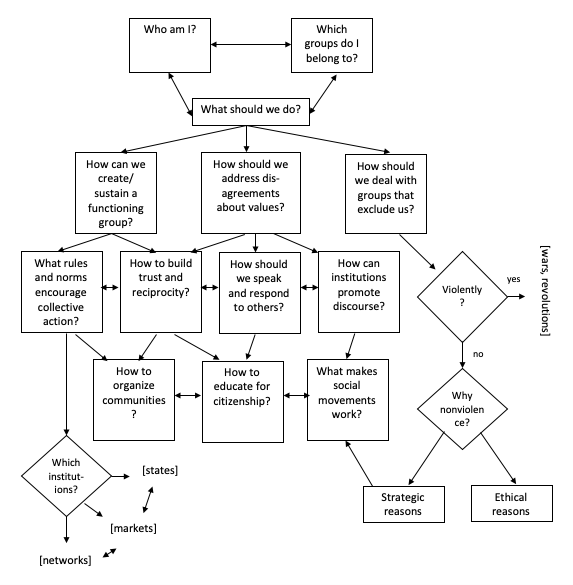
Conceptual Outline of the Course
(click for more information)

voter suppression shows we have a democracy

An interesting panel at the American Political Science Association conference explored whether the conceptual distinction between democracy and authoritarianism is (still) useful. In arguing against this distinction, some panelists cited ways that a particular democracy–the USA–fails to honor democratic norms. An example of our failure (which didn’t provoke any overt dissent on the panel) was voter suppression.

To be clear, I oppose the policies that are described as voter suppression. I was deposed and testified as an expert witness in the successful federal lawsuit against North Carolina, and I have done other work to promote access to voting and to attack restrictions.

However, I would make the conceptual distinction in a different way from several of the panelists. “Democracy” is not the name for a just or fair society. A democracy is a society in which majorities govern (for better or worse). Having a democracy opens vistas for developing human potential and for improving the world. But it also presents characteristic challenges.

Two endemic challenges of democracy are relevant to voter suppression. First, when the majority of people hold problematic views, we get problematic policies. For instance, requiring photo identification for voting is unnecessary and creates a barrier, but it is highly popular among a broad spectrum of Americans. Second, because majorities are powerful in a democracy, you can expect bare-knuckled struggles over who actually turns out. When such struggles go well, they become competitions to boost turnout. But you will predictably see efforts to keep the other side home.

Precisely because it matters who votes in the USA, political actors play rough here. Conceptually, that just reinforces the thesis that the US is a democracy. Nobody would bother to erect subtle impediments to turnout if the vote didn’t matter.

These examples raise the normative question of whether a democracy is the ideal system. Most people would say no, at least insofar as they would want to modify the core idea of democracy with one or more adjectives: liberal, classically republican, social, deliberative, or otherwise.

Given my way of thinking, was the US a democracy before the Civil War, before women’s suffrage, and under Jim Crow? Is it a democracy now, when more than two million people are incarcerated?

These are profound injustices, but democracies can be–and frequently are–unjust. To the degree that large numbers of people are officially excluded from the polity, the system is undemocratic. Therefore, the US was not a full democracy until the Voting Rights Act. Yet a diagnosis of these past and current injustices must put some of the blame on the democratic aspects of our system. A reason for racist policies has been the racist views of many in the white majority. A major reason for mass incarceration is popular support (across racial groups) for draconian punishments. A motive for disenfranchising women and African Americans is that voting matters.

In short, I am against saying, “We are not really a democracy and should stop congratulating ourselves on being different from authoritarian regimes.” Instead, I favor saying: “We are a democracy, and that is why we (the people) must fight–constantly, effectively, and hard–for fairness.”

See also: do we live in a republic or a democracy?; from modest civic reforms to a making a stand for democracy; what does it mean to say democracy is in retreat?; “Habermas with a Whiff of Tear Gas.”

civically engaged research in political science #APSA2019

(Washington, DC) Rogers Smith concluded his presidential address at the American Political Science Association’s annual meeting with a call for more engaged scholarship, which I would define as co-producing knowledge with people who belong to the communities being studied. Smith said that if political scientists had conducted more civically engaged research with such communities as African Americans after the Civil Rights era, gay Americans after Stonewall, industrial workers after deindustrialization, or rural whites since 2000, the discipline would have been better prepared to understand important political developments that have ensued–and those constituencies would trust political science more.*

Strengthening engaged scholarship in political science is a personal commitment of mine. Thanks to Smith’s leadership, colleagues and I offer the APSA Institute for Civically Engaged Research (ICER) through Tufts’ Tisch College. The first ICER was held last June, and the next one will be in 2020.

I believe that there are few fully documented, peer-reviewed examples of civically engaged projects in political science–especially compared to the large body of such studies in fields like public health. Many political scientists actually conduct civically engaged research, and they do it well. But peer-reviewed publications generally report only the findings of such studies, with hypotheses, data, and conclusions. It’s very rare to document the partnership that produced the research. The best examples that I have found are not peer-reviewed but are put online by institutes committed to the process of partnerships, such as MIT’s GovLab, or by the nonprofit organizations that collaborate with political scientists. There is also some important writing about collaboration, but without much detail about specific projects.

The shortage of fully-documented, peer-reviewed examples means that civically engaged research is not sufficiently valued in the discipline. The work involved in building and maintaining relationships only pays off to the extent that it results in generalizable findings that can be presented as if they came without a partnership.

Another result is that it’s hard to teach engaged scholarship. Appropriate reading assignments are scarce. Many of our readings for ICER did not come from political science. Relatedly, it is hard to discuss some of the serious issues that arise for engaged research in political science, because there is a scarcity of texts that explicitly address such issues.

A third consequence is that the partners who influence political science go unrepresented. One of my great heroes is Elinor Ostrom, whose work richly deserved the Nobel Prize that she won. She was an exemplary partner of many grassroots groups, from Indianapolis to Nepal, and learned a great deal from them. But they are not visible in her published work.

I suspect that one cause is the relatively strong grip of a certain form of positivism in political science, compared to fields like public health, education, and anthropology. The peer-review process focuses on findings and evidence, not process.

Another reason is that civically engaged research in political science presents special challenges. The discipline is not defined by a single methodological toolkit. Political scientists use methods that overlap with those employed in other fields, from the interpretation of classical texts to ethnography to econometrics. What defines the discipline is an explicit focus on power, authority, and governance.

When nonprofit organizations or social movements and networks focus explicitly on power, authority, and governance, we think of them as “political” entities. We readily assign partisan and ideological labels to them. For an academic, it can be tricky to work with groups that are political, let alone partisan. One solution is to downplay the partnership and simply report the findings. (Get-out-the-vote works, for example.)

The problem in a field like public health is that issues of power tend to be overlooked or concealed. But the problem for political science is that those issues are front-and-center.

Engaged research requires such values as loyalty, reciprocity, and trust. A scholar who forms a partnership with a non-academic group must commit (to some extent) to the needs and agendas of that group. If its agenda is political, such a commitment poses at least a potential challenge to the academic’s need to be nonpartisan, intellectually honest, and independent. We witnessed this tension during ICER when an excellent local elected official visited and basically told the political scientists that unless their work advances her agenda, it is part of the problem.

My conclusion is that Smith’s call for more engaged research in political science is an ambitious one. We do have the asset of plenty of political scientists who are quietly involved in exemplary partnerships. We do not–yet–have a sufficient body of explicit examples that help to build knowledge of how to do partnerships well.

*This is my paraphrase based on memory; some of the details may be wrong. See also: The American Political Science Association Institute for Civically Engaged Research (ICER) at Tisch College this summer; engaged political science; scholarship on engaged scholarship; Participatory Action Research as Civic Studies; and conservative engaged scholarship
courses that count for the Civic Studies major at Tufts, fall 2019

Required Introductory Course:

CVS 0020/PHIL 0020/PS 0020: Introduction to Civic Studies (Brian Schaffer, Peter Levine) (The syllabus from last semester is here, but it will change somewhat.)

Thinking about Justice:

ENG 176/CVS 0110/PJS 176/ENV 176: Earth Matters (Elizabeth Ammons)
CVS 0014/PHIL 24: Introduction to Ethics (Monica Link)
CVS 0018/PS 0041/PHIL 0041: Western Political Thought (Vickie Sullivan)
CVS 0015/REL 0001: Introduction to Religion (Owen Cornwall)
CVS 0210/UEP 0286: Environmental Ethics (Sheldon Krimsky)
PHIL 0092-03/Env 0095-01 Climate Change Ethics (George Smith)
PHIL 0191:03 Seminar: Race and Black Progress (Lionel McPherson)
SOC 188 Seminar: Du Bois’s Sociological Dream (Freeden Oeur)

Social Conflict, Inequality, and Violence:

CVS 0027/SOC 0011: Sociology of Race & Ethnicity (Staff) PS 121: Seminar: Political Culture in Comparative Perspective (Conuelo Cruz)
CVS 0121/SOC 113: Urban Sociology: Global Perspectives on Space, Inequality and Resistance (Anjuli Fahlberg)
CVS 0129/ECON 144: Income Inequality, Poverty, and Economic Justice (Elizabeth Setren)
HIST 109: Decolonization: Race, Empire, Archive (Kris Manjapra)
SOC 112: Criminology (Daanika Gordon)

Civic Action and Social Movements:

ANTH 144: Media of the Middle East (Amahl Bishara)
CVS 0033/REL 0042/HIST 125/AMER 15: Religion and Politics in American History (Heather Curtis)
CVS 0035/PSY 13: Social Psychology (Keith Maddox)
CVS 0131/SOC 106: Political Sociology (Anjuli Fahlberg)
CVS 0132/CSHD 165: Families, Schools, and Child Development (Christine McWayne)
CVS 0133/PS 0118-02: Organizing for Social Change (Daniel LeBlanc & Kenneth Gladston)
ENG 23/CVS 0031: Dissent & Democracy: American Literature to 1900 (Elizabeth Ammons or Nathan Wolff)

Civic Skills:

AMER 0145: Mass Incarceration and the Literature of Confinement (Hilary Binda)
CVS 0049/PHIL 92-02: Philosophy for Children (Susan Russinoff)
CVS 0145/ENV 120: Introduction to Environmental Fieldwork (Staff)
CVS 0147/CSHD 167: Children and Mass Media (Julie Dobrow)
CVS 150-04: Dialogue, Identity, and Civic Action (Jonathan Garlick)
CVS 0170/CSHD 143-02: Developing Leaders Who Make a Difference: Leadership in Civic Context (Diane Ryan)
CVS 0183/UEP 0130/PJS 0131: Negotiation, Mediation, and Conflict Resolution (Robert Burdick)
ED 164: Education for Peace and Justice (Deborah Donahue-Keegan)
ENV 170/CVS 0149: Environmental Data Analysis and Visualization (Kyle Monahan)
EXP 0079: EPIIC: Education for Public Inquiry and International Citizenship
PJS 50: Science and Civic Action (Jonathan Garlick)

Internship Seminar:

CVS 099: A required internship. This includes a weekly 2.5 hour class with graded assignments and a final project.