discrimination boosts civic engagement

My colleagues Debbie Schildkraut and Jayanthi Mistry have published a new research brief on the Tufts Equity Research page. They find that people who feel they have experienced discrimination are more likely to be involved in civic activities like canvassing and contributing money to causes. People who have been discriminated against are also more confident in their ability to address community problems.

For example,

As figure 4 shows, as the frequency of perceived discrimination in the past 12 months increases, the likelihood of having worked with others informally to solve a community problem increases substantially. While a white or Hispanic person who has never experienced discrimination the past 12 months has only a 25% chance of this type of collaboration, a white or Hispanic person who experienced all types of discrimination frequently has a 72% chance. Black respondents show an equally impressive increase in engagement (19% to 63%)

Viewing one’s own racial or ethnic identity as important does not boost civic engagement. Neither does thinking that being American is important. However, “When people are prompted to think specifically about their relationship to a larger group and its potential power, their racial identity and American identity matter more than perceptions of discrimination in promoting civic engagement.”

Read the rest here.

where have we already seen second waves of COVID-19?

I’m definitely not an epidemiologist, so take this post with thousands of grains of salt. But I am trying to think about whether we should expect a major second wave of COVID-19.

Andrew Atkeson, Karen Kopecky, Tao Zha look at the 23 countries and 25 states with the highest death tolls and find a consistent pattern for all of them. One clear peak has been followed by “relatively slow growth or even shrinkage of daily deaths from the disease.” These are illustrations of the classic pattern:

There is enormous variation in the death rate at the peak. For instance, at their respective peaks, 24 people per million died each day in Belgium, versus 0.27 per million in New Zealand. Yet most states and countries–and all the ones included by Atkeson, Kopecky, and Zha–look similar 20-30 days after the peak. Belgium, for example, has had less than one daily death per million since June 12.

However, some countries and states do not exhibit this pattern. I have found pretty clear evidence of second peaks in Croatia, Iran, Israel, Japan, and Turkey, plus Idaho, Louisiana, and Mississippi.

I included the USA in the graph because it also shows two humps (the second smaller than the first). However, disaggregating US data to the state level suggests that there were simply two batches of states that had one peak each. At the state level, the only true second peaks that I see are in Idaho, Louisiana, and Mississippi. There are also some cases, like Australia, in which you can see a second peak if you squint–but the death rate has never been high. And there are countries, like Ukraine, that seem to wobble upward slowly without peaking,

Reading Atkeson, Kopecky, and Zha, one might guess that most badly-afflicted countries have accomplished impressive declines by implementing interventions. That is not such good news, since these policies are costly and hard to sustain. But it would be surprising if all the jurisdictions in their sample accomplished the same outcome in 20-30 days despite applying divergent policies. There is some chatter that these places have reached herd immunity, but I am convinced by Howard Forman and others that’s not what’s happening. Still there could be a strong tendency for COVID-19 to taper off for other reasons, which might offer good news.

It could also be the case that we simply haven’t seen many second waves yet. When you play Russian Roulette, things often go fine for a while, but the game always ends the same. Possibly places like Turkey and Croatia and Idaho and Louisiana demonstrate that we’re all at risk of a resurgence at a random moment.

Some European countries have recently reported increases in cases, although not deaths. Perhaps this is only because of increased testing rates–but then again, why is testing becoming more common unless rising numbers of people are experiencing symptoms? Deaths may follow.

In any event, I am searching and waiting for more information about the actual second waves. Why have they happened and what can we learn from their experiences?

taxing and spending are more compatible with democratic values than regulation is

Democratic governments can choose what and how much to tax and how to spend the resulting revenue without undermining essential aspects of good governance: accountability, representativeness, rule of law, transparency, public deliberation, and the ability to learn from experience. In fact, better governance tends to accompany higher government spending.

Regulation is more difficult to square with democratic values and other aspects of good governance. Complex regulatory systems create tensions with democracy and other political values, which I briefly explore below.

This is why I am hopeful about proposals like the Green New Deal, which promise to address profound crises by taxing and spending. Insofar as we must also address the climate crisis by regulating (which may be necessary), we’ll face more difficult tradeoffs between ends and means–between essential environmental outcomes and improving our politics.

In any republic, whether a true democracy or not, we must know who the decision-makers are and what they do in order to hold them accountable. We must be able to predict the consequences of their actions to plan our own behavior, thus gaining a reasonable level of control and responsibility.

These two principles imply that state decisions should be made by finite groups of clearly identified actors, e.g., the 535 Members of Congress and the President, acting on the record. Their policies should be as clear, uncomplicated, and durable as possible. As Madison writes in Federalist 62:

The internal effects of a mutable policy are … calamitous. It poisons the blessings of liberty itself. It will be of little avail to the people, that the laws are made by men of their own choice, if the laws be so voluminous that they cannot be read, or so incoherent that they cannot be understood: if they be repealed or revised before they are promulg[at]ed, or undergo such incessant changes, that no man who knows what the law is to-day, can guess what it will be to-morrow.

Taxation is compatible with these principles. A tax usually requires a recorded vote in Congress and the president’s signature, so we know who enacted it. Although there can be some ambiguity and unpredictability about who ultimately pays–companies try to pass their taxes on to consumers–you often know if you are paying a tax. You can decide if you think it’s worth it.

Regulation can also be compatible with these principles. If Congress banned automatic weapons, that would be a clear regulation for which representatives could be held accountable. No one can be sure of its downstream consequences, such as its effects on the homicide rate. But the direct effect is very clear: companies must stop selling automatic weapons to consumers.

However, regulations often violate these principles. In a complex society, regulations that are designed to maximize outcomes (such as safety or efficiency) will be complicated, and they will have to change frequently to keep pace with changes in society. Congress cannot write such regulations. It is composed of too few people with too little time and expertise. Congress almost inevitably delegates its regulatory power to regulators. Those people are often dedicated, underpaid civil servants. Yet they are anonymous and numerous, and they have interests and biases that are hard to know, let alone control. They can write regulations to benefit incumbent companies and industries and to discourage competition. Special interests can capture the regulatory process. Meanwhile, Congress has every incentive to take credit for the declared intentions of a law while delegating the tough choices to regulators, thus dodging responsibility. A particularly common move is to pass a law that requires incompatible outcomes–like safety and economic efficiency–and then complain about the actual regulations.

To be sure, taxes can also be designed in ways that are complex, mutable, opaque, and biased in favor of incumbent interests. The federal tax code is 2,600 pages long, with too many exemptions and loopholes. However, the Code of Federal Regulations is 186,374 pages long, or 72 times as long. Several times as many pages are added to the CFR each year (including under Trump) than comprise the entire tax code.

Big differences in quantity (like a 72-to-one ratio in page numbers) can turn into qualitative differences. Taxing and spending are more transparent and predictable than regulation.

I vote for parties and candidates who are relatively favorable to both regulation and taxing-and-spending. Often those interventions promote equity and the public good. I understand them as components of a mixed or pluralist political economy, which is the kind I support.

Nevertheless, it is always important to consider the costs and risks of good things. For the drawbacks of taxation and regulation, it’s worth reading or rereading classical liberals/libertarians and public choice theorists. I believe they offer stronger arguments against regulation than against taxation. Their concerns are especially relevant when the regulatory state lacks both legitimacy and actual capacity. Then the odds are low that agencies will achieve clear victories as they address complex public problems. Their impact is likely to be ambiguous and contested, at best. Under these circumstances, it is much more promising to raise revenues and purchase solutions that all can see.

See also: on government versus governance, or the rule of law versus pragmatism; on the Deep State, the administrative state, and the civil service; The truth in Hayek; how a mixed economy shapes our mentalities; China teaches the value of political pluralism; better governments tend to be bigger; A Civic Green New Deal; and the Green New Deal and civic renewal.
police discrimination, race, and community poverty

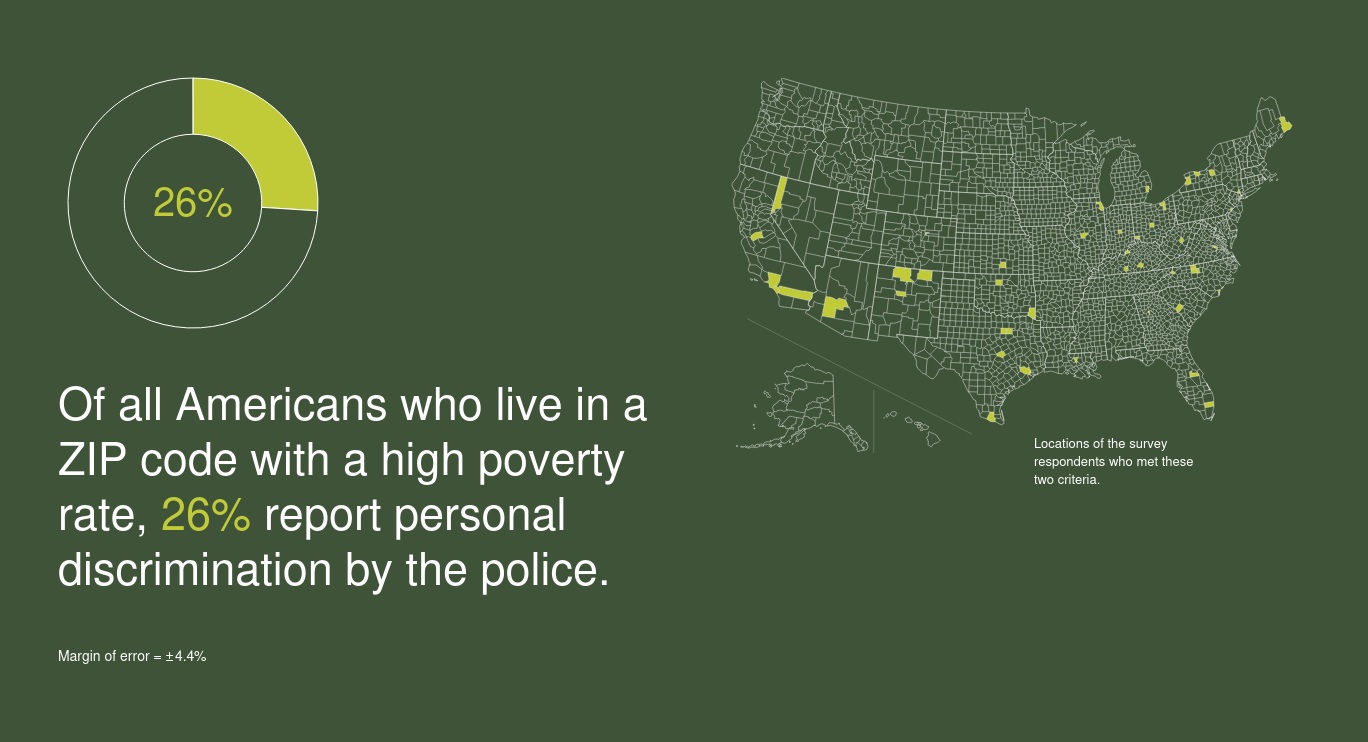
Our new Equity in America website shows that more than a quarter of Americans who live in high-poverty ZIP codes report having been personally mistreated by the police. That is 10 points higher than the rate in high-income communities.

Zooming in on the map shows that many of the people in our survey who live in high-poverty ZIP codes and who reported police discrimination reside in smaller cities or towns. Chicago, Miami, Queens (NY) and Los Angeles each supply one person in our survey who met these criteria, but so does my hometown of Syracuse, NY, Aurora, CO, and Spokane, WA, for example.

So I formed the hypothesis that living in a low-income, smaller community might be a risk factor for police discrimination. I tested that hypothesis with a binomial logistic regression, treating being discriminated against by the police as a yes-or-no matter. This is a similar method that might be used to predict being hired for a job or getting a disease. These issues are very different morally, but we can use the same math.

For possible predictors, I considered race, gender, education, age, English-language proficiency, household income, housing type, county-level income (not self-reported, but from Census data), and any mental health diagnosis.

It should not surprise anyone that being African American is the major risk factor. If we include any police discrimination, being Black raises the odds of being mistreated by the police almost five-fold (4.6 times), and that result is statistically significant at any level. If you exclude discrimination that happened far in the past, being Black still raises the odds threefold (2.955 times).

Identifying as female cuts your odds in half or better. More education helps, to a statistically significant yet modest degree. (This implies that highly educated African Americans have almost the same risk as those with little schooling.) The risk declines with age, but that pattern just misses being statistically significant, as does the risk from being Latino. Having a low family income, not speaking English well, reporting mental health issues, and living in an apartment rather than a house are not significant predictors. Neither is living in a poor ZIP code or a town or rural area as opposed to a city.

In short, my hypothesis about community factors was not correct–the race and gender of the individual is what matters. However, it remains true that a lot of police discrimination occurs in smaller, low-income communities, and that has implications for how we should address this grievous problem.

See also: Two-thirds of African Americans know someone mistreated by police, and 22% report mistreatment in past year; more data on police interactions by race; insights on police reform from Elinor Ostrom and social choice theory; and explore the dimensions of equity and inequity in the USA.

explore the dimensions of equity and inequity in the USA

How did I spend my summer vacation? Mainly, working with colleagues to build this new website.

You can use it to explore how various categories of Americans–racial groups and genders, people from different walks of life, voters supporting Trump or Biden, and more–fare on a whole range of social outcomes, from having diabetes, to being confused for someone of the same race, to being laid off because of COVID. A very simple interface yields results like this:

The site also presents “research briefs” based on the underlying survey data that go well beyond the queries that you can run yourself using on the homepage. So far, they are about COVID and policing; more are coming.

This is an effort to inject some additional facts into the public debate, to experiment with data-visualization, and to bring faculty together from across a research university to combine their disciplinary perspectives on one multifaceted issue.

See also: debating equity; defining equity and equality; sorting out human welfare, equity and mobility; college and mobility; and 14 kinds of research we need for #reducinginequality.