Please check out CivicGreen, a project (and website) hosted at the Tisch College of Civic Life. Carmen Sirianni is the editor-in-chief; I’m the executive editor; and Ann Ward is the managing editor. The 15 or so other key people are listed here.
Per the website:
CivicGreen is a collaborative project among scholars and practitioners to enrich our democratic imagination and to expand our policy options for sustainable, resilient, and just responses to climate crisis in the United States in the coming decades. Our perspective is to locate civic engagement at the heart of work that needs to occur in communities of all kinds, across cities and regions, and among professional and other institutional partners that are key to solving problems for the long run.
CivicGreen is fundamentally about civic democracy at the intersection of green strategies to address our ecological and climate crises and to build healthy and sustainable communities for all.
I would add that the project is all about practical environmental solutions that engage the public. It’s less about public pressure to accomplish environmental policies (although pressure is essential) than about public engagement in the work of saving the climate.
This is the video-recording of last Friday’s SNF Agora Conversation on Four Threats: The Recurring Crises of American Democracy. Suzanne Mettler and Robert C. Lieberman discussed their new book–with me as the moderator–and we got great questions from the audience.
I’m helping with the evaluation of a civic education curriculum. I don’t want to go into details because this is an unpublished evaluation for a specific organization in a particular context. However, I have observed an interesting pattern and wonder what explains it and whether it generalizes.
We asked both the students and the teachers about various pedagogies. For instance, the students were asked to evaluate statements like these (among others):
Memorizing facts was the best way to get a good grade from teachers my classes.
Teachers lectured, and the students took notes.
Students were encouraged to make up their own minds about issues.
Teachers encouraged students to express their opinions during class.
Their teachers were asked about the same list of pedagogies, but the questions for them were phrased in terms of how much they used each approach.
The goal was to distinguish various approaches and then correlate them with things like the number of correct answers to factual questions, students’ skills, and their beliefs about democracy. Then we could see whether, for example, students who discussed issues more in class were more confident about their skills for discussion. The findings wouldn’t be causal, but they would be suggestive.
In the actual data, the most teacher-centric and the most student-centric approaches (if you can accept those descriptions) correlated. For instance, there was a positive correlation (0.29) between “Teachers encouraged students to discuss political or social issues about which people have different opinions” and “Memorizing facts was the best way to get a good grade from teachers in my classes.” Likewise, there was positive correlation (0.28) between “Most students felt free to express opinions in class even when their opinions were different from most of the other students” and “Teachers required students to memorize facts or definitions.” The correlations were even larger in the teacher data.
Most of the student outcomes–especially their ability to answer factual questions–correlated positively with all of the pedagogies. Students were more likely to know the facts if their teachers lectured and if they discussed issues–not surprisingly, since these two pedagogies correlated with each other.
One interpretation is that some students just got more of everything than the others–their “dosage” was higher. But I don’t think so, based on what I know about the intervention. Besides, the questions weren’t phrased in a way that should measure dosage.
Another interpretation is that these approaches should and do complement each other. I can certainly see why good teachers might say both “I encouraged students to express their opinions during class” and “I placed great importance on students learning facts.” (These responses were correlated at 0.8).
A third interpretation is that these questions don’t yield valid data, because teachers and students are not very aware of the pedagogies they experience, and are especially unaware of how their experiences compare to others’.
I’m wondering whether the positive correlation between apparently contrasting teaching styles is commonly observed.
On Friday, September 25, from 12–12:45 p.m., I’ll be moderating a Zoom conversation with Suzanne Mettler and Robert C. Lieberman about their new book, Four Threats: The Recurring Crises of American Democracy. You can join us online.
The four threats are: partisan polarization, efforts to exclude some people from the polity, economic inequality, and executive aggrandizement. Mettler and Lieberman provide vivid historical narratives of five previous moments in US history when one or more of these threats almost brought us down. These narratives are compelling: well-told, full of overlooked but relevant characters and details, and suspenseful. They show that our republic has often hung by a thread. Worse, the solution to the threat of polarization has often been to forge an elite bipartisan consensus at the expense of society’s least advantaged, who have always included people of African descent. For instance, the truly dangerous partisan conflict of 1800 yielded to the “Era of Good Feelings” because of a bipartisan consensus to uphold slavery.
Mettler and Lieberman argue that although we have faced one or more of these threats before, now is the first time all four have come together.
We’ll discuss their argument, consider some of the historical cases, and focus especially on what we should do now.
The Supreme Court of Spain has 79 judges. The Federal Constitutional Court of Germany has 16 members. The Constitutional Court of Italy has 15, but Italy is like many countries that also has a final appeals court for regular cases, and that tribunal is staffed by 350 judges.
I mention these examples in the context of arguments for “packing” our Supreme Court. Franklin Roosevelt’s effort to expand the court is usually presented as an example of executive overreach and a partisan ploy that backfired. But the problem with the current court is now critical.
Who would imagine that the following system could work? 1) One court has final jurisdiction over many fundamental issues that confront the society. 2) The public is divided over those issues. 3) There are two political parties, which hold incompatible views on those issues. 4) Justices appointed by each party regularly and predictably vote to decide cases in line with their respective party’s position. 5) Justices serve for life terms. 6) The president can nominate anyone he wants to be a justice. 7) A majority of the Senate must confirm. 8) The president and the Senate may be controlled by the same or by different parties.
Once those eight conditions are in place, it’s more or less inevitable that presidents will be unable to replace Supreme Court vacancies unless their party controls the Senate, but when it does, they will be able to confirm virtually anyone they like to a life term. The defeats of Bork and Garland simply reflected opposition parties making rational decisions in the system they were given, and we should expect tit-for-tat from now on.
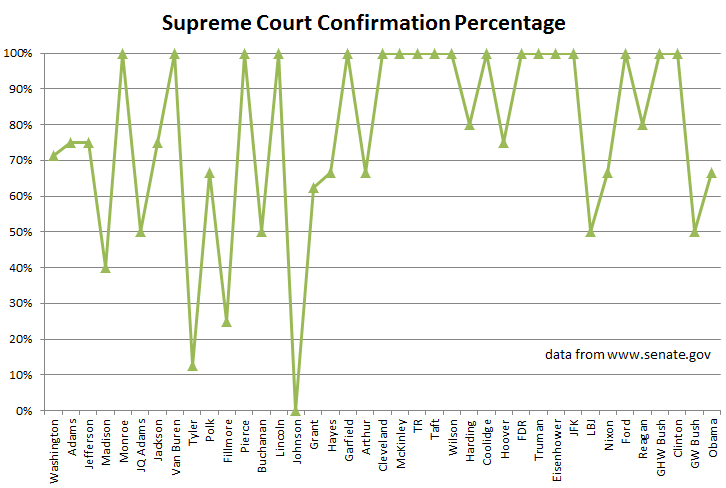
As I showed in a previous post, there have been periods when Supreme Court nominations have been uncontroversial. Those have been times of bipartisan elite consensus about constitutional questions. When that consensus has broken down, confirmations have been deeply contentious and the outcomes have been determined, to a large extent, by the luck of who controls which branch at which time.
If I could wave a magic wand, I would establish staggered terms for Supreme Court justices so that replacements become frequent. The stakes of each nomination would fall, and every president would be expected to have a strong but temporary impact on the court–as presidents influence the FCC. But this reform would require a constitutional amendment, since Article III, Sec. 1 decrees life terms.
An alternative is to change the number of justices. That is constitutional, since the number is set by a statute. But I’d change it a lot–to something like 25. Then turnover would be frequent, and the stakes of each appointment would be fairly low. I’d complement that change with a Senate rule that allows nominations to go through unless blocked by a super-majority.
In a large court, most cases are assigned to smaller panels–sometimes by lottery. There are reasonable processes for doing that. A larger court also has a much better chance of representing the diversity of the American people.
Letting the next president name 16 new justices seems a bit much (even if that president’s name turns out to be Joe), so I’d increase the size of the court by one seat every year for the next 16 years.