time again for civic courage

The day after the 2016 election, I posted a blog entitled “Time for Civic Courage” that seemed to strike a chord; it was shared much more than I’m used to. I mainly wrote it for people like myself– those who would not face much personal risk under Trump but who needed to step up. Compared to our fellow human beings, Americans have more leverage over the US government, and we had to protect them by resisting here. I wrote: “no jokes about moving to Canada. No thoughts about giving up on the nation you belong to, even if its majority and its institutions anger you. No opting out.”

On Election Day 2020, I am cautiously optimistic about the outcome, sharing the conventional view that Biden has roughly a 90% chance of winning, and even a 30% chance of a landslide. But there is certainly a risk of another Trump win. And it is now–not after a loss–when we should pledge Civic Courage. Regardless of what happens, we Americans must keep working and struggling for justice and peace. We’ll need plenty of courage and perseverance even if the election turns out well; and if not–that’s the time to show civic character.

youth voting 2020: Tisch College analysis so far

This is your regular reminder to follow Tisch College’s CIRCLE (@civicyouth) for the best data and analysis on youth voting. A list of their recent releases follows. They will have lots of timely data as the actual election unfolds.

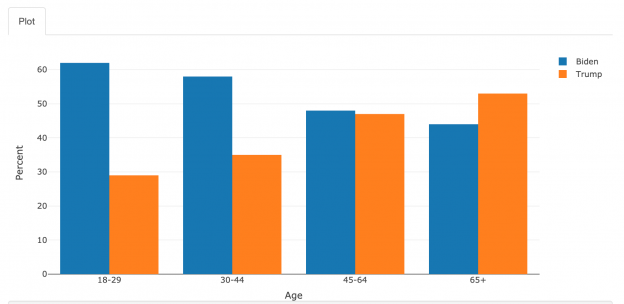
Brian Schaffner is also part of Tisch College. He co-leads the Cooperative Election Study (previously the CCES), which surveyed 71,789 people between Sept. 29th and Oct. 27th. (That is an enormous sample). His analysis of the likely voters in the CES shows why the youth vote is pivotal.

2020 CES Presidential vote preferences (likely voters)

Meanwhile, follow Tisch’s Institute for Democracy and Higher Education for detailed information on college students, our Metric Geometry and Gerrymandering Group for research on districting, and our Center for State Policy and Analysis for Massachusetts-related information, including work on the ranked-choice voting ballot initiative here.

What kind of a claim is “Biden has an 87% chance of winning”? (on the metaphysics of probability)

If you’re spending all your time nervously checking the election forecast on FiveThirtyEight.com, your mental health may suffer. You can stop checking and do something productive to improve the world. Or you can become intrigued about what a forecast means, read Alan Hájek’s “Interpretations of Probability” in The Stanford Encyclopedia of Philosophy (Fall 2019 Edition), and write some rambling reflections. That is the Path I have chosen.

Four years ago, Nate Silver’s FiveThirtyEight gave Hilary Clinton about a 75% chance of winning the 2016 election. The fact that she lost did not invalidate this prediction–outcomes with probabilities of 25% happen often. Looking retrospectively, it seems right that Trump’s chances were small. He had to win narrowly in just the right combination of states.

Of course, we now know that he did win. In October 2016, an omniscient deity would have known that already. The deity could have known it in either of two ways: by looking into the future, or by understanding the complete present situation with one week still left to go in the election. Presumably, if you could know exactly what every American was thinking about politics, the precise distance to their nearest polling place, whose contact lists everyone was on, what Putin was up to, how heat and humidity were distributed on the face of the globe, and everything else about the situation with one week to go in the election, you would know what would happen with the vote. (I leave aside the possibility that that the universe incorporates physical randomness at the quantum level that affects things like the outcome of an election a week away.)

Applying that theory to our present circumstances, we would say that either Biden has a 100% chance of winning the 2020 election or Trump has a 100% chance. These are falsifiable claims, and a maximum of one of them will turn out to be true. Every other probability estimate will turn out to be false, because either Biden or Trump will actually win.

Yet is seems rational to say that Biden has almost a 90% chance of winning right now, and wrong to say that he has a 100% chance–and even more wrong to say that Trump has a 90% chance. A lot of data and experience go into a plausible prediction. Even if Trump will win in 2020, he doesn’t have a 90% chance right now. Another Trump victory would be a second improbable event. But again, the actual vote won’t invalidate either a 10% or a 90% estimate of Trump’s chances, because either one is compatible with him winning or losing.

A different way to make sense of this is to say: If the election were held 100 times, Biden would win almost 90% of them. But that is weird in several ways. The election cannot be held 100 times in a row, and if we repeated it at all, the repetition would affect the outcomes. If we imagine 100 identical universes that all unfold separately from now until next week, perhaps Biden would win in 90 of them. Or perhaps the future is determined by the current situation, which must the same in all of the 100 identical universes. Then they must all turn out the same way. We just don’t know which way.

Forecasters like Nate Silver use simulations with random (or pseudo-random) numbers built in. Those are meant to model the actual world. But they are not replicas of the real world, which–leaving aside quantum physics–seems to have just one future that is determined by the state of things now.

Another interpretation is that giving Biden a 90% chance today is simply an assessment of our knowledge level. It’s as much about us as it’s about the world. Biden actually has a 100% or a 0% chance, but we (unlike an omniscient deity) don’t know which of those is right. However, the tools of forecasting allow us to estimate how much knowledge we have–with precision. In fact, Nate Silver’s estimate rises and falls by the hour.

According to this subjective interpretation of probability, when Silver’s estimate moves from 85%-86%, he has not invalidated his previous prediction but has updated his assessment of the best possible level of knowledge at the present time. Once the election is over, our knowledge will become complete, and we will rightly say that the odds are 100% in favor of what actually happened.

Two problems occur to me about this interpretation. First, a prediction is not falsifiable in the usual way (and falsifiability is a hallmark of science).

Second, how much knowledge is “possible” is relative to circumstances. Anyone who could see all the current, private, survey data at the congressional-district level would have more knowledge than Nate Silver has. But he knows a whole lot more than I do. His estimates seem to be measures of how much certainty he is entitled to, based on the work he has done and money he has spent. If I say that Biden has an 87% chance because that’s what I read on FiveThirtyEight, I am really saying that I believe Nate Silver’s claim that he has an 87% level of confidence. But how could I test whether that estimate is correct? How can we know that he is right to raise or lower the estimate by a point? Certainly not by waiting to find out what happens next week.
affective polarization is symmetrical

Shanto Iyengar and colleagues write, “Democrats and Republicans both say that the other party’s members are hypocritical, selfish, and closed-minded, and they are unwilling to socialize across party lines, or even to partner with opponents in a variety of other activities. This phenomenon of animosity between the parties is known as affective polarization.”*

Although affective polarization is far from our only problem, it does make public deliberation more difficult and hence undermines democracy. It is a particular problem for people who would like to build up public institutions: progressives. A minimal state doesn’t require much public comity, but an ambitious one does.

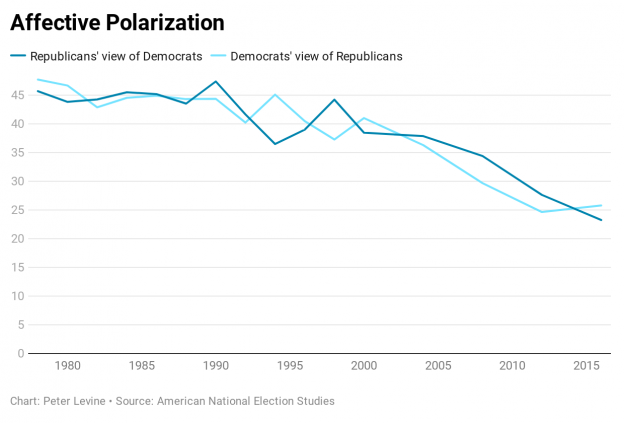
Iyengar and colleagues treat affective polarization as symmetrical, depicting both parties as equally affected. Based on the graphs below (which I contribute), I think that is fair.

The first one shows that in the late 1970s, Democrats and Republicans both rated the other party at almost 50 on a 1-100 scale (the ANES’ “feeling thermometer”). You could describe their feelings about the other side as neutral. Now both sides’ ratings are down to the mid-twenties on the same scale. You could call that hostility. The downward trend is pretty consistent from 1990-2016, across Clinton, Bush, and Obama.

This second graph is more dramatic still. It shows the percentage of Democrats and Republicans who chose to rate the opposite party at zero on the 0-100 scale. For both sides, that proportion has risen from very low in the late 1970s to about one in four people today. Again, the trend is linear all the way through the Bush and Obama years. More Democrats have rated Republicans at zero than vice-versa.

These graphs show ratings of the parties, not of party members. Ratings of people are better for this purpose, but ANES stopped asking that in the 1980s and now asks only about the parties. However, during the period when they asked the same respondents about both parties and party members, the correlations were high (>.75). Therefore, I think these lines are good proxy measures for how people feel about other people across party lines.

Independents–including leaners–began this period rating both parties above 50 on a 0-100 scale. Their ratings have fallen in parallel, although not as steeply as the partisans’ ratings of each other; and they have viewed Democrats more favorably than Republicans.

*Iyengar, S., Lelkes, Y., Levendusky, M., Malhotra, N. and Westwood, S.J., 2019. The origins and consequences of affective polarization in the United States. Annual Review of Political Science, 22, pp.129-146. See also: promoting democracy and reducing polarization; marginalizing views in a time of polarization; empathy boosts polarization; what is polarization and when is it bad?; civic education in a time of inequality and polarization, etc.

citizens against domination

This review-essay was recently published and is available for free: Peter Levine, “Citizens against Domination: A Critical Reading of Ian Shapiro,The Good Society, vol. 28, No. 1-2 (2019), pp. 1-8.

I admire and recommend Shapiro’s book, Politics against Domination, but I use the review as an opportunity to push two positions that I frequently advocate:

  1. The state should not be sharply distinguished from other institutions; it is not uniquely capable of dominating people [or preventing domination]; and
  2. The salient question is not how to design a state to prevent domination–because none of us are really state-designers–but how we should prevent domination by working through the state and the other institutions that we can influence.

The rest of the special issue is valuable. I have been particularly eager to see Brooke Ackerly’s essay, “Rage, Resistance, and Politics against Oppression,” in print. She explores the overlap and the differences between domination–the keyword in modern republican political theory–and oppression, a fundamental term for much of the left, especially for intersectional social movements. That contrast is valuable for anyone to consider.

See also: from classical liberalism to a civic perspective;  do we live in a republic or a democracy?; against state-centric political theory; avoiding arbitrary command; authoritarianism and deliberative democracy.