what secular people can get out of theology

I’m teaching a course on the thought of Martin Luther King, who obtained two graduate degrees in theology and contributed substantially to that discipline. I happen not to be a Christian, and I am teaching in a predominantly secular context with students who have diverse faith commitments that they rarely bring explicitly into the conversation.

It’s easy to say why we should read theology if we want to understand the thought of MLK, which is a historian’s task. But why should we want to understand the theological aspects of his thought if we are in a secular context and our interests are politics and justice?

Of course, I welcome all responses to these questions from my students, including opposition to religion (although I have not actually heard that lately). These are my own, personal thoughts.

First, it is not self-evident how to distinguish religious beliefs from other beliefs. MLK believed that all human beings are created by God in God’s image. I believe that all human beings have infinite intrinsic moral worth. What is the basis for saying that he is religious and I am not?

Second, we all think with the materials we find at hand. We cannot view the world completely anew. But we can make better or worse selections and enhance (or spoil) the things we select. Christian thinkers will start with Christian materials. We can learn from how they use those ideas and add to them. It’s as if you don’t want to be a biologist but you can improve your thinking by learning some biology. (Or change the analogy to ceramics if a craft seems more apt than a science.)

Third, it is illuminating to think in a hypothetical vein. Two Christian thinkers are on my mind this week. One is Howard Washington Thurman (1899 – 1981), whom I assigned. The other is Fox News pundit Laura Ingraham, who shows up in my social media feed denouncing homosexuality on biblical grounds.

Thurman notes that God could have expressed the divine in any form–for instance, as a Roman. “But the fact is he did not.” God chose instead that the only-begotten Son would be a poor Jew “in a sad and desolate time for the people”; “a member of a minority group in the midst of a larger dominant and controlling group”; and a non-citizen, someone lacking “that quiet sense of security which comes from knowing you belong and the general climate of confidence which it inspires. If a Roman soldier pushed Jesus into the ditch, he could not appeal to Caesar; he would be just another Jew in the ditch.” The Son of God was then tortured to death for nonviolently resisting the state.

I happen not to be able to think, “So it was,” but I can think: “If there is/were a God, this is how that God would act and feel.” And I can gain ethical insight–as well as inspiration–from this reasoning. At the same time, I am sure that if there is/were a God, God would not command and act the way that Laura Ingraham assumes.

I happen not to agree with the whole story that either Thurman or Ingraham believes. However, when I move into a hypothetical mode, I am confident that Thurman is right and that Ingraham is badly wrong. And making this distinction feels like a valid way to explore ethical and political issues.

Moving further away from specific authors, I can find specific value (and pitfalls) in each of the great world religions without happening to agree with some of the core metaphysics of any of them. For instance, I can compare Christianity to Judaism or Islam, or to Buddhism and Hinduism, without ever leaving the hypothetical level.

Source: Howard Thurman, Jesus and the Disinherited (1949), pp. 17, 18, 33. See also: Martin Luther King’s philosophy of time; Martin Luther King as a philosopher; Martin Luther and Martin Luther King; notes on the metaphysics of Gandhi and King; and Jesus was a person of color.

Apply for the 2021 Summer Virtual Institute for Civically Engaged Research (Deadline April 1s

Scholars in many disciplines are grappling with how to produce rigorous scholarship that addresses significant social challenges in collaboration with communities, organizations, and agencies. They strive to learn from those working outside of academia, to benefit from the insights of all kinds of groups and institutions, and to give back to communities rather than extract value from them. Although political scientists offer models of excellence in civically engaged research, relevant methods and strategies are not yet widely taught in the discipline’s graduate programs or sufficiently valued in the profession as a whole.

In an effort to address this need, the APSA Presidential Task Force on New Partnerships launched the now-annual APSA Institute for Civically Engaged Research (ICER) in 2019. 

The Institute is directed by Amy Cabrera Rasmussen (California State University Long Beach) Peter Levine (Tufts University’s Tisch College of Civic Life), and Valeria Sinclair Chapman (Purdue University).

About the Institute

WHERE: Typically, ICER is an in-person Institute held at Tufts University’s Tisch College. For 2021, the Directors have planned an engaging, supportive, and robust virtual institute using innovative best practices.  

WHO: ICER is intended for advanced graduate students in political science and political scientists at any stage of their careers who wish to shift to using civically engaged research. (It is not meant for scholars who are already experienced in the approach.)

FORMAT:  Approximately twenty ICER participants will meet and collaborate through virtual discussions, shared readings, breakout sessions, groupwork, writing exercises, and conversations with leaders in engaged research. The Institute will combine synchronous and asynchronous work, and generous breaks throughout the day over an extended sequence of days (see schedule below). Our aim is to ensure that all time spent online is participatory, engaging, and productive, and supplemented with innovative collaboration tools while also providing asynchronous options for engagement with one another, the Institute team, and special guests. 

We will explore a variety of issues around engaged research including models and methods, case studies, ethics, IRB, professional considerations, and provide focused feedback on participant projects. 

AGENDA: The full schedule will be announced in May and will include substantial time “offline” each day. However, participants should hold 7:30 am-3 pm PST (10:30 am-6 pm ET) for each of the days of the Institute. 

Tuesday, June 15th: Kickoff and full day of virtual activities

Wednesday, June 16th: Full day of virtual activities 

Thursday, June 17th: Break for rest and rejuvenation! Participants may be asked to commit a modest amount of time to reflection and preparation for the rest of the Institute. 

Friday, June 18th: Full day of virtual activities 

Saturday and Sunday, June 19th-20th: Break for rest and rejuvenation!  Participants may be asked to commit a modest amount of time to reflection and preparation for the rest of the Institute. 

Monday, June 21st: Full day of virtual activities 

Tuesday, June 22nd: Closeout and  full day of virtual activities 

Topics covered in the Institute will include: 

  • Expertise: what do political scientists uniquely contribute to collaborative, engaged research with scholars within and beyond our discipline, and outside of academia? What are the limitations of scholarly expertise? What types of expertise do those outside of academia bring to collaborations?
  • Models and best practices: what are the different approaches to engaged research? What methods exist for this work, and how do you determine which are the best fit for your work? How to navigate common social science values and norms while doing civically engaged work.
  • What are the priorities for engaged research at the present moment?
  • The ethics of collaboration: sharing of credit, funds, and overhead, navigating IRB, dealing with disagreements, ethical considerations beyond IRB.
  • Communicating results: how to talk to partners, relevant communities, the press, the broader public. 
  • Career considerations: publication and credit, tenure and promotion, funding your research.

To apply, please complete this form.

Application deadline: April 1, 2021. 

Wallace Stevens’ idea of order

Ramon Fernandez, tell me, if you know,   
Why, when the singing ended and we turned   
Toward the town, tell why the glassy lights,   
The lights in the fishing boats at anchor there,   
As the night descended, tilting in the air,   
Mastered the night and portioned out the sea,   
Fixing emblazoned zones and fiery poles,   
Arranging, deepening, enchanting night.
     from Wallace Stevens, "The Idea of Order at Key West." 

Anchored fishing boats at night will send luminous streaks across the water to point directly at you, the viewer. They seem to partition the sea in an ordered way that gives you the central place. By doing so, they make the dark sea more attractive: organized, deepened, enchanted. Although you are not hallucinating or succumbing to egoism, your impression is misleading, for anyone else will see the streaks pointing at them. From the sky, the sea would not appear partitioned at all, although it must seem that way to you.

George Eliot uses a comparable metaphor:

Your pier-glass or extensive surface of polished steel made to be rubbed by a housemaid, will be minutely and multitudinously scratched in all directions; but place now against it a lighted candle as a centre of illumination, and lo! the scratches will seem to arrange themselves in a fine series of concentric circles round that little sun. It is demonstrable that the scratches are going everywhere impartially and it is only your candle which produces the flattering illusion of a concentric arrangement, its light falling with an exclusive optical selection. These things are a parable. The scratches are events, and the candle is the egoism of any person now absent …

Eliot, Middlemarch, part 3, chap. 27

Eliot is concerned about moral egoism. I think Stevens’ main interest is the subjectivity of any order that we impose on nature. If we push such skepticism far, nature vanishes entirely and all we have is our description. But the boats really are at anchor off Key West.

This image from the end of the poem might offer some hints about how to read the earlier portions. It seems that the narrator is by the sea with his friend, Ramon Fernandez, and they have heard a “she” singing. Stevens said he invented the name of his friend, but he later acknowledged that he might have suppressed the memory of the real literary critic, who was not actually his friend, and who might have been too keen to impose order. (The real Fernandez was a communist at the time Stevens wrote this poem, on his way to becoming a fascist collaborator.)

As for the “she,” this is a pronoun without any concrete noun. She has no name and is not called a woman or anything else specific. She has a complex relationship with the sea: she may be describing it, or communicating the sound it makes, or creating it with her song; or she may have been invented by the narrator as a metaphor for the experience.

The narrator explores each of those hypotheses:

  • [the ocean’s] mimic motion /  Made constant cry … [The sea is singing.]
  • Even if what she sang was what she heard … / it was she and not the sea we heard. / For she was the maker of the song she sang. [She is singing.]
  • If it was only the dark voice of the sea / That rose … / But it was more than that, /
    More even than her voice, and ours …
    [It is more than she who is singing.]

Perhaps this section–about the moment of a subtropical sunset–offers a synthesis to follow the various theses and antitheses:

        It was her voice that made   
The sky acutest at its vanishing.   
She measured to the hour its solitude.   
She was the single artificer of the world
In which she sang. And when she sang, the sea,   
Whatever self it had, became the self
That was her song, for she was the maker. Then we,   
As we beheld her striding there alone,
Knew that there never was a world for her   
Except the one she sang and, singing, made.

One can read the poem very literally and imagine that Wallace Stevens, a man from the mainland, and his friend, a man with a Spanish surname, have seen a woman striding along the beach and singing about the sea. But her song has the very special power of making the whole world. Even though the narrator insists that “she was the maker of the song she sang,” her song is coterminous with the object of her singing–the sea–which suggests that she is not different from it but another way of naming it.

At this point, the literal reading collapses–much as a naive interpretation of the streaks of light collapses when you realize that they are not really pointing at you. The poem does not give us direct access to a real moment in the past when a woman, two men, and some boats were visible at Key West. The poem is the object that we see, and it has a writer and some readers.

Under the title of the poem is the name “Wallace Stevens,” which stands for an actual man, married to a woman, who became famous for writing words. It’s reasonable to begin with the assumption that the narrator who tells us, “She sang …” is this man, and that he either really heard her singing or made her up from scratch, thus functioning as her artistic creator.

It’s then reasonable to place the poem in a very long tradition of men writing about women who are their muses, objects of love, creatures of their art, and/or metaphors for abstractions, such as nature. The politics of this tradition is problematic, since the poet with the he-pronouns typically controls the “she” of his verse.* He certainly gets credit for the words that attach to his name. Stevens either maintains this tradition or possibly subverts it, depending on what you think of the phrases “mastered” and “maker’s rage for order” near the end.

I don’t disagree with using gender to analyze the poem, but I think it also asks us to question our metaphysics. Why are we so sure that the narrator is Wallace Stevens, the poet with the he-pronouns? Couldn’t she be speaking, or the ocean, or the reader?

In one recorded dialogue with a student, Basho instructed, “The problem with most poems is that they are either subjective or objective.” “Don’t you mean too subjective or too objective?” his student asked. Basho answered, simply, “No.” 

Jane Hirshfeld, The Heart of Haiku

The moment of sunset is neither day nor night. Stevens’ poem is neither objective nor subjective but right on that edge. Basho avoids tipping either way by means of imagism. His poems do not mean; they are. Stevens attempts it in a very different way–by arguing explicitly about the nature of his own verse in ways that skillfully undermine any fixed conclusion about who is saying what about what.

*For a good reading along these lines, see Brooke Baeten, “Whose Spirit Is This?”: Musings on the Woman Singer in ‘The Idea of Order at Key West.’ The Wallace Stevens Journal 24.1 (2000): 24-36. See also: nostalgia for now; homage to Basho; a poem should; and the tree and the rock.

two good books on Black Lives Matter

  • Lebron, Christopher J., The Making of Black Lives Matter: A Brief History of an Idea (Oxford University Press, 2017)
  • Ransby, Barbara. Making All Black Lives Matter: Reimagining Freedom in the Twenty-First century (Univ. of California Press, 2018).

These are two very different but complementary books.

Lebron offers a history of the idea that Black lives matter, describing thinkers who lived well before the current movement and developed its core principles. His book is an extended definition of the movement, a justification of it, and a contribution to it.

Lebron pairs Frederick Douglass and Ida B. Wells as pioneers of the idea that whites can be compelled to reckon with racial injustice through “shameful publicity.” He pairs Langston Hughes and Zora Neale Hurston as influential proponents of the idea that actual Black lives are rich and variegated and diverse, not defined entirely by oppression. Both authors “counter-colonize[d] the white imagination” by portraying this richness. He pairs Anna Julia Cooper and Audre Lorde, who demonstrated that you can’t value Black lives unless you value all Black lives, which requires appreciation for gender, sexuality, and other forms of diversity. These writers “teach us the lesson of unconditional self-possession.” And he pairs James Baldwin and Martin Luther King, Jr. as proponents of forms of love which–while significantly different–both imply “unfragmented compassion.”

Lebron is a great source of relatively overlooked quotations as well as an original interpreter of texts as familiar as Douglass’ “What to the Slave is the Fourth of July?” His overall framework is illuminating.

Ransby is an historian and a participant/observer in the current movement. She offers a wealth of detail about who did what, when, where, and why (up to her publication date in 2018). Like Lebron’s, her book is sprinkled with quotations that amount to arguments for Black Lives Matter, but her timeframe is narrower. She mainly traces the intellectual history of the movement from the 1977 Combahee River Collective’s statement (which, of course, had its own influences).

Ransby is attentive to organized structures. Many Black Lives Matter activists are concerned about concentrated power and prefer flat hierarchies. One source of these ideas is Ella Baker: see Ransby’s own book, Ella Baker and the Black Freedom Movement: A Radical Democratic Vision (2003).

However, it would not be accurate to describe Black Lives Matter as unorganized or as resistant to formal structures of any kind. Ransby describes “an assemblage of dozens of organizations and individuals that are actively in one another’s orbit, having collectively employed an array of tactics together.” Many of these organizations are autonomous nonprofits; some are companies or programs within organizations that also have other purposes. Ransby emphasizes the importance of local chapters, of organizations whose main purpose is to “weave together” these local groups, and of significant conferences, such as a gathering of more than two thousand organizers in Cleveland in July 2015. Most dedicated activists in the movement have long resumes of roles in formal organizations.

My impression is that resistance to hierarchy is real and valid. It goes back to the New Left and has drawn additional impetus from feminism. However, the major change from the classic era of the Civil Rights Movement is not that leaders then believed in top-down authority, whereas activists today favor looser networks. It is the profound shift in the sociology of American civil society.

The NAACP, the Urban League, and the Brotherhood of Sleeping Car Porters exemplified a model that was influential in the United States during the first half of the 1900s. National organizations often had state units and local chapters; members paid dues that were shared by the three tiers; and leaders were elected at each level, often at face-to-face conventions. Individuals made whole careers within one of these organizations. One reason that the Sleeping Car Porters’ A. Philip Randolph, the National Urban League’s Whitney Young, Jr., and the NAACP’s Roy Wilkins emerged as nationally famous civil rights leaders was that they headed their respective organizations, and smaller groups like King’s Southern Christian Leadership Conference imitated the same structure.

However, this format shrank and weakened dramatically in the United States after the 1960s. Instead, US civil society is now dominated by autonomous nonprofits that rely on donations, grants or contracts. They usually have self-perpetuating boards and relate to each other in networks rather than hierarchies. Many are both led and staffed by their original founders. Individuals typically affiliate with several of these nonprofits and add and subtract affiliations frequently.

Many of the organizations that Ransby describes (and they are very numerous) fit this description. I am not sure that anyone knows how to build new organizations that function as the NAACP or a union did in 1960. I wouldn’t say that philosophical opposition to hierarchy is irrelevant or invalid, but I am not sure that movements have much of a choice today. For better or worse, the way we organize ourselves is to form networks of small nonprofits.

launch of Educating for American Democracy #EADRoadmap

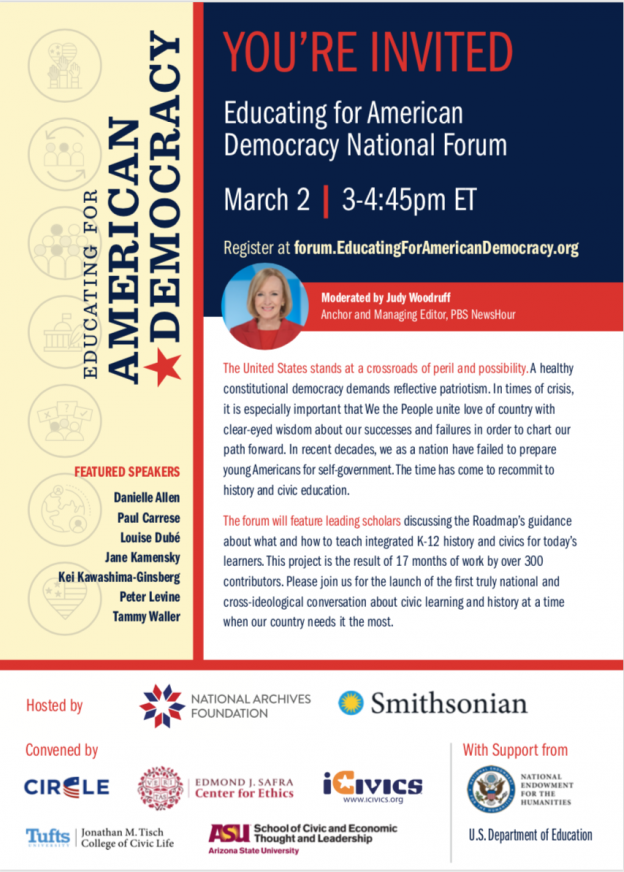
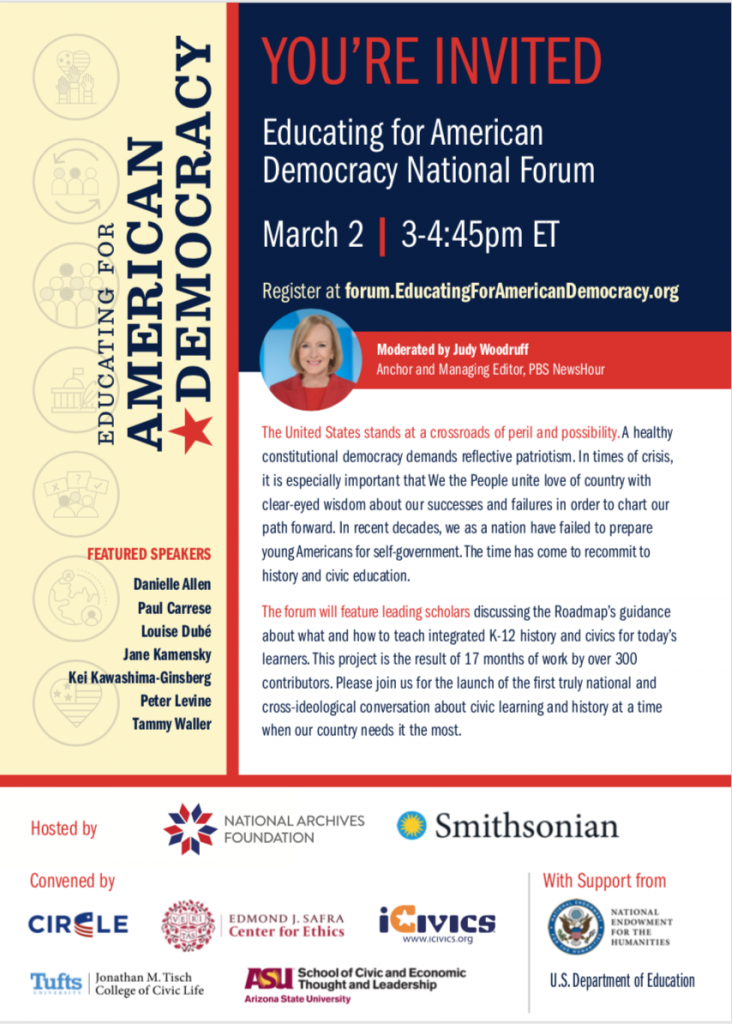
Join us at the National Forum on March 2nd from 3-4:45pm ET for the official release of the Educating for American Democracy report.

Moderated by Judy Woodruff of PBS Newshour, the forum will feature leading scholars discussing the Roadmap’s guidance about what and how to teach in history and civics. This project is the result of 17 months of work by over 300 contributors.

I was one of the co-PIs, and this project has been my focus (outside of Tufts work) since 2019.

Please join us for the launch of the first truly national and cross-ideological conversation about civic learning and history at a time when our country needs it most.

All are welcome to attend the national forum. Please register and encourage others to register at forum.educatingforamericandemocracy.org.