two good books on Black Lives Matter

  • Lebron, Christopher J., The Making of Black Lives Matter: A Brief History of an Idea (Oxford University Press, 2017)
  • Ransby, Barbara. Making All Black Lives Matter: Reimagining Freedom in the Twenty-First century (Univ. of California Press, 2018).

These are two very different but complementary books.

Lebron offers a history of the idea that Black lives matter, describing thinkers who lived well before the current movement and developed its core principles. His book is an extended definition of the movement, a justification of it, and a contribution to it.

Lebron pairs Frederick Douglass and Ida B. Wells as pioneers of the idea that whites can be compelled to reckon with racial injustice through “shameful publicity.” He pairs Langston Hughes and Zora Neale Hurston as influential proponents of the idea that actual Black lives are rich and variegated and diverse, not defined entirely by oppression. Both authors “counter-colonize[d] the white imagination” by portraying this richness. He pairs Anna Julia Cooper and Audre Lorde, who demonstrated that you can’t value Black lives unless you value all Black lives, which requires appreciation for gender, sexuality, and other forms of diversity. These writers “teach us the lesson of unconditional self-possession.” And he pairs James Baldwin and Martin Luther King, Jr. as proponents of forms of love which–while significantly different–both imply “unfragmented compassion.”

Lebron is a great source of relatively overlooked quotations as well as an original interpreter of texts as familiar as Douglass’ “What to the Slave is the Fourth of July?” His overall framework is illuminating.

Ransby is an historian and a participant/observer in the current movement. She offers a wealth of detail about who did what, when, where, and why (up to her publication date in 2018). Like Lebron’s, her book is sprinkled with quotations that amount to arguments for Black Lives Matter, but her timeframe is narrower. She mainly traces the intellectual history of the movement from the 1977 Combahee River Collective’s statement (which, of course, had its own influences).

Ransby is attentive to organized structures. Many Black Lives Matter activists are concerned about concentrated power and prefer flat hierarchies. One source of these ideas is Ella Baker: see Ransby’s own book, Ella Baker and the Black Freedom Movement: A Radical Democratic Vision (2003).

However, it would not be accurate to describe Black Lives Matter as unorganized or as resistant to formal structures of any kind. Ransby describes “an assemblage of dozens of organizations and individuals that are actively in one another’s orbit, having collectively employed an array of tactics together.” Many of these organizations are autonomous nonprofits; some are companies or programs within organizations that also have other purposes. Ransby emphasizes the importance of local chapters, of organizations whose main purpose is to “weave together” these local groups, and of significant conferences, such as a gathering of more than two thousand organizers in Cleveland in July 2015. Most dedicated activists in the movement have long resumes of roles in formal organizations.

My impression is that resistance to hierarchy is real and valid. It goes back to the New Left and has drawn additional impetus from feminism. However, the major change from the classic era of the Civil Rights Movement is not that leaders then believed in top-down authority, whereas activists today favor looser networks. It is the profound shift in the sociology of American civil society.

The NAACP, the Urban League, and the Brotherhood of Sleeping Car Porters exemplified a model that was influential in the United States during the first half of the 1900s. National organizations often had state units and local chapters; members paid dues that were shared by the three tiers; and leaders were elected at each level, often at face-to-face conventions. Individuals made whole careers within one of these organizations. One reason that the Sleeping Car Porters’ A. Philip Randolph, the National Urban League’s Whitney Young, Jr., and the NAACP’s Roy Wilkins emerged as nationally famous civil rights leaders was that they headed their respective organizations, and smaller groups like King’s Southern Christian Leadership Conference imitated the same structure.

However, this format shrank and weakened dramatically in the United States after the 1960s. Instead, US civil society is now dominated by autonomous nonprofits that rely on donations, grants or contracts. They usually have self-perpetuating boards and relate to each other in networks rather than hierarchies. Many are both led and staffed by their original founders. Individuals typically affiliate with several of these nonprofits and add and subtract affiliations frequently.

Many of the organizations that Ransby describes (and they are very numerous) fit this description. I am not sure that anyone knows how to build new organizations that function as the NAACP or a union did in 1960. I wouldn’t say that philosophical opposition to hierarchy is irrelevant or invalid, but I am not sure that movements have much of a choice today. For better or worse, the way we organize ourselves is to form networks of small nonprofits.
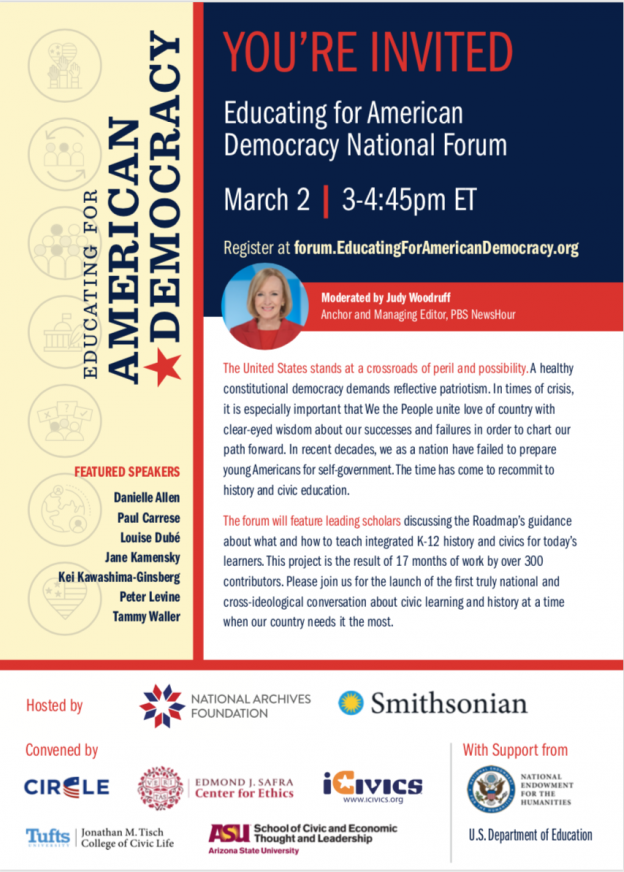
launch of Educating for American Democracy #EADRoadmap

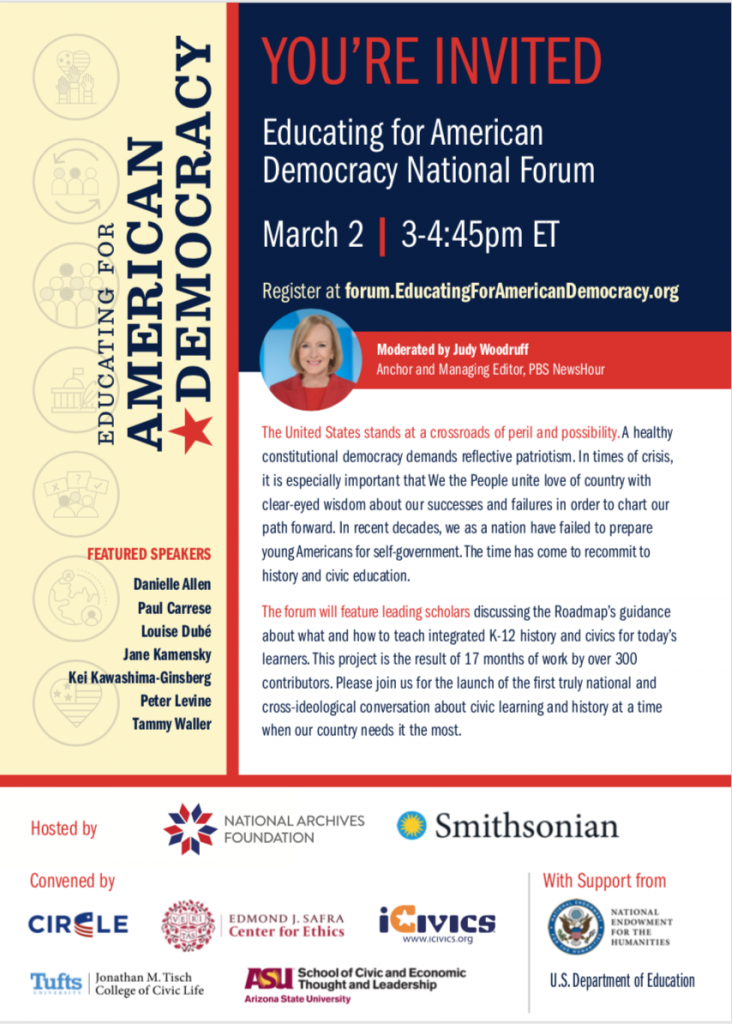
Join us at the National Forum on March 2nd from 3-4:45pm ET for the official release of the Educating for American Democracy report.

Moderated by Judy Woodruff of PBS Newshour, the forum will feature leading scholars discussing the Roadmap’s guidance about what and how to teach in history and civics. This project is the result of 17 months of work by over 300 contributors.

I was one of the co-PIs, and this project has been my focus (outside of Tufts work) since 2019.

Please join us for the launch of the first truly national and cross-ideological conversation about civic learning and history at a time when our country needs it most.

All are welcome to attend the national forum. Please register and encourage others to register at forum.educatingforamericandemocracy.org.

The COVID 19 Vaccine in the Global North & Global South: Ethics, Access & Resistance

This is the video from a recent event sponsored by Tufts Global Education and the Fletcher Global One Health Diplomacy Initiative. Susan Sánchez-Casal organized and introduced the event. I moderated and posed the questions. The experts were Karsten Noko, a lawyer & humanitarian aid practitioner originally from Zimbabwe, and Josep Lobera, a sociology professor at the Universidad Autónoma de Madrid & Tufts in Madrid.

In the Global South, billions of people are not going to be vaccinated any time soon because of a shortage of vaccines in their countries. A realistic timetable is 2024. Meanwhile, millions of people in the Global North are going to refuse to be vaccinated because of skepticism and distrust, which is partly caused by elites’ use of weaponized misinformation.

The speakers also explored nuances–including vaccine shortages in the North and hesitancy and misinformation in the South.

syllabus of a course on the Philosophy of Martin Luther King, Jr.

Summary

In this seminar, we will study Martin Luther King Jr. as a political thinker. The whole class will read major works by King and excerpts from biographies and historical documents. Additional readings will be distributed among students, who will contribute insights from their assigned texts to the seminar discussions. The additional readings will include works that influenced King, writings by some of his contemporaries, and recent interpretations. We will investigate King’s understanding of the Civil Rights Movement—why it was necessary and what it aimed to achieve. Specifically, we will study his ideas about the political and economic organization of white supremacy, the impact of racial ideologies, and the importance of racial integration and the right to vote. We will investigate King’s philosophy of civil disobedience and nonviolence as well as a set of values he relates to that philosophy: dignity, sacrifice, self-reflection, self-improvement, love, faith, and freedom. We will relate these values to King’s understanding of justice. Criticisms of King will also be considered. Studying King and his critics will provide a window into post-WWII American political thought. (This course is the Capstone for the Civic Studies Major and open to other majors.)

Grading rubric:

  • Regular participation in Canvas discussion threads about the readings: 40%. I will post a prompt one week before each class session, and you will reply to my prompt before class. Reading and responding to other students’ comments will be appreciated but not graded.
  • 5-page paper, due at the end of the semester: 30%
  • class participation: 30%

Criteria for assessing class participation:

  1. Attendance. 
  2. Engaging in a discussion that is informed by the assigned texts. 
  3. Focusing on the topic and the texts, which does not preclude drawing connections beyond them.
  4. Being responsive to other students. Responsiveness needn’t always be immediate, verbal, or occur within the class discussion itself.
  5. Building on others’ contributions, and sometimes making links among different people’s contributions or between what they have said and the text.
  6. Demonstrating genuine respect for the others, where respect does not require agreement. In fact, sometimes respect requires explicit disagreement because you take the other person’s ideas seriously.
  7. Taking risks, trying out ideas that you don’t necessarily endorse, and asking questions that might be perceived as naive or uninformed.
  8. Seeking truth or clarity or insight (instead of other objectives).
  9. Exercising freedom of speech along with a degree of tact and concern for the other people.
  10. Demonstrating responsibility for the other students’ learning in what you say (and occasionally by a decision not to speak).
Continue reading

setting a higher standard for success in civic education

Sarah Garland has a good piece in The Hechinger Report on whether schools–and specifically, civic educators–can combat political extremism. She presents the evidence as mixed, and no one thinks that schools are equipped to solve that problem all by themselves.

Meanwhile Weinschenk & Dawes have a new article that re-analyzes longitudinal data from US students and finds that civic education does not boost voter turnout, once other factors are considered.*

My response is the same in both cases. Thousands of dedicated civic educators are doing their best in classrooms and community settings. However, as a society, we have not invested in civics. We have not put much public or private money into it, or built it into policy reforms, or required kids to spend much time on it, or emphasized it when educating future teachers, or even conveyed its importance to most of our youth.

As a result, the aggregate effects from taking a civics course are not likely to be large. Program evaluations and studies of specific classrooms sometimes find big impacts (albeit in the short term, since few evaluations involve long-term follow-up), but the effects of typical courses are limited.

If people take away the conclusion that civics doesn’t work, that will be a self-fulfilling prophesy. (And it would reflect a misunderstanding of the relationship between data–which always describes the past–and envisioning the future.) But it is true that we must invest considerably more in civics to get the results we need.

*Weinschenk, A., & Dawes, C. (2021). Civic Education in High School and Voter Turnout in Adulthood. British Journal of Political Science, 1-15. doi:10.1017/S0007123420000435. See also The Educating for Democracy Act of 2020.