conservatism and identifying as white among Latinos

Latinos preferred Biden over Trump by 65%-32% according to the exit polls. There is some debate about that statistic, but it seems safe to say that Latinos tilt Democratic, yet somewhat less so than they did in the recent past.

We also know that people who consider their own whiteness important to their identity are more likely to support Trump. In the Tufts Equity study, whites who consider race important to their own identity favored Trump by 61.5%-31%, whereas Trump’s lead among other whites was just 5 points (47%-42%: less than a majority).

In this context, it seems significant that a majority of Hispanics identify as white, and a substantial proportion–one quarter in the 2012 American National Election Study (ANES)–say that being white is important to their identity.

I get that last statistic from Filindra and Kolbe 2020. These authors find that Latinos are more likely to identify as white if they have higher incomes, and less likely to identify as white if they have more education and if they report strong consciousness as Latinos. (Possibly, education increases social awareness.) Latinos are more likely to be Republicans and to support cuts in welfare if they identify as white.

These are not mere correlations but the results of models that control for numerous other variables. It is equally interesting that some variables do not seem to matter, e.g., religion, skin tone (albeit known for only some respondents), and whether one was born in the US or overseas. The degree of acculturation is related to views of welfare but not to other measures.

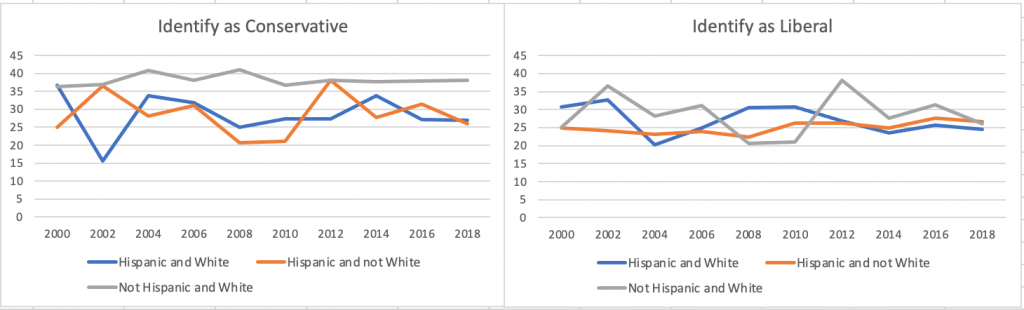
Filindra and Kolbe use 2012 ANES data, and I was interested in change since then. In a nutshell, I find no important shifts. My graphs below show rates of identifying as conservative and as liberal in the ANES since 2000. (Moderates are not shown, although they are the largest group.) Whites who are not Hispanic are the most conservative, and at a steady rate. However, they have also become the most likely to identify as liberal (at the expense of moderates). Hispanics who identify as white have been somewhat less conservative than other whites. And Hispanics who do not identify as white have not been statistically different from those who do.
Source: Filindra, Alexandra and Kolbe, Melanie, Are Latinos Becoming White? The Role of White Self-Categorization and White Identity in Shaping Contemporary Hispanic Political and Policy Preferences (May 16, 2020). Available at SSRN: https://ssrn.com/abstract=3602372 or http://dx.doi.org/10.2139/ssrn.3602372
what if climate change isn’t a tragedy of the commons?

Robinson Meyer’s Atlantic piece, “An Outdated Idea Is Still Shaping Climate Policy” led me to “Prisoners of the Wrong Dilemma: Why Distributive Conflict, Not Collective Action, Characterizes the Politics of Climate Change” by Michaël Aklin and Matto Mildenberger. I think the implications are profound.

Climate change looks like a tragedy of the commons. Most people stand to lose a great deal as the earth’s climate heats up. However, to prevent or mitigate that process, substantial numbers of individuals, companies, and countries would have pay or forego benefits. Each party will want the others to bear the burden and not make voluntary contributions by itself.

One classic solution to such dilemmas is a top-down rule that alters everyone’s incentives–in this case, a tax on carbon. However, the United Nations can’t tax anything. Each country’s carbon tax costs its own economy without (by itself) solving the climate crisis. Thus the tragedy reemerges at the international level and predicts that satisfactory carbon taxes will be hard to enact. Although 64% of Americans agree that “the U.S. should reduce greenhouse gas emissions regardless of what other countries do,” the theory suggests that this belief is soft and not likely to support ambitious policies. I’ve even made a simple online game to simulate this problem in teaching.

However, evidence seems to be building for a different model. Some people gain tangibly and immediately from decarbonization. Consider firms that build solar panels, low-carbon farmers, individuals who teach environmental science in high school, environmental engineers, and even residents of cities that are powered by renewables and compete with cities that depend on coal.

If some gain while others lose, it is no longer a Tragedy of the Commons. It is regular game in which the winners obtain benefits and the losers bear costs. Aklin and Mildenberger call this a “distributive conflict.”

In a mixed economy, the winning is side is likely to be more numerous (with more votes) and richer (with more buying and investing power). The size and wealth of both sides may change over time.

A distributive conflict makes new solutions appear possible. Governments can borrow or tax and spend the revenue to expand the size and power of the coalition that favors decarbonization. They can also compensate the losing side for reasons of equity or to reduce opposition. The game is rivalrous but not strictly zero-sum; everyone can gain in important respects even if some pay more than others.

According to the Tragedy of the Commons model, spending money will not solve climate change. This model views both costs and benefits in a static way: each dollar reduces carbon by a certain amount. The results are not necessarily very impressive, and they face a limit. There is still a lot of carbon under the ground; it has market value; and subsidizing renewables does not make the carbon worthless. Thus it will be burned. Besides, governments will surely–and perhaps rightly–fail to use spending to minimize carbon emissions. Since they will also be interested in other goals (jobs, health, equity, or ensuring their own reelection) they will not buy as much carbon reduction as they could.

But the alternative model offers hope that spending may be dynamic. Dollars invested in renewables, a new power grid, R&D, an electric car for one’s family, and even environmental education build constituencies for decarbonization. As these constituencies grow, they will use their economic and political power to demand more decarbonization–including the harder solutions of taxes and regulations. In that case, subsidies have leverage.

See, for instance, Liu, Lixia, Yuchao Zhu, and Shubing Guo. “The evolutionary game analysis of multiple stakeholders in the low-carbon agricultural innovation diffusion.” Complexity 2020 (2020). See also: public event on Governing the Commons: 30 Years Later with discussion of policing and climate change; A Civic Green New Deal; a Green recovery; taxing and spending are more compatible with democratic values than regulation is. And see our Civic Green project.

an overview of civic education in the USA and Germany

In this video, I offer a very broad introduction to civic education in the USA–framing my remarks historically. Essentially, I trace a tradition of experiential, community-based civic learning that runs from de Tocqueville through Jane Addams to Dorothy Cotton and onward; and a tradition of studying civics in school that really takes off with Horace Mann. These two traditions intertwine, and John Dewey is an important bridge between them. I argue that neither is in very good condition today.

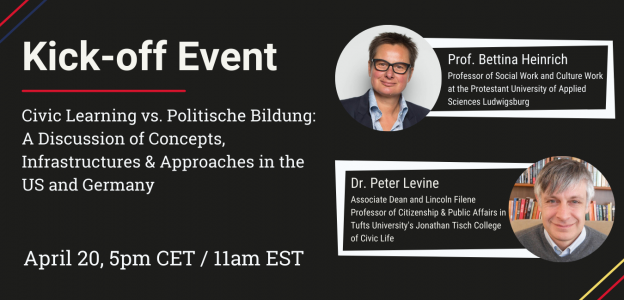
Then Bettina Heinrich, from the Protestant University of Applied Sciences Ludwigsburg, gives an overview of “politische Bildung” (political education or development) in the Federal Republic of Germany, focusing on the post-War period. We both note significant mutual influence between these two countries.

Another event will follow this one:

“Growing Up Across the Pond” (May 3, noon US Eastern Time) will be more about the general context for youth in Germany and the USA today. (You can register here.)

These are both open events, meant for anyone who is interested. They are also introductory events for people who might want to join The Transatlantic Exchange of Civic Educators (TECE), which “will bring together German and U.S.-American extracurricular civic learning professionals to unlock opportunities for mutual learning and reintroduce a transatlantic dimension to the field.”

a business/GOP rift?

Here is a sample of articles published within the past week alone: “The Right’s Anti-Business Turn“; “The GOP-Big Business Divorce Goes Deeper Than You Think“; “Republicans Will Regret Their Breakup With Big Business“; “Existential Threat-Or Politics as Usual,” and “Is the Business Community At Last Falling Out of Love With the Republican Party?

The situation is fluid and hard to interpret. Our predictions are inevitably influenced by our assumptions about how business generally relates to politics in the USA. In that spirit, I’ll disclose my own premises.

First, businesses influence government. There is no consensus among political scientists that campaign contributions and paid lobbying matter very much. It’s certainly not evident that companies can decide who wins elections. The main source of influence is what Charles E. Lindblom called the “privileged position of business.” The basic idea is that businesses create jobs in a capitalist economy; politicians want jobs to be created; therefore, politicians cater to business. Direct communications from corporations to politicians are effective mainly because they convey information that politicians are eager to hear. Although companies may exaggerate the costs of taxing and spending, politicians take their predictions seriously because they think their own interests are at stake. Compared to other politicians, liberal Democrats are more skeptical of business and more likely to want to hear from labor, but even most liberals listen hard when a company is deciding whether to move in or out of their own district. This dynamic is built into a mixed economy (or what Lindblom called, following Dahl, a “polyarchy”).

However, people see the world through ideological frames. We do not just behold the truth and maximize our self-interest (profits for firms; reelection for politicians). Instead, we use conceptual frameworks to interpret the world. A politician who believes in “free markets” is primed to assume that a tax increase will cost jobs even if it won’t. At the same time, a business that sees itself as a fair and inclusive workplace is primed to see xenophobic rhetoric as bad for the bottom line (even if it isn’t).

The dominant framework in corporate boardrooms is pro-market, pro-technology, meritocratic/elitist, cosmopolitan, and self-congratulatory about the business’s own fairness and inclusivity. This is partly because of the demographics of the corporate ranks: heavily “coastal” and international and highly educated. The most coveted employees and consumers–the ones with the most buying power–share those characteristics. Businesses observe politics through this lens.

At the same time, businesses do not particularly want to engage with politics. Government can be helpful, particularly if you want big government contracts. But it also presents risks. Politics is controversial, so involvement can hurt your reputation. The last thing you want is to be targeted by boycotts from several directions. Politicians can also extract rents. Businesses contribute to candidates not only to get benefits but also to stave off harms. A stable policy that is fairly expensive to business (such as a higher corporate tax rate) may actually be preferable to a rapidly changing and highly contested policy environment.

Finally, it is much easier to advocate a narrow policy, particularly one that has low public salience, than to try to steer the whole ship of state.

As a result, most businesses probably prefer outcomes in this order:

  1. A particular politician of any party and persuasion who champions their highly specific interests–a given tax break, an import permit, etc.
  2. Traditional Republicans who instinctively favor business interests, focus on economics, and don’t court controversy.
  3. Moderate Democrats, who are practically tied with #2.
  4. Quite liberal Democrats, as long as they are forced to compromise. If Sen. Sanders could write the tax code, that would be expensive for corporate America. If he has a seat at the table, it’s OK.
  5. Trump. He’s a loose cannon. He’s protectionist. Business doesn’t like his explicit stances on race and immigration; and he may hurt traditional Republicans against Democrats. For instance, with a different Republican president on the ballot in 2020, the GOP would probably control the White House and at least one house of Congress. right now Sanders and Ocasio-Cortez would be in the minority party now, rather than the majority. This means that Trump presents, overall, a bigger problem for business than Bernie does.

If this ranking is correct, then the relationship between business and the GOP is fraught; however, corporations’ calculations are complicated, and they will surely hedge their bets.

wicked problems, and excuses

Is the following true for social problems?

Will + resources + planning = a solution

A corollary would hold:

If there isn’t a solution, there must be a lack of will or resources or a bad plan.

I think this logic sometimes holds, and it’s the basis for holding responsible parties accountable. They may not have cared enough, or spent enough, or thought well enough about a problem. If not, they should be called on it.

On the other hand, the formula overlooks the power of sheer chance. Sometimes decision-makers are just lucky or unlucky. And it ignores the possibility that some problems may be really hard: “wicked problems,” in the best-remembered phrase from the famous article by Horst Rittel and Melvin M. Webber, “Dilemmas in a General Theory of Planning,” Policy Sciences 4.2 (1973), 155-169. (We discussed this article recently in my introduction to public policy course.)

Rittel and Webber write, “Solutions to wicked problems are not true-or-false, but good-or-bad” (p. 162). Yet people disagree about what is good.

“With wicked problems… any solution, after being implemented, will generate waves of consequences over an extended–virtually an unbounded–period of time” (p. 163). Since change keeps happening, there is no point when you can definitively assess the impact of a policy (p. 163). Also, there is no agreed-upon criterion for a successful policy (p. 162), and therefore, no way to know whether your solution succeeded.

“Every wicked problem can be considered to be a symptom of another problem” (p. 165). Thus we can endlessly disagree about the center or “locus” of the problem. This is one reason that “There is no definitive formulation of a wicked problem” (p. 161).

You can’t learn by trial-and-error, because every time you implement a policy, you change the world permanently (p. 163). You can’t start a social experiment over from scratch and try something different. And because your policy affects real people, you have “no right to be wrong” (p. 165).

There is no way to develop an exhaustive list of all the possible solutions (p. 164). And “Every wicked problem is essentially unique” (164)

One upshot of Rittel and Webber’s argument could be humility: do not overestimate one’s own ability to solve social problems. Another would be decentralization, whether to small governing units or to firms in a market. Decentralization is a way of mitigating damage and allowing local solutions to fit local circumstances. A third upshot would be participation: if problems are deeply contestable, maybe everyone should be involved in addressing them.

Yet another takeaway might be defeatism and tolerance for injustice, but that seems the wrong lesson to draw.

See also: Complexities of Civic Life; qualms about Effective Altruism; The truth in Hayek; trying to keep myself honest.