wildlife commons

As a follower of the late Elinor Ostrom (1933-2012), I am glad to see Michelle Nijhuis‘s article “The Miracle of the Commons” in Aeon. Nijhuis draws on her book, Beloved Beasts: Fighting for Life in an Age of Extinction (2021), which looks important.

I would offer the following very brief summary as an enticement to read more of the article. We can think of beloved megafauna, like wild elephants and lions, as public resources. Their survival is good for human beings in general, yet individual humans can profit from hunting them one by one.

If we apply a simple tragedy-of-the-commons model, then these beasts are doomed unless “something is done.” And that something must be some kind of enforced prohibition on hunting, perhaps connected to state ownership of the land. However, we should be concerned that the state will use its powers badly–that poachers will bribe wardens, or officials will prove incompetent, or authorities will turn a blind eye to development.

Ostrom found, instead, that communities are entirely capable of managing and protecting vulnerable public resources. They need mechanisms for allocating tasks and benefits and making decisions–and the authority to do so.

Nijhuis shows that communities in Namibia have been very successful at preserving endangered species when permitted–and, to some extent, supported–to manage these commons themselves. This is a perfect example of a commons as neither a “tragedy” (doomed to failure), nor a “comedy” (sure to work out well), but a “drama” whose outcome depends on us.

See also many previous posts about Ostrom.

the case for (and against) nonviolence

During a whole semester reading and debating Martin Luther King Jr, I think my students and I built a richer understanding of nonviolence as a political tradition and alternative. Several students noted that they had moved from thinking of nonviolence as a restriction or limitation (i.e., you must exclude violent means) to a powerful approach of its own.

The Case for Nonviolence

  1. It tends to work. Erica Chenoweth and Maria J. Stephan find that nonviolence has a higher rate of success than violent methods, at least in their sample of large movements aimed at major political change. (See Why Civil Resistance Works.)

One reason is that nonviolence actually draws larger and more diverse participants, and big and diverse movements are more likely to win. It is true that some people feel a need to employ violent means, but they tend to be tilted toward young men. Nonviolence broadens the base of a movement. I also think that nonviolent movements are more favorable to intense internal debate and discussion, and that is useful for success. (See the value of diversity and discussion within social movements.)

It is worth noting, however, that the success-rate of nonviolent social movements has fallen during the 2000s. I interpret both nonviolence and state repression as general approaches that evolve over time as their practitioners innovate and learn. I think that nonviolent strategies improved dramatically from 1955-1989 while autocrats stagnated, but the autocrats are learning fast. (See why autocrats are winning (right now).)

  1. It improves the odds that the resulting system will be democratic.

This is another empirical finding from Chenoweth and Stephan. One reason is that nonviolence allows a negotiated settlement and the peaceful exit of the incumbents. Autocrats have reason to fear violent movements and may respond by fighting almost to the death. They are more likely to settle with a movement that demonstrates nonviolence.

Relatedly, nonviolence prevents a cycle of escalating violence that makes democracy harder to attain. And it compels a movement to use relatively democratic methods for making decisions internally, because the leaders cannot violently compel their own people. That prepares the movement to govern democratically if it wins. And it gives the participants the specific skills and values that will be most useful to them in democratic governance.

  1. It is a variety of self-limitation, and self-limitation is valuable

Movements face twin risks: heating up too much (until they cannot sustain the intensity), or else dwindling away. It’s important to keep the intensity within bounds. One way to do that is to establish explicit or implicit norms of behavior. Nonviolence is not the only norm that works to regulate intensity. In the Intifada, the rule was to use rocks, not guns or bombs. From a pragmatic perspective, that worked–the effort persisted for two years. However, nonviolence has the advantage of being an intuitive, bright line that people understand, even under duress.

  1. It brings a particular kind of dignity, self-respect or efficacy to the participants

Martin Luther King Jr. described his goal as “seeking to instill in my people a sense of dignity and self-respect.” He recalls that African American Montgomerians “who had previously trembled before the law were now proud to be arrested for the cause of freedom. … They looked the solicitor and the judge in the eye with a courage and dignity for which there was no answer.”

It is possible that nonviolence is especially likely to enhance self-respect, because nonviolent movements are self-reliant. They don’t depend on guns, which are impersonal tools (and are often supplied by outsiders of some kind). The accomplishments of a nonviolent movement are theirs alone.

  1. It is compatible with uncertainty about one’s goals and strategies.

Gandhi emphasizes this point. If you do not know (for sure) what your ultimate objective should be, and you are not certain about the best path forward, you should prefer nonviolence. Violence is irrevocable and closes options. (see Gandhi on the primacy of means over ends.) As King says, nonviolence permits learning, including learning from the other side: “Here is the true meaning and value of compassion and nonviolence, when it helps us to see the enemy’s point of view, to hear his questions, to know his assessment of ourselves.”

I recently found a very nice statement of a similar idea at the very end of The Combahee River Collective Statement (1977) which is a seminal text for today’s social movements:

In the practice of our politics we do not believe that the end always justifies the means. Many reactionary and destructive acts have been done in the name of achieving “correct” political goals. As feminists we do not want to mess over people in the name of politics. We believe in collective process and a nonhierarchical distribution of power within our own group and in our vision of a revolutionary society. We are committed to a continual examination of our politics as they develop through criticism and self-criticism as an essential aspect of our practice.

  1. It might be particularly relevant to a dispersed minority group that confronts a basically stable regime.

King depicted violence as futile in a situation like the USA in his time:

When one tries to pin down advocates of violence as to what acts would be effective, the answers are blatantly illogical. Sometimes they talk of overthrowing racist state and local governments. They fail to see that no internal revolution has ever succeeded in overthrowing a government by violence unless the government had already lost the allegiance and effective control of its armed forces. Anyone in his right mind knows that this will not happen in the United States. In a violent racial situation, the power structure has the local police, the state troopers, the national guard and finally the army to call on, all of which are predominantly white.

King thought that nonviolence looked promising in comparison.

  1. It is compatible with ethical scruples, including the principle that you should not kill.

Maybe sometimes we do have to kill. I don’t see how Auschwitz could have been closed without killing the German soldiers posted to the beaches of Normandy (and many, many more). However, if nonviolence has at least as good a chance of succeeding as violence does, then surely, it is better not to kill.

II. The Case Against?

  1. It doesn’t work all the time.

(Would it have ended slavery or defeated Nazism?)

2. It does not satisfy all kinds of people

Maybe more people will participate in a nonviolent social movement than an armed insurrection, but what about the people who feel compelled to arms? Don’t they need some kind of outlet?

3. It demands sacrifice–up to and including death–from the people who should be least obliged to sacrifice, those who are oppressed.

(Then again, a violent campaign is also bound to cause casualties, including completely innocent ones. And to leave the status quo unchallenged is to tolerate ongoing violence and oppression.) See: the kind of sacrifice required in nonviolence and the question of sacrifice in politics.)

4. It might rely on certain external factors, such as media and partisan competition.

Both Gandhi and King were able to play to audiences of voters who had reasonably free access to media and choices at the ballot box. Even though most African Americans and all Indians were disenfranchised, white British and US voters had the power to make change. That means that success is somewhat contingent on factors that cannot always be counted on. Contrary to I.4, above, nonviolence is not always self-reliant.

5. It requires a mildness or compassion toward opponents that they may not deserve.

(Then again, I am not sure that defeating an opponent by using effective non-violent means is all that kind.)
the youth vote in 2020

From CIRCLE’s latest release, based on voter files:

We estimate that 50% of young people, ages 18-29, voted in the 2020 presidential election, a remarkable 11-point increase from 2016 (39%) and likely one of the highest rates of youth electoral participation since the voting age was lowered to 18. …

However, as is the case in every election cycle, youth voter turnout rates varied widely across the country: New Jersey (67%), Minnesota (65%), Colorado (64%) and Maine (61%) had the highest statewide youth turnout rates, while South Dakota (32%), Oklahoma (34%), Arkansas (35%), and New Mexico (39%) had the lowest. ..

Numerous interconnected factors shape whether youth electoral participation is high or low. These include the competitiveness of elections, how much (or how little) campaigns and organizations reach out to young people, the state’s civic culture and civic education policies, the demographic composition of the youth population, and state voting laws … that can either facilitate voting or pose barriers for youth. ….

Understanding the effect of electoral policies on youth turnout is especially relevant at a time when the U.S. Congress is considering HR1: For the People Act of 2021. This bill would standardize some election laws across the country and nationally establish: automatic voter registration (AVR), online voter registration (OVR), same-day or Election-Day registration (SDR), early voting, no-excuse absentee voting, pre-registration, and requirements for voter registration programming in high schools. ….

We divided states into those with a majority of the electoral policies in HR1 and those with few of the policies, and we found that, on average, states with more of these policies had higher youth turnout. States with four or more of the HR1 policies had a combined youth turnout rate of 53%, compared to 43% turnout from states with less than four policies. It appears likely that a number of policies complement each other to create a system and culture of voting that is more conducive to youth participation, and the lack of them may have the opposite effect.

antisemitism on the right and left

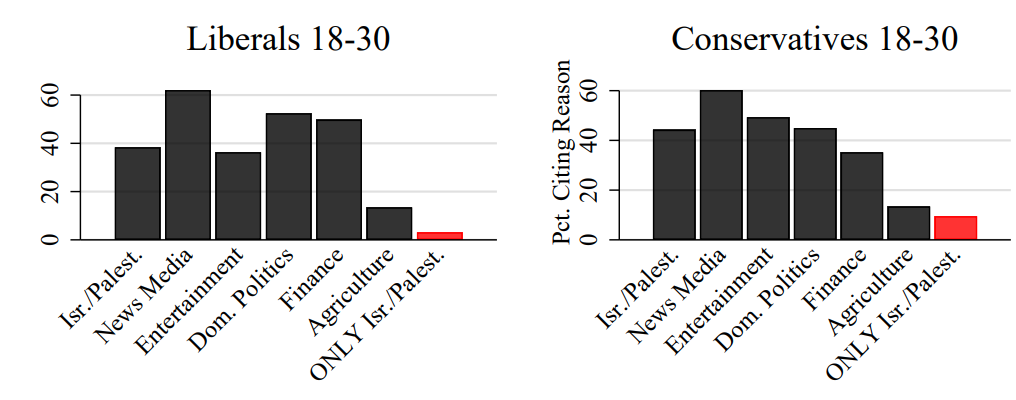
In “Antisemitic Attitudes Across the Ideological Spectrum,” my colleague Eitan Hersh and Laura Royden show that antisemitism is much more common on the right than the left in the US today and is particularly common among young people on the far right.

Their study is complex and nuanced, and the authors acknowledge room for disagreement about whether certain survey items, especially those related to Israel, measure antisemitism. I will zero in on a few findings that I find especially interesting.

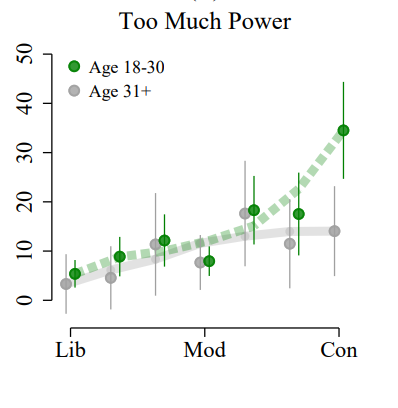
First, a pretty clear way to test a traditional aspect of antisemitism is to ask whether Jews have too much power. Rates of agreement with that claim rise dramatically as we move from the political left to right. Young adults (18-30) drive most of the antisemitism on the right, and young right-wingers are by far the most antisemitic group.

Importantly, the people who say that Jews have too much power are not thinking about (criticizing) Israel. The next two graphs show responses by the people on the left and the right who think that Jews have too much power. (The antisemitic group on the right is much larger, but these graphs show percentages within each group.) Tiny proportions on both sides cite Israel/Palestine alone. News and entertainment media, finance, and even agriculture are cited frequently as domains in which Jews are too powerful.

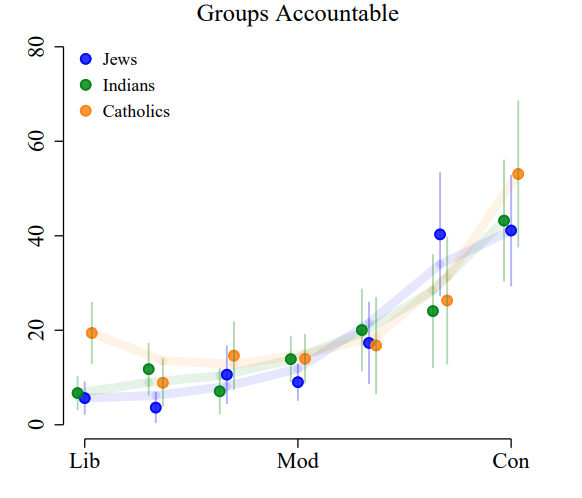
In one part of this complex study, respondents were asked whether Jews should be held accountable for actions by the state of Israel, but also whether Indians should be held accountable for India, and Catholics for the Vatican. The differences are very small. People who think that one group is responsible for the policies of a foreign entity think the same about the other groups as well. In all cases, this attitude becomes more prevalent as one moves from the left to the right. Interestingly, conservatives seem more committed to collective responsibility. (So much for libertarian individualism.)

Liberals do seem to treat Catholicism a bit differently. They are somewhat more likely to hold Catholics accountable for the Church than they would Jews for Israel or Indians for India. Still, only 20% of liberals would do so, compared to 60% of conservatives.

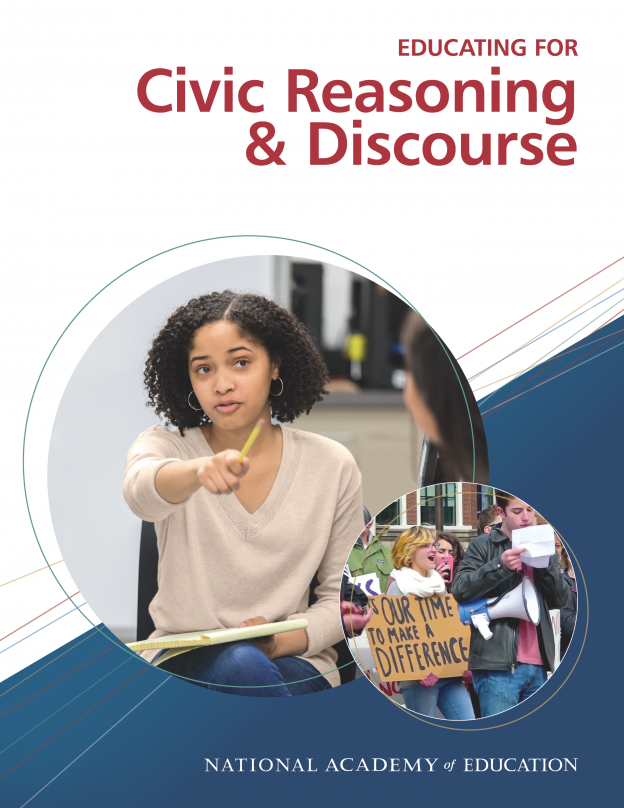
NAEd Report on Educating for Civic Reasoning and Discourse

The National Academy of Education (NAEd) is releasing its report on Educating for Civic Reasoning and Discourse. I was on the Steering Committee along with eight wonderful colleagues, and many more scholars contributed to writing the document. You can attend a public forum to hear more about it on May 3, 2021, 12:00 pm – 2:00 pm Eastern Time. Register here.

I’d describe this report as a response to problems of polarization, incivility, motivated reasoning, propaganda, and strained democratic institutions, along with racial injustice and other social crises. It is a response from the learning sciences, with papers by specialists on learning, schooling, and human development. In contrast to the Educating for American Democracy Roadmap, this report is more about how to teach (rather than what to teach); and it addresses education broadly, not just the disciplines of history and civics, which are the focus of the Roadmap. I worked on both projects simultaneously and benefited from the two perspectives.

Aficionados of Civic Studies will recognize this definition from the NAEd report:

DEFINING CIVIC REASONING AND DISCOURSE

Early in its work, the National Academy of Education (NAEd) Committee on Civic Reasoning and Discourse agreed on a shared definition of civic reasoning and discourse to guide the development of this report. The central question guiding the formulation of this definition concerns “What should we do?” and the “we” includes anyone in a group or community, regardless of their citizenship status. To engage in civic reasoning, one needs to think through a public issue using rigorous inquiry skills and methods to weigh different points of view and examine available evidence. Civic discourse concerns how to communicate with one another around the challenges of public issues in order to enhance both individual and group understanding. It also involves enabling effective decision making aimed at finding consensus, compromise, or in some cases, confronting social injustices through dissent. Finally, engaging in civic discourse should be guided by respect for fundamental human rights