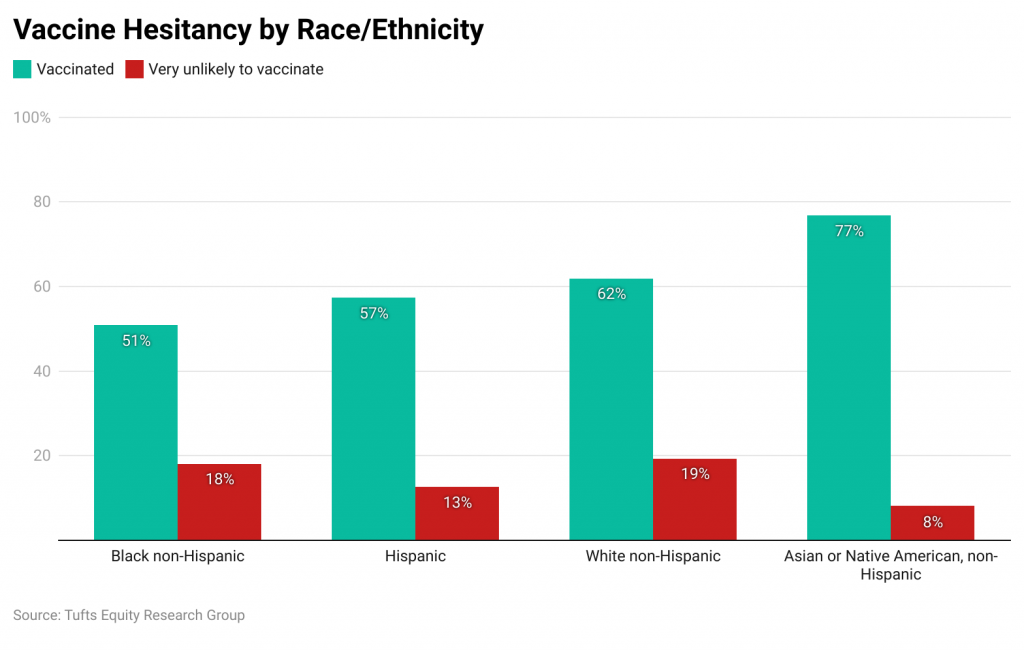
Despite Similar Levels of Vaccine Hesitancy, White People More Likely to Be Vaccinated Than Black People

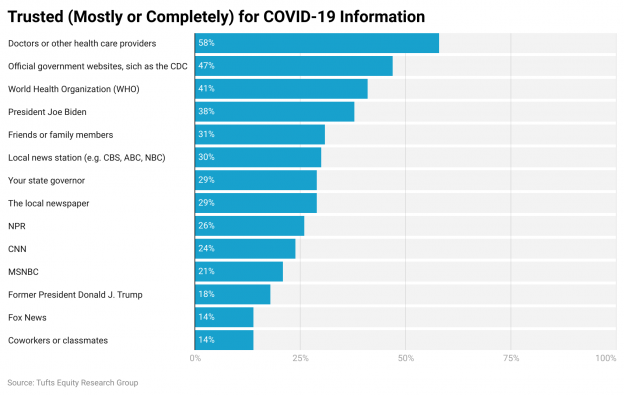
I crunched the data for this new release, based on our very recent national survey. We find that those most hesitant to be vaccinated are younger, less educated, and more likely to trust former President Donald Trump; we also find a racial divide in access to the vaccine.

Image courtesy Tufts University Research Group on Equity in Health, Wealth and Civic Engagement

White people are more likely to have been vaccinated than Black people despite similar levels of vaccine hesitancy, or saying they are very unlikely to get a vaccine. Therefore, access to vaccines and other factors could be limiting vaccination efforts.

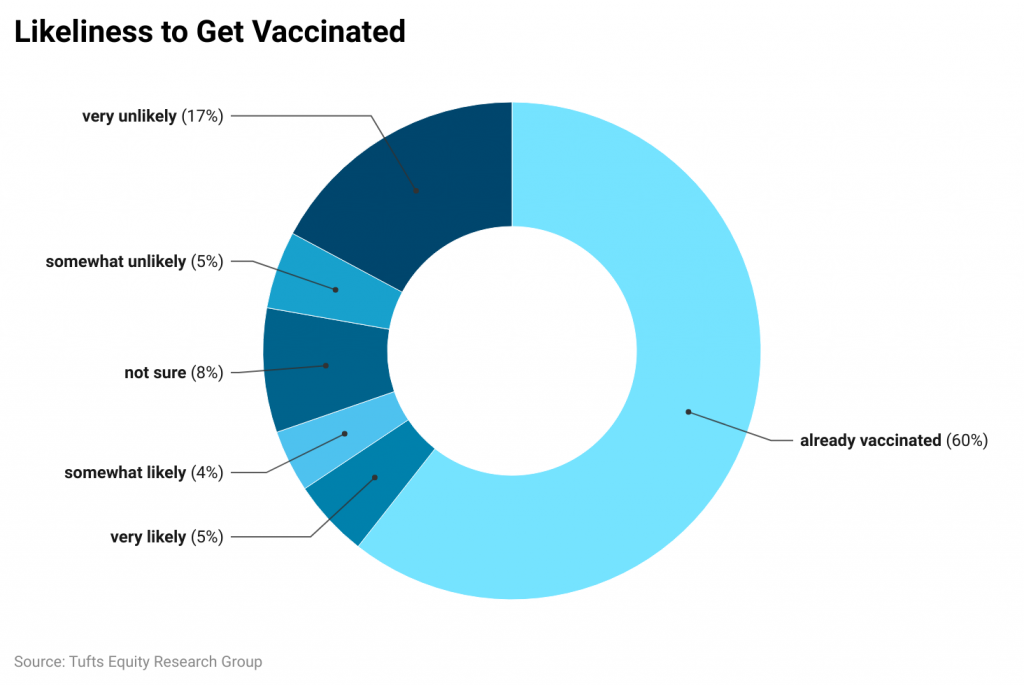
About 17 percent of the U.S. adult population currently say they are “very unlikely” to get a vaccination for COVID-19.

This nationally representative survey by Ipsos, using its KnowledgePanel, for the Tufts the Tufts University Research Group on Equity in Health, Wealth and Civic Engagement was fielded online between April 23 and May 3, 2021 and had 1,449 respondents.

Please read more here.

open positions at Tisch College: senior researcher for student programs, postdoc in Civic Science

Please consider applying and spread the word …

Senior Researcher, Student Programs – Tisch College (More details here)

The Jonathan M. Tisch College of Civic Life prepares students in all fields of study for lifetimes of active citizenship. Tisch College promotes new knowledge in the field and applies this knowledge to evidence-based practice in programs, community partnerships, and advocacy efforts. Central to the university’s mission, the college offers Tufts’ students opportunities to engage in meaningful community building, civic and political experiences, and explore commitments to civic participation.

The Senior Researcher will report to the Director of Programs at Tisch College and be based on the Medford/Somerville Tufts University Campus.  As a member of the Tisch College Student Programs team, the Sr. Researcher will focus on designing and implementing a comprehensive assessment strategy encompassing all Tisch College programs and endeavors. In addition, the Senior Researcher will grow and promote a shared vision for assessing civic engagement across all the Health Sciences campuses.  Tufts has made a commitment to be an anti-racist university, and this is also an important aspect of this role. The Senior Researcher will be committed to ensuring that all assessment and evaluation is conducted with a commitment to equity.        

Specific responsibilities will include: conducing literature reviews and background research; designing and conducting quantitative, qualitative, and mixed methods assessment designs; developing and executing an external publication plan, including collaborations with Tufts faculty and, where appropriate, colleagues across the nation and internationally; collaboration with the advancement team and Tufts faculty to secure grant funding; coding and transcribing data; curating and preparing data sets for various audiences; developing and executing a plan for representing Tisch College Programs with conference presentations; conducting program evaluation for community-engaged, service-learning initiatives across Tufts; providing feedback, assistance, and support to colleagues on research and evaluation related questions; performing administrative duties as needed; and participation in Tisch College and Tufts’ meetings and activities.

Postdoc in Civic Science–Tisch College (read more here)

Deadline: May 20, 2021 at 11:59 PM Eastern Time. Please note that this position was inadvertently shown as closed for a week or more, but it remains open.

Tufts University’s Jonathan M. Tisch College of Civic Life will award a Postdoctoral Fellowship in Civic Science for the 2021-22 academic year (June 1, 2021-May 31, 2022). This postdoctoral fellowship is offered in partnership with the Charles F. Kettering Foundation in Dayton, OH and involves some work at Kettering’s offices in Dayton as well as full-time employment at Tufts in the Boston area.

The Tisch College Civic Science initiative (https://tischcollege.tufts.edu/civic-studies/civic-science), led by Dr. Peter Levine and Dr. Samantha Fried, aims to reframe the relationships among scientists and scientific institutions, institutions of higher education, the state, the media and the public. It also asks about the relationships and distinctions among those institutions, historically and today. With this context in mind, Civic Science seeks to…

  • Reconfigure the national conversation on divisive and complex issues that are both scientific and political in nature, thereby connecting scientific institutions, research, and publications to people’s values, beliefs, and choices.
  • Define and advance the public good in science, thereby finding ways for scientific institutions to better serve communities.
  • Explore the concept of knowledge as a commons (or common-pool resource), developing a line of work pioneered by Elinor Ostrom and her colleagues
  • Develop curricula that simultaneously attend to scientific and civic issues and that teach students to understand and communicate both kinds of narratives together to a variety of audiences.
  • Develop approaches to democratic governance that are attuned to the role of the scientific enterprise in society.
  • Ask what it would mean to earn the trust of communities that have been historically marginalized by the institution of science, and what science would look like if this was a priority.
  • Intervene at institutional and grassroots levels, alongside a robust theoretical analysis.

A PhD is required. Applicants must also demonstrate a strong interest in investigating the intersections of science and civic matters as the focus of their postdoctoral year.

Civic Science is interdisciplinary, and this fellowship is open to specialists in any relevant field.
problem-solving, not worrying, is addictive

The main points I learned from Ezra Klein’s interview with Brown professor Jud Brewer may be very widely known already, but they were new to me. This is what I took away …

Anxiety and worrying can be habitual, even addictive. Most people are probably addicted to these behaviors at least some of the time. The mystery is why we would become addicted to something that brings discomfort, not pleasure. One answer is that we are not directly addicted to worrying. The addictive habit is problem-solving.

You wake up in the morning and realize you want coffee. Without expending much mental energy at all, you identify that need, locate the coffee, water, mug, and machine, make yourself a cup, and enjoy it. You experience an arc from the problem to the solution, which repeats many times every day. It brings satisfaction and is deeply habitual, partly because it is adaptive. Solving problems increases the odds of survival.

But what if you cannot solve the problem that you have identified? Perhaps it is beyond your control–you are powerless–or perhaps you cannot address it now. For instance, you will be able to deal with the problem during the meeting scheduled for next Tuesday at 3, but you can’t do anything about it until then.

In such cases, the addictive desire to address a problem causes your brain to turn it over and over, looking for a new way to solve it now. This is anxious worrying. It is unfortunate because it wastes the most precious scarce resource of all–the very stuff of life–which is time. It also tends to reduce your ability to deal with the problem at hand or other problems that may arise, because it may cost you sleep, confidence, mental sharpness, and other useful assets.

Jud Brewer’s recommendation is to replace the addictive behavior with another one that is equally or more compelling. One option is kindness: do something good for someone else. That seems right, except that there may be no available outlet for kindness when you need it. You can’t wake other people up at three in the morning to be nice to them. It is also challenging to shift one’s attention away from oneself when one is anxious.

A different option is curiosity. We are drawn to curious inquiry for much the same reasons that we are drawn to problem-solving: it is adaptive. Answering a question brings satisfaction. Brewer especially recommends asking curious questions about one’s own bodily state. The nervous system is the locus of the anxiety, and one can investigate it with curiosity. “Where do I feel nervous? How does my breath feel?”

I am certainly no expert in the science of happiness or psychological approaches to well-being. But I keep my eyes open for this kind of research, for two main reasons. First, I am always glad to learn useful tips. Second, I am fascinated by the interplay among three questions: 1) What are practical ways to enhance the quality of life (or to reduce suffering)? 2) What constitutes a good or admirable life? And 3) What are metaphysical and epistemological truths that pertain to those two questions? (For instance, is there a benign and omnipotent creator? Does the self exist?) Some people have argued that these three questions fit naturally together: an admirable person knows the truth and attains happiness as a result of believing and doing the right things. I am much less confident about such harmony.

See also: questions about happiness; why we wish that goodness brought happiness, and why that is not so; unhappiness and injustice are different problems; three truths and a question about happiness; how to think about the self (Buddhist and Kantian perspectives), etc. etc.

The Tufts Equity Research Group

This is a video of me and my colleague Dr. Wenhui Feng discussing the Tufts Equity Research Group. I talk broadly about our research, and Wenhui shares some specific findings about COVID-19 vaccination. We are in the field right now with a new national survey, so please stay tuned for results and check out our interactive website about equity in the USA, which I describe in the video. This presentation was at the Tufts Clinical & Translational Institute (CTSI)’s annual Translational Research Day 2021.

wildlife commons

As a follower of the late Elinor Ostrom (1933-2012), I am glad to see Michelle Nijhuis‘s article “The Miracle of the Commons” in Aeon. Nijhuis draws on her book, Beloved Beasts: Fighting for Life in an Age of Extinction (2021), which looks important.

I would offer the following very brief summary as an enticement to read more of the article. We can think of beloved megafauna, like wild elephants and lions, as public resources. Their survival is good for human beings in general, yet individual humans can profit from hunting them one by one.

If we apply a simple tragedy-of-the-commons model, then these beasts are doomed unless “something is done.” And that something must be some kind of enforced prohibition on hunting, perhaps connected to state ownership of the land. However, we should be concerned that the state will use its powers badly–that poachers will bribe wardens, or officials will prove incompetent, or authorities will turn a blind eye to development.

Ostrom found, instead, that communities are entirely capable of managing and protecting vulnerable public resources. They need mechanisms for allocating tasks and benefits and making decisions–and the authority to do so.

Nijhuis shows that communities in Namibia have been very successful at preserving endangered species when permitted–and, to some extent, supported–to manage these commons themselves. This is a perfect example of a commons as neither a “tragedy” (doomed to failure), nor a “comedy” (sure to work out well), but a “drama” whose outcome depends on us.

See also many previous posts about Ostrom.