antisemitism on the right and left

In “Antisemitic Attitudes Across the Ideological Spectrum,” my colleague Eitan Hersh and Laura Royden show that antisemitism is much more common on the right than the left in the US today and is particularly common among young people on the far right.

Their study is complex and nuanced, and the authors acknowledge room for disagreement about whether certain survey items, especially those related to Israel, measure antisemitism. I will zero in on a few findings that I find especially interesting.

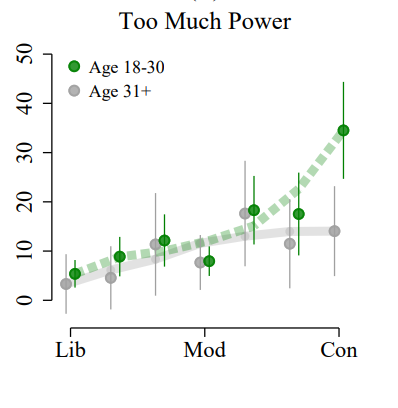
First, a pretty clear way to test a traditional aspect of antisemitism is to ask whether Jews have too much power. Rates of agreement with that claim rise dramatically as we move from the political left to right. Young adults (18-30) drive most of the antisemitism on the right, and young right-wingers are by far the most antisemitic group.
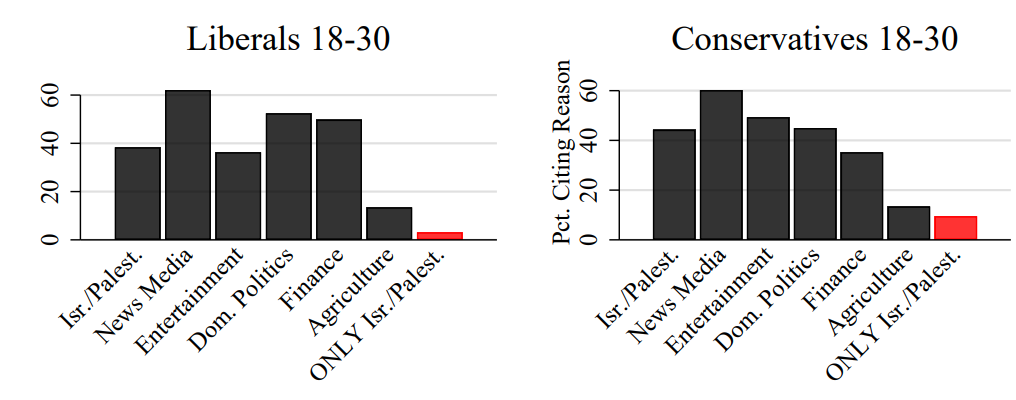
Importantly, the people who say that Jews have too much power are not thinking about (criticizing) Israel. The next two graphs show responses by the people on the left and the right who think that Jews have too much power. (The antisemitic group on the right is much larger, but these graphs show percentages within each group.) Tiny proportions on both sides cite Israel/Palestine alone. News and entertainment media, finance, and even agriculture are cited frequently as domains in which Jews are too powerful.
In one part of this complex study, respondents were asked whether Jews should be held accountable for actions by the state of Israel, but also whether Indians should be held accountable for India, and Catholics for the Vatican. The differences are very small. People who think that one group is responsible for the policies of a foreign entity think the same about the other groups as well. In all cases, this attitude becomes more prevalent as one moves from the left to the right. Interestingly, conservatives seem more committed to collective responsibility. (So much for libertarian individualism.)
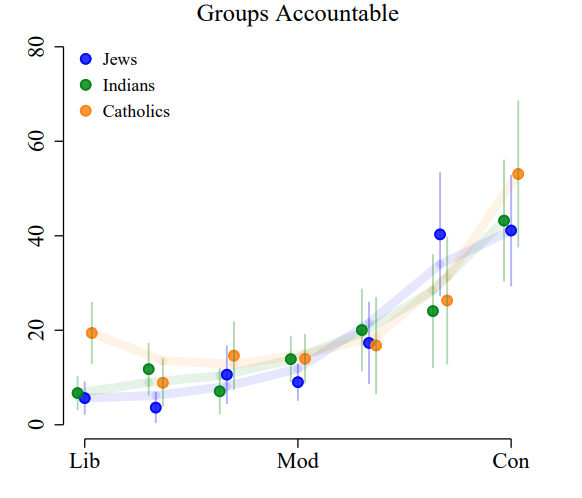
Liberals do seem to treat Catholicism a bit differently. They are somewhat more likely to hold Catholics accountable for the Church than they would Jews for Israel or Indians for India. Still, only 20% of liberals would do so, compared to 60% of conservatives.
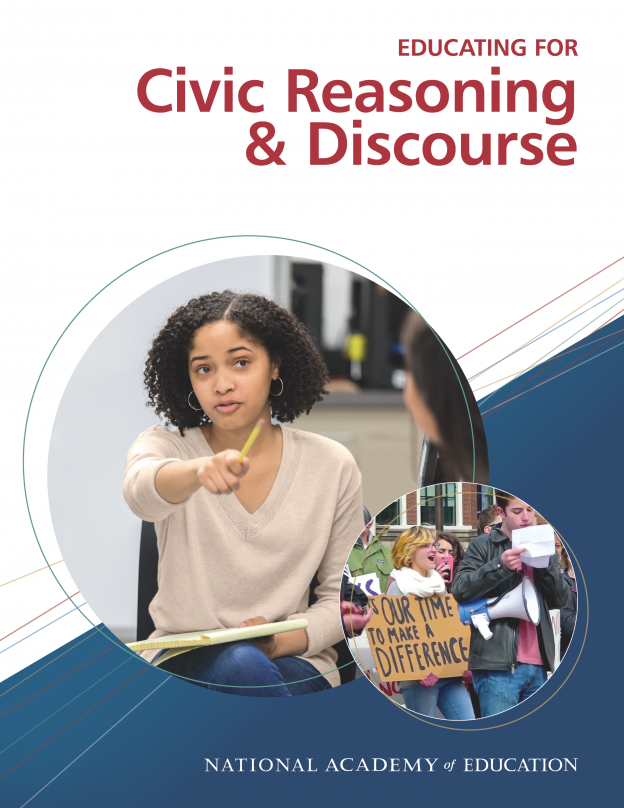
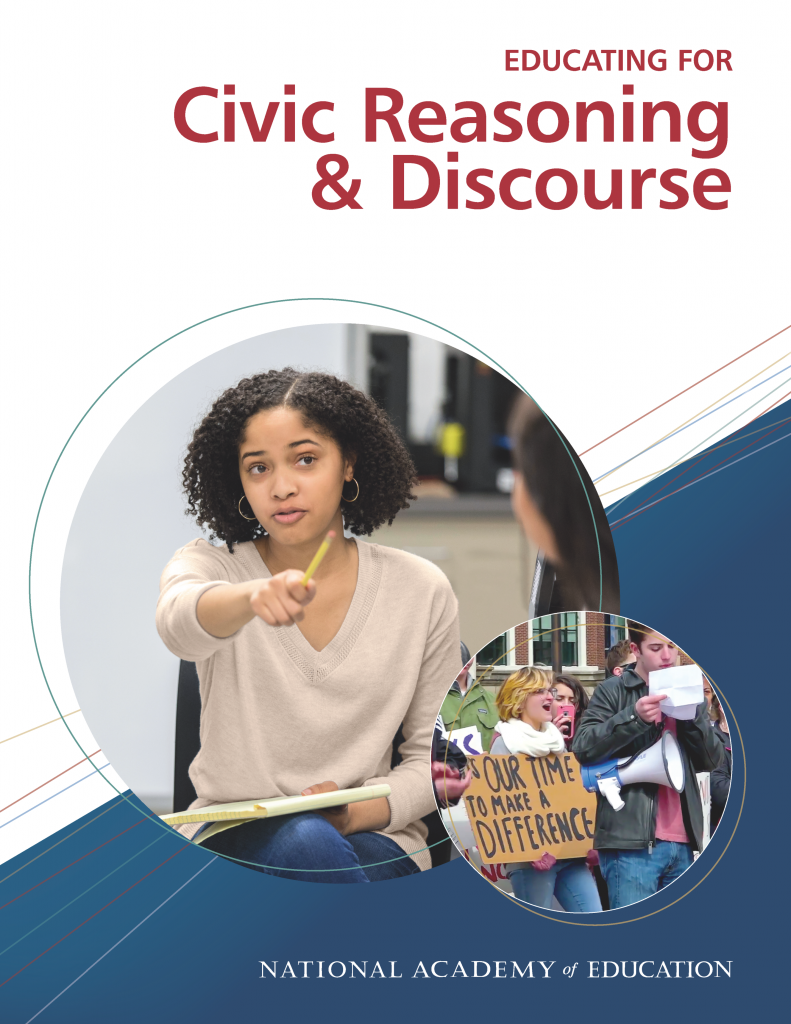
NAEd Report on Educating for Civic Reasoning and Discourse

The National Academy of Education (NAEd) is releasing its report on Educating for Civic Reasoning and Discourse. I was on the Steering Committee along with eight wonderful colleagues, and many more scholars contributed to writing the document. You can attend a public forum to hear more about it on May 3, 2021, 12:00 pm – 2:00 pm Eastern Time. Register here.

I’d describe this report as a response to problems of polarization, incivility, motivated reasoning, propaganda, and strained democratic institutions, along with racial injustice and other social crises. It is a response from the learning sciences, with papers by specialists on learning, schooling, and human development. In contrast to the Educating for American Democracy Roadmap, this report is more about how to teach (rather than what to teach); and it addresses education broadly, not just the disciplines of history and civics, which are the focus of the Roadmap. I worked on both projects simultaneously and benefited from the two perspectives.

Aficionados of Civic Studies will recognize this definition from the NAEd report:

DEFINING CIVIC REASONING AND DISCOURSE

Early in its work, the National Academy of Education (NAEd) Committee on Civic Reasoning and Discourse agreed on a shared definition of civic reasoning and discourse to guide the development of this report. The central question guiding the formulation of this definition concerns “What should we do?” and the “we” includes anyone in a group or community, regardless of their citizenship status. To engage in civic reasoning, one needs to think through a public issue using rigorous inquiry skills and methods to weigh different points of view and examine available evidence. Civic discourse concerns how to communicate with one another around the challenges of public issues in order to enhance both individual and group understanding. It also involves enabling effective decision making aimed at finding consensus, compromise, or in some cases, confronting social injustices through dissent. Finally, engaging in civic discourse should be guided by respect for fundamental human rights

conservatism and identifying as white among Latinos

Latinos preferred Biden over Trump by 65%-32% according to the exit polls. There is some debate about that statistic, but it seems safe to say that Latinos tilt Democratic, yet somewhat less so than they did in the recent past.

We also know that people who consider their own whiteness important to their identity are more likely to support Trump. In the Tufts Equity study, whites who consider race important to their own identity favored Trump by 61.5%-31%, whereas Trump’s lead among other whites was just 5 points (47%-42%: less than a majority).

In this context, it seems significant that a majority of Hispanics identify as white, and a substantial proportion–one quarter in the 2012 American National Election Study (ANES)–say that being white is important to their identity.

I get that last statistic from Filindra and Kolbe 2020. These authors find that Latinos are more likely to identify as white if they have higher incomes, and less likely to identify as white if they have more education and if they report strong consciousness as Latinos. (Possibly, education increases social awareness.) Latinos are more likely to be Republicans and to support cuts in welfare if they identify as white.

These are not mere correlations but the results of models that control for numerous other variables. It is equally interesting that some variables do not seem to matter, e.g., religion, skin tone (albeit known for only some respondents), and whether one was born in the US or overseas. The degree of acculturation is related to views of welfare but not to other measures.

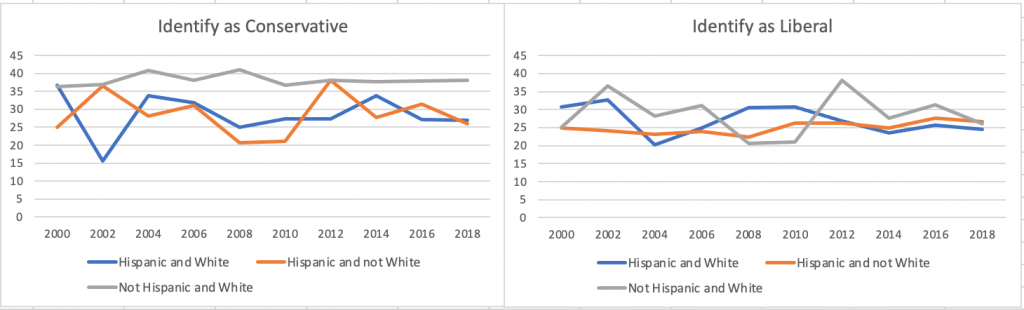
Filindra and Kolbe use 2012 ANES data, and I was interested in change since then. In a nutshell, I find no important shifts. My graphs below show rates of identifying as conservative and as liberal in the ANES since 2000. (Moderates are not shown, although they are the largest group.) Whites who are not Hispanic are the most conservative, and at a steady rate. However, they have also become the most likely to identify as liberal (at the expense of moderates). Hispanics who identify as white have been somewhat less conservative than other whites. And Hispanics who do not identify as white have not been statistically different from those who do.

Source: Filindra, Alexandra and Kolbe, Melanie, Are Latinos Becoming White? The Role of White Self-Categorization and White Identity in Shaping Contemporary Hispanic Political and Policy Preferences (May 16, 2020). Available at SSRN: https://ssrn.com/abstract=3602372 or http://dx.doi.org/10.2139/ssrn.3602372

what if climate change isn’t a tragedy of the commons?

Robinson Meyer’s Atlantic piece, “An Outdated Idea Is Still Shaping Climate Policy” led me to “Prisoners of the Wrong Dilemma: Why Distributive Conflict, Not Collective Action, Characterizes the Politics of Climate Change” by Michaël Aklin and Matto Mildenberger. I think the implications are profound.

Climate change looks like a tragedy of the commons. Most people stand to lose a great deal as the earth’s climate heats up. However, to prevent or mitigate that process, substantial numbers of individuals, companies, and countries would have pay or forego benefits. Each party will want the others to bear the burden and not make voluntary contributions by itself.

One classic solution to such dilemmas is a top-down rule that alters everyone’s incentives–in this case, a tax on carbon. However, the United Nations can’t tax anything. Each country’s carbon tax costs its own economy without (by itself) solving the climate crisis. Thus the tragedy reemerges at the international level and predicts that satisfactory carbon taxes will be hard to enact. Although 64% of Americans agree that “the U.S. should reduce greenhouse gas emissions regardless of what other countries do,” the theory suggests that this belief is soft and not likely to support ambitious policies. I’ve even made a simple online game to simulate this problem in teaching.

However, evidence seems to be building for a different model. Some people gain tangibly and immediately from decarbonization. Consider firms that build solar panels, low-carbon farmers, individuals who teach environmental science in high school, environmental engineers, and even residents of cities that are powered by renewables and compete with cities that depend on coal.

If some gain while others lose, it is no longer a Tragedy of the Commons. It is regular game in which the winners obtain benefits and the losers bear costs. Aklin and Mildenberger call this a “distributive conflict.”

In a mixed economy, the winning is side is likely to be more numerous (with more votes) and richer (with more buying and investing power). The size and wealth of both sides may change over time.

A distributive conflict makes new solutions appear possible. Governments can borrow or tax and spend the revenue to expand the size and power of the coalition that favors decarbonization. They can also compensate the losing side for reasons of equity or to reduce opposition. The game is rivalrous but not strictly zero-sum; everyone can gain in important respects even if some pay more than others.

According to the Tragedy of the Commons model, spending money will not solve climate change. This model views both costs and benefits in a static way: each dollar reduces carbon by a certain amount. The results are not necessarily very impressive, and they face a limit. There is still a lot of carbon under the ground; it has market value; and subsidizing renewables does not make the carbon worthless. Thus it will be burned. Besides, governments will surely–and perhaps rightly–fail to use spending to minimize carbon emissions. Since they will also be interested in other goals (jobs, health, equity, or ensuring their own reelection) they will not buy as much carbon reduction as they could.

But the alternative model offers hope that spending may be dynamic. Dollars invested in renewables, a new power grid, R&D, an electric car for one’s family, and even environmental education build constituencies for decarbonization. As these constituencies grow, they will use their economic and political power to demand more decarbonization–including the harder solutions of taxes and regulations. In that case, subsidies have leverage.

See, for instance, Liu, Lixia, Yuchao Zhu, and Shubing Guo. “The evolutionary game analysis of multiple stakeholders in the low-carbon agricultural innovation diffusion.” Complexity 2020 (2020). See also: public event on Governing the Commons: 30 Years Later with discussion of policing and climate change; A Civic Green New Deal; a Green recovery; taxing and spending are more compatible with democratic values than regulation is. And see our Civic Green project.

an overview of civic education in the USA and Germany

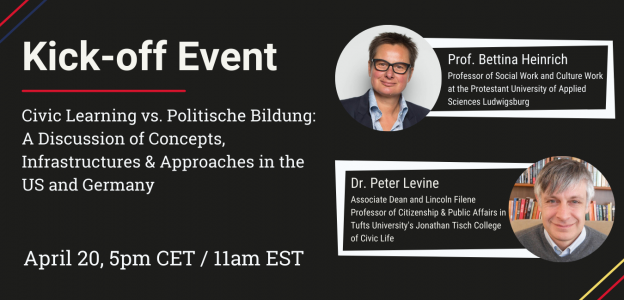
In this video, I offer a very broad introduction to civic education in the USA–framing my remarks historically. Essentially, I trace a tradition of experiential, community-based civic learning that runs from de Tocqueville through Jane Addams to Dorothy Cotton and onward; and a tradition of studying civics in school that really takes off with Horace Mann. These two traditions intertwine, and John Dewey is an important bridge between them. I argue that neither is in very good condition today.

Then Bettina Heinrich, from the Protestant University of Applied Sciences Ludwigsburg, gives an overview of “politische Bildung” (political education or development) in the Federal Republic of Germany, focusing on the post-War period. We both note significant mutual influence between these two countries.

Another event will follow this one:

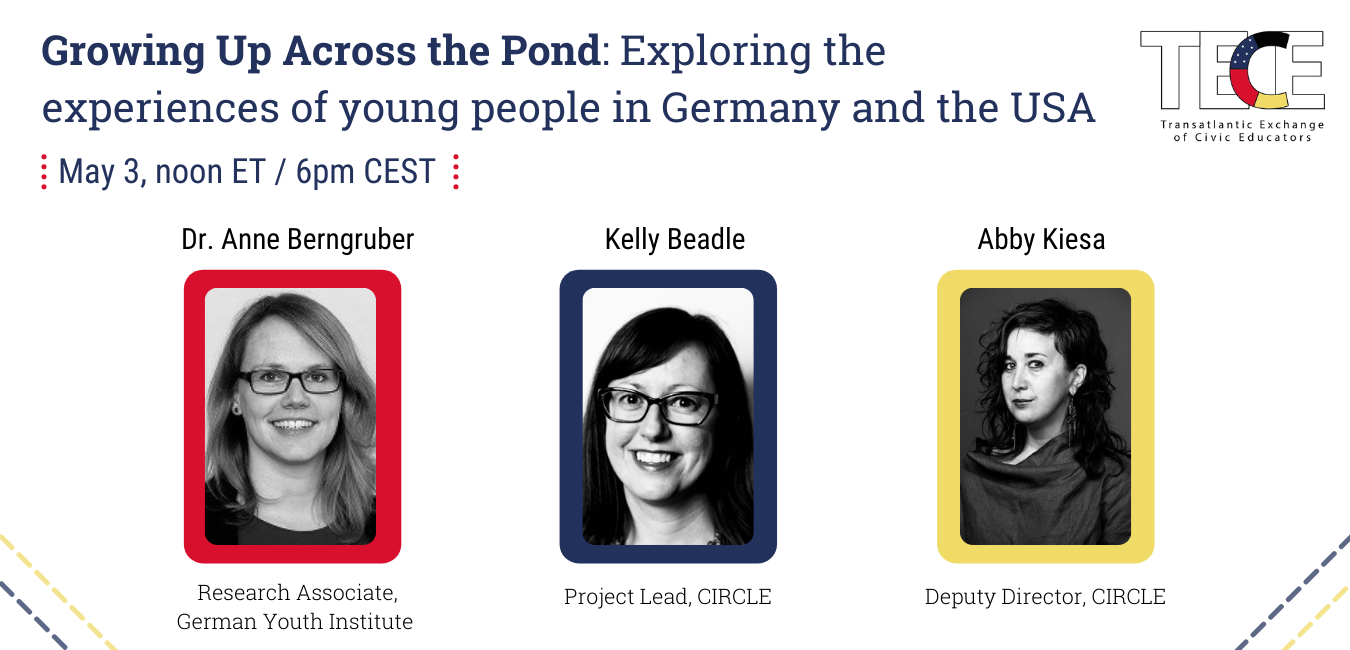
“Growing Up Across the Pond” (May 3, noon US Eastern Time) will be more about the general context for youth in Germany and the USA today. (You can register here.)

These are both open events, meant for anyone who is interested. They are also introductory events for people who might want to join The Transatlantic Exchange of Civic Educators (TECE), which “will bring together German and U.S.-American extracurricular civic learning professionals to unlock opportunities for mutual learning and reintroduce a transatlantic dimension to the field.”