Horace against the Stoics

Horace wrote his first book of Satires (meaning “medley” rather than “satire” in the modern English sense) no later than 33 BCE. In a passage in the Third Satire, he criticizes the Stoic doctrine that justice has its basis in nature. He suggests that rules are conventions that allow us to prevent conflict with minimal cruelty.

Nothing about his position is unique, but his language is luxuriant: “cum prorepserunt primis animalia terris / mutum et turpe pecus, glandem atque cubilia propter / unguibus et pugnis …” In my version …

When the animals crawled from the new* earth,
That mute and ugly herd fought for a nut 
Or a place to rest--with nail and fist, 
Then with clubs, then with tools they’d designed for war,
Until they came upon words to mark out sounds 
And sense, and names. From then on, war waned. 
They walled towns and wrote laws so that no one
Should be a thief, a thug, or an adulterer.
For even before Helen, sex** was a vile 
Cause of conflict, but those are forgotten 
Who died chasing it, like the bull in the herd, 
Cut down by someone more fit than he is.
You have to admit, if you really search the files,
That laws were contrived in fear of injustice, 
For nature can’t distinguish just from unjust
As she makes some things safe and others best to shun,
Nor can reason convince us it is just as bad--
And bad in the same way--to step on someone’s 
Garden plant as to steal a holy relic 
By cover of night.*** Let there be a standard 
To tell the right penalty, so the cruel lash 
Isn’t used when a regular beating would suffice.

Horace, Satires. 1.3.99-119, my translation

*Literally, “first earth.” **Actually a vulgar, sexist word. *** I’m surprised he doesn’t say: reason can’t convince us it is worse to steal the sacred object.

See also some thoughts on natural law; “The Wedding of Peleus and Thetis“; pragmatism and the problem of evil

public opinion has moved against mandatory vaccination

Using Ipsos’ KnowledgePanel, the Tufts University Research Group on Equity in Health, Wealth, and Civic Engagement surveyed representative samples of Americans in 2020 and 2021. Among many other questions, we asked whether authorities should be able to mandate vaccination. Most respondents said no both times. Support declined from 42.6% to 34.5% from 2020-2021. Biden supporters were more favorable than non-voters, who were more favorable than Trump supporters. However, both Biden and Trump voters moved against mandatory vaccinations. Possibly, Trump supporters have become less likely to favor vaccination mandates now that the federal government is led by a Democrat, but that wouldn’t explain the decline among Biden supporters.

I report these results without a strong value-judgment. I think I would support mandates (with appropriate exemptions), but that's just an opinion. I don't have expertise or fixed views.

Some caveats: In 2020, we asked about vaccinations in general. In 2021, we asked about the COVID-19 vaccines. In 2020, we asked whether people would vote in the next November election--and if so, for whom. In 2021, we asked whether and how they did vote in the prior election. Too few people admitted they didn't vote; our turnout estimate is inflated by over-reporting.

See also: Despite Similar Levels of Vaccine Hesitancy, White People More Likely to Be Vaccinated Than Black People.

methods for engaged research

We are in the second day of the American Political Science Association’s Institute for Civically Engaged Research (ICER), hosted by Tisch College but held online this summer. Twenty excellent engaged political scientists are the participants, and they are interacting with the directors and visitors.

One issue for discussion is the relationship between methodology and civically engaged research. Is engaged research a method? Does it favor one or more methods over others? Or is it methodologically neutral?

I won’t try to characterize the other ICER participants’ views, except to note that they hold diverse and thoughtful opinions on questions like this. For myself, I’d want to resist a tendency (outside of ICER) to equate engaged research with qualitative methods.

I have a biographical reason not to endorse this distinction. My own background is in philosophy, and I succeeded Bill Galston (a political theorist) as the second director of CIRCLE until 2015. CIRCLE is well-known for quantitative research: its own surveys plus analysis of federal data and voting records. Yet CIRCLE has always employed full-time experienced professionals whose main focus is building partnerships and capacity in its partner organizations. I see CIRCLE as a deeply civically engaged research center, in the sense that Amy Cabrera Rasmussen, Robert Lieberman, Valeria Sinclair-Chapman, Rogers Smith, and I propose in a forthcoming article in PS:

Civically How people govern themselves. Engaged  research teams are self-governing  collaborative groups (composed of  community organizations, government  actors, social movements and others); their  research strengthens self-governance for  others.
engaged Collaborative, in partnership, with benefits  and substantive roles for both political  scientists and non-academics in the same  projects.
research Any organized, rigorous production of  knowledge, including empirical, interpretive,  historical, conceptual, normative, and other  forms of inquiry.
political science A pluralist discipline with a central focus on  questions of power, politics, and governance.

Given my background, I’ve always found it natural that engaged research can involve any method, from big-data analytics to randomized field experiments to philosophical inquiry. I would acknowledge a debt to the atmosphere at the University of Maryland in the 1990s, when people like Galston, Steve Elkin, Gar Alperovitz, Linda Williams, and others comfortably combined political theory with empirical research and civic engagement. I also found inspiring models in Elinor Ostrom and Jane Mansbridge.

Meanwhile, I observe that community partners of various kinds are drawn to the full range of methods. Some groups are very comfortable with robust and explicit debates about normative issues. They may connect more easily to the methods of philosophy, political theory, and theology than to qualitative social science. Other groups have big datasets and are already quite good at crunching numbers but would like to collaborate with people situated within universities. Some run interventions and are quite happy to randomize treatment and control groups. Certainly, some are not comfortable with any of those methods, but that doesn’t mean that interviews and focus groups will suit them best.

If anything, engaged research seems an invitation to mix methods and to develop methodological pluralism. Positivism may be an obstacle to engaged research, but “positivism” doesn’t mean quantitative research methods or the application of statistics. Positivism in the problematic sense is a philosophy that sharply distinguishes facts from values, scientists from subjects, and knowledge from power. Qualitative researches can be naive positivists, while number-crunchers can hold nuanced and productive ideas about epistemology.

See also civically engaged research in political science #APSA2019; we should be debating the big social and political paradigms; how to present mixed-methods research; what gives some research methods legitimacy? etc.

The New Hampshire Institute for Civic Education’s William W. Treat Lecture Series

How can we renew faith in our institutions and in our neighbors? That is theme of the following public events:

the UK in a polycentric Europe

I’ve had deep connections to the UK since childhood and have always been committed to the idea of Britain in Europe. I believe that the UK has been much better off as a part of the EU, while the EU could benefit from particular British perspectives and institutions. For those reasons, Brexit saddened me.

However, I also believe in polycentricity. As a descriptive theory of the world, it says that there are (almost) always many centers of power, and they need not stack up neatly, with smaller, weaker units inside bigger and stronger ones. Jurisdictions and roles usually overlap and interrelate in complex ways.

As a reform agenda, polycentricity says that things work better when power is divided into many parts that partially overlap. Over-centralization is generally unwise.

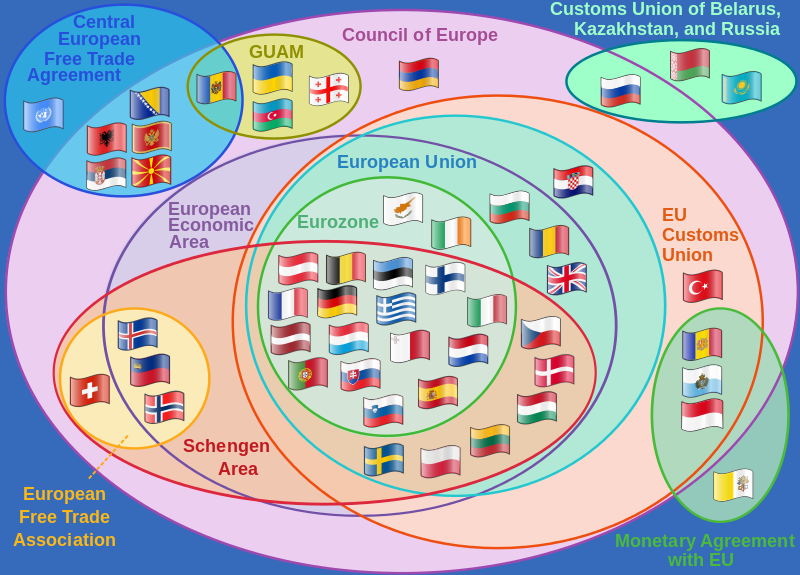
“Europe” is already polycentric in this sense. Here is one person‘s diagram of important treaties among European nations. The treaty groups overlap in a classic polycentric way.

“Euler Diagram of Europe” from https://www.reddit.com/r/europe/comments/2etvpz/euler_diagram_of_europe/

This diagram is useful but far from complete. In addition to treaty arrangements, one could add other partnerships among nations, cities, companies, labor unions, universities, parties, professional groups, and more. Also, the image presents each nation as a unit, when many EU member states are federal or otherwise decentralized.

The picture is a little dated; the Union Jack will have to move outside of several circles where it appears above. However, the UK will not move outside of the polycentric network of Europe. Like it or not, Britain is “in.”

To British people who favor European integration, I would say: Brexit was bad. But you are still in Europe. The path forward is to encourage as much participation as possible in a wide range of cooperative ventures, whether among nations or among other kinds of entities. These cooperative activities should extend across Europe but not always be limited to the European continent.

To people who aspire to a federal Europe, I would say: Federalism, as implemented in republics like the USA, Germany, and Brazil, is one approach to combining centralization with decentralization. It assumes a Westphalian sovereign state that has ultimate power and attracts the deepest allegiance from all its citizens, with a neat tessellation of smaller and weaker units inside it that resemble each other and have similar relationships to the whole. This is by no means the only approach to making something large out of many smaller components. In the European context, federalism may have outrun its mandate and potential, at least for now. So everyone who wants to see Europe integrate should be willing to experiment with other overlapping associations.

To Euroskeptic Britons, I would say: You’re in Europe. You always have been, at least since prehistoric French people helped build Stonehenge. Sovereignty is an oversimplification, since power is always polycentric. By overestimating the importance of the national level of government, you have reaped a bunch of unnecessary problems and foreclosed some beautiful solutions, such as a borderless Ireland within the EU. Nevertheless, you and your children and your children’s children must belong to numerous networks and partnerships that cross the Channel. You should be working on making these partnerships work.

See also: Brexit: a personal reflection; modus vivendi theory; avoiding a sharp distinction between the state and the private sphere; British exceptionalism 2: the unique nature of the aristocracy; a range of federalism options for Israel-Palestine.