US polarization in context

A comparative approach is useful for testing theories about one of the prominent phenomena of our time: polarization.

If you assume that people naturally polarize because of hard-wired features, such as the human tendency to prefer members of our own groups, then you would expect levels of polarization to be consistent across time and countries.

If you assume that polarization is specifically an American issue, you might look at unusual features of US society that have persisted over time, such as our two-party system, the salience of race and racism, sheer size, the private news media, or the fact that we have several regional elites who don’t necessarily know each other (Wall Street financiers, Texas oilmen, Silicon Valley entrepreneurs, etc.).

If you assume that the problem is global and recent, you might look at international developments, such as social media, plutocracy, the decline of a neoliberal consensus, or the revival of illiberal nationalism.

If you assume that the problem is specifically American and recent, you might focus on changes in the US system, such as the departure of Southern conservatives from the Democratic Party after the 1960s, or the replacement of national party structures with entrepreneurial candidates, or more sophisticated gerrymandering, or the election of Barack Obama, which may have alerted some White voters to the emerging reality that the Democrats are decisively more diverse than the Republicans:

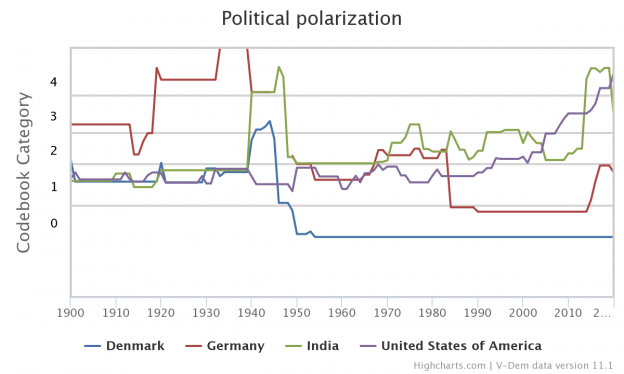
The comparative graph for this post illustrates a few selected points.

FIrst, current levels of polarization in the USA are comparable to those in Weimar Germany or India at the time of partition and worse than Denmark’s under occupation. Bolsonaro’s Brazil and Venezuela score even higher than the USA today, but that is not good company. Polarization cannot be hard-wired if it varies so much, and our levels are alarming.

Second, social media cannot simply and straightforwardly explain the recent growth in polarization, for media would affect tech-savvy Denmark as much as the USA. Yet Denmark is one of several democracies that demonstrate consistently low polarization. (The EU as a whole shows some increase in polarization since 2000, but much less than the USA.)

Third, the USA has seen polarization increase a lot lately, which works against explanations that evoke stable features of US society, such as the two-party system.

I am not one who views polarization as an intrinsic evil. If a society is divided between democrats and authoritarians, the problem is not polarization; it is the authoritarians. Less division between good and bad players may indicate a harmful compromise. In the Weimar case, I think polarization posed a challenge to the fragile representative system, but the main problem was the Nazis. (Stalinists made things worse.) Describing Weimar as an example of “polarization” suggests that there were several groups who just didn’t get along. Instead, some groups belonged in jail.

Nevertheless, polarization poses challenges of its own. It encourages political actors at all levels to push their own rights and interests to the limits, without concern for any collateral damage to the institutions. The levels in the USA today exceed those in comparable countries by large margins and resemble those recorded just before notorious historical disasters.

Caveat: the graph (from V-Dem) does not show objective measures of polarization, but the assessments of social scientists who study these countries. See also: affective polarization is symmetrical; promoting democracy and reducing polarization; empathy boosts polarization; marginalizing views in a time of polarization; civic education in a time of inequality and polarization; vaccination, masking, political polarization, and the authority of science

the sublime and other people

Early last month, I posted a little poem in celebration of a deep snowfall. I was hardly the first. People appreciate natural phenomena, find ways to represent aspects of what they see, and share the results. We have done this, I suppose, for at least 64,000 years, since the oldest cave paintings we know.

In some cases, an explicit goal is to thank a benevolent power for the gift. For instance, I love how Gerard Manley Hopkins detects a Divine Father behind all “dappled things“–like “skies of couple-colour” or “a brinded cow.” “Praise Him,” says Hopkins. Unfortunately, I cannot share that type of explanation.

For others, the theme is the objective beauty of nature, understood as impersonal but perfect. “The hills / Rock-ribbed and ancient as the sun,—the vales / Stretching in pensive quietness between …” I must admit that I am struck by the subjectivity of such judgments. Our dog appreciates, but I don’t think he is much taken by distant vistas of snow on sagging branches. Smelly fire hydrants are closer to his sublime. A nest of cockroaches has as much objective complexity and order as a snow-covered forest, but most of us human beings (although not all of us) would recoil from it. Nature gives us pure drifts of fresh snow, but also muddy slush and freezing rain. These examples cause me to doubt that beauty lies in nature.

Another response is that we are constituted to enjoy things like snowy views, and this is a wonderfully good fact about us. Just as we may lament our human proclivities to violence, despair, and cruelty, so we can celebrate our ability to savor what we find sublime. And not only celebrate it, but actively cultivate this appreciation and share it with other people through the representations that we create. In that case, the beauty is essentially in us, but it is really there, and that is a reason for gratitude.

I don’t know whether human beings are automatically constituted to enjoy a snowscape. Perhaps we are, but our responses could vary by personality and culture. I am sure that my own appreciation is something learned. I do not simply see the snow; I see it with things already in my mind, like Christmas decorations, paper snowflakes on second-grade bulletin boards, Ezra Jack Keats’ A Snowy Day, Pieter Bruegel the Elder’s “Hunters in the Snow,” Han-shan’s Cold Mountain lyrics, Robert Frost’s ”lovely, dark and deep” woods, Hiroshige’s woodblock prints of wintry Japan, Rosemary Clooney with Bing Crosby. In short, I have been taught to appreciate a winter wonderland, a marshmallow world, and a whipped cream day. Some of these influences probably detract, but they were meant well, which is how I would defend “Hush.”

It’s sometimes said that when Petrarch climbed Mont Ventoux (in Provence) in 1336–simply to enjoy and describe the view–he was the first European ever to do such a thing. Clearly, some people outside of Europe had loved mountain views long before Petrarch. I find it plausible that certain communities of people appreciate vistas, while others do not. And some of us may have learned the sublimity of landscapes from a chain of people originally inspired by Petrarch, although he was surely influenced by the classical sources that he knew so well. We all see what we have learned to see.

To me, this debt to other human beings only deepens the sublime. Nature was not created for us; it just is. And we were not created to enjoy it, although–very fortunately–we do. But our fellow human beings have deliberately shared their appreciation and heightened our own, which means that we are the beneficiaries of benevolent intelligence after all. Praise them.

Activities and ideas for activists

Just lately, I have been writing copy for a new Civic Studies website (more than for this blog). It began as a companion to my forthcoming book, What Should We Do? A Theory of Civic Life. I wanted to summarize some core ideas from the book and link them to activities and practical tools that readers might find useful. I’ll be happy if the site gradually evolves away from the book to reflect changes in the world, the publication of new research, and other people’s contributions.

The backbone is this navigable “learning map,” which poses recurrent questions that confront groups of people who try to make change:

I anticipate roughly doubling the number of entries over the next month or so. (Requests are welcome.) And then I would hope to see it grow more gradually, with input from others.

assessing equity in health, wealth, and civic engagement

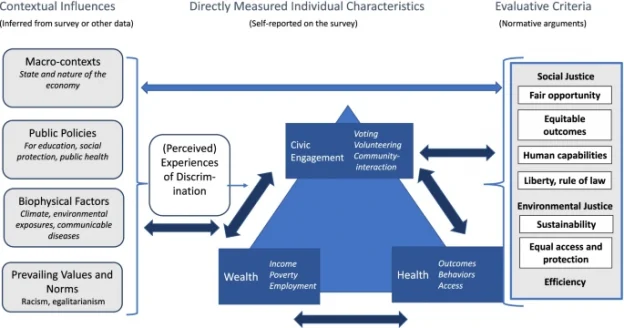
Newly published and open-access: Stopka, T.J., Feng, W., Corlin, L., King, E, Mistry, J. Mansfield, W, Wang, Y, Levine, P. & Allen, J. Assessing equity in health, wealth, and civic engagement: a nationally representative survey, United States, 2020Int J Equity Health 2112 (2022). The abstract is below. The project website, with interactive tools for exploring the data, is here.

I am proud that our model includes “evaluative criteria” (normative principles) along with empirical information and causal arrows. One of my most basic beliefs is that these domains must be integrated in order to decide what to do in the world. I would acknowledge, however, that our approach is cross-sectional–it’s all about similarities and differences in the present. It therefore obscures historic injustices, which are central to many of our most important current debates about social justice.

Background

The principle of equity is fundamental to many current debates about social issues and plays an important role in community and individual health. Traditional research has focused on singular dimensions of equity (e.g., wealth), and often lacks a comprehensive perspective. The goal of this study was to assess relationships among three domains of equity, health, wealth, and civic engagement, in a nationally representative sample of U.S. residents.

Methods

We developed a conceptual framework to guide our inquiry of equity across health, wealth, and civic engagement constructs to generate a broad but nuanced understanding of equity. Through Ipsos’ KnowledgePanel service, we conducted a cross-sectional, online survey between May 29–June 20, 2020 designed to be representative of the adult U.S. population. Based on our conceptual framework, we assessed the population-weighted prevalence of health outcomes and behaviors, as well as measures of wealth and civic engagement. We linked individual-level data with population-level environmental and social context variables. Using structural equation modeling, we developed latent constructs for wealth and civic engagement, to assess associations with a measured health variable.

Results

We found that the distribution of sociodemographic, health, and wealth measures in our sample (n =?1267) were comparable to those from other national surveys. Our quantitative illustration of the relationships among the domains of health, wealth, and civic engagement provided support for the interrelationships of constructs within our conceptual model. Latent constructs for wealth and civic engagement were significantly correlated (p =?0.013), and both constructs were used to predict self-reported health. Beta coefficients for all indicators of health, wealth, and civic engagement had the expected direction (positive or negative associations).

Conclusion

Through development and assessment of our comprehensive equity framework, we found significant associations among key equity domains. Our conceptual framework and results can serve as a guide for future equity research, encouraging a more thorough assessment of equity.

Apply for the 2022 Institute for Civically Engaged Research (ICER)

The American Political Science Associations’ Institute for Civically Engaged Research (ICER) is a four-day, residential institute that provides political scientists with training to conduct ethical and rigorous civically engaged research. Up to 20 scholars will be selected as ICER Fellows and invited to attend the 2022 Summer Institute. ICER Fellows will network with other like-minded political scientists, and together, learn best practices for conducting academically robust, mutually beneficial scholarship in collaboration with communities, organizations, and agencies outside of academia.

The first Summer Institute was organized in partnership with Tufts University’s Jonathan M. Tisch College of Civic Life in 2019. ICER was canceled in 2020 due to COVID-19 and hosted virtually in 2021. For 2022, we anticipate holding the Institute in person at Tufts University, outside of Boston, MA, from June 20-23.

The Institute will take place on campus at Tufts University from June 20-23. Approximately twenty fellows will meet each day for intensive discussions and workshops. Thanks to support from the Ivywood Foundation, participation in the Institute for Civically Engaged Research is free, housing on the Tufts campus will be provided, and scholarships are available to defray costs of meals and travel. Applicants are expected to seek financial support from their home institution, but admission to the Institute will not be affected by financial need.

To apply, please complete this form. Application deadline: March 1, 2022.

Note: The Institute will operate according to the recommendations and requirements of federal and local public health authorities. We plan for the Institute to be held in person at Tufts University but reserve the right to change these plans as the public health situation warrants.