This is a 12.5-minute video in which I introduce the republican tradition (or just “republicanism”) as it is typically discussed in political theory these days. I’m drawing on authors like G.J.A. Pocock, Quentin Skinner, Philip Pettit, and Ian Shapiro. I also refer to Melvin Rogers’ important recent work on Black American republican thought and some ideas of Brooke Ackerly about how domination (which is the main concern of republican theorists) may relate to oppression. In our Introduction to Civic Studies course, we will be reading and discussing Rogers, so an immediate purpose of my video is to give our students some definitions that they can use to understand his work. But I hope that the video may be useful for others as well.
Last week, in a course I am co-teaching on Religious Pluralism and Civic Life, we discussed a fascinating story from The Jerusalem Talmud (completed before 400 CE), with help from my Tufts colleague Yonatan Brafman:
§ Rav Yehuda [Judah bar Ezekiel, 220–299 CE] says that Rav [Abba Arikha 175–247 CE] says: When Moses ascended on High [to Mount Sinai], he found the Holy One, Blessed be He, sitting and tying crowns on the letters of the Torah [kether or decorative tags added to specific Hebrew letters]. Moses said before God: Master of the Universe, who is preventing You from giving the Torah without these additions? God said to him: There is a man who is destined to be born after several generations, and Akiva ben Yosef [50-135 CE] is his name; he is destined to derive from each and every thorn of these crowns mounds upon mounds of halakhot [laws and ordinances]. It is for his sake that the crowns must be added to the letters of the Torah.
Moses said before God: Master of the Universe, show him to me. God said to him: Return behind you. Moses went and sat at the end of the eighth row in Rabbi Akiva’s study hall and did not understand what they were saying. Moses’ strength waned, as he thought his Torah knowledge was deficient. When Rabbi Akiva arrived at the discussion of one matter, his students said to him: My teacher, from where do you derive this? Rabbi Akiva said to them: It is a halakha transmitted to Moses from Sinai. When Moses heard this, his mind was put at ease, as this too was part of the Torah that he was to receive.
Moses returned and came before the Holy One, Blessed be He, and said before Him: Master of the Universe, You have a man as great as this and yet You still choose to give the Torah through me. Why? God said to him: Be silent; this intention arose before Me. Moses said before God: Master of the Universe, You have shown me Rabbi Akiva’s Torah, now show me his reward. God said to him: Return to where you were. Moses went back and saw that they were weighing Rabbi Akiva’s flesh in a butcher shop [bemakkulin], as Rabbi Akiva was tortured to death by the Romans [for teaching the Torah]. Moses said before Him: Master of the Universe, this is Torah and this is its reward? God said to him: Be silent; this intention arose before Me.
When Moses magically enters Akiva’s classroom (maybe 1500 years in the future), he chooses to sit in the back row, like an apprehensive freshman, and then feels his confidence slip even further when he realizes that he cannot follow the sophisticated conversation. This is a metaphor for intellectual progress and growing expertise.
But then, when Akiva’s authority is challenged, the rabbi credits everything he knows to Moses (or to the commandments that Moses that had received on Sinai), which is a metaphor for original revelation. Akiva is saying that everything was already known at the beginning of the tradition.
At the moment that Moses experiences his vision of Akiva’s classroom, he has not yet received the Torah and does not know its content. He is consoled by the thought that the text that he will receive will “contain” Akiva’s interpretations of it.
The frame text (“Rav Yehuda says that Rav says …”) alerts us to the chain of pronouncements and commentary that is central to Judaism–and to many, if not all, intellectual and spiritual traditions. Ideas come from sources. Interpreters analyze and interpret these ideas, building larger bodies of thought that derive authority from their origins even when they no longer express the founders’ intentions.
One could say the same of US constitutional law. In that tradition, too, it is common to think that the founders would be bewildered by contemporary legal arguments, or that everything we argue today is somehow contained in the founding documents–or both. We might imagine:
The ghost of James Madison went and sat at the back of Larry Tribe’s Harvard con-law lecture class and didn’t understand what anyone was talking about. He ducked low in his seat in case Tribe decided to cold-call him. Madison was relieved when Tribe suddenly mentioned him as the “Father of the Constitution.”
To doubt that there is–or ought to be–any link between the founding and the present is to dispute the value of the whole framework.
At some point, it’s natural to ask why such an edifice exists, as Moses does when he asks about the “reward” of Torah. According to tradition, Akiva was tortured to death for refusing to stop teaching scripture, which dramatizes this question. The answer is: “Be silent; this intention arose before Me.” In other words: “Don’t ask.” Even the divine voice is passive, as if the “intention” arose of its own volition.
At the base of the structure is obligation, not choice–or so this Talmudic story suggests. Is that always the case?
On one hand, I am concerned about the phenomenon of white Christian nationalism in the United States. In some churches and religious networks, some people believe that the nation ought to be fundamentally white and Christian and that Christianity somehow undergirds this idea. White Christian nationalism competes with more emancipatory and inclusive theological views, but it’s influential.
On the other hand, I am still drawn to the old, Tocquevillian argument that participating in the governance of an organization that contains any diversity can teach skills and values of deliberation, tolerance, and inclusion. And churches can be such organizations.
Therefore, I am worried about people who identify as white and Christian without actually participating in maintaining communities or wrestling with the complexities required by self-government. At the same time, I am cautiously optimistic that asking people to take responsibility for real religious communities will strengthen democracy, because members can learn how to hold a group together, manage disagreements, select good leaders, interact with outsiders, and hold each other accountable.
Thus I would hypothesize that:
H1 Identifying as a white Christian will be associated with racial anxiety and intolerance, because white Christian dominance is threatened today by growing racial diversity and greater equality. But …
H2 Participating in groups that offer an element of self-governance will promote democratic values and therefore should correlate negatively with racial anxiety. (Especially if the group is diverse).
Churches are manifestations of Christian identity and places where some people receive racialized messages, but they are also groups that can offer various degrees of diversity and self-governance. Therefore:
H3 Among whites, church membership (a proxy for Christian identity) will be associated with racial anxiety and intolerance. However,
H4 Controlling for religious identity as well as race, church participation will be associated with higher tolerance. (This hypothesis is similar to the findings of Ekins 2018.)
Nationally representative survey data collected by Data for Progress from August 4-30, 2022 offer a chance to test these hypotheses. The sample is 1,899 likely voters (who differ from non-voters in the US resident population). The survey asks several questions about religious belief, identity, attendance, and participation.
The survey also asks several attitudinal questions about diversity. I chose: “It would bother me if, one day, white people were an ethnic minority in the United States.” I will label disagreement with that prompt “inclusiveness,” for the sake of using one word.*
Two limitations of the survey: It doesn’t ask about the diversity of respondents’ religious congregations or which religion people belong to. However, 94% of white Americans who identify as religious are Christian (2% are Jewish), so a relatively modest error results from assuming that white religious respondents are Christian and their congregations are churches.
I have run Ordinary Least Squares (OLS) regressions to predict inclusiveness based on various other questions in the survey and to test the four hypotheses stated above.
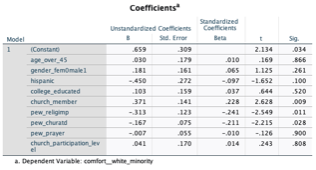
H1 is correct: The importance of religion to a person is negatively correlated with their inclusiveness (when controlling for demographics). Being white, over 45, and not being college educated are also negatively associated with inclusiveness in this model.
Another way to look at the same pattern is to restrict the sample to whites (most of whom are either Christian or non-religious) and omit race from the regression. For whites, being religious, over 45, and not college educated are negatively associated with inclusiveness.
H2 is not correct: Contrary to what de Tocqueville or Dewey might predict, a person’s total number of active group memberships is negatively associated with inclusiveness. The more groups you actively participate in, the less likely you are to accept whites becoming a minority. This relationship is statistically significant but small. When looking only at whites, the relationship is no longer significant, but it isn’t positive, as I would have hoped.
Different group memberships evidently have different relationships with racial anxiety. The bivariate correlation between religious-congregation membership and inclusiveness is -.058** (Pearson), but no other forms of membership are correlated to a significant extent with this outcome. In a regression with group memberships as the only independent variables (i.e., without demographics), religious groups and sports are negatively correlated with inclusiveness; art groups are positively related.
H3 is correct: Being a member of a religious congregation is associated with less inclusiveness (controlling for demographics).
H4 is correct: Religious participation helps.
In a model that includes prayer, attendance, religiosity, congregational membership, and religious participation, membership has a significant positive correlation with inclusiveness, whereas religiosity is a negative correlate. When looking at whites only, congregational membership is a positive; religiosity and attendance are negative.
The previous sentence is my takeaway. For white Christians, being actively involved in a church builds the values that we need for a pluralistic democracy. At the same time, simply identifying as Christian and hearing Christian messages is associated with intolerant values. We need the first effect to outweigh the second one, and that is a struggle in an era when most associations (including churches) have weakened while mass and social media have expanded.
*Data for Progress actually ran a survey experiment and asked some people whether they would be bothered and others whether they would not be bothered. This difference in question-wording yielded somewhat different results. I combined the two items into one measure.
Newly published: Peter Levine & David Abromowitz, “Challenges Reported by Candidates for Local Office,” State and Local Government Review (2022). Available behind a paywall: https://doi.org/10.1177/0160323X221130449 or in page proofs as open access here.
Abstract:
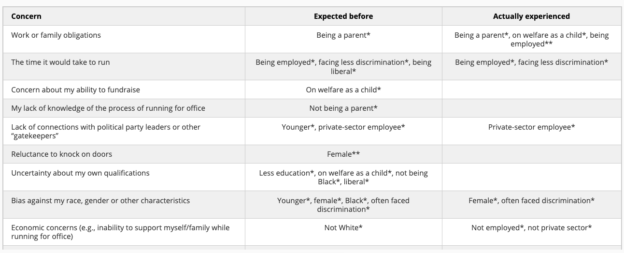
A survey of 711 candidates for local offices in the United States, conducted in December 2021, reveals that many were concerned before they began their campaigns about the impact of politics on their work and family, the time demands of campaigning, their ability to raise funds, and their knowledge of the process, among other obstacles. Many candidates who had anticipated each concern found it less onerous than they had expected. Those who were parents, those with full-time jobs, and those who had experienced poverty as children were especially likely to have difficulty meeting work and family obligations while campaigning. Being liberal, being young, having less education, and experiencing poverty in childhood were all associated with concerns about being qualified to run. The study offers additional details about which backgrounds and experiences are associated with specific challenges in local campaigns. The results may inform efforts to recruit and support underrepresented candidates.
Table 6 (“Predictors of Concerns”) summarizes some key findings. It is based on statistical models that account for other factors.
Our paper is an example of Civically Engaged Research (CER) in political science: “an approach to inquiry that involves political scientists collaborating in a mutually beneficial way with people and groups beyond the academy to co-produce, share, and apply knowledge related to power or politics, contributing to self-governance.”* David Abromowitz is a leader of the the New Power Project, which is “uniquely focused on recruiting and empowering values-driven individuals who have grown up in marginalized or underserved communities” to run for office. David approached me with the idea of conducting a survey of current candidates, drawing the sample from BallotReady. We designed the survey instrument together. I crunched the numbers, addressing David’s queries as well as my own. Our article illustrates that civically or community-engaged research is not always qualitative or hands-on. Although we statistically analyzed an anonymous survey, our collaboration was essential, and the results should help the New Power Project while contributing to the scholarly literature.
I wish I could follow the uprisings in Iran more closely and insightfully, but my background knowledge is limited and news coverage in English is scanty. I must admit that the regime’s victory over mass nonviolent protests in 2011-2012 made me pessimistic, especially since that turned out to be the first in a series of victories by repressive regimes. The global success rate for nonviolent social movements has fallen from near 70% in the 1990s to under 30% in the past decade, probably because authoritarian governments have improved their tactics.
That said, pessimism can be self-fulfilling. Turning trend-lines into predictions squelches agency and hope. Successful revolutionaries are not determinists. Walter Benjamin wrote in 1940, “The awareness that they are about to make the continuum of history explode is characteristic of the revolutionary classes at the moment of their action.” One never knows when masses of people will find inspiration in selected moments from the past and disrupt the patterns of recent history.
The literature on social movements and popular uprisings may offer some insights. That literature suggests that we should focus on certain recent developments in Iran.
The protests appear widespread, highly decentralized, and attractive to a diverse range of Iranians, including students, merchants, oil workers, and ethnic minority groups. In the literature, both the size and the pluralism of protests are related to their odds of success. (The “s” and “p” in my SPUD framework stand for those two factors.)
The movement appears capable of coordinating across a large country even though Iran has shut down the Internet and the protesters do not follow a few charismatic (and hence vulnerable) national leaders.
There are preliminary reports of some soldiers and police joining protests. Although “security force defection” has not occurred yet at substantial scale in Iran, it is a recognized phenomenon in popular uprisings. Chenoweth and Stephan (2011) found that nonviolent movements have been 46 times more likely to succeed when some members of the security forces defect. Anisin (2020) identifies “the size of the oppositional campaign (100,000+ participants)” as a common precondition of security force defection. One recent example was in neighboring Armenia in 2018.
There are also some preliminary reports of possible fissures within the regime, with (for instance) a “Hardline Chief Justice Call[ing] For ‘Dialogue With People’.” The supreme leader, Ayatollah Ali Khamenei, is said to be “gravely ill,” and his office may represent a power vacuum.
I believe that whether to use violence is a matter of judgment that depends on the circumstances, yet movements generally benefit by imposing restraints on their own behavior. Unrestrained tactics tend to escalate in ways that can damage or split a movement. Refraining from physical violence against human targets–or refusing to use live ammunition–can be bright lines that prevent such escalation. So far, the Iranian protesters seem to be using nonviolence as a self-imposed restraint.
By the way, a movement can be nonviolent despite scattered exceptions. Indeed, a mass movement that is predominantly nonviolent can benefit from the pressure imposed by parallel military movements. In the current case in Iran, several armed insurgencies are underway that may prove synergistic with the civilian protests.
Women play a disproportionate role in the Iranian protest movement. Women have certain strategic assets for social movements. For one thing, their activism can present “an apolitical appearance” that allows them to “engage in more political forms of resistance” without seeming to threaten the state’s monopoly on violence, as my colleague Anjuli Fahlberg notes in her study of Rio (Fahlberg 2018).
So far, we are seeing a familiar cycle: violent state repression instigates broader and more intense popular protest, which create dilemmas for the security forces and may initiate a downward spiral for the regime. That was the pattern in Paris in 1789 and also in Tehran in 1979, when every time the Shah’s regime killed protesters, the vast funeral processions turned into new expressions of popular will. Of course, it was also the pattern in Syria in 2011, with an ultimately tragic outcome.
Overall, I would be looking–and hoping–for scale and diversity, security force defections, self-imposed limitations, and acts of repression that stimulate even broader resistance. Success is far from inevitable but remains possible.
Citations: W. Benjamin, Theses on the Philosophy of History (1940), trans. by Harry Zohn, xv; Erica Chenoweth and Maria Stephan, Why Civil Resistance Works: The Strategic Logic of Nonviolent Conflict (New York: Columbia University Press, 2011; Alexei Anisin (2020) Unravelling the complex nature of security force defection, Global Change, Peace & Security, 32:2, 135-155; Fahlberg, A. N. (2018). Rethinking Favela Governance: Nonviolent Politics in Rio de Janeiro’s Gang Territories. Politics & Society, 46(4), 95–110. See also: people power in Iran (2009); why autocrats are winning (right now); Why Civil Resistance Works; the case for (and against) nonviolence; pay attention to movements, not just activists and events; etc.