- Facebook16
- Threads
- Bluesky
- Total 16
In our century, a major fault line in US politics has been the question of “American exceptionalism,” meaning the unique excellence or mission of the USA–“the notion that America is freer and more democratic than any other nation, and for that reason, a model, vindicator, and at times the chief defender of ordered liberty and self-government in the world” (Stanley Kurtz).
As I observed in 2010, “Newt Gingrich, Sarah Palin, Mike Huckabee, Mitt Romney, and Rick Santorum agree: the president and his allies in Washington deny ‘American exceptionalism’ in a way that is unprecedented (Huckabee), ‘truly alarming’ (Gingrich), or ‘misguided and bankrupt’ (Romney).”
This was ironic, since Barack Obama had come to national attention with a riveting speech at the 2004 Democratic convention in defense of nothing other than … American exceptionalism. “Tonight,” Senator Obama had said, “we gather to affirm the greatness of our nation.” Throughout his presidency, he often spoke on the same theme. In 2014, he said, “I believe in American exceptionalism with every fiber of my being.” And yet accusing him of failing to understand–or of actively undermining–America’s unique excellence became a competitive sport on the right.
But there is an important group that doesn’t really believe in American exceptionalism: the American public. Here is a result from this week’s Wall Street Journal/NBC poll: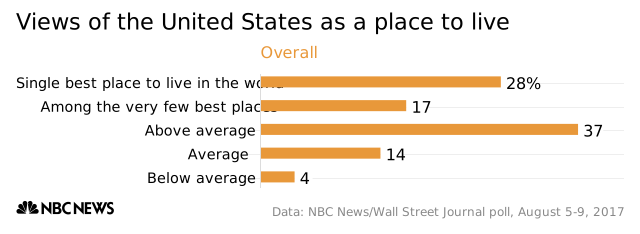
It looks as if most Americans think the US is above average as a place to live (I agree, by the way), but that just over a quarter think it’s the single best place in the world. Asked to rate the “national character,” the median respondent gives us a score of 5 out of 10, down from 6 out of 10 in 1998. This survey question makes no explicit mention of other countries, and it’s possible that people would rate every other nation’s character lower than ours–but that seems unlikely for the people who rate us 5 or lower.
The claim that America is “is freer and more democratic than any other nation” is empirical. It begs for comparative statistics. Freedom House rates the US 89 on freedom, a good score but 11 points below Sweden’s perfect 100. Maybe they’re wrong, but ranking the US number one in the world certainly requires evidence. It’s not a test of patriotism but a hypothesis about the world.
One might focus instead on prosperity and economic dynamism. But the enormous comparative advantages that we held as result of the Second World War have faded away, and we now represent just 4% of the population of a competitive world in which lots of nations, small and large, inevitably score economic successes.
This gap between a rhetoric of unique superiority and the facts seems to cause profound anxiety. In 2016, Trump positioned himself as the candidate who believed that the US should be better than every other nation but had lost that status due to feckless politicians. He often asserts that we are worse off today than anyone else–for example, that our tax rates are uniquely high, as if we were the socialist exception in a neoliberal world. Clinton took the view that we were “already great.”
Both positions could be seen as responses to anxiety. Valid criticisms of the American past (slavery and segregation, especially) have perhaps fueled this anxiety by suggesting that we were never exceptionally great to start with. That’s a raw point for people who think that our exceptionalism is threatened.
Three issues to think about:
- To what extent is the US actually “exceptional”–not in the sense of better, but different? We are unusual (but not actually unique) in our degree of racial diversity. We have the oldest constitution in the world. We have no way to call an early election to end a failing administration. We have never had a socialist government, but our left has a robust alternative tradition of pluralist populism. We are the birthplace of the Civil Rights Movement and its philosophy of politics. We fought a civil war over the question of slavery in which 750,000 died. We tend to think of ourselves as a commercial republic instead of, for example, a social democracy, a social market economy, or a consensus model. We may once have had a high degree of economic mobility, but now we do not. We once had a very strong voluntary sector, but it, too, is now probably weaker than those in other nations. We are a Petri dish for new religions, some messianic in nature; and we are more religious than other advanced economies. These are just examples of ways that we are, or once were, unusual.
- Underlying most claims of exceptionalism are normative positions: assertions that some aspects of our society are not just unusual, but valuable. What values that are plausibly associated with the US are worthy of praise? Should we be proud because we have a tradition of laissez-faire economic policies? Or because of the New Deal and its legacies?
- What attitude should an American citizen hold toward the US Republic? Favoritism over other countries? An even-handed and detached stance toward the US as just one of many countries? For myself, I would say: a special, focused responsibility for awakening the better angels of our nature.
See also: the new history wars; American exceptionalism; British exceptionalism: how the UK is different from Europe; should we teach patriotism?; and a palindrome (a poem on America).