Monthly Archives: March 2017

school choice is a question of values not data

I disagree with my friend Robert Pondiscio about many policies, but I agree with an essential aspect of his argument in a US News article entitled “Asking the Wrong Questions on School Choice.”

Some impressive-looking recent studies assert that school choice doesn’t “work” because test scores go down when families use vouchers to transfer their kids to private schools. The New York Times describes these results as “dismal” and cites “harms” to the children from voucher experiments. Pondiscio believes that the preponderance of the evidence still “tends to favor school choice.” I don’t know if that is right, but I’m with Pondiscio that “this entire debate puts the cart before the horse.”

After all, who said that test scores are the purpose of schooling? “Choice exists to allow parents to educate their children in accordance with their own needs, desires and values.” Some parents will prefer schools that achieve lower scores on state standardized tests because they value other ends. To measure choice in terms of test scores “says, in effect, that one’s values, aspirations and priorities for one’s child amount to nothing.” He concludes:

If we limit the frame of this debate to academic outputs alone, every new study provides ammunition, but never a conclusion. The real debate we should be having is, “What kind of system do we want?” Answer that question first, then use evidence to improve the school designs, policies and programs we have agreed deserve public support.

I’ve made similar points in debates about, for example, the economic impact of civic engagement, the educational value of service learning, and the evaluation of policy more generally. We live in an age when science has enormous prestige and values are widely viewed as merely subjective. In that context, it’s common to treat programs and policies much as scientists would view natural phenomena, as things that arise on their own and have measurable effects. To decide whether they “work” means measuring their causal impact with apparently objective measures, of which state-written tests are good examples. Negative results lead to strongly value-laden conclusions–such as the Times’ headline about “dismal failures”–that are not themselves scientific.

In fact, programs and policies arise because people have value commitments. They strive to make their ideas work, albeit for various and contested purposes. Usually nothing works at first. If its impact improves, it’s because people have made it work by refining and improving the practice. The reason that data provides “ammunition, but never a conclusion” is that any empirical result can be changed by revising and improving the program under study. Therefore, the fundamental question is not what works but what we should value and try to make work.

An everyday example is public schooling. Nineteenth century reformers like Horace Mann drew from previous thinkers—and from successful experiences in countries like Prussia—to propose a new idea: every child should be educated at the government’s expense in a state-funded common school under local political control. Since then, not only have educators and policymakers refined and revised most aspects of public schooling, but scholars have critically evaluated actual schools from a wide variety of perspectives. A few observers have concluded that Horace Mann’s core idea was misplaced, but most see their role as helping to make his vision become successful. Public schools did not arise like a new species in Darwinian evolution to survive or fail on its own. Nor did Horace Mann propose a hypothesis that could be tested with a single experiment (e.g., “Common schools will work.”). Rather, universal public schooling originated with an argument that combined values and empirical predictions, and it launched a process of improvement that has combined research with practice.

The question is whether individual family choice is a transcendent value. Robert Pondiscio argues that using test scores to assess vouchers makes family preferences “amount to nothing.” I think we all value parental choice to a degree, but everyone also weighs other concerns: children’s rights, interests, and preferences, community values, prosperity at the state and national scales, democratic ideals of collective self-governance, our responsibilities to children other than one’s own, and criteria of excellence that may be unpopular.

I agree that the American ideal of the common school has always been a bit problematic, and versions of family choice common in Western Europe may get the balance better than we do with our odd mix of local monopoly schools plus radical economic inequality. But if we seriously considered the question “What kind of system do we want?”, I’m not sure the answer would be a system driven by parental preferences.

I should add that another kind of reasoning (besides scientism) motivates experiments with school choice. Some people think that market competition always or generally increases efficiency, so that introducing choice into a former monopoly will improve outcomes, almost regardless of how they’re measured. Then the effects of vouchers on test scores becomes an experiment in the efficiency hypothesis. Even if the results are mixed, the existence of major, high-quality, and recent studies in which the effects are strongly negative sounds like counter-evidence. I think that should embarrass proponents of market efficiency, of whom one was Elizabeth Warren in The Two-Income Trap: Why Middle-Class Parents are Going Broke (2003):
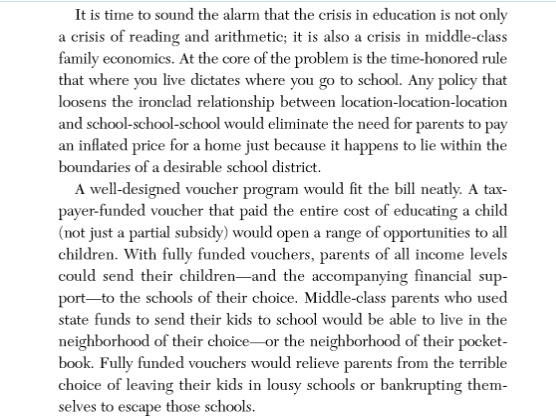
However, as Pondiscio argues, you can support choice as an inherent value, not because of an empirical hypothesis about economic efficiency.

hearing the faint music of democracy

Democracy has many inherent flaws. This is just the start of a comprehensive list:

  1. Majority tyranny: the many may oppress the few.
  2. Free-riding: it doesn’t pay to be informed or active when you can let others engage instead.
  3. Propaganda: it works.
  4.  Motivated reasoning: people pick information to reinforce existing beliefs.
  5. Boundary problems: many political issues are about who belongs within a given polity, so how can a polity legitimately decide where to draw that line?
  6. The Iron Law of Oligarchy: even in organizations fundamentally committed to equality, a few come to dominate because bureaucracy rewards specialized expertise.
  7. The privileged position of business: because communities need investment, capital will be advantaged even if businesses don’t actively lobby.

Most of these issues have been understood for centuries, yet the scholarly evidence for them accumulates. Then along comes an actual fiasco like the 2016 election, and it’s tempting to give up on the whole idea. Democracy seems to be that system that places a racist fool in the White House.

Yet people have constructed rather remarkable “patches” to keep democracy going. Just for instance, it seems implausible that many citizens would purchase and consume a daily source of fairly independent and well-sourced news that focuses on matters of public importance. But for about a century, most Americans did buy a metropolitan newspaper every day, and the proceeds funded shoe-leather journalism. The newspaper’s financial model worked because people paid for classified ads, comics, and sports as well as news, but they saw the daily headlines on the front page. Although the model was profitable–hence sustainable–it couldn’t have existed without the dedication of the people we call “the press”: professional reporters, editors, publishers, journalism educators (k-16), and some newspaper owners, who were motivated in part by the public interest.

That’s just one example. I would add broad-based political parties, civil rights organizations, public-interest lobbies, responsive government agencies, civic education courses, civic forums, community organizing efforts, the DREAMer movement, and many more.

Why have people worked so hard to create and sustain these efforts, when the flaws of democracy seem intrinsic and intractable? They’ve heard the democratic music as well as the everyday prose.

The music is there if you listen for it. Whitman heard it: “Though it is no doubt important who is elected governor, mayor, or legislator, (and full of dismay when incompetent or vile ones get elected, as they sometimes do,) there are other, quieter contingencies, infinitely more important.” Alexander Hamilton, in most ways so unlike Whitman, heard similar chords. He started the Federalist Papers asking whether we can live together by “reflection and choice” rather than “accident and force.” These authors saw republican self-rule not only as a way of making decisions by choice but also as a path to cultural and spiritual development. For Whitman, it meant being able to stand up “without humiliation, and equal with the rest” and starting that “grand experiment of development, whose end, (perhaps requiring several generations,) may be the forming of a full-grown man or woman.”

If we’re smart, we’ll focus on the prose: the catalog of serious and enduring flaws that beset democracy. But if we’re wise, we’ll also hear the music, and that will keep us working on a new generation of solutions.

The Civic State of the Union

The Civic State of the Union

Tuesday, March 7 | 6:00 p.m.
ASEAN Auditorium, Fletcher School | Tufts Medford Campus

Join us for a panel about the state of civic life in the United States and the role of civic engagement in addressing national and global problems. Our featured panelists will be Robert D. Putnam, a political scientist and the Malkin Professor of Public Policy at the Harvard University John F. Kennedy School of Government who wrote the seminal book Bowling Alone; Shirley Sagawa, President and CEO of the Service Year Alliance and a Visiting Senior Fellow at the Center for American Progress; and Peter Levine, Tisch College’s Associate Dean for Research and the author of We Are the Ones We Have Been Waiting For: The Promise of Civic Renewal in America. The panel will be moderated by Mara Liasson, National Political Correspondent for NPR and a contributor at Fox News. RSVP below. Can’t make it? Watch the live stream here.

new postdoc in civic studies

Jonathan M. Tisch College of Civic Life Postdoctoral Fellowship in Philosophy or Political Theory

Tufts University’s Tisch College, in collaboration with the departments of Philosophy and of Political Science, will award a Jonathan M. Tisch College of Civic Life Postdoctoral Fellowship in the 2017-18 academic year to a junior scholar with a PhD in the field of philosophy or political theory who is not yet tenured. Candidates should submit a research proposal for scholarly work related to civic studies. Civic studies is an emerging interdisciplinary field that develops ideas and ways of thinking helpful to citizens, understood as co-creators of their worlds. Because civic studies emphasizes the agency of people and groups, it combines ethics, empirical work, strategies, and institutions. Tufts will hold a social ontology conference in 2018, and therefore applicants with interests in social ontology or collective agency are particularly encouraged.

Scholars are required to spend the year (September–May) in residence at Tufts University. For the 2017-18 academic year the Fellowship carries a stipend of $55,000, health insurance, and a $3,000 research fund. The Fellow will be expected to support capstone experiences with Tufts undergraduates and to teach one academic course in addition to conducting their research. The fellow will also be expected to deliver a public lecture at Tufts on the topic of their research at some point during the fellowship year.

Qualifications

Junior scholar with a PhD in the field of philosophy or political theory who is not yet tenured. Candidates should submit a research proposal for scholarly work related to civic studies.

Application Instructions

Applications must include: a cover letter, CV, writing sample, two-page research proposal, and three letters of recommendation. Applications should be submitted to: https://apply.interfolio.com/40979

Application deadline: April 15, 2017. Notification of award: May 8, 2017.

Questions about the position should be addressed to Tisch College Associate Dean of Research Peter Levine at Peter.Levine@tufts.edu.

what it means that people prefer a businessman to a politician for president

The contrast between Donald Trump the businessman and Hillary Clinton the politician has been underplayed (although not entirely overlooked) as an explanation of the 2016 election. I don’t interpret Americans’ admiration for business leaders as a preference for the market over the government, although that distinction might influence some people. Instead, evidence shows that many people dislike deliberation and compromise in politics. That stance is compatible with admiring a president who expands the government, as long as he acts like a private-sector boss.

In 1998 (when HRC was First Lady), John R. Hibbing and Elizabeth Theiss-Morse* found that most Americans didn’t rate their fellow citizens as informed or intelligent. They didn’t want to participate in government or politics, nor did they prefer a political system with much public involvement. They had few policy preferences, but they strongly disliked the people in charge of the government. They suspected political elites of selfish and greedy behavior. For instance, they thought that elected officials get rich from government service. They believed that the public had consensus on most issues, yet agreement was mysteriously absent in Congress. They interpreted elites’ disagreement as a sign of corruption. A majority of their respondents (about 70%) agreed with two or three of the following propositions, which qualified them as believers in what Hibbing and Theiss-Morse called “Stealth Democracy”:

  • “elected officials would help the country more if they would stop talking and just take action on important problems” (86% agree)
  • “what people call compromise in politics is really just selling out on one’s principles” (60%); and
  • “our government would run better if decisions were left up to nonelected, independent experts rather than politicians or the people” (31%) or “our government would run better if decisions were left up to successful business people” (32%)

Fifty percent wanted the government to be run more like a business. There was also considerable support for billionaires and technocratic experts, since neither could profit from their own decisions. In 1992 Harris Poll, 55% of respondents had agreed that Ross Perot wouldn’t be influenced by special interests because he was rich.

In their book, Hibbing and Theiss-Morse used a survey that’s now 19 years old. In 2009, Michael Neblo, Kevin Esterling, Ryan Kennedy, David Lazer, and Anand Sokhey challenged their findings empirically, but in 2015, Hibbing and Theiss-Morse repeated the analysis and connected it to the Trump campaign. Believers in what they called “Stealth Democracy” preferred Trump to Clinton by 38%-13%; people who disagreed with that view narrowly favored Clinton.

Trump is a perfect example of a leader who says he’ll “just take action,” in harmony with the consensus of all real Americans. Hillary Clinton exemplifies a politician who is good at compromise, who acknowledges disagreements and engages in debates–and who has become rich as a result of her political career.

I believe that people learn from experience that disagreement exists and compromise is necessary. They learn those truths by participating in diverse groups that can make consequential decisions. But the proportion of adult Americans who either attend weekly religious services or belong to a union has dropped by 21 points, from a majority of 55 percent in 1970 to a minority of 34 percent in 2012. The proportion of all Americans who serve on any local board had plummeted by 75% since the mid-1900s, due mostly to consolidation of governmental functions plus professionalization. Juries are also much less prevalent: 1 in 40 felony cases now goes to a jury trial, down from 1 in 12 as recently as the 1970s.

People still know how bosses operate in the private sector. But few know what it’s like to be democratic leaders, because few are allowed to play such roles locally. That’s a recipe for a rejection of democratic values.

*Stealth Democracy: Americans’ Beliefs about How Government Should Work (Cambridge University Press, 2002). I draw here from my own 2003 summary.