Monthly Archives: March 2017

The “civic state of the union”

This is the video from the “Civic State of the Union” on March 7 at Tisch College. The participants are Mara Liasson, National Political Correspondent for NPR and contributor to Fox News; Robert D. Putnam, political scientist, Professor of Public Policy at the Kennedy School of Government, and author of numerous works, including Bowling Alone; Shirley Sagawa, President and CEO of the Service Year Alliance and a Visiting Senior Fellow at the Center for American Progress; and me. We talked about the civic condition of the United States and what to do about it.

on the Deep State, the administrative state, and the civil service

The last few days have seen several prominent articles about “the Deep State”: by David Remnick in the New Yorker, Marc Ambinder in The Washington Post, Julie Hirschfeld Davis in the New York Times, and Kevin Williamson in The National Review, among others. I’d been thinking of writing myself, and I think we need some definitions:

  • The Civil Service: a body of government employees who are protected against political patronage and dismissal without cause in return for embracing norms of nonpartisanship, public service, and professionalism.
  • The Administrative State: government agencies that make and enforce rules and regulations (in contrast to statutes enacted by legislatures) and/or directly manage public resources, such as land.
  • The National Security Apparatus: military and spy agencies as well as police agencies concerned with terrorism, foreign espionage, and subversion.
  • Bureaucracy: any large organization divided into specialized offices, each requiring appropriate training and having defined roles and responsibilities, the whole being organized hierarchically and aimed at achieving some predefined or externally defined end or purpose.
  • The Deep State: a group of people within any or all of the above who collude secretly to pursue their own shared agenda, which may reflect their self-interest or an ideological interest contrary to the goals of elected leaders.

Some observations based on those definitions:

Most of the above definitely exist. Whether the (or a) Deep State exists is a matter of conjecture. One reason that the answer is not obvious is that the National Security Apparatus is cloaked in considerable secrecy. But secrecy is necessary for the existence of such an apparatus at all, and is not indefensible. There are many things we would like our government to know yet not publicly disclose. State secrecy is a problem for a democracy but not necessarily an avoidable one.

If there is a Deep State, it would form within one or more bureaucracies yet would subvert them. That is because bureaucracies constrain their employees to carry out defined tasks, but people who collude for their own agendas are evading such constraints.

The Deep State could exist within the National Security Apparatus, the domestic civic service, or both. Americans in a large swath of the center-left and left tend to be critical of US foreign policy but supportive of regulation and the welfare state. Some of them have feared secret agendas in the National Security Apparatus while viewing officials in the domestic welfare and regulatory agencies as dedicated civil servants. Americans in a large swath of the right have been more supportive of foreign policy than of domestic policy, so they have been prone to see soldiers, police officers, and spies as public servants, and other federal employees as uncontrollable bureaucrats. However, the hard right has also been critical of foreign policy, so there have been Deep State narratives on the right at least since the McCarthy Era. Some on the hard left see the domestic policy apparatus as basically a Deep State devoted to disciplining the poor, but I hear less of that than I used to 20 years ago.

To the extent that we have a genuine civil service, it is designed to push back against elected officials and political appointees. That is not sign of a conspiracy but evidence that popular sovereignty conflicts with such values as scientific rigor and legal consistency. The civil service has a checks-and-balances relationship with elected politicians.

Finally, we do have a problem with the Administrative State, but it is not a conspiracy or anything wrong with the people who work in it. Theodore Lowi was a very fine political scientist whose death on Feb. 17 didn’t get enough attention. Lowi argued that liberals built the regulatory and administrative agencies to enact demanding values for which they had received popular support. But the agencies that liberals created do not have legitimacy to make value-judgments themselves. In lieu of making explicit value-judgments, they claim to make their decisions based on science, efficiency, precedent, or stakeholder negotiation. But they actually make value judgments every day. This creates a crisis of legitimacy that threatens the liberal project.

Another way to make Lowi’s argument is to note that the Administrative State is not envisioned in our Constitution (nor is a permanent National Security Apparatus). Agencies are widely understood as parts of the executive branch or as arms of Congress. (They even employ their own judges, which makes them resemble the judicial branch.) I think a better interpretation is that they represent a fourth branch altogether, which has developed since 1900. It should embody certain norms, such as impartiality, rigor, and predictability, and it should be designed to push and pull with the branches that reflect popular will (Congress and the presidency), deliberation (Congress), discretion and flexibility (the presidency), and law (the judiciary). We should expect tension between the president and the administrative agencies and improve our means of resolving those tensions.

As long as we do not regard the Administrative State as a branch with its own norms and standing, we should expect constant crises of legitimacy, because the existence of this branch has never been recognized by the American people. This is not to defend or rationalize Stephen K. Bannon’s attack on the administrative state. But there is a deeper and longer-term problem that will require attention sooner or later.

See also:  the Citizens United decision and the inadequate sociology of the US Constitutionthe public interest and why it matters;  problems with “stakeholders”; and on government versus governance, or the rule of law versus pragmatism.
Millennials’ political opinions: insights from the new CIRCLE poll

In November’s election, youth turnout seems to have been roughly on par with recent elections. Young voters preferred Clinton to Trump by 55% to 37%, but a majority of young whites chose Trump. See the full CIRCLE post-election report based on exit poll data.

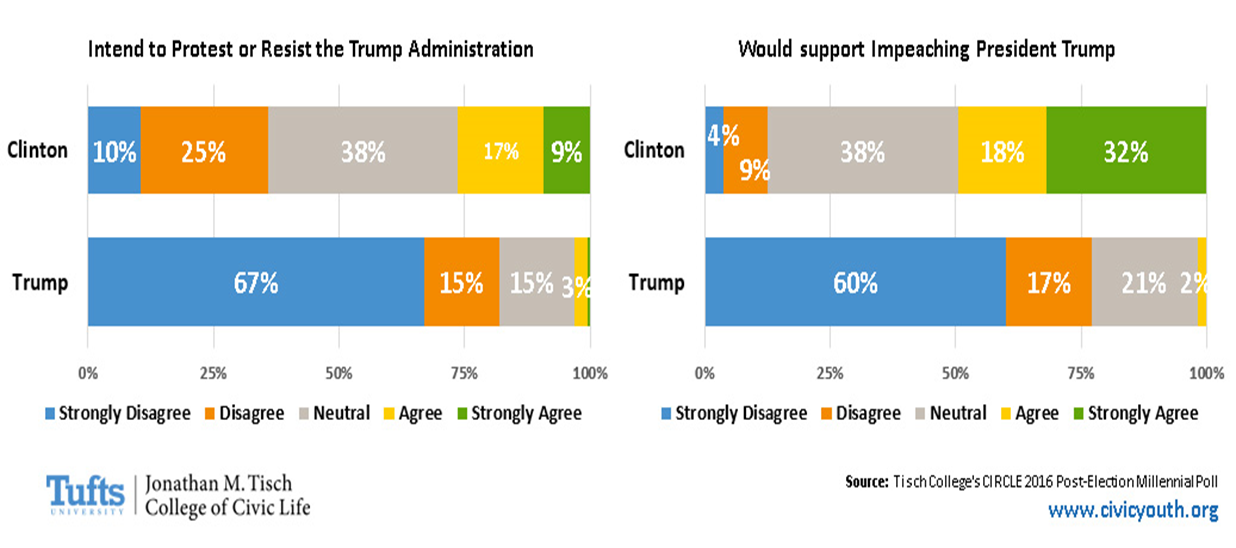
Since then, there has been much political ferment among Americans in general, and specifically among Millennials. My colleagues at CIRCLE surveyed 1,608 young adults last October and recontacted 1,002 of them for a post-election survey released on March 7. The new CIRCLE report contains many insights about the election and the Trump era.  I’ll just mention two to give a flavor.

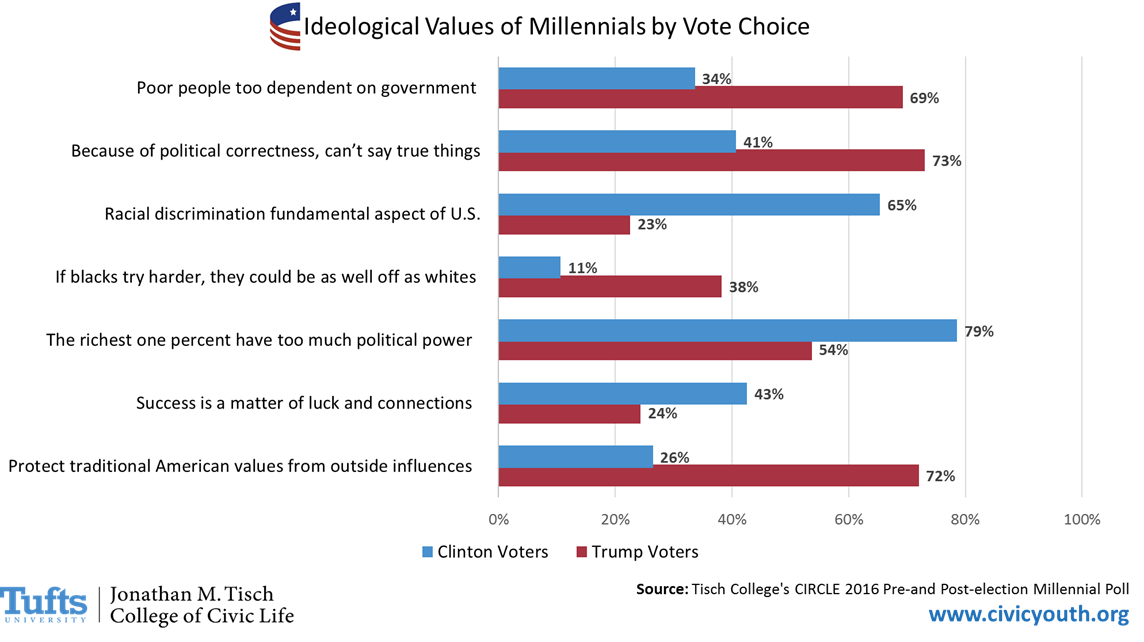
First, young people who voted for Clinton and Trump differed on many contested social issues, which is not surprising in itself. Young Trump voters were more likely to think poor people are too dependent on government, much less likely to be concerned about racial discrimination, and more critical of political correctness (although 43% of Clinton voters shared that view). Almost three quarters of Trump voters wanted to protect traditional American values from outside influences, a rare concern for Clinton voters. But a majority of Trump voters agreed with a larger majority of Clinton voters that the top 1% have too much political power.

Second, even as early as January, CIRCLE found that most Millennials (whether voters or not) said they intended to protest or resist the Trump administration, and half were ready to support his impeachment. Of course, most Trump voters didn’t intend to protest or call for impeachment, but small minorities of his voters did seem to support the resistance, broadly defined.

Read the whole report here.


microgenetic, ontogenetic, and sociogenetic civic learning

At a Center for Ethics & Education conference last week in Kansas City, I learned from Larry Nucci about an important taxonomy. In my summary:

  • Microgenetic learning means obtaining particular knowledge, skills, concepts, values, etc. through particular experiences. A student doesn’t know about Abe Lincoln, reads a book about him, and knows and remembers the president’s story. That is an example of microgenetic learning. We often measure it with assessments before and after lessons or courses. However, it happens at more precise moments, so it’s possible to zero in on the learning events and understand the learning mechanisms.
  • Ontogenetic learning means becoming something different. A small child doesn’t know how to read but becomes literate, a reader. An undergrad doesn’t know much about medicine but ultimately turns into a skilled, practicing physician. Typically, the timescale of ontogenesis is longer than that of microgenesis, but that’s not the essential difference. In theory, ontogenetic change could happen suddenly, as perhaps for Paul on the road to Damascus. The definition is a change in who the person is, not just what he or she knows.
  • Sociogenetic learning is change at the level of a community or society. A community is oral and becomes literate, or pagan and becomes Christian, or analog and becomes digital. Such changes imply that different ontogenetic learning outcomes will become possible, valued, and typical. For instance, a Roman pagan ca. 100 BC couldn’t learn to be a Christian, but his descendants three centuries later could and even had to become Christians. That implied some new microgenetic experiences, like reading scripture and listening to sermons.

These levels of learning can relate in many complex ways. For instance, people can learn specific skills for civic engagement that help them to become activists, and as activists they can change what their society values. Then microgenesis -> ontogenesis -> sociogenesis. Probably more common is the reverse pattern: a society starts to value something, it establishes a new standard of success, and that leads schools to assign new lessons.

This diagram from Saxe 2012 illustrates the various possible pathways.

In fields like literacy and STEM education, which have received heavy investment, scholars have given attention to all three domains. However, I perceive a trend toward the microgenetic level in those fields. It’s increasingly common to apply Learning Sciences and Cognitive Sciences to understand how child A learns skill B at time C. If that trend comes to dominate, there will be need for a critique. We’ll be at risk of missing the forest for the trees and–especially–overlooking what people should learn ontogenically to produce a good society.

In civics, which is underfunded and understudied, most of the research is ontogenetic. It’s most common to use surveys to determine whether children or young adults have become good citizens of one kind or another, and then ask whether civics courses, democratic school climates, or other large influences are related to those outcomes. Practitioners and scholars are certainly interested in microgenetic questions, but that research is scattered and limited, mostly for lack of resources.

Meanwhile, there is a robust debate about sociogenetic changes in civic life. Scholars and pundits debate how the American polity and political culture have changed, what that means for citizens, and how our polity compares to others. Just as an example, Robert Putnam’s Bowling Alone offers a sociogenetic thesis: it’s about how Americans have come to engage more individualistically and less collaboratively since the 1960s. The underlying reasons include changes in technology and the economy (not shifts in civic education).

The sociogenetic debate about citizenship still tends to be somewhat disconnected from microgenetic and ontogenetic research. I didn’t know this vocabulary when Jim Youniss and I edited the volume Engaging Young People in Civic Life, but our explicit goal was to connect debates about civic education to debates about changes in civic life. We thought that developmental psychologists tended to assume that civic life was historically constant, and political scientists and sociologists tended to view civic education as historically constant. However, regimes and modes of education change, and these changes affect each other. It’s even possible for kids to gain skills through microgenetic civic learning that enable them to change what the society values.

Ultimately, we need civic education research that combines the microgenetic, ontogenetic, and sociogenetic levels and yields practical advice for practitioners, policymakers, and advocates.

Figure from Saxe, G. (2012). Cultural development of mathematical ideas: Papua New Guinea studies. Cambridge, UK: Cambridge University Press. My main source is Larry Nucci (2016) Recovering the role of reasoning in moral education to address inequity and social justice, Journal of Moral Education, 45:3, 291-307, DOI: 10.1080/03057240.2016.1167027

public speaking this spring

Please join me if you’re able and interested:

March 10, Medford, MA: Fletcher Political Risk conference, morning concurrent session on varieties of populism.

March 24, Boston, MA: Northeastern University’s NULab for Texts, Maps and Networks, keynote at a conference on “Keeping the Public Sphere Open” (Boston, MA)

March 27, Orlando, FL: University of Central Florida: keynote at the Prince Mohammad Bin Fahd Program for Strategic Research & Studies, the Lou Frey Institute, and the Partnership for Civic Learning conference on “Teaching Tolerance & Peace in Education: American Experiences & International Lessons.”

March 29, Waterville, ME: The 2017 William R. and Linda K. Cotter Debate at Colby College: “American Democracy?”, with Benjamin Page, Gordon Scott Fulcher Professor of Decision Making, Northwestern University; author of Democracy in America? What Has Gone Wrong and What We Can Do About It (Forthcoming); Roslyn Fuller, scholar; author of Beasts and Gods: How Democracy Changed Its Meaning and Lost Its Purpose (2015); and me. Moderator: Joseph R. Reisert, Harriet S. Wiswell and George C. Wiswell Jr. Associate Professor of American Constitutional Law, Colby College.

April 12, Oxford, OH. At Miami University of Ohio’s Humanities Center, “Civic Studies: An Emerging Field

April 19, Los Angeles, at the University of Southern California, Center for Economic and Social Research, “The Hollowing Out of US Democracy.

April 27, San Antonio, TX: panel at the John Dewey Society annual meeting.

May 18, Medford, MA: Tisch College/Good Society symposium on Facts, Values, and Strategies. (Seminar on works-in-progress; you must request papers in advance.)

June 9, Boston, MA: plenary panel at the 2017 Social Science Education Consortium (SSEC) meeting on the theme, “Whither Democracy? Current State and Future Prospects.”

June 22-4, Boston, MA: Frontiers of Democracy conference.