Category Archives: verse and worse

Syria by Eugenio Montale

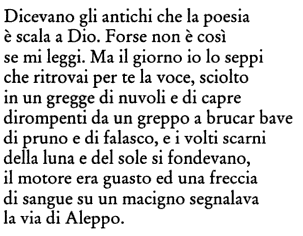
They said, the ancients, that poetry
is a ladder to God. Maybe it’s not like that
when you read mine. But the day I knew it,
that I had recovered my voice through you–loose
as I was in a flock of clouds and goats
crashing out of a ravine to graze on dribble
of thornbush and bulrush, and the lean faces
of the moon and sun were fusing together–
that day the car broke down and an arrow
of blood on a boulder marked the road to Aleppo.

(“Siria,” from La bufera e altro, 1956, translated by Peter Levine)

Montale

a poem should

A poem should compel respect and pity
As a siren stops the city,

Cry
To see the stricken hobble by.

A poem should mutely display
What would hush a room to say:
A handful of dust, a rapist swan,
Bodies scythed into ditches of clay.

A poem should see
What the fry-cook sees, the whale,
The refugee.

It should lay its wrinkled fingers
Gently on and squeeze.

It should release in the back of the nose
Scents of salt water, sex, new rain on soot,
Grandfather’s undiscarded clothes.

A poem is built from parts
And then left on the curb.
You take a piece home, plug it in.
It restarts.

A poem’s every line
Can split and recombine,
Lie unexpressed until it arrests
An ethical decline.

A poem is equal to:
Me plus you.

(With apologies to Archibald MacLeish.)

six-ten

I am not forty-six. It’s not six-ten.
I have no appointments and no inbox.
I am just a head pinned to a pillow,
An eye watching the shade turn from black
To a grey rectangle with pale white rims,
The same shape an infant would see before
It cried, or an old man on his last bed,
Or a cat on its side with its legs stretched.
The clock ticks until it buzzes, but while
It ticks, it ticks, and I am just a head.

a translation for spring

Dante sought his last refuge in Ravenna at the invitation of Count Guido Novello da Polenta (?-1320). According to Boccaccio, Guido was a person “well tutored in liberal studies” who honored “worthy men and especially those who exceeded others in knowledge.” Dante served Guido in various important capacities, including possibly as professor of rhetoric. He died as a member of the count’s household, having just completed a crucial diplomatic mission to Venice on Ravenna’s behalf. Guido organized a solemn funeral for Dante and had the poet buried in a classical sarcophagus in the local monastery of San Francesco.

Dante chose Guido’s own aunt, Francesca da Rimini, as a major character in the Inferno. Romantic-era critics saw Francesca as a doomed heroine, suffering because her love had violated arbitrary conventions and oppressive rules. I argue (along with several modern critics) that she is supposed to be a real sinner. Dante has placed her in hell because she deserves her punishment for adultery, and besides, she doesn’t really love Paolo, whom she describes with a pastiche of slight misquotations taken from love poetry. She is a 14th-century Madame Bovary, in love with the literary concept of love, not with the individual man.

But back to Guido: Intriguingly, he wrote a minor poem that contains a striking phrase that Francesca also utters (almost verbatim) in her last lines to Dante in hell. Either Guido borrowed the phrase that was spoken by his own dead-and-damned aunt in Dante’s already-famous poem, or else Dante read Guido’s poem before he wrote the Inferno and had Francesca quote it. Since almost everything else Francesca says in the Divine Comedy is a slight misquotation, I am inclined to think the latter is true: Dante took a line from his friend’s naive ingenuous sonnet and assigned it to a sinner in hell.

I make no great claims for Guido’s poem, and less for my translation, but I offer it today because the Boston weather reminded me of it. It’s in my Dante book, pp. 17-18:

The air was serene and the sky was clear
And the birds by the river sang.
That day was the first that felt like spring
When I saw you, my joy, so fair.
Your face wore an unaccustomed blush
That never leaves my thoughts today
And whenever I travel far away
Your pleasing smile seems to rush,
Gently launched toward my heart
By the look that comes to your pretty eyes,
And the smile that so sweetly flies
To blend with mine and never part.
Now she can never be torn away;
Joy shall spare me from misery.

Era l’aer sereno e lo bel tempo
et cantavan gli augei per la rivera
et in quel giorno apparve primavera
qand’io te vidi prima, bella gioia.
Ben fosti gioia, chè tal m’apparisti
e col novo color nel tuo bel viso
che già da la mia mente non se parte.
E quando sono in più lontana parte
più mi sovvien del tuo piacente riso.
Sì dolcemente nel mio cor venisti
per un soave sguardo che facesti
dal tuoi begli occhi, che mi mirar fiso
sì che già mai da te non fia diviso,
tanta allegrezza mi dà fuor di noia.

(cf. “che non mai da me no fia diviso”: Inferno v, 133-5).