Category Archives: revitalizing the left

creation, not redistribution

I’m increasingly dissatisfied with programs to redistribute

wealth from the rich to the poor. To be sure, redistribution

can increase aggregate happiness and opportunity, since an extra dollar

makes much more of a difference to a poor person than to a rich one.

Also, there is some evidence that inequality

reduces health and longevity (regardless of the total amount of

wealth in the society). Nevertheless, I think that aiming for more

redistribution is politically foolish, since a majority of American

households are now wealthy enough that they do not imagine themselves

as the beneficiaries. Even some of those who might benefit from redistribution

consider it undesirable. It’s coercive; it’s divisive; it may be economically

inefficient (at best, it’s zero-sum); and it makes the recipient feel

beholden and dependent.

The alternative would be to increase people’s opportunities

to become creators of wealth. There could be two parts to

this agenda. First, we could strive to lower barriers to entrepreneurship.

This is a Republican goal, identified especially with Jack Kemp (who

has done good work). The problem is the standard Republican solution,

which boils down to tax cuts. Cutting taxes does nothing to increase

opportunities for people who don’t have much money to start with.

The Hope Street Group,

an organization of business executives, is working on much more serious

ideas for expanding real economic opportunity. They say:

"Equality of opportunity" is the notion that all Americans

should get a genuine chance to make the most of their talents and

efforts to benefit themselves, their families, and their communities.

It requires that children have the educational opportunities that

allow them to realize their own potential. It requires fair access

to job markets, capital markets, and the home market. It requires

that government lighten the burden of those who are just beginning

to build up their earning power and their savings. It requires a

system in which people can bounce back from failure, so that they’re

not afraid to take risks and to invest in themselves in the first

place.

While helping more everyone to contribute to the market economy,

we could also increase citizens’ opportunities to make public

goods. To do this, we would encourage public service by expanding

(rather than brutally cutting) Americorps; by opening new routes into

professions such as teaching and nursing; and by making such professions

more desirable and satisfying. Indeed, we would encourage all

the learned professions to recover their civic and public purposes.

And we would increase public contributions to the government itself,

for instance by asking citizens to collect GIS data on environmental

issues, or by assigning important regulatory issues to citizen juries.

Not all public goods are created in the state sector. For example,

as I’ve argued in several articles (for instance, this

one), there is a "digital commons" composed of the protocols,

the open-source software, and the free webpages of the Internet. The

Internet was built by volunteers, including teenagers and poor immigrants;

by nonprofit associations; by the government; by profit-seeking entrepreneurs;

and my major corporations. All these players were doing what Harry

Boyte calls "public work,"

that is, working together to build an accessible public good. The

Internet commons is now in grave danger from several directions (spammers

and virus-makers, corporate monopolists, government censors). However,

groups such as the New

America Foundation have lots of concrete ideas about how to expand

and protect the Internet and other public assets.

Putting all these policies together, we could have a movement

whose goal would be to make everyone a creator of wealth.
who are the anti-globalizers?

(posted on Friday morning) I am curious about the "transnational

activists": those young people who organize movements and stage

protests about global issues. In particular, I wonder about

their knowledge levels. In the 1999 IEA

Civic Education Study, American 14-year-olds ranked dead last (out

of 28 countries) in their knowledge of international issues and institutions.

I presume that the transnational activists are more knowledgeable than

their peers are, although that should be investigated. I wonder whether

knowledge is a predictor of activism, and/or whether people gain knowledge

through participation.

It is possible that interest in transnational issues has risen because

knowledge of local and national issues and institutions has fallen.

A lot of young people are fairly perplexed about how and why they might

participate in local or national issues. Before they can participate,

they must form opinions about private actors (such as corporations)

and also about elaborate sets of public institutions. For example, if

they want to get involved in US environmental issues, they may find

that they have to understand the role of the EPA and the courts, the

differences between Democrats and Republicans, their own state’s regulations,

and many other matters that polls show they do not grasp. They also

have to understand and consider a wide range of potential actions, such

as voting for particular candidates, joining parties, and criticizing

specific public officials. At the international level, however, the

public institutions are very weak and can more easily be ignored. I

realize that activists often choose to protest outside the existing

international public institutions, such as the World Bank and the IMF.

But my sense is that these bodies are viewed mainly as symbols of multinational

capitalism. They don’t exercise as much power as national governments

do, and they give average people no opportunities for influence. Paradoxically,

their weakness and undemocratic nature may make them easier to understand.

state taxes and personal wealth

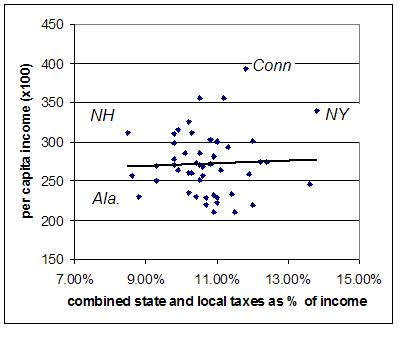
I was wondering whether the states that tax their residents

at high rates tend to have higher or lower income levels. I

suppose a crude form of free-market economics would predict that states

with lower taxes would tend to generate more personal income. This is

not the case. Although the relationship between tax rates and per capita

income is not significant, generally the states that take the biggest

portion of income in state and local taxes also have the most per

capita wealth. States like Alabama have been low-tax zones for at least

a hundred years, yet they remain among the poorest of all states.

This isn’t "social science." It’s just playing with a computer

to get a quick answer to a simplistic question. Still, the graph poses

a real question for supporters of laissez-faire economics: if low taxes

create wealth, what explains Alabama? (Sources for the tax

rates and the per

capita income stats.)

Dean vs. Gephardt

I was interviewed on New Hampshire Public Radio last Friday about the

different styles of the Gephardt, Edwards, and Dean presidential

campaigns (see an imperfect

and incomplete text transcript or listen to the audio here.) Actually,

the reporter, David Darman, asked a very interesting set of questions

(which didn’t come across clearly in the broadcast radio segment) about

what conception of the role of citizens is implicit in each campaign.

My quotes suggest that I’m biased in favor of Rep. Gephardt, which

is not really true. I do believe that if he fails, it will be symptomatic

of the collapse of mass mobilizing institutions, such as unions and

political parties, that used to multiply the power of ordinary people

and connect them to Washington. I do not believe that the Gov. Dean

style of campaigning, which is very “21st century,” offers

an entree to people near the bottom of the socio-economic heap. They

won’t be mobilized by listservs, blogs, and Meetup.com. This is

not only because they lack Internet access and interest in politics.

It’s also because of the basic logic of collective action, which tell

us that people won’t take costly action in the public interest unless

they are assured that others will also contribute. Voting is always

partly an altruistic act, because even if one votes in one’s own self-interest,

it’s more “rational” (meaning self-interest-maximizing) not

to expend the energy. Disciplined organizations such as unions overcome

this problem by guaranteeing that not only you will vote; so will many

like-minded people. Meanwhile, they lower the “cost” of voting

by providing free information. Wealthy and well-educated citizens find

that the cost of voting is relatively low, because they already have

much of the necessary information. Thus they don’t need unions and parties;

and they are adept at using voluntary resources such as listservs or

blogs. Poor and poorly education people are at a disadvantage in this

environment, and their disadvantage is worse than it was fifty years

ago.

the budget

A lot of people’s eyes glaze over when they hear about a “budget”—whether

it’s for a business, a club, or the government of the United States.

Yet the government has enormous influence on our lives because of the

way it collects our money and spends it for various purposes. Its spending

priorities are reflected in its budget.

Unless you understand roughly what the budget includes, your opinions

may be completely irrelevant. For example, according to an

excellent survey by the Program on International Policy Attitudes

(PIPA), a majority of Americans believe that the US spends too much

money on foreign aid. They estimate that 20 percent of the federal budget

goes to foreign aid; they would reduce this amount to 5 percent. In

fact, the federal government devotes less than 1 percent of its budget

to foreign, nonmilitary aid. Anyone who calls for aid to be cut to 5

percent has an irrelevant opinion, because he or she doesn’t understand

what the government does.

Here, then, is how the federal government spent an average

tax dollar during the years 1998-2004 (2003-4 are estimated).

The data come from this

OMB document, but I have made decisions about what programs to put

in each category. The federal government is responsible for about two-thirds

of all taxation, although it gives some of its funds to states. States

and local governments together raise about one third of all taxes. (Source:

OMB.)

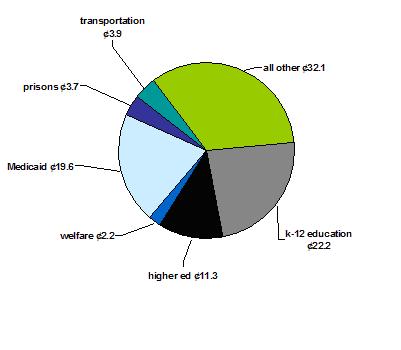
The "all other" slice in the chart above is distributed as

follows:

Here is how an average state tax dollar is spent. Data from National

Association of State Budget Officers, State Expenditure Report, 2001

(Summer, 2002).

And this is an average county budget from 1996-7, based on the US Census

Bureau’s survey of county officials