Category Archives: Internet and public issues

the best thing Mubarak did was shut down the Internet

(Berkeley, CA) Yesterday, I heard two different American colleagues quote a story by the same Egyptian democracy activist. First, he said, there was lots of online activism against the Egyptian regime: people commenting, posting links, and “liking” each others’ comments. Then, when the Mubarak government blocked the Internet, the online advocates went onto the streets. And it was their street protests (combined with the nonviolent reaction of the army) that toppled the regime. Bottom line: “The best thing Mubarak did was shut down the Internet.”

I suspect the first phase of Internet activism was essential, for a particular purpose. It let everyone know that there was a potential mass movement. The inability to tell whether other people are at the point of acting is often a barrier to popular action. Still, even if you know that other people are angry, you can’t tell from their Tweeting and Facebook-posting whether they would actually put their lives on the line. Not knowing, you may fear to act.

That impasse had to be broken by a decisive signal that it was time to revolt together. And Mubarak (ironically) gave the signal by shutting down the Internet. It was a particularly powerful signal because all the energy that people had been expending online had nowhere to go–unless they went into the streets.

The lesson for dictators: don’t suddenly shut down the Internet. (Although the situation in Egypt may never be replicated exactly.) The lesson for activists of all stripes: you need a powerful signal and incentive to move people offline, once you have critical mass of supporters. If there is no dictator to provide the signal for you, you’ll have to find a way to do it yourself.

building web communities for policy discussion

(Chicago, IL) I am here to visit the impressive Institute for Policy and Civic Engagement at the University of Illinois at Chicago. (It is located right near my favorite shrine to American democracy, Jane Addams’ own Hull House.) Among its many activities and projects is a whole web portal, civicsource.org, that is devoted to policy-relevant information and discussion, plus training modules and tools that help citizens to engage. It just launched, but the IPCE and the urban research university that it represents have the human resources to make it a rich source of news, ideas, and tools.

Meanwhile, AmericaSpeaks, on whose board I am honored to serve, has launched The American Square, a social network/discussion forum “devoted to enabling respectful, multi-partisan conversation about policy and politics.” The organizers say, “We will find real solutions to real problems rather than on sound bites, ego, and demonization of those who disagree with us.”

critical thinking, from a youth perspective

Cathy Davidson has a great report from the recent “Designing Learning Futures” conference in LA, sponsored by the Digital Media and Learning Initiative of the MacArthur Foundation. Here is a sample to encourage you to read her whole piece:

    There were thirty or thirty five students, from Renaissance Academy in East Los Angeles, and they were part of the Out the Window project. …. I kept hearing … “critical thinking” over and over, so I asked one of the young artists, “What do you mean by ‘critical thinking’?” She didn’t even pause, “It means being able to see where I am standing and also where you are. It means having enough knowledge and research and discipline not to over-react if you disagree with me or if you dislike me or disrespect me but to pause, and think about who you are, and then help bridge the gap between us.”

Here is a video about the Out of the Window project.

the Internet’s role in making engaged citizens

Below is my own summary of an important new study by Joe Kahne and colleagues. The original research is here. Or read Joe’s Huff Post piece.

Drawing on a unique panel survey of the online practices and the civic and political engagement of youth (ages 16–21), the new study, partially funded by CIRCLE, addresses broad and timely questions:

  • Does interacting online cause young people to drop out of their real-world communities? The study suggests that this is not a concern. On the contrary, young people who become heavily involved in online communities tend to increase their offline volunteering, charity, and work with neighbors.

  • Do young people spend their time in online "echo chambers"? For more than a decade, many authors and observers have worried that people go online to find their own political and ideological views confirmed, causing society to become more polarized. But the new study finds that young people who see any political opinions online tend to see diverse opinions. (A larger concern is the substantial proportion, 34%, who don’t see political opinions at all when they are online.)

  • Can we teach media literacy? It is difficult to use the Internet and other new media effectively and responsibly. The new study suggests that young people can be taught to do so. Studying digital media literacy dramatically increases the odds that students will be exposed to diverse perspectives online and will engage online with civic and political issues.

Joseph E. Kahne is an education professor at Mills College and CIRCLE Advisory Board member.

creating informed communities (part 4)

This is the fourth of five strategies proposed to achieve the goals of the Knight Commission on the Information Needs of Communities. See Monday’s post for an overview.

Strategy 4: Generate Public “Relational” Knowledge

Citizens need facts about organizations, leaders, and issues. They need rival interpretations of those facts, and deliberative public judgments based on such interpretations. Citizens also need to understand the relationships among people, organizations, and issues. All competent civic and political actors, since the beginning of time, have held in their heads implicit “network maps” that link ideas and individuals in their community. They know, for example, that if they want to talk to the leader of the town, they should go through an accessible individual whom the leader regularly consults. If someone raises a local issue, they can link it to relevant organizations and to related issues.

In recent years, three developments have underlined the importance of such thinking. One is the “The New Science of Networks,” as Albert-László Barabás subtitles his book Linked. This science is the mathematical exploration of nodes and network ties as they arise under various conditions, and it has yielded powerful insights, such as the value of “weak ties” and the importance of individuals who connect disparate communities.

The second development is the enormous popularity of social networking sites like Facebook, which are driven by webs of relationships. These sites have popularized the concept of network ties and underlined their importance. But Facebook and other corporate social networks keep the relational data–the “network map”–to themselves. They do so to protect users’ privacy and also to give themselves a valuable asset. For example, to reach everyone at Tufts who has a Facebook account, we must pay Facebook to advertise. We cannot see a list of users who have Tufts connections.

The third development is the art of relational organizing. Relational organization groups such as the Industrial Areas Foundation and the PICO and Gamaliel Networks do not begin with clear and fixed goals. They decide what their causes should be by means of long periods of listening and discussing within diverse networks that they carefully nurture. They are highly skilled at mapping networks to identify power relationships, excluded groups, and key hubs. [See, e g., Mark R. Warren, Dry Bones Rattling: Community Building to Revitalize American Democracy (Princeton: Princeton University Press, 2001, pp. 31-2..

The next step is to democratize the possession of effective network maps, so that they do not exist only in the brains of skilled organizers or on the servers of Facebook and MySpace. Informed communities should have access not only to discrete facts and lists of organizations–nor should they be satisfied with geographical maps that show the physical location of organizations. They should be able to build and consult public network maps that allow them to identify power, influence, exclusion, division, and other attributes of relationships, not of individuals.

Working with Lew Friedland and his colleagues at Community Knowledge Base, we have been experimenting with public network maps in two contexts:

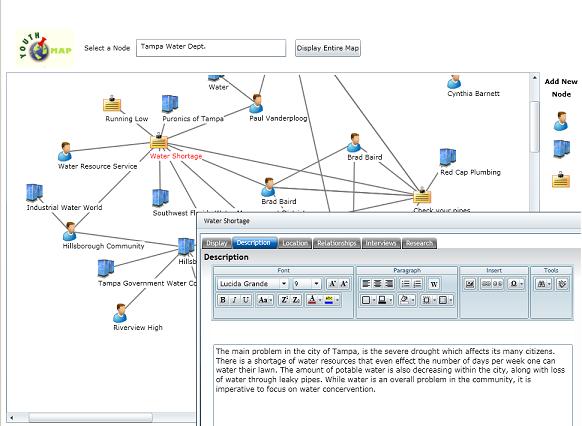
  • We have begun to create computer-based games in which classes of high school or middle school students quickly generate network maps of local issues, organizations, and people. The following is part of a real map concerned with water issues in the Tampa, Florida area. It was quickly created by a class of 9th graders, who pooled their knowledge to produce a sophisticated understanding. (One node is open to reveal notes the student has typed.)
  • We are also in the midst of creating an open network for the Boston metro area in which nodes will be organizations or issues, and anyone will be able to add to the map, use it to recruit volunteers, and navigate it to explore the structure of this region’s civil society. It’s not ready for a public launch, but one can explore the map here.

These are just preliminary experiments. They do not yet harness the full potential of network analysis and visualization, nor the power of computers to harvest network data automatically from websites. My basic recommendation is that governments and foundations should invest in providing transparent relational data along with the other information that is already online.