Category Archives: deliberation

Nicole Doerr, Political Translation: How Social Movement Democracies Survive

A century ago, Robert Michels observed what he called the “Iron Law of Oligarchy” at work in the socialist and revolutionary labor parties and movements of Europe. He argued that these groups provided “the best field of observation” for the problem of oligarchy, because they were committed in principle to equality and democracy (p. 11). If even they turned into oligarchies, it was “probable that this cruel game will continue without end” (p. 408).

This was the pattern he observed:

Democracy is inconceivable without organization. [But] Organization implies the tendency to oligarchy. In every organization, whether it be a political party, a professional union, or any other association of the kind, the aristocratic tendency manifests itself very clearly. … As a result of organization, every party or professional union becomes divided into a minority of directors and a majority of directed. … All power thus proceeds in a natural cycle: issuing from the people, it ends by raising itself above the people (pp. 21, 32, 38).

Since about 2003, the University of Copenhagen Sociologist Nicole Doerr has been observing the successors of Michels’ socialist and revolutionary movements–the heterogeneous leftist organizations that have come together in contexts like the European Social Forum, the US Social Forum, and a low-income city in California. She observes many of the same specific dynamics that struck Michels, and she adds new ones.

For example, experienced, professional organizers tend to know one another and give each other much more attention than they give to newcomers (pp. 33-34). Representatives of “New Left” organizations that demand loose, horizontal interactions appear to union organizers to be “arrogant and upper-class” (p. 32). Questions that matter to marginalized people–such as whether the location of the next meeting will be accessible to them–get tabled as irrelevant (p. 56). Despite strong leftist convictions, leaders reveal unconscious bias against people unlike them, such as women from Turkey and Eastern Europe (pp. 54-5). Decisions laboriously reached in earlier meetings become sacrosanct, even though newcomers have reasons to object to them. The need to translate for–or to speak more slowly to–linguistic minorities is perceived as a mere nuisance (p. 39). Gatherings tend to grow more “ideologically homogeneous” over time (p. 54), as those who don’t agree drop out.

But Doerr also contributes a fascinating positive finding. She first noticed that a multilingual meeting was more equitable and deliberative than meetings in which translation was unnecessary (p. 25). That seemed paradoxical. One would assume that if some participants require simultaneous translation, a layer of inequality will be added.

But then she started noticing the translators. Although they were easily dismissed as providing a mere technical support service–and one that inconvenienced the speakers of the dominant languages–they also became involved in advocating for inclusion. They were professionally resistant to entering the discussion of substance, since their job was to translate for others. But they were also professionally committed to making sure that the people they served could be heard. Thus they often intervened on matters of process.

The translators suddenly took center stage when they went on strike during a Paris gathering, with the terse announcement, “we translators now collectively interrupt our linguistic service” (p. 42). Their demand was to change the list of official speakers so that more immigrants were included. They quickly prevailed, thanks to their leverage over the entire meeting.

At the US Social Forum in Atlanta, there were again linguistic translators. But by now, Doerr had begun using the term more broadly. Translators are people who enter a discussion without having substantive views of their own but with the goal of making sure that certain specific people, vulnerable to being ignored, are heard and understood. One of the activists in Atlanta “often intervened when established NGO staffers working on immigration reform had trouble not only understanding the language but also the content and importance of demands by undocumented immigrants.” She told Doerr, “What we did for the US Social Forum was translation … But it’s not just about linguistic translation. It’s also about emotion. It’s a translation of space, of class, of gender” (p. 59).

These translators–linguistic or otherwise–emerge for Doerr as a “third voice within deliberation” (p. 10), neither participants nor facilitators.

She recognizes that they have the power to advance their own interests (pp. 47-9). In the words of the old Italian pun, “traduttore, traditore” (translator = traitor). Their value is dependent on their motivations.  Doerr devotes a chapter to a California example in which bilingual elected officials favored their self-interests: “translation had turned into representation and domination” (p. 97). In meetings at city hall, these officials “repeatedly interrupted, disciplined, marginalized, and implicitly stigmatized residents,” especially those who spoke in Spanish.

But then a grassroots organizing group created community forums and invited the same city leaders to participate on its turf. Volunteer translators played essential roles in designing these forums, in preparing the city officials to be respectful at the meetings (pp. 102-3), and then intervening to demand that specific questions be answered (p. 110). While literally translating between Spanish and English, the organizers also explained technical matters in understandable terms. Although the votes at these community forums had no legal force, the city council made some concessions in response.

I’d like to emphasize four larger themes:

First, we are used to a dichotomy between direct and representative democracy. But translators (linguistic or otherwise) complicate that. They represent individuals in order to permit direct participation.

Second, the beneficial cases in Doer’s book depend on organized power. The translators in Paris struck, withholding their services all at once. The community organizers in the US case engaged sufficient numbers of voters that they could compel city officials to attend their meetings. It’s not just the act of translating that matters; it’s the translators’ connection to organizations. (At this point, Michels would ask how organized translators can avoid becoming a new oligarchy.)

Third, translators sometimes escape notice; their influence is unseen because all they seem to be doing is translating someone else’s words (p. 126). I imagine that listeners literally look at the original speakers, not the translators. This invisibility can be problematic if translators misuse their power. But it’s also a strategic asset, because they can get away with influencing the powerful when others would fail.

Finally, these acts of translation are classic examples of “public work,” in my friend Harry Boyte’s sense: “self-organized efforts by a mix of people who create goods, material or symbolic, whose civic value is determined through an ongoing process of deliberation” (Boyte and Scarnatti, p. 78.). Thinking of political translation as a form of work is helpful because it brings out the translators’ professional commitments and values and the craft-like skills that they contribute to make democracy work better.

References

  • Boyte, Harry C. & Scarnati, Blase. 2014. “Transforming Higher Education in a Larger Context: The Civic Politics of Public Work,” in Peter Levine and Karol Edward Soltan, eds., Civic Studies: Approaches to the Emerging Field. American Association of Colleges & Universities, 2014
  • Doerr, Nicole. 2018. Political Translation: How Social Movement Democracies Survive Cambridge: Cambridge University Press.
  • Michels, Robert. 1915. Political Parties: A Sociological Study of the Oligarchical Tendencies of Modern Democracy, trans. Eden and Cedar Paul. New York: Heart’s International Library
analyzing Donald Trump’s speech patterns

Just before the 2016 presidential election, I wrote:

Donald Trump’s speaking style is extraordinarily paratactic. That is, he utters declarative sentences without any of the explicit transitional words that can explain why sentences fit together. No “therefore’s,” “on the other hand’s,” or even “well, I think’s.” He just plunges in. Many listeners perceive the content of his various sentences to be logically unrelated. However, he is remarkably repetitive when he speaks at any length, so the unity of his speech derives from his returning to the same phrases. Finally, he uses “I” sentences overwhelmingly, plus “you” when he’s talking to someone in particular. He makes relatively rare use of the third person. We could name his style “paratactic/egocentric.”

I have no expertise in linguistics. To the extent my observations were based on any disciplined research, I was thinking of attempts to model discussions as networks of ideas. I’m interested in how different network structures may allow people to deliberate better or worse with others. I implied that Trump’s “paratactic/ egocentric” style was bad for deliberation.

Unlike me, John McWhorter is a linguist, and he has an interesting analysis in The New York Times. He confirms my observation that Trump’s speech is “paratactic,” “repetitious,” and “subjective.” He also shows that Trump’s style has changed. When he was young man, Trump was much more hypotactic (favoring subordinate clauses and logical connections), more explicitly organized, and less emotive. But McWhorter does not think this is evidence of cognitive decline. Rather, everyday spoken English is much like Trump’s public speech nowadays. Most people most of the time produce disconnected, repetitive bursts of speech, linked by body language and other emotional cues rather than logical connectives. McWhorter thinks that young-man Trump spoke in an unnatural, elevated, formal way because he still thought he had to work at being accepted. Today, Trump thinks he can talk naturally in public forums, so he does. And for some audiences, it works.

This seems plausible. I would only add a normative question: what kind of speech do we have the right to expect from public figures in public forums? Hypotaxis is artificial for all of us; it’s how schools teach us to talk and write in public, to strangers. But it could be that people should talk that way in formal settings, just because the logical connections allow the listener to assess our arguments critically. Skipping over them is normal for private speech among people with strong affective ties, but it’s a way of evading accountability among strangers.

See also: Trump’s rhetorical style and deliberationDoes Twitter “smoosh” the public and private?  it’s not just what you think, but how your thoughts are organizedtracking change in a group that discusses issuesnetwork dynamics in conversation; and assessing a discussion.

watching democratic cultures decline

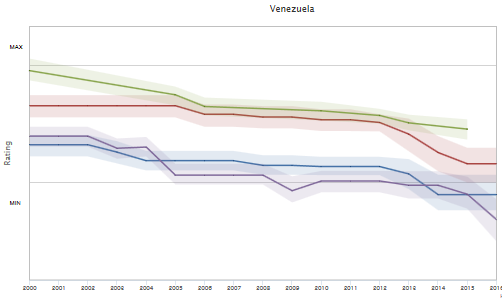
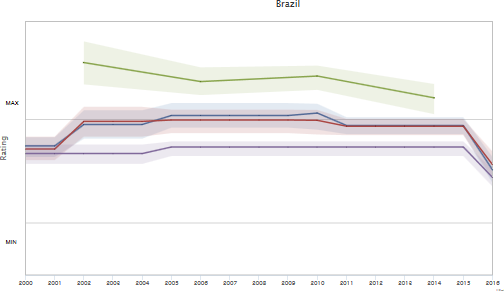
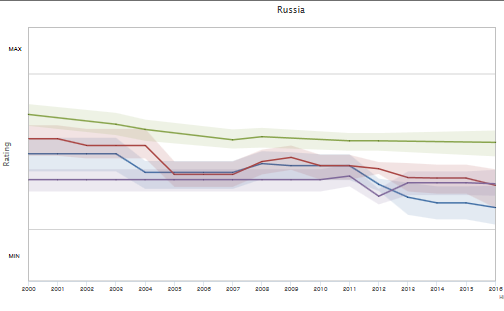
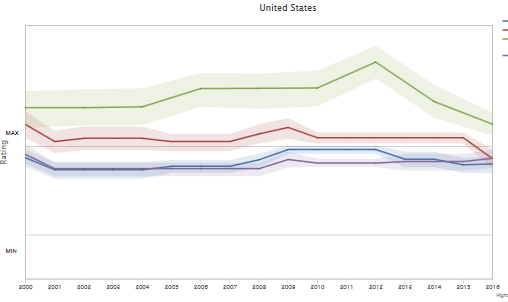
Yesterday, I offered some evidence that broad public deliberation declines when authoritarianism rises. I used data Varieties of Democracy, which asks 2,800 experts questions about specific countries in specific years.

For this purpose, I’ll define “authoritarianism” as a system that relies on the arbitrary will of leaders. It’s a system of rulers without many rules. Its opposite, then, is “republicanism” in Philip Pettit’s sense: a system in which nobody can be told what to do without a justification. Many variables in the V-Dem database relate to authoritarianism, but I’ve selected two: (1) whether the executive branch respects the constitution of its country, and (2) whether elections are held without intimidation. I chose this election-related variable because regular and fair elections provide a check on arbitrary rule, and also because a typical tactic of an autocrat is to interfere with elections.

Pettit, citing Quentin Skinner, emphasizes that “one of the central themes” of the civic republican tradition is “belief in dialogical reason.” The connection between republicanism and deliberation is not definitional. In other words, you could imagine an authoritarian state that encourages deliberation or a genuine republic that is weak on deliberation. But republicanism and deliberation have often been connected because one way to make decisions non-arbitrary is to encourage discussion of them.

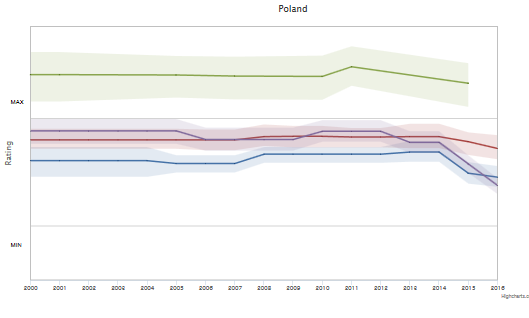
V-Dem offers two measures of deliberation: 1) to what extent do “large numbers of non-elite groups as well as ordinary people … discuss major policies among themselves, in the media, in associations or neighborhoods, or in the streets”?; and 2) to what extent do leaders consult a wide range of stakeholders? Along with the two measures of authoritarianism, we have four variables whose relationships interest me.

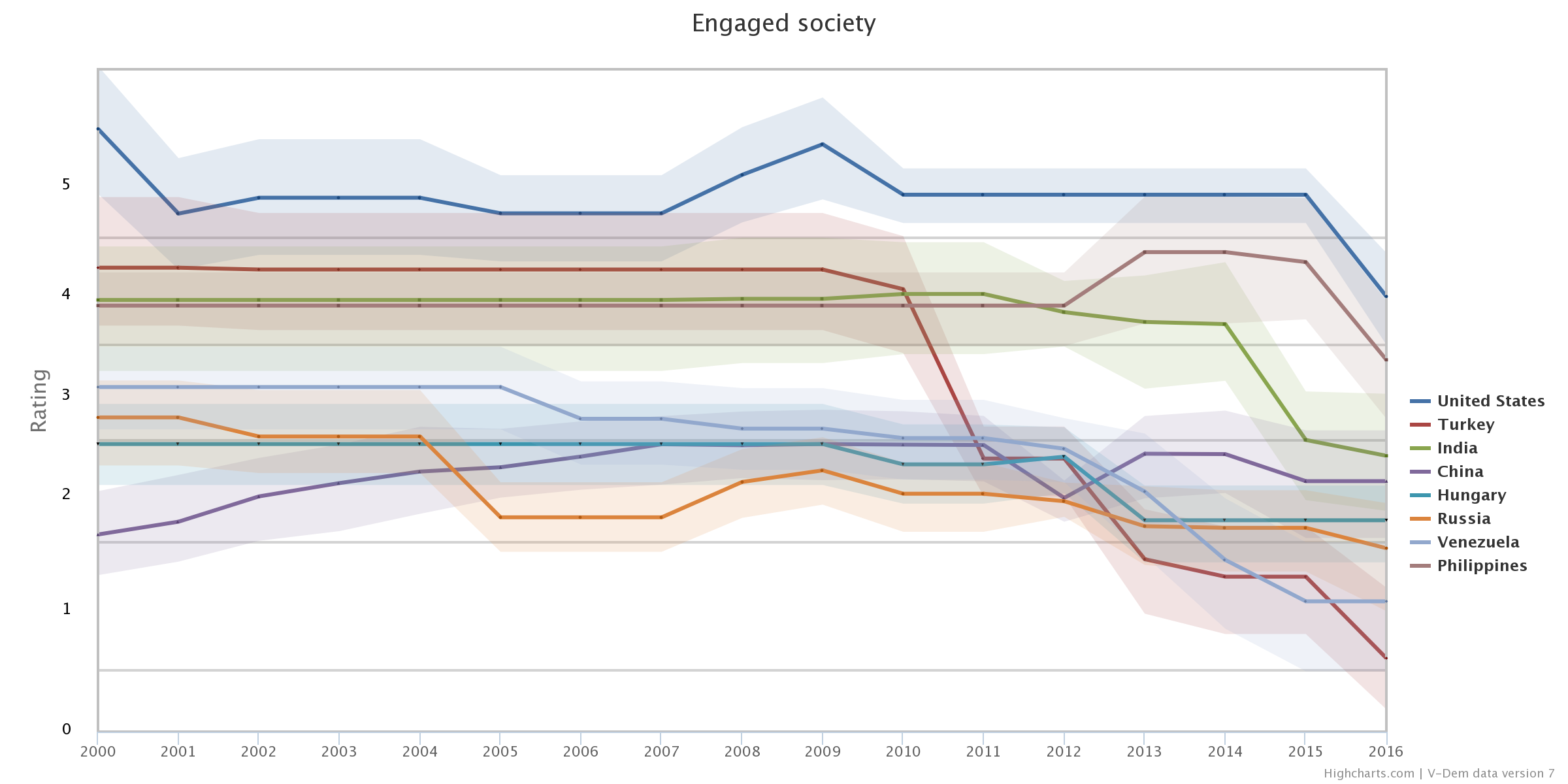
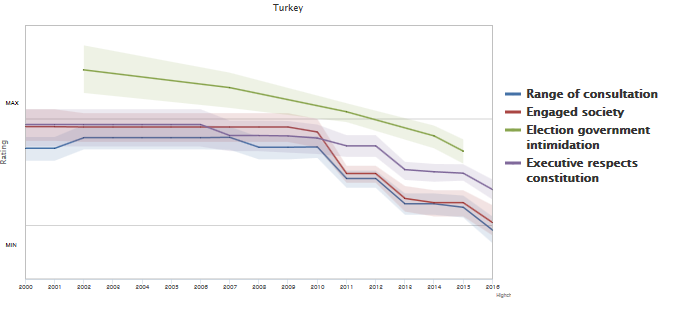
In Turkey, for example, all four measures have fallen since 2010. The fair elections variable began to decline first; then the other three fell in tandem.

The pattern is less pronounced but similar in Poland since 2011.
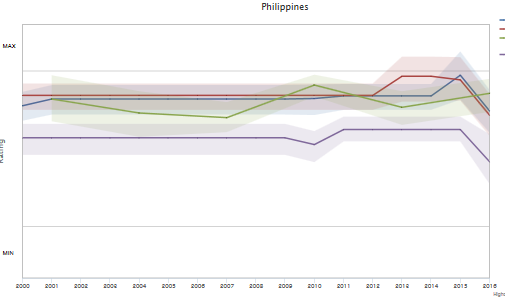
In the Philippines, election intimidation has not grown worse, but the other three variables have taken a dive since 2012.

In Venezuela, it’s been steadily downhill since 2000.

Brazil’s elections got a little worse first (starting at a high baseline), and then everything plunged after 2015.

Russia has seen fairly steady declines from a lower baseline.

And the US saw declines before 2016 in elections and in public dialogue that may presage rising state authoritarianism in 2017 and ’18 (not shown yet).

authoritarianism and deliberative democracy

The Varieties of Democracy project asks 2,800 experts many questions about specific countries in specific years. One question is “When important policy changes are being considered, how wide and how independent are public deliberations?” The scale ranges from zero (“Public deliberation is never, or almost never allowed”) to 5 (“Large numbers of non-elite groups as well as ordinary people tend to discuss major policies among themselves, in the media, in associations or neighborhoods, or in the streets. Grass-roots deliberation is common and unconstrained”).

Below is a graph that shows the change in public deliberation (so measured) since 2000 for eight countries that I see as increasingly authoritarian. My choice of these countries is subjective. (Why not the Central African Republic, which Freedom House names as the single-biggest “backslider” on democracy in the world? Because I don’t know much about the CAR.) But of the countries that I selected in advance to serve as examples of growing authoritarianism, all but one showed declines in the V-Dem measure of broad public deliberation.

This pattern may seem self-evident or even tautological. Perhaps countries that are tending toward authoritarianism see less deliberation because authoritarianism is the opposite of deliberation. But I find the graph at least somewhat meaningful. At the core of authoritarianism is a reliance on powerful leaders who disdain constitutional limits. It’s possible for authoritarians to run a state even while “large numbers of people … discuss major policies among themselves, in the media, in associations or neighborhoods, or in the streets.” Some authoritarian states even choose to expand deliberative fora. For example, China’s Communist Party is implementing deliberative processes, which it probably sees as devices for blunting criticism and improving satisfaction with its deeply undemocratic regime (He & Warren 2017). Caroline W. Lee (2015) has argued that small-scale deliberation co-opts resistance in the USA, and Cristina Lafont (2017) worries that creating ideal deliberative fora can delegitimize regular democratic processes.

So the question arises whether authoritarianism is really contrary to deliberation at all. One might even suspect that the biggest threats to deliberation arise in mass capitalist societies, where corporate and partisan propaganda drown out reasoned conversation on poorly designed platforms, like Twitter.

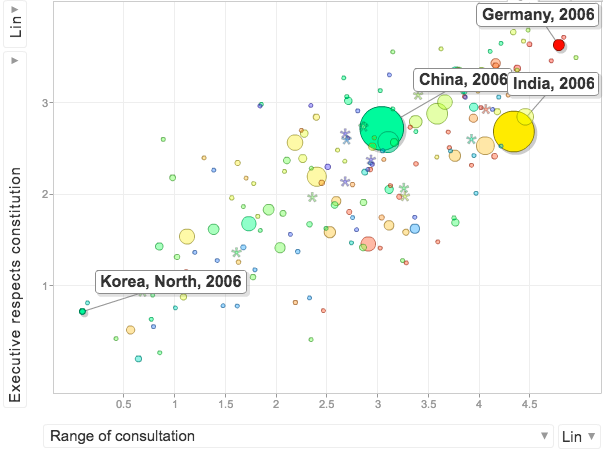
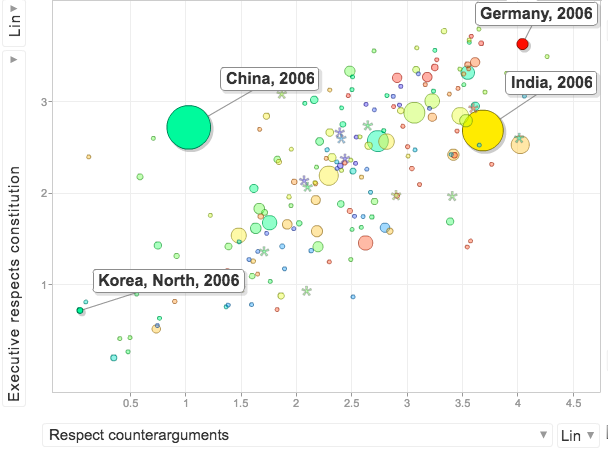
But this is partly an empirical question, and I do see evidence of a negative correlation between authoritarianism and deliberative values. Above I showed that countries well known for turning more authoritarian are also seeing less public deliberation. Below are two graphs showing a different relationship–between leaders’ respect for the constitution and the government’s tendency to consult a wide range of stakeholders. Again the source is V-Dem data, but unfortunately from 2006.

I take respect for the constitution as an inverse measure of authoritarianism, and consultation as a sign that a government wants to deliberate. The correlation is pretty clear. Most countries fall on a line between North Korea and Germany. India’s government consults more than China’s does. Neither respects its own constitution more than the other, but the Indian constitution is much better on civil liberties. The US is a circle between those two countries but a little higher up.

The next graph shows the same y-axis (respect for the constitution) plotted against the degree to which politicians respect counter-arguments. A high score on that measure means that they generally feel compelled to give explanations when they are challenged. Again, the line is defined by North Korea and Germany. On this plot, China is an outlier, showing decent respect for its own constitution but reluctance to consult diverse stakeholders.

Much more analysis could be done (and it would be better to use more recent data than 2006). Still, this seems to be evidence of a correlation–in practice, if not in theory–between respect for constitutional restraints and deliberative values. One reason may be that political leaders tend to model deliberation in societies where they also respect limits, and they fail to do so when they turn authoritarian. Or it could be that when publics are organized and motivated to demand discussion, they also block authoritarianism.

Sources: Baogang He  & Mark E. Warren “Authoritarian Deliberation in China,” Daedalus, 146, 3, 155-166; Caroline W. Lee, Do-It-Yourself Democracy: The Rise of the Public Engagement Industry New York: Oxford University Press, 2015; Cristina Lafont, “Can Democracy be Deliberative & Participatory? The Democratic Case for Political Uses of Mini-Publics,” Daedalus 2017 146:3, 85-105.

how to tell if you’re doing good

If you have the capacity to affect other people, there seem to be three basic ways to decide what to do–and then to assess how much good you’ve done once you’ve acted.

  1. You can talk to the people affected. You can consult your fellow citizens or even convene them to deliberate and decide together. The advantages include sensitivity to a wide range of perspectives and considerations, from justice to practicality; nuance and complexity; and the chance for people to learn and enrich their individual views. Asking people to assess and influence the policy also honors their dignity and agency. On the other hand, actually asking very large numbers of people to deliberate and decide everything is prohibitively difficult and expensive. Consulting samples of people fails to enhance the agency of everyone else. Further, discussions are subject to serious and pervasive flaws, such as cognitive biases, inequalities of power and influence, tyranny of the majority, and vulnerability to manipulation and strategic action.
  2. You can predict and empirically assess the impact of what you do. You can use scientific methods to make predictions and test causal hypotheses. Science incorporates safeguards against biases, such as random sampling and blind review. It’s much more likely than deliberation to predict accurately what will happen if you do something. But it cannot determine whether your methods or your goals are good ones. And it confers power on experts (or employers of expertise) in ways that can be problematic.
  3. You can observe price signals. If milk is selling for more than the price of producing it, then people must want milk, and providing it meets a need. The feedback from prices is immediate; it reflects many people’s knowledge, choices, and agency; it’s hard to manipulate; and it allows comparisons. Since you are responsible for allocating finite resources among all possible purposes, prices give you a common metric. One evident drawback  is inequality. For example, market prices would suggest that there’s weak demand for clean water, even though 2.1 billion people lack access to it. They have too little money to affect prices. However, if you are concerned with justice, you can adjust price signals for equity. For instance, you can give poor people money and let them decide how to spend it, instead of dictating their choices. The other major problem with price signals is that they fail to make moral distinctions. Methamphetamine and antibiotics both have prices. It takes a combination of science (to assess affects) and deliberation (to discuss values) to determine that antibiotics are good while meth is bad.

All sectors of a modern society use all three methods. But I would argue that democratic governments are particularly obliged and well-suited to use deliberation. The fact that every citizen has a vote reflects: 1) the equal right of each person to affect outcomes, and 2) the obligation of every citizen to learn and discuss before making choices. For that reason, governments have formed parliamentary bodies and courts that are supposed to deliberate, they have safeguarded free speech, and they have built ways of consulting publics. Unlike a discretionary decision by a private entity, a government program must be subject to public deliberation because it is the people’s government.

Nonprofit associations and philanthropies use discussion and price-signals. But they are particularly well suited to use “science” (in its broadest form, including ad hoc experimentation and program evaluation). The fact that there are large numbers of modest-sized nonprofits and donors means that each one can try different things and observe the effects without accumulating dangerous amounts of power and influence. When their experiments work, others can pick them up. And unlike for-profit firms, they can ignore price signals in order to pursue goals that they believe in for moral reasons. This is why program evaluation is so common in the non-profit sector, whereas major governmental decisions–even massive tax cuts or wars–are hardly ever subject to formal evaluation.

Companies, obviously, use price-signals. If Toyota can’t sell enough Corollas at a profit, it will realize it must change its business. If it observes that Subaru is more profitable, it will consider copying Subaru. However, it’s worth noting that prices offer insufficient guidance even for profit-maximizing firms. Again, assume that Toyota suddenly cannot sell enough Corollas. It must find out why not, and that will probably require some combination of asking people what they value and studying causes and effects–the same techniques used by democratic governments and philanthropies.

Among people committed to democracy and/or philanthropy, prices provoke unease. When something previously offered free is charged for, critics will complain of “neoliberalism” and “marketization” or “commodification.” But if that good was scarce and provided to some group without a charge, then someone must have decided to allocate resources for that purpose and to that group (instead of to something and someone else). Those who make such decisions are morally responsible for exercising their power well. They should strive to determine whether their choices benefit the world. Consultation and science are two means for that purpose, but both have limitations. Prices are also very useful for determining demand and for making comparisons. Not only should responsible people notice prices, but they should worry about whether their actions (through governments and philanthropies) are distorting price signals in ways the deprive them of useful information about other people’s needs. For instance, if you offer free tuition, you can no longer tell whether schooling is what people want.

On the other hand, prices certainly do not offer all the necessary and relevant information, even for people and firms that want to make a profit–and still less for people who pursue justice.