Category Archives: deliberation

deliberation and the California budget mess

A concrete proposal for a deliberative public forum made it to today’s Times op-ed page. Chris Elmendorf and Ethan J. Leib call for a “citizens assembly” that would meet when the legislature deadlocks on a budget. The California legislature needs a two-thirds vote to pass a budget and labors under many constraints created by initiatives. It has a chronic problem of failing to pass decent, reasonable budgets on time, a problem that reached a critical stage this year when the largest American state issued IOUs in lieu of real checks.

Other activists are causing for a constitutional convention–which could be called the “nuclear option” of public deliberation, because it would enlist a deliberative group in blowing up the whole constitution and starting over. The Elmendorf and Lieb proposal is much more modest. In fact, it might cause elected officials to propose moderate budgets in order to avoid a deadlock and then a loss of power to the citizen’s assembly.

I presume citizen participants would be randomly selected and paid for their time. They would consider various alternative budgets, hear from experts, talk (a lot), and decide. As a populist reform, it beats the initiative and referendum on two grounds. First, it’s deliberative–people exchange ideas and evidence before they vote. Second, the subject of deliberation is the whole budget, not an individual yes-or-no proposition like capping taxes or reducing class sizes. You’re really not acting responsibly as a participant in self-government unless you are willing to make tradeoffs.

Whatever one thinks of this particular proposal, I would argue that California’s problems are civic, not economic. Legislators could balance the budget by raising taxes and/or cutting spending; they don’t need aid from outside, which would only encourage them to continue their irresponsibility. Their civic problems lie partly in the rules of the formal political system, but another cause is a relatively weak civil society. The newspapers that cover state and metropolitan issues are inadequate, for example. Californians have plenty of civic assets, as well, but they need to mobilize them much better.

on the limits of online forums

The White House recently created a space where anyone could post “ideas and comments on how to make government more transparent, participatory and collaborative.” More than 2,000 ideas were posted. I was happy to participate; my ideas are here.

The site is a gesture in favor of openness, deliberation, and interactivity. But the results so far are at least somewhat problematic. They underline the importance of deliberations or discussions in which the participants are representative of the whole population and there is some moderation.

The very top vote-getter was proposed by “republicanleaderjohnboehner.” It is a “72-hour mandatory public review period on major spending bills.” I do not know whether that is a good idea. The explanation seems a bit partisan: the main example of a “taxpayer-funded outrage” is “the empty ‘Airport for No One’ in the congressional district of Democratic Rep. John Murtha (D-PA).” (Note the double identification of Rep. Murtha as a Democrat–both before and after his name.) 1201 people voted for this idea, 187 against it.

The Republican House leader had a right to participate in this dialogue; arguably, it is a good innovation to create an open space where he would be able to weigh in. But without prejudice against Mr. Boehner’s idea, I suspect that it got so many votes because someone activated an an online Republican network to support it.

The second-rated idea was to legalize marijuana, which seems unrelated to the purpose of the site and must also reflect the activation of a network or a mailing list. It could indeed turn out that the number of votes was proportional to the size of one’s network. (I used my blog and facebook page and got a total of 139 favorable votes.)

There were many cranky “proposals.” For instance, 53 voted for, and 10 against, a proposal headed, “Obama may be Kenyan. His father is Kenyan. Obama is not natural born! Release [birth certificate].” My proposal to engage young Americans got comments like this one: “Stop spending money on racist preemtive genocidal wars. We need education not war.” Whoever wrote this comment had a right to express himself. I disagree that the current US wars are “genocidal,” but I’m not on the opposite side from this person. I would question whether (a) the comment was germane and relevant, and (b) whether a dialogue in which such views are prevalent can possibly influence national policy.

The important next step of the White House process is a “discussion phase.” It will be very interesting to see how this works.

controversy in the classroom

University of Wisconsin Professor Diana Hess has published Controversy in the Classroom: The Democratic Power of Discussion (Routledge, 2009). The longitudinal study of high school students that is a major source of data for this book was partly funded by CIRCLE. Hess argues that planned, moderated discussions of controversial issues teach essential democratic skills. She provides research-based advice about how to define “controversial issues” and handle them in classrooms.

According to my blurb on the back cover:

    Controversy in the Classroom is a model of scholarship. Diana Hess combines her personal experience as a teacher with rigorous qualitative and quantitative data and philosophical argumentation to conclude that students must learn to be citizens by discussing controversial issues. This is an important and neglected finding that should influence parents, teachers, and policymakers.

the politics of negative capability

Zadie Smith’s article “Speaking in Tongues” (The New York Review, Feb 26) combines several of the fixations of this blog–literature as an alternative to moral philosophy, deliberation, Shakespeare, and Barack Obama–and makes me think that my own most fundamental and pervasive commitment is “negative capability.” That is Keat’s phrase, quoted thus by Zadie Smith:

    At once it struck me, what quality went to form a Man of Achievement especially in Literature and which Shakespeare possessed so enormously—I mean Negative Capability, that is when man is capable of being in uncertainties, Mysteries, doubts, without any irritable reaching after fact and reason.

Other critics have noted Shakespeare’s remarkable ability not to speak on his own behalf, from his own perspective, or in support of his own positions. Coleridge called this skill “myriad-mindedness,” and Matthew Arnold said that Shakespeare was “free from our questions.” Hazlitt said that the “striking peculiarity of [Shakespeare’s] mind was its generic quality, its power of communication with all other minds–so that it contained a universe of feeling within itself, and had no one peculiar bias, or exclusive excellence more than another. He was just like any other man, but that he was like all other men.” Keats aspired to have the same “poetical Character” as Shakespeare. Borrowing closely from Hazlitt, Keats said that his own type of poetic imagination “has no self–it is every thing and nothing–It has no character. … It has as much delight in conceiving an Iago as an Imogen. What shocks the virtuous philosop[h]er, delights the camelion poet.” When we read philosophical prose, we encounter explicit opinions that reflect the author’s thinking. But, said Keats, although “it is a wretched thing to express … it is a very fact that not one word I ever utter can be taken for granted as an opinion growing out of my identical nature [i.e., my identity].”

In Shakespeare’s case, it helps, of course, that he left no recorded statements about anything other than his own business arrangements: no letters like Keats’ beautiful ones, no Nobel Prize speech to explain his views, no interviews with Charlie Rose. All we have is his representation of the speech of thousands of other people.

Stephen Greenblatt, in a book that Smith quotes, attributes Shakespeare’s negative capability to his childhood during the wrenching English Reformation. Under Queen Mary, you could be burned for Protestantism. Under her sister Queen Elizabeth, you could have your viscera cut out and burned before your living eyes for Catholicism. It is likely that Shakespeare’s father was both: he helped whitewash Catholic frescoes and yet kept Catholic texts hidden in his attic. This could have been simple subterfuge, but it’s equally likely that he was torn and unsure. His “identical nature” was mixed. Greenblatt argues that Shakespeare learned to avoid taking any positions himself and instead created fictional worlds full of Iagos and Imogens and Falstaffs and Prince Harrys.

What does this have to do with Barack Obama? As far as I know, he is the first American president who can write convincing dialog (in Dreams from My Father). He understands and expresses other perspectives as well as his own. And he has wrestled all his life with a mixed identity.

Smith is a very acute reader of Obama:

    We now know that Obama spoke of Main Street in Iowa and of sweet potato pie in Northwest Philly, and it could be argued that he succeeded because he so rarely misspoke, carefully tailoring his intonations to suit the sensibility of his listeners. Sometimes he did this within one speech, within one line: ‘We worship an awesome God in the blue states, and we don’t like federal agents poking around our libraries in the red states.’ Awesome God comes to you straight from the pews of a Georgia church; poking around feels more at home at a kitchen table in South Bend, Indiana. The balance was perfect, cunningly counterpoised and never accidental.

The challenge for Obama is that he doesn’t write fiction (although Smith remarks that he “displays an enviable facility for dialogue”), but instead holds political office. Generally, we want our politicians to say exactly what they think. To write lines for someone else to say, with which you do not agree, is an important example of “irony.” We tend not to like ironic leaders. Socrates’ “famous irony” was held against him at his trial. Achilles exclaims, “I hate like the gates of hell the man who says one thing with his tongue and another in his heart.” That is a good description of any novelist–and also of Odysseus, Achilles’ wily opposite, who dons costumes and feigns love. Generally, people with the personality of Odysseus, when they run for office, at least pretend to resemble the straightforward Achilles.

But what if you are not too sure that you are right (to paraphrase Learned Hand’s definition of a liberal)? What if you see things from several perspectives, and–more importantly–love the fact that these many perspectives exist and interact? What if your fundamental cause is not the attainment of any single outcome but the vibrant juxtaposition of many voices, voices that also sound in your own mind?

In that case, you can be a citizen or a political leader whose fundamental commitments include freedom of expression, diversity, and dialogue or deliberation. Of course, these commitments won’t tell you what to do about failing banks or Afghanistan. Negative capability isn’t sufficient for politics. (Even Shakespeare must have made decisions and expressed strong personal opinions when he successfully managed his theatrical company). But in our time, when the major ideologies are hollow, problems are complex, cultural conflict is omnipresent and dangerous, and relationships have fractured, a strong dose of non-cynical irony is just what we need.

discussion and service on MLK Day

USA Service.org, the official site that promotes service activities on Martin Luther King Day, was kind enough to ask me to post a blog entry over the weekend. I reproduce it here as an appropriate offering for today:

Between now and January 19th, we’ll feature a series of guest bloggers on USAservice.org. Today we’re pleased to share a post by Peter Levine, Director of Research and Director of CIRCLE (Center for Information & Research on Civic Learning & Engagement).

Just a few days before Dr. Martin Luther King Jr. was assassinated, he said:

“It is always a rich and rewarding experience to take a brief break from our day-to-day demands and the struggle for freedom and human dignity and discuss the issues involved in that struggle with concerned friends of goodwill all over our nation.”

We have lost Dr. King, but we must continue that discussion.

I’m Peter Levine from CIRCLE at Tufts University’s Tisch College of Citizenship & Public Service. I also represent a consortium of groups that organize nonpartisan discussions and deliberations in communities around America.

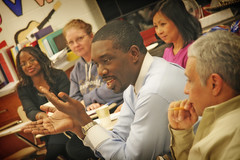
My colleagues and I believe that service is essential, and that it is best when it involves reflection and discussion. This weekend, volunteers can meet to choose their issues and plan their service. On January 19th, after completing a service activity, volunteers can reflect on what they learned and what they should do next. Such discussions can help turn thousands of MLK Day service events into powerful opportunities for learning, analyzing issues, forming human connections, and addressing serious, long-term problems.

Americans who volunteer on MLK Day may plan to conduct additional service together in the months ahead. They may decide to recruit others to join their efforts, conduct research, create public art and media to inform people about their cause, make changes in their homes, companies, and careers, advocate for policy changes, or even launch new organizations. They may reflect together on profound issues, like the ones that kept Dr. King thinking, conversing, organizing, and learning all his life.

USAservice.org has posted a great new toolkit to help Americans organize “Citizen Action Conversations” connected to service. The guide is flexible, but it has contains practical ideas for how to organize a productive conversation.

President-elect Obama has said, “I will ask for your service and your active citizenship when I am President of the United States. This will not be a call issued in one speech or one program–this will be a central cause of my presidency.” It is up to each of us to serve and to make our service as meaningful as possible. A great way to start is by combining a service event with a Citizen Action Conversation on this Martin Luther King Day.