Category Archives: deliberation

Planning for Stronger Local Democracy

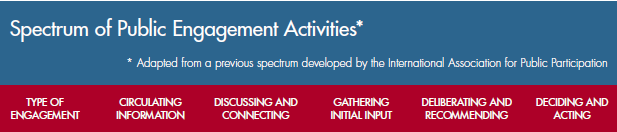
Here is a spectrum of public engagement appropriate for local governments in the United States. The activities range from “circulating information” to giving the public a role in “deciding and acting.”

It is based on a spectrum developed by the IAP2, but I have pasted this version from a new report entitled Planning for Stronger Local Democracy: A Field Guide for Local Officials. Written by Matt Leighninger, the Executive Director of the Deliberative Democracy Consortium,  and Bonnie Mann, Project Manager at the National League of Cities, this report is a practical guide for public officials who recognize a “‘Catch-22’ dilemma: public trust in government has declined steadily, while the active support and engagement of citizens has become increasingly critical for solving public problems.” The local officials who figure as positive examples in the report have figured out how to engage the public in governance–to mutual benefit.

The first part of the report is organized around a series of major questions, each accompanied by additional specific questions, examples of success, and other advice. Some of the major questions are nitty-gritty, such as “What are the legal mandates and restrictions on how you interact with the public?” Other questions indicate that formal structures and processes are not the only factors that matter; local officials ought to be concerned about civil society as a whole. For example: “How well are neighborhood associations and other grassroots groups serving their neighborhoods?” Still other questions raise essential issues of diversity and inclusion. For example: “In what ways are recent immigrants and other newcomers connected, or disconnected, from the rest of the community?”

The second part of the report is a guide for “Developing Shared Civic Infrastructure.” The practical outcomes could range from using social media more effectively to changing laws or even building physical spaces where people can meet.

If it’s true that distrust for government and for other citizens is preventing us from governing ourselves as a democratic people, then this report ought to be required reading for all leaders.

understanding public deliberation as a field

In the current Journal of Public Deliberation (which, by the way, is a free, open-access, peer-reviewed publication), Caroline W. Lee has an article entitled, “Five Assumptions Academics Make About Public Deliberation, And Why They Deserve Rethinking.”

Her first major contribution is to see that public deliberation is not just a philosophy or a set of practices; it is a bunch of people and organizations whose actors “interact with knowledge of one another under a set of common understandings about the purposes of the field, the relationships in the field (including who has power and why), and the field’s rules” (quoting Fligstein and McAdam). If you have been to as many “D&D” (dialogue and deliberation) meetings as I have, you know that this is true, and you will recognize some of Lee’s anonymous informants:

The professional consultant from California, the non-profit executive from Connecticut, the minister from Texas, the rural development expert from North Dakota, the academic from Colorado, the foundation executive from New York City, the think tank staffer from DC, the therapist from Virginia, the EEO officer from Nevada, the deliberation organization staffer from Ohio …

Her empirical analysis of these people and their relationships challenges many common assumptions about the field.

To begin, “much of the activity in the field is driven by elite actors—a fact that practitioners readily acknowledge.” (She cites me as one source.) Although some of the leaders in the field emerged from participatory democracy in the 1960s and retain left-of-center political views, they are more heterogeneous than that:

Deliberation draws on many fields, including alternative dispute resolution in legal systems, workplace participation reforms in private companies, psychological counseling and therapy, personal recovery movements, and New Age and New Thought religious practices …

Relatedly, issues of equity and diversity only concern some in this field. To be sure, sessions on equality and diversity draw overflow crowds, but that can obscure the fact that many other participants in the “D&D” field are actually quite uncomfortable with these topics. As one leader wrote, “Topics like ‘race’ and ‘gender’ by themselves create an exclusive, divisive, and even demeaning frame. (Do people really want to be defined genetically rather than by their choices?)” The most sympathetic interpretation would be that issues of identity and equality are hotly debated within the deliberation field, but I fear that what really happens is division into separate conversations: the passionate proponents are in one room, the quiet critics in another.

Turning to the methods that D&D practitioners employ, Lee finds, “despite the apparent heterogeneity …, many methods involve routine combinations of a limited palette of practices. The heterogeneous engagement techniques described by Girard and Stark (2007) are in fact standard elements of deliberation practitioners’ toolkits.” She is insightful about common elements that might be overlooked, such as a tendency to use “Appreciative Inquiry” or something very much like “its explicitly positive and opportunity-focused philosophy.”

Just as the various methods are more similar than they might at first appear, they also have much in common with widespread practices used in corporations and government. Practitioners of D&D reported that they had also participated in such approaches as “Stanford T-group training,” “IBM Jam,” “Plowshares,” “Encounter Programs,” “federal mediation training, “Transactional Analysis training,” “AT&T University,” “Quality Circle,” “Community Dispute Resolution Training,” “activist trainings,” “advanced facilitation for Covey 7  Habits of Highly Effective People,” “Gestalt Intervener Certificate,” and “Environmental Stakeholder dialogue.” One claimed “extensive in-house government and corporate facilitator training.”

Not only are techniques similar in grassroots community settings and in corporate offices, but companies employ many of the experts on deliberation. “Private clients represent a small, but important—and unusually remunerative—part of practitioners’ client base. At conferences, many practitioners report that work with private clients is typically easier than dealing with the thicket of agencies involved in public sector processes, and can expose deliberative principles to greater numbers of stakeholders.”

This finding is not necessarily a critique. Working in the corporate sector can be smart and beneficial. But it deserves critical scrutiny since, as Lee notes, “There is a substantial literature starting with Habermas (1989) documenting general trends in incursions of private enterprise into the public sphere and their negative consequences on democratic politics and deliberative possibilities.”

Overall, the paper sets a hugely valuable agenda for research aimed not at understanding how deliberation affects participants or communities, but what it is as a field of practice–including its composition, the dominant incentives and power structures, and potential for change.
why we are choosing to abolish the jury system

According to Richard Oppel in today’s New York Times, just one in 40 felony cases goes to trial, down from one in twelve in the 1970s. Mandatory sentencing laws have given prosecutors the ability to threaten long prison terms that can’t be limited by juries or judges. Almost all defendants plea-bargain to avoid those sentences. As one federal judge told Oppel, “We hardly have trials anymore.”

The mandatory sentencing laws were passed by referenda or by popular votes in state legislatures. Influenced by Albert Dzur’s work, I would say that the people (using the ballot box) have chosen to remove the people (convened as jurors) from criminal law. This choice perfectly illustrates my greatest worry: that we have lost trust in both institutions and one another.

A majority of Americans distrust the criminal justice system, and they are mainly concerned that the guilty will go free. Crime remains high, by comparative standards. People are afraid of it, in part because of media sensationalism. And attitudes toward crime are infused with race. Thus majorities vote to impose simple, understandable rules on the whole system, like “Three Strikes” in California. One ironic result is to transform criminal cases from transparent public events (full of explicit moral rhetoric) into bargaining sessions managed behind the scenes by lawyers. That is a recipe for even lower trust, which encourages even more draconian sentencing laws. Meanwhile, at least some American are angry because we have incarcerated 2.29 million of our people, with terrible effects for their lives and communities and high costs to society. People (like me) who are angry from that direction get outvoted but contribute to low confidence.

The old system for ensuring that the public trusted the law (dating to Anglo Saxon times) was to empanel members of the public to hear actual cases. We could go back to that system. But there is no groundswell for such a remedy because Americans trust one another about as little as they trust major institutions, like the courts.

The results are very bad: not only is our incarceration rate unconscionable, not only do innocent people have reasons to plea-bargain to avoid draconian sentences, but democracy is distorted. We the people are wisest when we gather to discuss with others and when we focus on complex cases in their particular contexts. Then our everyday experience, diversity of backgrounds, and human sensitivities improve our thinking. We the people are least wise when we make simplistic decisions in the ballot box, without expertise and under the influence of advertising campaigns. But because we distrust the government and ourselves, we are substituting our most foolish mode of thought for our wisest one.

Frontiers of Democracy

I have been offline because I’ve been at the Frontiers of Democracy conference with about 120 scholars, activists, public officials, and students. There is a lively discussion of the conference themes on Twitter under the hashtag #demfront. Various subsets of conference participants have produced statements, and you can vote for which ones you like best or think are most important. (We’ll take the votes back to the conference tomorrow morning.)

on religion in public debates and specifically in middle school classrooms

Harvard Ed. School professor Meira Levinson visited the Summer Institute of Civic Studies yesterday and led us in a discussion of a case that raises two fundamental issues. Students were required to choose and implement a civic action project. An Orthodox Jewish 8th-grader chose as his project arguing against the Massachusetts gay marriage law on religious grounds, taking as a premise that homosexuality is immoral and citing scripture as evidence. The chief issues are: 1) the legitimacy of any religious arguments in public forums, such as deliberations in public school classrooms; and 2) the potential effects on any students who might be gay–in other words, the effects on inclusion and equity.

I am inclined to say the following. First, the school and its teacher should not be neutral about homosexuality. Gay students have a right to be included and fully respected in the classroom. The teacher should strongly communicate that anti-gay rhetoric is disallowed.

But there are several reasons to allow the religious student to argue against gay marriage on reasons of faith: 1) Gay marriage is actually a live debate in the legislature and the press, and students should learn to follow such debates. 2) Although a student does not have a constitutional right to say whatever he wants in class, it is good pedagogy to create free speech zones within social studies classrooms. 3) Other students will learn something about orthodox Jewish thought if he can speak candidly. 4) The student in question may learn from other students’ responses, and it is better that he bring his values into the classroom than to feel that he was censored there and continue to hold them privately.

I think that religiously-based arguments should be permitted in a classroom (or a legislature) and not rejected on the ground that they are religious. At the same time, I think anyone who brings religious arguments into the public domain can be required to defend them. If the religious student states, “God says homosexuality is sinful,” other people may reply that God does not say that, or that God does not exist, or that God’s word should not determine human laws. He cannot be permitted to close the debate by claiming that his identity generates his opinions, and therefore a critique of his opinions constitutes an unfair attack on his identity. He is entitled to have his identity as a Jew respected and to be fully included in the classroom, but he is not entitled to have his opinion about homosexuality respected by other people in the classroom. He should expect that it will be challenged.

I am proposing an asymmetry here. Being gay is an identity that must be accepted in a public school classroom; hence the teacher must be against homophobia and must favor inclusion and respect. Holding religiously-based, anti-gay opinions is not an identity but a position, and it can be challenged. (Yet being Jewish is an identity.) I recognize the problem: what counts as an “identity” and an “opinion” is contested and changes over time. But I’m sticking to my position. …