Category Archives: deliberation

what we should talk about? (notes on Trayvon Martin and the state of national dialogue)

(Albuquerque, NM) After Newtown, President Obama “direct[ed] the Departments of Health and Human Services (HHS) and Education to launch a National Dialogue on Mental Health.” This presidential directive led, in turn, to “community conversations,” including a big meeting here in Albuquerque on Saturday. I am here because I serve on the board of Everyday Democracy, which helped to organize the Albuquerque deliberation.

Note that the whole effort began in response to the Newtown shooting, but the focus shifted—for understandable, if debatable reasons—from guns to mental illness. Now, several months later, it is very hard to talk about gun violence without thinking about George Zimmerman and Trayvon Martin. And the president has called for a national dialogue on race.

These shifts of topic raise a general and urgent question about framing, or, in blunter terms, What should we talk about?

For instance, if you are concerned about the Trayvon Martin killing, it may be because you despise anti-black racism and oppose “stand your ground” laws. If you are still thinking about the Newtown murders today, you probably want to regulate or ban assault weapons. On the other hand, if you oppose gun control and think (as most white Americans say they do) that anti-black racism is overemphasized, then you may want to change the focus away from Trayvon Martin and away from Newtown. You may find urban crime a more congenial topic, because the accused are disproportionately Black, and gun control has been used locally without seeming to work. See, for example, Pat Buchanan.

Incidentally, people like Buchanan have helped to make the Martin case a major news story by talking about how “the media” is overplaying it. Within their own circles, they want to talk about the Zimmerman trial, which reinforces their views about race and guns. (It allows them to remind everyone that men who look like them can act as the law.) The debate about whether we should be talking about the Trayvon Martin case actually increases attention to the case and serves the interest of the hard right as well as civil rights groups.

As a participant in political debates, you are entitled to try to shift the focus. Each framing pushes the conversation in certain directions instead of others. So it is not intrinsically wrong to say, in response to the Trayvon Martin case, “Let’s talk about the 500 murders committed in Chicago last year.”

In fact, I also want to talk about urban crime, including the crimes committed by young Black men, which produce many victims and also partially explain why nearly 1 million African American men are incarcerated today. Not only Pat Buchanan but also the NAACP want people to know that African Americans are disproportionately convicted of crimes.

So what is the right conversation for us to be having in this situation? I would say we need to be able to talk both about urban violent crime–in which Black people are disproportionately perpetrators and victims–and racially motivated violence against African Americans. One of those topics must not be eclipsed or trivialized by invoking the other one. If the phrase “comparisons are odious” means anything, its wisdom emerges in cases like this. It would be true but odious to say that almost as many German gentiles died in WWII as Jews died in the Holocaust. It’s not that the German lives were valueless and we shouldn’t care, but the comparison trivializes. Likewise, a person who cared about all these victims would not casually juxtapose 500 homicides in Chicago against 27 in Newtown and one in Sanford, FL.

Although no one should try to eclipse one topic with the other, they may be related in various important ways. For instance, maybe we teach most Americans (Black as well as White) to think that Black people’s lives are cheap. Then Zimmerman’s decision to shoot had something in common with decisions that are taken nearly every day in cities like Chicago. It is also true that many people are sincerely afraid of crime, and their fear is legitimately part of the conversation.

One place where both police (or vigilante) violence against Black people and crime committed by Black people are extensively and continually discussed is within the African American community itself. At “Frontiers of Democracy,” Peter Pihos gave a great historical talk about Chicago around 1970, when crime was rising rapidly and mass incarceration was just around the corner. He focused on several African American leaders who very explicitly opposed both “genocide” (by the white government) and “suicide” (by the Black community) and connected them to each other. That was an important moment, but similar discourse has been constant and vibrant. After all, compared to the national population, African Americans are disproportionately represented in urban police forces, corrections departments, and among the citizens who call the police and sometimes complain about slow and inadequate responses. So this is a subgroup of Americans on both sides of the prison industry and well aware of that.

A right-wing trope holds that we don’t pay enough attention to crimes committed by Black people because that discussion would violate political correctness. We may indeed not talk very well about race and racism, but our actions speak loudly. We spend about $27 billion a year simply incarcerating African Americans,* to say nothing of the costs of policing and the judicial process. Michigan, whose great city is bankrupt, spends one fifth of its general fund on prisons. California spends more on prisons than on its once-vaunted system of public higher education. The relative silence on this topic in venues like the US Congress is indeed problematic, but we can’t let that silence be filled by the kind of words one sees on open comment forums about the Zimmerman trial. It must be a conversation about how to treasure and protect all human lives.

*I extrapolate from the total cost of prisons ($68 billion) and the proportion of all prisoners who are Black (roughly 40%).

sessions at the American Political Science Association

I am helping to organize three sessions at this year’s APSA Conference that are relevant to civic renewal and civic education. The theme of the whole conference is “Power and Persuasion,” and the APSA president is the excellent Jane Mansbridge. Improving the relationship between persuasion and power is an essential goal of civic renewal. In that context …

1. Theme Panel: “Power and Persuasion from Below: Civic Renewal, Youth Engagement, and the Case for Civic Studies”
Aug 30, 2013, 4:15 PM-6:00 PM
Chair: Peter Levine, Tufts University. Participants: Paul Dragos Aligica, George Mason University; Carmen Sirianni, Brandeis University; Karol E. Soltan, University of Maryland; Filippo A. Sabetti McGill University; and Meira Levinson, Harvard University

“Civic renewal” refers to an international set of movements and practices that enhance citizens’ agency and may therefore strengthen persuasion over raw power. In the US, it includes public deliberation, broad-based community organizing, and collaborative governance, among other efforts. Its values have also been reflected in aspects of the Occupy Movement and the Arab Spring, to name just two recent global movements. Youth are at the forefront of some of these efforts and must always be incorporated in them. “Civic Studies” is an emerging scholarly field inspired by Elinor and Vincent Ostrom and the Bloomington School, by social science as phronesis, by the new constitutionalism, by theories of public work and democratic professionalism, by research on deliberative democracy, and by related academic movements that take civic agency seriously. Civic education should draw on Civic Studies and support civic renewal.

2. APSA Committee on Civic Education and Engagement Roundtable: The Measurement and Assessment of Civic Learning in K -12 and College Education
Saturday, Aug 31, 2013, 8:00 AM-9:45 AM
13:00-14:30 on 29, 30 and 31 August 2013, Chicago
Chaired by Peter Levine. Participants: Elizabeth Bennion, Indiana University, South Bend; David Campbell, Notre Dame; Meira Levinson, Harvard University.

We will be thinking about what should be measured, how to measure it, and new opportunities afforded by tools like games and badges. One topic will be the ideas in the APSA’s edited volume, Teaching Civic Engagement: From Student to Active Citizen. But we will broaden the discussion beyond the question of how to measure students’ learning in college-level political science classes.

3. APSA Working Group on Young People’s Politics
August 29, 30 and 31, 2013, 1:00-2:30 PM
Convenors: Peter Levine, Tufts University; James Sloam, Royal Holloway, University of London

The political participation of young people in industrialized democracies has changed significantly over the past few decades. Although youth turnout in elections may be declining (or, as in the United States, has flatlined at a relatively low level), there is overwhelming evidence to show that young people are not apathetic. Indeed, it is young people who are diversifying political engagement: from consumer politics, to community campaigns, to international action groups; from the ballot box, to the street, to the Internet. Since the onset of the global financial crisis, we have witnessed a proliferation of youth protest: against authoritarianism (the Arab Spring), corporate greed and economic inequality (Occupy), youth unemployment (the ‘outraged young’ in Spain), and political corruption (the rise of populist parties like the Five-Star Movement in Italy). The international dimension of young people’s politics has also become increasingly apparent through the diffusion ideas and mobilisation from Cairo, to Madrid, to New York, to Istanbul to Rio. The APSA working group on young people’s politics will explore research on the nature of youth participation from a comparative perspective. To contextualise youth participation, it will also examine how public policy defines young people’s lives in our democracies e.g. through participation (or non-participation) in the labour market or opportunities (or lack of opportunities) for social mobility. Finally, the working group will focus on efforts to strengthen the civic and political engagement of young people (e.g. through civic education or political science education).

The working group sessions will provide an interactive forum for participants to discuss their own research with colleagues working in the same area, to reflect on panels visited by participants at the Annual Meeting (in the first meeting, we will agree on panels to recommend to participants), and discuss the potential for future research collaboration (e.g. conferences, funding, edited volumes) and the establishment of an APSA organised section on young people’s politics.

the Oregon Citizens Initiative Review

(This is the sixth in a series of blog posts by CIRCLE, which evaluated several initiatives funded by the Democracy Fund to inform and engage voters during the 2012 election. These posts discuss issues of general interest that emerged from specific evaluations. It is also on the Democracy Fund’s website.)

CIRCLE evaluated seven initiatives funded by the Democracy Fund during the 2012 election. These interventions were not comparable; they had diverse purposes and operated in various contexts and scales. We certainly do not have a favorite among them. But we do recommend that policymakers pay attention to one of the projects because it can be adopted by law—with positive effects.

In 2011, the Oregon legislature instituted a process called the Citizens’ Initiative Review (CIR). This reform unifies two apparently contrasting forms of democracy, the popular initiative and the deliberative forum.

Presentation of Key findings from Measure 85, 2012 CIR, Healthy Democracy Fund

With a referendum, the public can circumvent entrenched interests and hold politicians accountable. A referendum honors the democratic principle of one person/one vote.

Oregon was one of the first states to institute referenda, initiatives, and recall elections. Perhaps the most famous advocate of these populist reforms was William Simon U’Ren, known nationally as “Referendum U’Ren,” who formed the Oregon Direct Legislation League in 1897. As a result of early initiatives, Oregon was the first state to elect its US Senators directly (1908), the first to hold a presidential primary election (1910), and one of the first to allow women to vote (1912).

These were achievements. But a referendum does not require people to learn, think, or discuss. As the number of referenda rises, the odds fall that voters will be thoughtful and well-informed about each ballot measure. Deliberation is a form of democracy that encourages people to be well-informed and thoughtful. Juries and New England town meetings are deliberative bodies that have deep roots in the United States, but governments can also create innovative deliberative forums today. For instance, several cities have asked AmericaSPEAKS to convene large numbers of representative citizens to discuss an issue—such as the city plan of New Orleans or the budget of Washington, DC—and give official input on the final decisions.

Referenda can easily reach large scale and offer every citizen an equal vote, but they may not reflect thoughtful opinion and may in fact present information in a format that is too complex or filled with jargon to be easily understood even by well-informed voters. They can even be manipulated by the authors of ballot measures or by groups that spend money on campaigns. Deliberation addresses those two problems, but deliberations tend to be small and would cost a great deal (in both money and participants’ time) to make widespread.

The Citizens Initiative Review process combines the best of both ideas. The text of an initiative is given to a randomly selected, representative body of 24 citizens who study it, hear testimony on both sides of the issue, and collaboratively write an explanatory statement. They spend five days on this work. Their explanation does not endorse or reject the initiative but gives deliberated and informed arguments for and against it. A copy is mailed to all households in Oregon as part of the state’s Voters Pamphlet.

CIR: How it Works, Healthy Democracy Fund

Penn State Professor John Gastil found that nearly half of Oregon voters were aware of the CIR’s explanations in fall 2012. He also conducted a randomized experiment, surveying a sample of Oregonians who were given the explanations and a control group who were not. His experiment showed that the text produced by the CIR influenced people’s views of the ballot measure and increased their understanding of it. If many people knew about the explanation, and the explanation changed people’s opinions in an experiment, then the CIR probably changed many people’s opinions across the state.

CIRCLE conducted an analysis of media coverage of the CIR process in December of 2012.  With the bulk of coverage appearing in Oregon-based media outlets, it generally focused on the CIR process—describing it and communicating its validity and trustworthiness. Healthy Democracy, the organization that managed the CIR, created strong and consistent messages that guided this public conversation, which at times expanded into advocacy for the CIR or appeals to strengthen democracy through such processes. The media also used the CIR as a way to talk about deliberative dialogue in a concrete form. For the non-Oregon media especially, it offered a way to think about the possibilities for such processes in other locales. Advocating  deliberative processes and igniting the public imagination about new forms of engagement were clearly strong narrative threads in the public discourse caused by CIR media coverage.

CIRCLE is also in the final stages of interviewing political leaders from other states who have observed the CIR in Oregon or are engaged in other educational activities about the CIR. We are asking them what would influence their decision to adopt the reform. We will report our results here.

The previous entries in the series can be accessed below:

1 – Educating Voters in a Time of Political Polarization

2 – Supporting a Beleaguered New Industry

3 – How to Reach a Large Scale with High-Quality Messages

4 – Tell it Straight?  The Advantages and Dangers of Parody

5 – Educating the Public When People Don’t Trust Each Other

how to reach a large scale with high-quality messages

(Washington, DC) This post–cross-posted on the Democracy Fund blogis the third in a series about CIRCLE’s  evaluations of the Fund’s initiatives to inform and engage voters during the 2012 election. These posts discuss issues of general interest that emerged from our specific evaluations. The previous entries in the series are: “Educating Voters in a Time of Political Polarization” and “Supporting a Beleaguered News Industry.” Join CIRCLE for discussion of the posts using the hashtag #ChangeTheDialogue, as well as a live chat on Tuesday, June 25th at 2pm ET/1pm CT/11am PT.

Since 2012, the Democracy Fund has invested in projects and experiments intended to inform and engage voters. Several of these efforts sought to change the way citizens respond to divisive and deceptive rhetoric. To succeed, an organization would have to (1) create an experience that altered people’s skills, attitudes, and/or habits, and (2) reach a mass audience.

In this post we focus on the second issue: scale. Since adults cannot be compelled to undergo civic education, and about 241 million Americans were eligible to vote in 2012, engaging citizens in sufficient numbers to improve a national election is challenging. Democracy Fund grantees used at least four different strategies to reach mass audiences with nonpartisan education.

First, the Healthy Democracy Fund’s Citizens Initiative Reviews convened representative groups of citizens to deliberate about pending state ballot initiatives in Oregon. The citizens’ panels wrote summaries of these ballot initiatives that the state then mailed to all voters as part of the Oregon voter guide. Although only 48 people were directly involved in the deliberations, the results of their discussions reached hundreds of thousands of Oregon voters. Penn State Professor John Gastil found that nearly half of Oregon voters were aware of the statements that these deliberators had written and that a significant portion of the voting public found the statements to be useful. In an experiment that Gastil conducted, citizens who read the statements shifted their views substantially and showed evidence of learning. So, in this case, a small-scale exercise in deliberative democracy led to mass public education.

Second, Flackcheck.org produced videos ridiculing deceptive campaign ads. The videos were free, online, and meant to be funny. A major reason to use parody and humor was to increase the odds that viewers would voluntarily share the videos with their friends and relatives. We asked a representative sample of Americans what would generally encourage them to share a political video, and 39% said that they would be more likely to share it if it was funny. The only attribute that attracted more support was the importance of the topic. We also asked respondents to watch one of three Flackcheck parody videos, and 37% thought the one they saw was funny, although 20% did not.

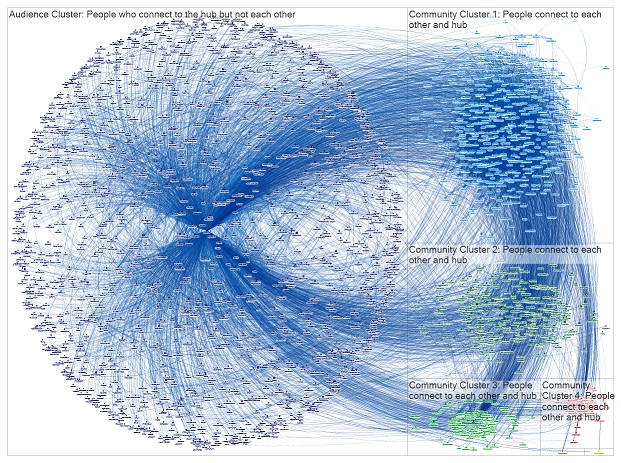
In the end, the Flackcheck parody videos attracted some 800,000 views. That is a relatively large number, although a small proportion of the electorate. On a subcontract from CIRCLE, Marc Smith is analyzing the dissemination network created by the sharing of Flackcheck videos online. Below are shown the people and organizations that follow Flackcheck’s Twitter account and their mutual connections. It is a substantial online community.

Third, AmericaSpeaks recruited individuals to deliberate online as part of Face the Facts USA. AmericaSpeaks is best known for large, face-to-face deliberative events called 21st Century Town meetings. Although they convene thousands of people, often in conference centers, their scale is small compared to the national population. The Face the Facts project provided an opportunity for AmericaSpeaks to recruit participants to low-cost and scalable Google Hangout discussions. That is a model that could be replicated as an alternative or a complement to more expensive, face-to-face discussions.

Finally, several projects involved influencing professional journalists or media outlets as an indirect means of educating the public. These projects took advantage of the fact that millions of Americans still receive information and commentary from news media sources. The Democracy Fund grantees strove to improve the quality of their coverage and thereby reach a substantial portion of the voting public.

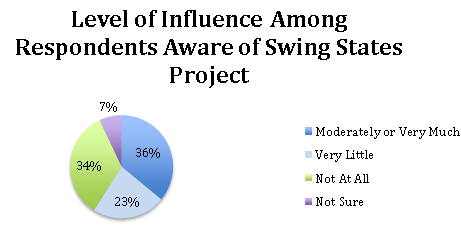
The Columbia Journalism Review’s “Swing States Project” attempted to improve the quality of local media coverage by commissioning local media critics to critique the coverage . We interviewed political journalists in the targeted states. Among respondents who were aware of the project, 59% responded that it had influenced them. Thirty-six percent indicated that it had a moderate influence or influenced them “very much.” Although we cannot estimate how this influence on journalists affected voters’ understanding of the issues, the findings suggest that a fair number of journalists whose work is being read and watched by voters in swing states were taking steps to improve their coverage.

The Center for Public Integrity’s “Consider the Source” provided in-depth reporting on campaign finance issues that newspapers, broadcasters, and other news sources could use. CIRCLE interviewed 13 prominent experts who report on money and politics. Nearly half of these interviewees felt that CPI resources had influenced the conversation among media professionals, and that consequently the media now offers more comprehensive stories about money in politics. Although only 200,000 people read the CPI stories at the CPI website, the organization’s media tracking service estimated that the stories reached a potential circulation of 48 million people through pick up by other media organizations.

Although CIRCLE’s evaluations did not yield recipes for changing mass behavior, the following conclusions are consistent with our findings:

  1. Distributing recommendations from a credible public deliberation can have significant influence on the public, if the deliberation is reflected in an official vehicle, such as a state voter guide.
  2. “Providing resources to the media can be an effective means of reaching scale, if the source is viewed as fair and providing them with relevant and valued content
  3. It’s hard to get to scale by trying to become a destination site.

the Deliberative Democracy Handbook in Japanese

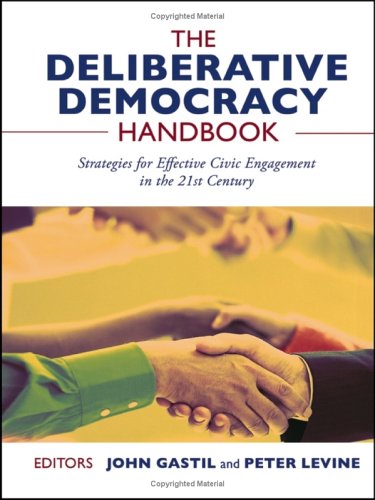
Here is the new Japanese version of The Deliberative Democracy Handbook: Strategies for Effective Civic Engagement in the Twenty-First Century, edited by John Gastil and me. A cleaned-up version of the Google translation of the Japanese blurb would say:

Don’t leave it to the legislature alone! This is a practical handbook for a new form of democracy by direct participation of citizens. It describes a method of citizen participation in the political process, describing concrete case studies from other countries, mainly the United States of America. It is a useful single book for all those who are interested in civil juries, deliberative polls, town meetings, and other formats, summarizing both their strengths and weaknesses for local governments, educational institutions, and others.

Compare the Chinese and English covers, below: