Category Archives: elections

conservatism and identifying as white among Latinos

Latinos preferred Biden over Trump by 65%-32% according to the exit polls. There is some debate about that statistic, but it seems safe to say that Latinos tilt Democratic, yet somewhat less so than they did in the recent past.

We also know that people who consider their own whiteness important to their identity are more likely to support Trump. In the Tufts Equity study, whites who consider race important to their own identity favored Trump by 61.5%-31%, whereas Trump’s lead among other whites was just 5 points (47%-42%: less than a majority).

In this context, it seems significant that a majority of Hispanics identify as white, and a substantial proportion–one quarter in the 2012 American National Election Study (ANES)–say that being white is important to their identity.

I get that last statistic from Filindra and Kolbe 2020. These authors find that Latinos are more likely to identify as white if they have higher incomes, and less likely to identify as white if they have more education and if they report strong consciousness as Latinos. (Possibly, education increases social awareness.) Latinos are more likely to be Republicans and to support cuts in welfare if they identify as white.

These are not mere correlations but the results of models that control for numerous other variables. It is equally interesting that some variables do not seem to matter, e.g., religion, skin tone (albeit known for only some respondents), and whether one was born in the US or overseas. The degree of acculturation is related to views of welfare but not to other measures.

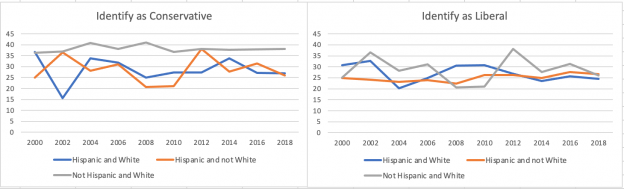
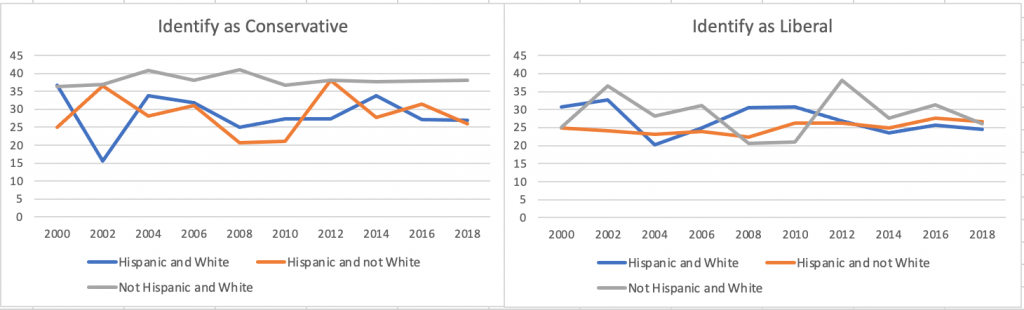
Filindra and Kolbe use 2012 ANES data, and I was interested in change since then. In a nutshell, I find no important shifts. My graphs below show rates of identifying as conservative and as liberal in the ANES since 2000. (Moderates are not shown, although they are the largest group.) Whites who are not Hispanic are the most conservative, and at a steady rate. However, they have also become the most likely to identify as liberal (at the expense of moderates). Hispanics who identify as white have been somewhat less conservative than other whites. And Hispanics who do not identify as white have not been statistically different from those who do.
Source: Filindra, Alexandra and Kolbe, Melanie, Are Latinos Becoming White? The Role of White Self-Categorization and White Identity in Shaping Contemporary Hispanic Political and Policy Preferences (May 16, 2020). Available at SSRN: https://ssrn.com/abstract=3602372 or http://dx.doi.org/10.2139/ssrn.3602372
CIRCLE survey of young voters

CIRCLE has released a national survey of 2,645 eligible voters under 30 conducted between Nov. 3 and Dec. 2, 2020. Their release emphasizes that young people–especially those who supported Joe Biden–were highly engaged in the campaign, with nearly half talking to others about voting.

CIRCLE also notes the salience of anti-racism: “68% said they saw voting as a way to stop violence against people of color, 56% talked to peers about how racism affects society, and 57% say they took action for racial justice in their communities.“

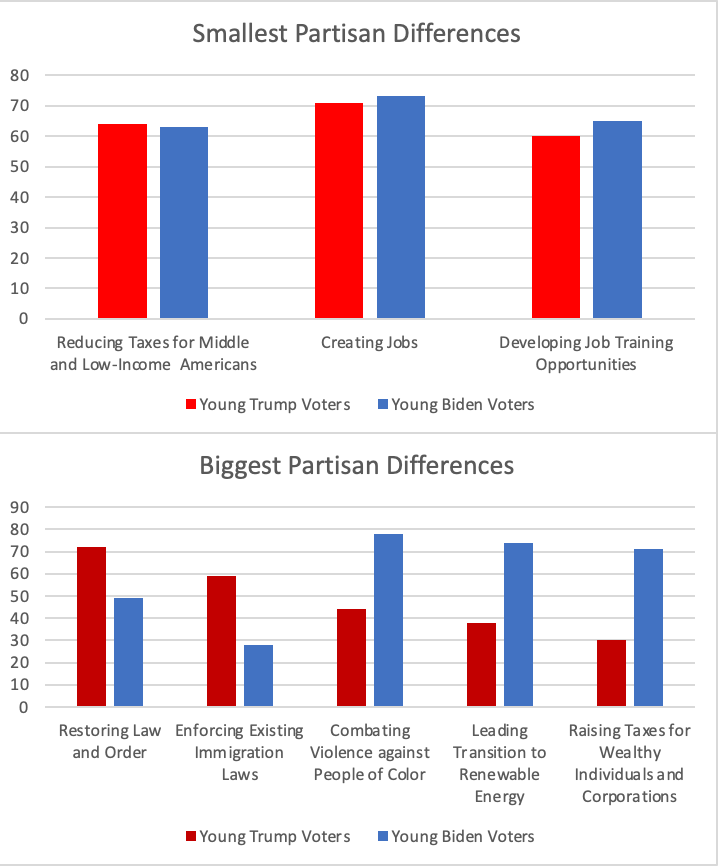
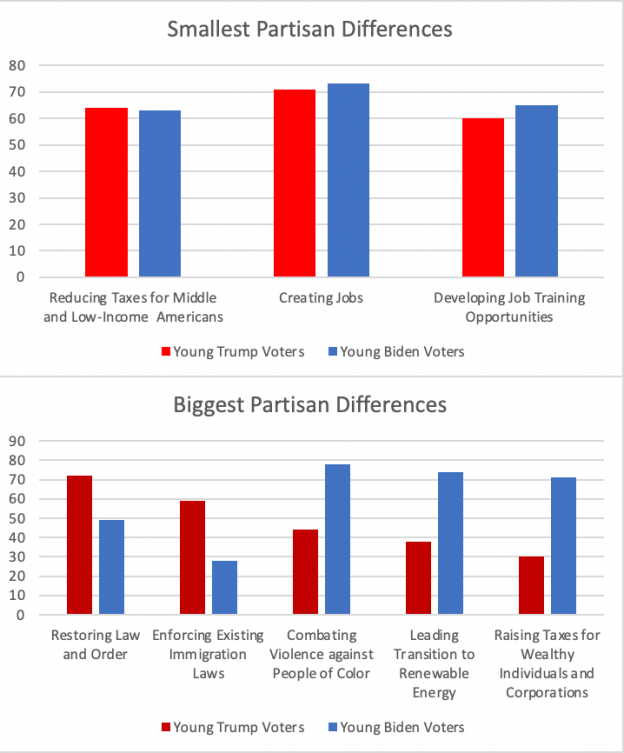
I was interested in the differences and similarities between young people who supported Trump and Biden (the latter being much more numerous). As shown below, they are indistinguishable on some economic issues. They differ a lot on “law and order,” immigration, racist violence, climate, and taxing the rich. However, it’s worth noting that 44% of young Trump voters favor reducing violence against people of color and more than a third want to move to renewable energy.

who needs civic education?

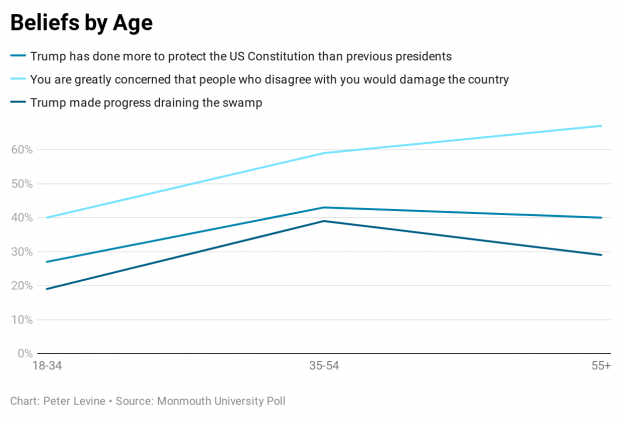
The Monmouth University Poll released on Nov. 19 asked people (among other questions), whether Trump has done more than other presidents to undermine or to uphold the Constitution, whether respondents fear what their political opponents would do to the country, and whether Donald Trump has “drained the swamp” or made corruption worse. Here are the responses by age group.

Young people are the least likely to think that Trump upheld the Constitution, least afraid of their opponents governing, and most likely to believe that Trump worsened corruption.

I suppose reasonable people might debate these questions. A very conservative person might believe that Trump’s judicial appointments are saving the Constitution. A thoughtful progressive might fear what Trumpian Republicans would do to the country.

But generally, we would want people to answer these questions in the negative. Citizens should know that Trump disparages the Constitution, that it’s important to cede power when opponents win elections, and that the forms of corruption reported during the Trump administration are deeply problematic.

Of course, everyone needs civic education. The young need it most because they are the future and because they must be equipped to become more effective as citizens. But if you want to know who demonstrates the greatest deficits in basic civic dispositions, it is not the young.

Campus Compact podcast

This is the audio of my friend Andrew Seligsohn, the President of Campus Compact, interviewing me earlier this week about the election, what it tells us about civic life, and what we should do next. I enjoyed it and appreciated the opportunity. Follow Campus Compact for other #CompactNation podcasts.

the highest turnout ever

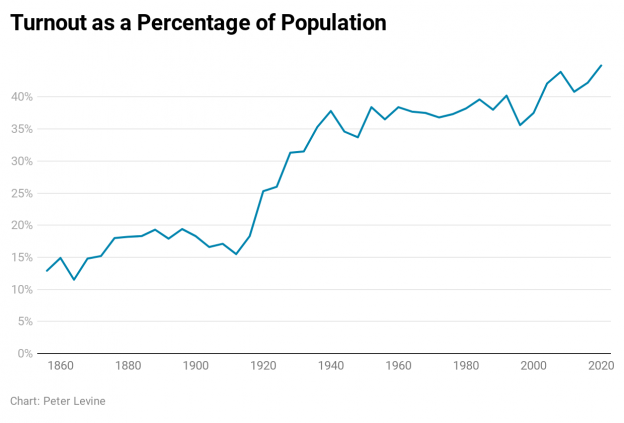
“Turnout” is usually defined as the percentage of legally eligible people who actually vote. So defined, turnout was higher back in 1900, when no women and few African Americans were permitted to vote. But if we want to measure how democratic the society is, it’s better to ask how many people voted out of the whole population. By that measure, 2020 will be the best year in US history.

This graph assumes that 149.5 million Americans voted in 2020, although that number may actually be higher. It implies that 45 percent of the people voted. That beats the previous high of 43.9 percent in 2008. Note that the ideal rate would not be 100%, because the population includes people of all ages, even babies. But 45 percent is not high enough.

Population estimates from the decennial Census, with my own linear estimates for the intervening years. Number of votes cast from Dave Leip.