Category Archives: elections

a real surge in youth voting

According to CIRCLE, youth turnout has doubled in Virginia over the past three gubernatorial races, from 17% of eligible young people in 2009 to 34% yesterday. Virginians under the age of 30 also tilted dramatically to the Democratic side. Just over half (54%) of young Virginians had chosen Hillary Clinton one year ago; 69% voted for the Democrat, Ralph Northam, yesterday. Voting in force and tilting to one party is how to have real impact.

In New Jersey, where this year’s gubernatorial race was not particularly competitive, the youth turnout trend was flat.

Closer to home, Boston (like several major cities) held a mayoral election yesterday. We don’t know the youth turnout rate there because the data aren’t available yet. However, in the past two Boston mayoral elections (each conducted in an odd-numbered year), youth turnout did not reach even two percent. In contrast, last November, about 35% of young eligible voters voted in Boston, and 80%-87% of the registered young adults in each ward turned out. Although there’s work to be done to educate and engage young people in local politics–and some excellent organizers are doing that right now in Boston–it’s also bad to hold elections in off years. If you want your city to flourish, you need a youth perspective. You should hold elections on years when one in three–instead of one in fifty–young people turn out.

college student voting rose in 2016

Today, my colleagues at Tisch College’s Institute for Democracy and Higher Education have released their national study of college students’ voting, based on the voting records of 9,784,931 students at 1,023 higher education institutions.  The team finds a national college turnout rate of 48.3% in the 2016 presidential election, up from 45.1% in 2012, with significant variations by race, gender, field of study, and institution type. Women voted at rates about seven points above men in both years. (It’s interesting that the dynamics of the 2016 campaign didn’t change that pattern.) Asians and Latinos increased their turnout substantially. African Americans’ turnout slipped from a high baseline in 2012.

  • Here is the full national report.
  • This is an interactive portal where you can explore the data yourself.
  • The team also sent individual reports to 1,005 colleges, with their own turnout data broken down as much as possible by students’ demographics and fields of study.
  • On NPR, Danielle Kurtzleben covers the release in a story headlined, “2016 Voter Turnout Dropped At HBCUs, Climbed At Women’s Colleges, Study Finds.”

Democrats as technocrats

This web search takes you to a whole stack of good recent writing about the Democratic Party as the technocratic party, with headlines ranging from Twilight of the Technocrats? to The Triumph of the Technocrats. In lieu of a critical review, I’d pose these questions:

  1. What would a technocrat support and do in our context? It’s possible to be a socialist technocrat or a technocrat who works for a huge, for-profit company. I presume that a technocratic Democrat today is someone who believes in optimizing GDP growth, environmental sustainability, and reductions in tangible human distress (e.g., disease, homicide) through efficient governmental policies. These desired outcomes often conflict, and then technocrats are fine with compromise. To qualify as a technocrat, you can’t be too enthusiastic about working with ordinary citizens on public issues, and you can’t base your agenda on controversial, challenging moral ideals.
  2. Do Democrats present themselves as technocrats, in this sense? Some do and some don’t. It seems fair to read the positive agenda of Hillary Clinton’s 2016 campaign as largely technocratic (she promised to govern competently and continue the balanced progress of her predecessor), although her critique of Donald Trump was ethical rather than technical. I also think that Clinton was in a tough spot because she didn’t believe that she could accomplish transformative change with a Republican Congress; thus managerial competence seemed a workable alternative. The 2016 campaign does not demonstrate that she–let alone all Democrats–are fully technocratic. However, consider a different case that is pretty revealing: the Josiah Bartlet Administration. This is an informative example just because it is idealized and fictional, free of any necessary constraints. The Bartlet White House is staffed with hard-working, highly-educated, unrealistically competent, smartest-guy-in-the-room, ethical people who strive to balance the budget while making incremental progress on social issues. Hollywood’s idealized Democrats are technocrats in full.
  3. Do Democrats choose technocratic policies? Again, I’d say “sometimes.” Both the Clinton and Obama Administrations definitely showed some predilection for measurable, testable outcomes; for behavioral economics; and for models that were consistent with academic research about the economy and the climate. They weren’t particularly good at empowering citizens to govern themselves or collaborating with social movements. On the other hand, the Affordable Care Act has a moral core (aiming to cover people without health insurance), even if many of its tools and strategies are best defined as technocratic.
  4. Are Democrats good technocrats? There has been more economic growth under Democratic than Republican presidents. But the sample is small, several Democratic presidents faced conservative congresses, and any correlation with a small “n” can easily be spurious. A deeper point is that Democrats are currently more committed to the mainstream findings of climate science, social policy research, and academic economics than Republicans are. Their accomplishments may be affected by sheer chance, but their strategies tend to be consistent with positivist, empirical research.
  5. Is Democratic technocracy consistent with justice? No. Almost any theory of justice, from libertarian to strongly egalitarian, would demand fundamental shifts from the status quo. Certainly, I would favor deeper changes in our basic social contract. On the other hand, compared to what? Managing our existing social policies in a competent way delivers substantial, if inadequate, justice. It beats incompetence or deliberate assaults on existing social institutions. In a multi-party parliamentary democracy, a center-left technocratic party would play an important role. I would be open to voting for it, depending on the circumstances and the alternatives. In our two-party system, a technocratic and centrist component competes for control of the Democratic Party. It shouldn’t be surprising that this component receives constant criticism from within the Party, because the Democrats represent a broader coalition, and there is plenty of room to the left of someone like Hillary Clinton. Whatever you think of her, I don’t think you can complain that she was criticized from her left.
  6. Is Democratic technocracy good politics? That’s not a question that will be settled to everyone’s satisfaction any time soon. Clinton lost to Trump but also won the popular vote. She was technocratic but not completely so. She faced many contingencies, from Fox News to Bernie to Comey, and handled them in ways that we can debate for the next decade. Again, the answer has to be: Compared to what? A compelling new vision of America’s social contract would beat competent management at the polls. But competent management may beat incompetence or a deeply unpopular vision (from either right or left).
  7. What’s driving the Democratic Party’s drift to technocracy? One could explain it in class terms: the Democratic coalition is now highly educated, including many people who make a living by demonstrating expertise. But I would propose a deeper thesis. Modernity itself is defined by constant increases in specialization and differentiation, plus radical doubts about our ability to know which ends are moral or just. In that context, people prosper who are good at applying technical reasoning to complex problems without worrying too much about whether the ultimate ends are right. Modernity has generated a white-collar governing class that is currently aligned with the Democrats, but more than that, it has generated a very high estimation of expertise combined with a leeriness about moral discourse. Religious conservatives monopolize the opposition to both of these trends. Getting out of this trap requires more than new messages and policies. It is a fundamental cultural problem.

See also: the rise of an expert class and its implications for democracyvarieties of neoliberalismthe big lessons of Obamacarethe new manipulative politics: behavioral economics, microtargeting, and the choice confronting Organizing for Action; and why the white working class must organize.

how political knowledge related to opinions in 2016

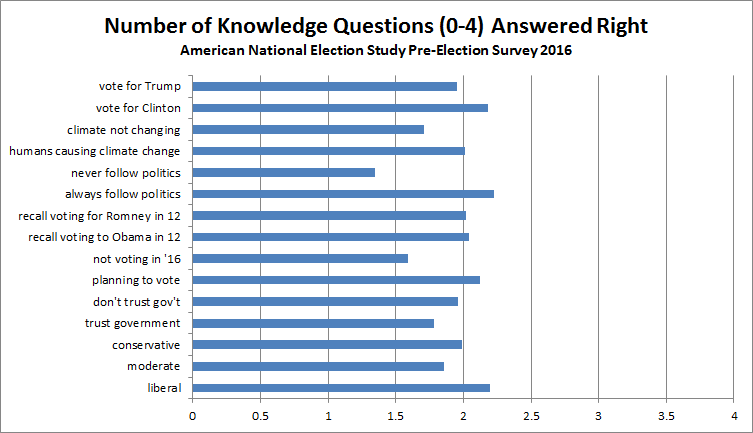
Last fall, the American National Election Study asked a representative sample of Americans four factual-knowledge questions about government: which party controlled the House and the Senate, how long a Senator’s term lasts, and which federal program costs the most. The mean respondent got just under two (1.94) of the four items right.

I thought some comparisons would be interesting. As shown in the chart below, Clinton voters scored a bit higher than Trump voters–but not by a mile. Political knowledge of this type correlated somewhat with understanding climate change, and a lot with following political news and planning to vote. Obama and Romney voters had indistinguishable levels of political knowledge. Liberals performed a bit better than conservatives, and both knew more than moderates. Knowing more about government correlated with trusting it a bit less.

the Hollowing Out of US Democracy

In lieu of an original post here today, I’ll link to a new post of mine on The Evidence Base, a group blog from CESR, the Center for Economic and Social Research at University of Southern California.  I argue that the decline of certain types of associations has left many Americans, especially White working-class citizens, in what my colleagues at the Tisch College of Civic Life and I call “Civic Deserts.” This trend does not explain why a Republican president won in 2016 or why he has taken certain views of policy and ideology. But it does explain the appeal of his leadership style. Citizens who have never belonged to everyday local associations with responsible and accountable leaders do not expect such leadership from their president.

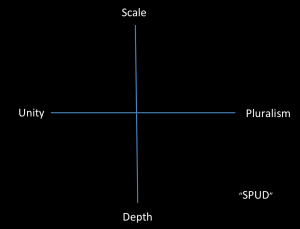
I also explain my SPUD framework, which stands for Scale, Pluralism, Unity, and Depth. SPUD, I propose, is the recipe for effective civic and political organizations, but it is difficult to achieve and is much scarcer today than decades ago.