Category Archives: elections

the 2020 election in the shadow of the Iraq War

Polls usually show that foreign policy is a low-priority issue in US political campaigns. This year is no exception: asked to choose one priority, just 13 percent of prospective voters recently selected foreign policy.

But I think the Iraq and Afghan wars influence Americans in deeper ways. These are not “foreign policy issues,” like how we should address Brexit or North Korea. They represent a wound that hasn’t been treated. The question on people’s minds is not, “What should we do about Iraq?” or even “What should have been done in 2001?” The question underneath people’s explicit thinking is: “What kind of people are in charge of our country?”

After all, the decision to invade Iraq and Afghanistan caused about 60,000 US casualties. (That includes those killed or wounded but not suicides or PTSD cases.)

It is very hard to know how many Iraqis and Afghans have died, because the data are not available and because it’s debatable how much causal responsibility the US holds for the deaths of various combatants and civilians. However, by 2007, 53% of Iraqis were saying that “a close friend or relative” had “been hurt or killed in the current violence.”

The running tab for the two wars is about $6 trillion, which is about 30% of the goods and services that all Americans produce in a year.

And for all this sacrifice and damage, we have lost–failing to attain any of the original objectives of the Bush Administration. Iran has the most power in Iraq; we are negotiating a ceasefire with the Taliban, whom we supposedly defeated in 2002.

For some Americans, none of this may be very salient. But for others, it reflects a deep betrayal by the global elites who sent our men and women into danger overseas. For still others, it is a classic case of American imperialism running amok. Considering the magnitude of the disaster, the debate has been relatively marginal or even submerged. But I think it’s always just below the surface.

Consider the record of these presidential candidates since 2008:

  • Hillary Clinton: votes for the war, apparently in large part because she, her husband, and other senior members of her own party favored it (not just because of the Bush Administration). She later calls her vote her mistake but still feels qualified to run for president in 2008 and 2016 and to serve as a hawkish Secretary of State in between. Thus she is partly responsible for managing the war after having helped to start it. When she comes before the voters, she loses both times.
  • Barack Obama: against the war from the outset, not in Washington when it starts, seems to want to wind it down; wins the presidency twice.
  • Jeb Bush: the presumed front-runner for the Republican nomination in 2016, but his brother launched the wars. Wins 4 delegates in the 2016 primary.
  • Donald Trump: actually fairly positive about the war when it started, but claims to have been against it, which is consistent with his general attitude that foreign interventions waste American lives and treasure. Beats all the establishment Republican primary candidates and Clinton. In office, battles the national security establishment and generally refrains from deploying US military assets overseas. His record conveys a willingness to spend money on the troops, a reluctance to put them in danger, and a contempt for the top brass. Now he’s in a good position for reelection.
  • Joe Biden: as chair of the Senate Foreign Relations Committee, he votes to authorize the war. Although he is the former vice president in a popular Democratic administration, he looks likely to lose the current primary.
  • Pete Buttigieg: he opposes the Iraq War yet serves in Afghanistan–sort of the opposite of the bipartisan elites who started the war without putting themselves in danger. Considering that he’s the 38-year-old mayor of the 4th-largest city in Indiana, he’s done pretty well in a presidential primary campaign.
  • Bernie Sanders: the only Democratic primary candidate who can provide clear evidence that he was opposed to the war and tried to stop it. This is credible not only because his House vote was recorded but because he has opposed almost all US interventions since the 1970s.

If you believe (as I tend to) that dominant US institutions deserved to be sustained and protected even after the debacle of these wars, then there should have been a much deeper house-cleaning. It’s true that Members of Congress who voted for the war faced a hard choice with limited knowledge and no foreknowledge of the 19 years ahead. Nevertheless, they chose wrong and should have been banished from public life unless they took full responsibility for their own decisions and used their power to prevent anything similar from happening again. You don’t shake off hundreds of thousands of deaths, a $6 trillion bill, and a catastrophic defeat and move on to other topics. National leadership is a privilege, not a right, and if you help cause a disaster, you lose the privilege.

Some Americans never had strong reasons to sustain dominant US institutions. They have now been joined by people for whom the past 19 years provide reasons for distrust–whether they believe that globalist elites have betrayed real Americans or that America is the global bully of the neoliberal era. Although I make no equivalence between Trump and Sanders–they are opposites in character, policy proposals, and commitment to democracy and rule of law–a national campaign between those two is surely a consequence of decisions made by 2003.

youth in the Iowa caucuses

Posted just now by CIRCLE:

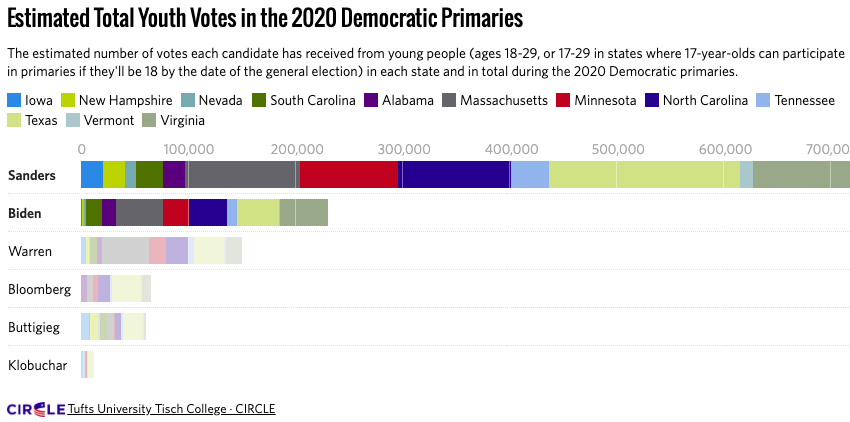
Young people had an extraordinary impact on the first-in-the-nation Iowa caucuses, representing a higher share of the overall vote than in previous caucuses and propelling Sen. Bernie Sanders to one of the top spots, according to a youth turnout analysis released by researchers from the Center for Information & Research on Civic Learning and Engagement (CIRCLE)—the preeminent, non-partisan research center on youth engagement at Tufts University’s Jonathan M. Tisch College of Civic Life.

Young people (ages 17-29) turned out at an estimated rate of 8% and made up a 24% share of all caucusgoers, the highest youth share since CIRCLE has been tracking Iowa entrance polls.

Young people strongly backed Sen. Bernie Sanders (48%), followed by former Mayor Pete Buttigieg (19%) and Sen. Elizabeth Warren (12%). 

new CIRCLE poll of Iowa youth

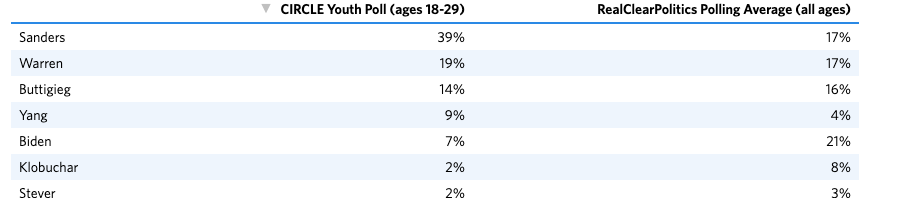
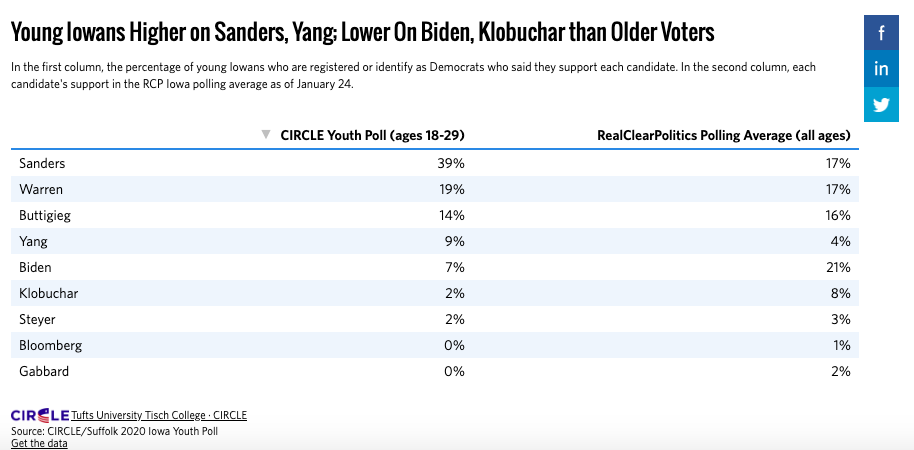
Here is one finding from CIRCLE’s survey of young Iowans, released today. The differences between younger and older Iowa Democrats on Sanders v. Biden are pretty striking.

Although people always overestimate their chances of participating in future elections, 35% of young Iowans say they are “extremely likely” to participate in the presidential caucus. That suggests a substantial increase in youth turnout compared to past years.

The release is on CIRCLE’s awesome new website, also launched today and valuable to explore.

how to assess candidates in a presidential primary

Voters in a primary are a bit like members of a hiring committee. They have a batch of eager candidates and must choose one to represent their party and–they hope–hold the office.

I have served on dozens of hiring committees, including some for nonprofit CEOs and senior university administrators. Head-hunters give consistent advice about how to assess candidates. They advise committees not to ask how a candidate will or would address issues in the future. Candidates don’t really know, because their strategies will depend on the details of the issue and the other stakeholders’ actions. They almost inevitably give platitudinous responses: “I will bring people together, build consensus, and then move decisively.” “I will identify the ineffective programs and phase them out.” Such responses have zero informational and predictive value. Instead, committees should ask candidates how they actually addressed challenges in their previous work, and what they learned from that experience. This is more informative.

I don’t think that advice applies to voters in legislative elections. A legislator faces decisions about whether to vote yea or nay on bills. Newly elected legislators–back-benchers–do little else than vote yea or nay. It makes sense to ask legislative candidates (especially newcomers) how they would vote.

I realize that voters around the world are cynical about politicians’ promises. But I think cynicism should be reserved for their very general rhetoric about outcomes. “I will bring the country together” or “I will generate 5% growth” — these are promises waiting to be broken. (If they come to pass, it’s mostly good luck.) On the other hand, when candidates say, “I will support HR 1234,” that is quite predictive. It’s good to ask them how they will vote.

But presidents are more like CEOs than legislators. To be sure, they face decisions about whether to sign or veto bills, but those are rarely their decisive actions. Most of their impact results from hiring, firing, and guiding subordinates and jawboning all kinds of independent actors: 535 members of Congress, foreign heads of state, civil society actors and corporate leaders. (They also have the bully pulpit to address the nation, but the impact of that is somewhat overrated.)

We’d like to know how well they’ll do in those conversations and what their (precise) objectives will be. But what they say how they will deal with other people has limited value. It’s currently fashionable to place Democratic candidates on a scale from accommodating to tough, where the question is how they will handle their relationship with Republicans. I don’t think how they present themselves on the campaign trail predicts that very well at all.

Candidates should publish policy briefs, and we should read them. The main reason is that a campaign is a precious opportunity for a national debate about issues, influencing citizens’ knowledge and values. But policy briefs are not very informative about a candidate’s actual performance as president.

A brief may tell you something about the candidate’s goals and values. A Democratic candidate who says “Medicaid for all,” is conveying more progressive ideals that a candidate who asks, “How will we pay for that?” But an actual Democratic president will not choose between those two policy positions. She or he will: (1) choose one or two issues to emphasize at key moments, (2) deal with members of Congress across the spectrum about those issues and the many issues that arise for other reasons; and (3) decide whether to sign or veto the actual bills that emerge from Congress–if any do. Asking candidates how they will perform those tasks is not terribly informative, because the question yields platitudes of the form, “I will bring people together and move forward together” or “I will rally the troops and drive change through.” (Those sound different, but neither describes what they will actually do.)

The 2020 Democratic Primary has generated an especially large number of interesting policy proposals. The Warren campaign, in particular, has made a meta-issue of having detailed policy briefs. (“I have a plan for that.”) I like the message that Warren is detail-oriented and interested in policy, a major contrast to the incumbent and probably predictive of how she would govern. I like the ethic of presenting specific ideas to the voters: it takes people seriously as thinkers. I also think the policy debate among candidates may have some influence on other actors–Members of Congress, interest groups, and the public–which is beneficial. But I would still take the headhunters’ advice and focus more on how candidates have actually dealt with challenges than on what they say they would do if they were president.
why I am optimistic about the impeachment process

I find myself less anxious than most friends and commentators. Here are my largely sanguine responses to several current concerns about the impeachment process:

It’s a mistake to focus on one specific scandal. Congress should persuade the American people to condemn a whole pattern of corruption in the administration. (See David Atkins, for example).

Congress can focus on one or two articles of impeachment in order to handle those charges well. (The best current guess is that the articles will involve: 1. Trump’s interaction with Ukraine, and 2. the administration’s obstruction of Congress across many issues.) Meanwhile, the press, presidential candidates, pundits, social movements, and regular citizens will inevitably conduct a wider inquiry and debate. I don’t think the big picture will be lost just because the articles in Congress are precise and narrow.

The Ukraine story also implicates Hunter Biden, and hence (in some way) Joe Biden. That either means that it’s a poor choice of a scandal for the Democrats to use in an election year, or that it’s bad for the public, because both parties will end up defending crony capitalism.

Joe Biden has an opportunity to make a case that he is truly blameless in the Ukraine matter. If he is persuasive, fine. If he fails to persuade, then it’s better that he should fail now, rather than during the general election. Meanwhile, Elizabeth Warren has every incentive to broaden the issue to encompass crony capitalism writ large. Her voice (and others’, too) will ensure that the whole Democratic Party is not soft on corruption.

Impeachment will drown out the Democratic primary campaign, overwhelming an important debate about our future.

During the primary season, a party wants its own faithful to pay attention to the rival proposals, critiques, counter-arguments, endorsements, gaffes, etc. It’s generally fine if other voters pay little attention until a nominee emerges to address the whole public. With vast attendance at primary campaign events and a lively debate online, there is little chance that core Democratic voters will tune out the primary. The intended audience is paying attention.

The impeachment debate will arbitrarily affect the outcome of the Democratic primary.

If it takes Joe Biden down, he was doomed anyway. If he turns it to his advantage, it will reinforce his best argument: his electability. If Warren benefits because she makes the sharpest critique of corruption–well, she is raising a real issue. And if someone else (say, Kamala Harris during a Senate trial) uses the impeachment effectively, it’s evidence of that candidate’s skill.

The Speaker seems to want a short, narrow impeachment process. That will not persuade the American people of the deeper problems with Trump. Pelosi is resigned to an unpopular process and doesn’t understand that impeachment hearings could change Americans’ opinions.

Don’t take what Speaker Pelosi says precisely at face value. I’m not saying that she’s lying; she would genuinely prefer a shorter and tighter process. But she knows that impeachment is likely to extend and expand. She wants unconvinced voters to believe that Democrats are trying to make this quick so that they can move onto other matters. She is also putting mild pressure on her caucus to move things along. I would be very surprised if things actually do wrap up by Thanksgiving, or if she believes that they will.

(By the way, I am continually surprised by strong partisans’ assumption that when someone on their side says something conciliatory about the other side, that person really means it. Do you really think Nancy Pelosi’s main reaction to this situation is to be “heartbroken and prayerful,” as she told ABC News? Are you sure Joe Biden actually believes the Senate Republicans are reasonable? It is not only the other side that sometimes doesn’t say exactly what they think.)

The Senate will acquit, Trump will survive, and as a result, not only will impeachment be further weakened as a tool for accountability, but Trump’s electoral prospects will improve.

Yes, the Senate is overwhelmingly likely to acquit, and Trump will still hold office on Election Day in 2020. But the American people should by then have a clear account of his criminality, which should weigh, at least mildly, against his reelection prospects. That is a sanction. Subsequently, he may face a federal jury on related charges.

If anything, I would have some qualms about actually removing him less than a year before the election. Who would the GOP nominate? What kind of mandate would a Democratic president hold? My ideal outcome might be for the House to impeach, a majority of US Senators to vote to remove Trump, for him to hang on because fewer than 67 Senators voted against him, and for the American people to finish the job in November.

Impeachment creates (at best) a tough vote for Democrats in districts that voted for Trump. Why “punish” the president by giving his party a boost in the congressional election?

This matter has received vast amounts of attention. My tentative takeaway is that any electoral impact will be small and may be a wash–a few Democrats losing in conservative districts and states (like Alabama), but a few Republican Senators facing very tough votes as a result of impeachment. There is a long tail of possible outcomes in either direction, but the best bet is a limited effect.

It’s a mistake to give many House committees a role in impeachment. One committee should handle it.

Pelosi is trying to build support by giving several leaders and groupings within her caucus a stake. Also, one of the articles is likely to be obstruction, and the Administration has obstructed several committees.

The Democrats grandstand amateurishly in hearings. They don’t know how to cross-examine and build a case.

True. And there’s a reason for it: individual politicians want to talk on camera, even though the inquiry would be much better handled by professional counsel. This problem is worth worrying about, but surely the Democrats will finally get it together now ….?