Category Archives: philosophy

moral network mapping and literary criticism: a methodological proposal

A moral worldview is a set of beliefs or values connected by various kinds of relationships. For instance, one belief may imply another, or may subsume another, or may be in tension with another even though both are truths. If analyzed that way, a whole worldview can be mapped as a network, with the beliefs viewed as nodes, and the relationships as ties.

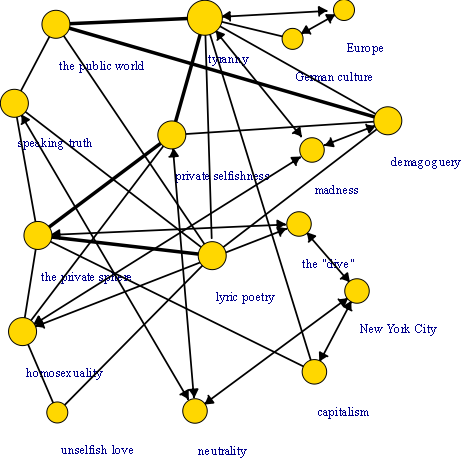
Using that method, we can map the moral network implied by a work of literature, such as a lyric poem. Previously, I wrote some notes on W.H. Auden’s poem “September 1, 1939” (notes here; full text here.) I then mapped the moral network of that work. I think my first effort was a bit off, so here is a revised map:
What assumptions underlie this method?

1. The moral evaluation of literature is a valid and useful mode of criticism. It is not just about judging the values of the text (pro or con), nor is it merely a matter of elucidating what the author meant or what the text implies about moral issues. It is rather a critical engagement with the moral perspective of the work, a kind of joint investigation into what is really good and right that is informed by both the text and the reader’s critical response. Although I think that remains a rare mode of literary criticism, it has prominent defenders.*

2. Formal network analysis, a branch of graph theory, offers insights about the structure of any system that is composed of objects and relationships. Tools from network analysis, such as calculating the centrality of nodes or the density of relationships, can help to elucidate and assess the moral worldview of a work of literature.

Underlying this premise is a deeper assumption that moral worldviews should not be assessed only (or mainly?) by evaluating the correspondence between their separate ideas and truths about the world. It’s also (or more?) important to ask how the whole worldview hangs together. The question is not whether Auden should be against tyranny, but how that stance fits into his overall thinking. When people argue for assessing a whole worldview instead of individual principles, their next step is usually to look for internal consistency. But consistency is not the main virtue of a well-structured worldview. Better a mentality that incorporates valid and fruitful tensions than one that avoids all inconsistencies at the cost of narrowness or oversimplification.** Network analysis reveals density and other virtues that are more helpful than consistency. (See also “ethical reasoning as a scale-free network.”)

3. Abstract and general principles are overrated. I do not claim that they should be expunged from one’s moral thinking (that would be an over-radical form of “particularism”), but rather that there is no good reason to assume that a well-ordered moral mentality can be arranged like an organizational chart, with the abstract principles at the top and all one’s concrete beliefs and commitments as mere implications. That would be one kind of moral network map, and some people do think that way. Other people are much more concrete, or they mix concrete particularities with abstract generalities in interesting and complex networks. For instance, I think New York City and the “dive” bar where Auden sits in this poem are just as important to his moral vision as tyranny or selfishness.

One reason not to try to make the abstract principles fundamental to one’s whole network is that certain crucial ideas, such as love, will then be distorted. These ideas have the feature that they are sometimes good and sometimes bad, depending on the circumstances. If you try to organize your thinking around abstract and general principles, you will be compelled to divide love into the good and bad kinds, and that is false to the experience of what love is.***

Turning the map above back into a written analysis of “Sept 1, 1939” would take some space, but I think a few key points emerge:

  • Auden has a dense moral network, not dependent on just one or two ideas. It’s robust. For instance, he later came to hate the line, “We must love one another or die.” But the poem does not rest on that.
  • Love, art, and politics are densely interconnected.
  • Homosexuality is not mentioned in the poem but is alluded to at least twice. It is hard to know whether Auden would connect it to “unselfish love.” I would. So I am either in disagreement with the poem or sympathetic with Auden (a gay man in the 1930s) because he could not draw that connection openly.
  • Much depends on a polarity between public and private, but poetry occupies an uneasy space between. Consider declamatory statements like this: “There is no such thing as the State /  And no one exists alone.” Are they incursions of public demagoguery into a poem, which should be private? Or should the poem speak truth to power?

*See David Parker, Ethics, Theory and the Novel (Cambridge: Cambridge University Press, 1994); Todd F. Davis and Kenneth Womack, Mapping the Ethical Turn: A Reader in Ethics, Culture, and Literary Theory (Charlottesville, University Press of Virginia, 2001), Amanda Anderson, The Way We Argue Now: A Study in the Cultures of Theory (Princeton, 2006)

** Simon Blackburn, “Securing the Nots,” in W. Sinnott-Armstrong and M Timmons, eds., Moral Knowledge (New York, Oxford University Press, 1996), p. 95

*** This is basically my thesis in Reforming the Humanities: Literature and Ethics from Dante through Modern Times (Palgrave Macmillan, December 2009).

what a libertarian commune says about political socialization and freedom

The Citadel will be a community of 3,500-7,000 families, surrounded by walls and towers amid Idaho’s mountains. Its organizers say it will be devoted to “Our proud history of Liberty as defined by our Founding Fathers.” The “patriotic Americans” who choose to live there will pledge to own, bear, and train in the use of firearms. It’s optional to move there, of course, but “Marxists, Socialists, Liberals, and Establishment Republicans may find that living within our Citadel Community is incompatible with their existing ideology and preferred lifestyles.” This comes on the same day that the Dallas Observer reports, “Glenn Beck is Planning a $2 Billion Libertarian Commune in Texas.”

Conor Friedersdorf, who’s an excellent, libertarian-leaning writer, thinks that Americans have the right to create such communities, whether “made up of extreme gun enthusiasts or hippies or Scientologists or Trappist monks.” But he denies that The Citadel would embody libertarian values. Real freedom is compatible with, and generates, pluralism. If you want to see a libertarian community, Friedersdorf says, look not to The Citadel but to LA County, with its

happy residents from most nations on earth; people of most every ideology; mountain and desert and city and rural people; the religious and secular; and parents whose kids are different kinds of people than they are, but live close by because all kinds of people are happy here, except perhaps the types that feel impelled to order the lives of everyone around them to correspond to their own preferred lifestyles.

I think this opens a deep and serious point. Our beliefs, values, and identities are profoundly shaped by our parents and other formative influences. Even if we rebel (as many people do) we still structure our thoughts in response to our parents and other influences from our childhood.

As Americans are raised today, they do not turn out libertarians. Less than one percent voted for the Libertarian Party, and on policy questions, most libertarian positions do not poll well. Libertarians might like to think that the state uses the public schools to brainwash kids, but the evidence suggests schools have very limited influence on ideology.* Also, schools are not mere arms of the state; they are assemblages of teachers who reflect the values in their communities and have some latitude to present politics as they see it. If young people are being raised to be non-libertarians, that is not the state’s doing; it is the people’s.

So what is to be done, from a libertarian perspective? You can secede from the corrupt, liberty-forgetting society around you and raise your kids in a setting where they will turn out to be libertarians (unless they rebel against you and define themselves as anti-libertarians, but even then you will have shaped them). If you succeed, you will have forced them to be free.

That is obviously a contradiction. It points to a deeper problem about freedom. Individual liberty is a high principle, not to be neglected or negotiated. But the liberty of embodied, evolved, social animals like homo sapiens cannot be defined in a way that ignores the overwhelming influence of parents and communities on individuals. We are what our predecessors make us.

The best classical thinkers on liberty, people like J.S. Mill and Alexis de Tocqueville, recognized that peer pressure, parental influence, and majority opinion were threats to freedom–probably worse dangers than the state is, if the state is limited by law and popular votes. There is no such thing as a neutral setting for growing up; Los Angeles may be more pluralist than The Citadel, but both teach their own implicit lessons. But LA broadens the mind more than The Citadel will by offering a greater variety of lifestyles and perspectives. Friedersdorf is right to see the advantages for freedom.

*E.g., Yates and Youniss find that a powerful dose of Catholic social doctrine does not convert predominantly Protestant African American students, but provokes them to reflect on their own values. McDevitt and colleagues (in a series of papers including this one) find that political debates in school stimulate critical discussions in the home. Colby et al. find that interactive political courses at the college level, although taught by liberal professors, do not move the students in a liberal direction but deepen their understanding of diverse perspectives. Evidence of the effects of college climates is ambiguous because of students’ self-selection into friendly environments.

(See also “schools’ role in enhancing liberty,” “why libertarians need a theory of political socialization,”and David Friedman on education.”)

on modernity and the distinction between East and West

I think the following information has tremendous, even global significance. It comes from David Shluman’s review of Pankaj Mishra’s From the Ruins of Empire:

As Velcheru Narayana Rao has eloquently shown for southern India, a form of awareness that can be characterized as modern emerged naturally and organically in the Telugu- and Tamil-speaking parts of the subcontinent toward the end of the fifteenth century.1 It had nothing whatever to do with Western influence or the arrival of Vasco da Gama in Calicut in 1498. Highly original thinkers and poets, writing in all the languages of the south, discovered, or invented, a series of interlocking notions that together comprise a novel anthropology.

Thus we find, with particular prominence, the concept of an autonomous, subjective individual, responsible for his or her fate; a new theory of romantic love; the development of literary fiction as a privileged literary technique; a vogue for skepticism and realism, seen as informing the pragmatics of everyday life; the emergence of a cash economy and the conceptual revolution that rapid monetarization entails; the appearance of a bold, full-throated, unfettered female voice; and a new concept of nature as a rule-bound domain, separate from the human and amenable to disciplined observation and extrapolation. An innovative economic model of the mind, centered on the imaginative faculty, came to define the meaning of being human.2

With this shift in incorrigible assumptions there arose a new kind of state, which we call “Nayaka,” founded by a recently recruited elite of self-made men who had cut free from their ascriptive caste and family backgrounds and who saw themselves as free agents in a world of hitherto unknown opportunities.

I resist generalizations about “the West” because it encompasses too much diversity to be a meaningful category. What do such “Westerners” as Saint Teresa of Ávila, Oscar Wilde, Daniel Boone, Lenin, William Penn, Cole Porter, Thomas Edison, Martin Heidegger, Andy Warhol, Donald Trump, Emily Dickinson, and Hernán Cortés have in common? There is also, of course, tremendous internal diversity in other parts of the world–witness the ancient tradition of materialistic and hyper-individualistic thinkers from India, which is supposedly the home of mysticism and communitarianism.

Also, the borders of any area that we might call “the West” have been too vague and too porous for too long. Did you know that Menander I was a Buddhist Greek king of part of India in the second century BC, named after the Athenian comic playwright, whose coins bore Greek inscriptions on one side and Pali (the language of the Buddhist scriptures) on the other? He and successor kings, with names like Strato I and Theophilos, often depicted themselves as Greek gods in Buddhist poses and called themselves Dharmaraja or “King of the Dharma.” Was this the East or the West?

But I did used to think that the West could be distinguished from the rest of the world on one specific dimension. During the 19th century, in some parts of some European countries or countries settled predominantly by Europeans, two phenomena developed:

Modernity: a social order in which great masses of people are governed by laws and markets more than personal ties; in which few traditions and norms are seen as natural or inevitable and society is understood as an artifact; in which contract has replaced status as an organizing principle; in which individuals are primarily interested in their own personal attributes and rights; and in which technology pervasively mediates individuals’ relationship with nature.

Modernism: a set of intellectual and cultural movements that emerge in modernity, that describe modernity, and that bring modernity into the realm of ideas by renouncing aesthetic or intellectual traditions; instead, the ideal artist invents a new “contract” for each work.

Everywhere that modernity and modernism arrived, even in Paris and New York, they were perceived as new and problematic phenomena that caused distress. But the experience felt different in the West. This was also the age of European imperialism, of gunboats, missionaries, and the East India Company. And it was an age of race-consciousness, in which some people saw themselves as “white” and were seen that way by others. If you lived in a country where people were predominantly white and Christian (“the West”), then modernity and modernism seemed like indigenous changes. “We” were changing–for better or worse. If you lived elsewhere, modernity and modernism seemed to arrive with the imperialists, whether they came as conquerors or traders.

Thus modernists outside of Europe were pro-Western; anti-modernists were typically also anti-Western. In contrast, modernists in America or Europe (perhaps excepting Russia) were simply the progressives within those countries. The distinction was temporal in the West and spatial elsewhere. It was about “us” in the West and about “them and us” elsewhere.

Regardless of our views of modernism/modernity and of European global influence, we often equate the two. For instance, when a group of us viewed graphic art from the Johannesburg-based Artist Proof Studio last summer, the debate was whether young Black South African artists had been “Westernized.” See Leroye Malaton’s linotype “Zoey” below as an example:


Johannesburg is a modern city, and the contributors to Artist Proof Studio are modernists (or post-modernists, which I take to be just a stage in modernism). Authors like Shulman and Rao are asking us to drop the identification of modernity and modernism with the West. If the same social structures and intellectual responses also developed in Southern India in the 15th century, then they may have popped up in many other places as well. They are best understood not as Western inventions but as responses to a certain logic of development and scale. Then modernity and modernism are as much the property of Black South African artists as of (say) contemporary Germans. Neither invented modernity; both contribute to it; both must deal with it. Thinking that way would not solve any of the dilemmas of modern life, but it would make the dialogue healthier and more productive.

how morality came into the world

In the beginning, there was matter, arrayed in space and time and subject to forces. Morality was irrelevant. If a star blew itself to bits or a whole galaxy vanished, that was neither good nor bad. Whether the universe even existed was a matter of moral indifference, except that it was the basis of what developed thereafter.

One tendency was toward entropy, but that was not the only trend, because complex systems developed and overcame their own fragility by beginning to replicate themselves. On our own little planet, organic chemicals, organisms, organizations composed of organisms (ant hills, cities), and whole ecosystems replicate.

A replicating carbon molecule still has no moral significance. But some organisms—and perhaps some larger systems of organisms—also developed the capacity to sense their environment and react. Plants do that, turning toward light. So do machines, and it is not clear that this capacity creates moral significance. Even a great tree is arguably just a configuration of matter, like a rock but more complicated. What animals developed was an internal sensation of pleasure in response to beneficial aspects of their environment and pain or fear at bad aspects. They developed this capacity because of random mutations, and it only persisted as one factor that might encourage survival and replication. To this day, insentient grasses are more prevalent than sentient mammals. But the sentient animals persisted because of their sensitivity, their suffering.

To us, another creature’s subjective or internal feelings of happiness, pain, and fear are not matters of indifference. A distant star’s collapse is of no direct consequence, but a dying sparrow counts. David Hume said that our compassion was an “arbitrary and original instinct implanted in our nature.” He lacked a Darwinian explanation for why it would be implanted, but he already saw that we care about “the happiness or misery of others” just because we do care—we are designed that way. (Hume, A Treatise of Human Nature, sec. vii., “Of Compassion.”)

One can easily imagine a powerful and intelligent being that did not care at all. We would call that being amoral or even evil. These are our terms, rooted perhaps in our biology. And yet we have choices. We can care more or less. We can also change our societies so that they care more or less. Ashoka assembled a great empire by ruthlessly killing people and then repented, deciding that it was wrong to have caused or countenanced suffering. He constructed a regime that depended as little as possible upon force and fear. The turning point supposedly came when he toured the battlefield after his own victory, crying, “What have I done? If this is a victory, what’s a defeat? Is it valor to kill innocent children and women?”

H.G. Wells wrote,

In the history of the world there have been thousands of kings and emperors who called themselves “Their Highnesses”, “Their Majesties” and “Their Exalted Majesties” and so on. They shone for a brief moment, and as quickly disappeared. But Ashoka shines and shines brightly like a bright star, even unto this day.

Wells may have been right or wrong about Ashoka, but we understand the nature of his assertion. It is better to be Ashoka after his conversion than before.

The problem, of course, is that all sentient beings–and collectivities of sentient beings –suffer and then die. Knowing this, and caring about ourselves and others, we cannot be happy in a simple or straightforward way. The late theologian and philosopher Leszek Kolakowski wrote (in an essay recently translated and published in The New York Review):

Since being truly human involves the ability to feel compassion, to participate in the pain and joy of others, the young Siddhartha could have been happy, or rather could have enjoyed his illusion of happiness, only as a result of his ignorance. In our world that kind of happiness is possible only for children, and then only for some children: for a child under five, say, in a loving family, with no experience of great pain or death among those close to him. Perhaps such a child can be happy in the sense that I am considering here. Above the age of five we are probably too old for happiness.. …. Happiness is something we can imagine but not experience.

Kolakowski even argued that the God and the other denizens of heaven must be unhappy because they remember the world—or else they are free from unhappiness in some way that we cannot grasp.

The philosophical traditions that originated in Greece and in India offer several responses. Live as much as possible in the present, because the past and the future contain unhappiness. Reduce one’s own will or attachment to oneself in order to be less a hostage to fortune. Care as much as possible about doing the right thing, because that is under your control.

Leading philosophers of ancient India and the Hellenistic world insisted that death and suffering are inevitable. Consider, for example, the elaborate health-care system of an advanced nation, served by physicians and nurses, scientists, administrators, technicians and cleaners, and many more. This system does not ultimately prevent the death or suffering of any human being. To pour one’s will into it is to court disappointment and defeat. But there is a different reason to devote oneself to collaboration in the service of a common good or to help maintain an elaborate system that supports life. It is not the ultimate end of this system that counts but the absorbing activity of sustaining and improving it.

See also: Three Truths and a Question about Happiness; The Tree and the Rock; and Must You be Good to be Happy?

the consolation of philosophy

Most of the ancient schools taught that investigating the eternal questions is a source of equanimity and solace in a merciless world beyond our control.

From 8:30-3:30 today, I am the director of a research center that studies American politics, almost on the eve of a contentious national election. I am on the phone, on email, usually on both at the same time, trying to persuade, to influence, to explain, hoping earnestly for events to take a certain course, conscious of our limited power, but striving to make a mark.

From 3:30-5:30 pm, in an attractive lecture hall just feet from my office–a room full of bodies in gently creaking chairs–we strain to hear the old man who speaks without amplification in the well. He is a famous philosopher, already a distinguished Harvard professor before I was born. He speaks technically, learnedly, but also autobiographically, recalling how, as a small boy on the beach in Atlantic City, he realized that colors look richer when one eye is closed rather than the other. That city was wrecked last week, but his perception still has this feature. He speaks of apples that appear to change as the light shifts. I am fascinated but neutral, immune to disappointment whether it turns out to be the apples or our mental states that change. The back wall is painted an unusually rich blue; it is the focus of my attention and an example for the famous philosopher.

Someone asks him whether his objections to Bertrand Russell’s epistemology are ethical. Should we (in a serious sense of the word “should”) insist that the table we see is really there? He evades the question but says that philosophy ought to encompass ethics as well as natural science. We cannot justify science by claiming that it serves the good, for with it, we may destroy life on earth. Our job is to improve science. It seems that we have work to do outside the room, after all.

[Having cited some specific views, I ought to credit the speaker as Hilary Putnam.]