- People hold many morally relevant opinions, some concrete and particular, some abstract and general, some tentative and others categorical.
- People see connections–usually logical or empirical relationships–between some pairs of their own opinions and can link all of their opinions into one network. (Note: these first two theses are empirical, in that I have now “mapped” several dozen students’ or colleagues’ moral worldviews, and each person has connected all of his or her numerous moral ideas into a single, connected network. However, this is a smallish number of people who hardly reflect the world’s diversity.)
- Explicit moral argumentation takes the form of citing relevant moral ideas and explaining the links among them.
- The network structure of a person’s moral ideas is important. For instance, some ideas may be particularly central to the network or distant from each other. These properties affect our conclusions and behaviors. (Note: this is an empirical thesis for which I do not yet have adequate data. There are at least two rival theses. If people reason like classical utilitarians or rather simplistic Kantians, then they consistently apply one algorithm in all cases, and network analysis is irrelevant. Network analysis is also irrelevant if people make moral judgments because of unconscious assumptions and then rationalize them post hoc by inventing reasons.)
- Not all of our ideas are clearly defined, and many of the connections that we see among our ideas are not logically or empirically rigorous arguments. They are loose empirical generalizations or rough implications.
- It is better to have a large, complex map than a simple one that would meet stricter tests of logical and empirical rigor and clarity. It is better to preserve most of a typical person’s network because each idea and connection captures valid experiences and serves as a hedge against self-interest and fanaticism. The emergent social world is so complex that human beings, with our cognitive limits, cannot develop adequate networks of moral ideas that are clear and rigorous.
- Our ideas are not individual; they are relational. We hold ideas and make connections because of what others have proposed, asked, made salient, or provoked from us. A person’s moral map at a given moment is a piece of a community’s constantly evolving map.
- We begin with the moral ideas and connections that we are taught by our community and culture. We cannot be blamed (or praised) for their content. But we are responsible for interacting responsively with people who have had different experiences. Therefore, discursive virtues are paramount.
- Discursive virtues can be defined in network terms. For instance, a person whose network is centralized around one nonnegotiable idea cannot deliberate, and neither can a person whose ideas are disconnected. If two people interact but their networks remain unchanged, that is a sign of unresponsiveness.
- It is a worthwhile exercise to map one’s own current moral ideas as a network, reflect on both its content and its form, and interact with others who do the same.
Category Archives: philosophy
the advantages and drawbacks of precision in ethics
3 Replies
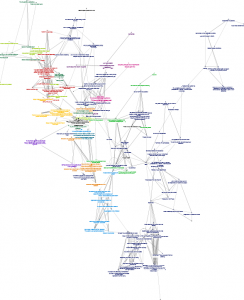 I like to ask people to state their own beliefs that are relevant to ethics and then draw connections among those ideas to create networks that represent their moral worldviews. I put people (students and others) in dialogue with each other, invite them to explain their networks to peers, and watch connections form.
Usually the ideas that people propose are not precise. In explaining what we believe, we don’t employ many terms that we could define with necessary and sufficient conditions, nor do we often use quantifiers like “all” or “exactly one.” The connections we detect among our ideas are rarely logical inferences. They are looser links: resemblances, rough implications, empirical generalizations.
One impulse is to strive for as much precision as possible. That is a fundamental goal of analytic moral philosophy and it has significant merit. If someone proposed, “We should strive to improve everyone’s lives,” I would join mainstream analytic philosophers in requesting more clarity. Does that mean maximizing net human welfare? Does “welfare” mean happiness, satisfaction, or objective well-being? Does it trade off against freedom and autonomy? Does “everyone” mean all currently living human beings? (What about future generations?) Does “strive” mean actually maximize net welfare, or have a generally beneficent attitude toward others? These are valid and hard questions.
On the other hand, if the goal is descriptive moral psychology, it is a mistake to ask for that level of precision. We all hold–and are motivated by–rougher moral ideas and looser connections than could pass muster with an analytical philosopher. If you want to know what people believe, you must model those ideas and relationships as well as the clear ones. If you encourage people to map out many of their ideas and relationships, they will produce complex and elaborate networks that are useful for representing their mentalities and for provoking reflection.
That still leaves the normative question: how much precision should each of us strive for? I would say some but not too much. One of my favorite quotes is from Bernard Williams, in Ethics and the Limits of Philosophy (1985, p. 117): “Theory typically uses the assumption that we probably have too many ethical ideas, some of which may well turn out to be mere prejudices. Our major problem now is actually that we have not too many but too few, and we need to cherish as many as we can.”
I’d expand that remark as follows: Through direct and vicarious experience, we build up collections of moral ideas that give our lives meaning and restrain our basest instincts. We also connect our ideas; we say that we believe A because it seems somehow related to B. If we must pass all these ideas and connections through a screen for clarity, precision, and inferential rigor, most will have to go. That will leave us with less meaning and less constraint against mere inclination and will.
Seeking clarity can illuminate. It can, for instance, force us to disaggregate a vague idea into a set of related ideas that are worth seeing on their own. Or it can reveal gaps and tradeoffs that deserve consideration. Formal philosophy is also useful for developing specific ideas that are clear and precise and that relate to one another logically.
However, it is a false dream that we can convert our entire networks of moral ideas into structures of clearly defined concepts and implications. Even the best moral arguments carry just a short distance–from a premise to a conclusion, or maybe as far as another conclusion or two, but not all the way across the domain of the moral. It is good to have a dense, complex, and expansive network of ideas that draws on experience and demands constant reflection and reevaluation, even if its components are a bit vague and the links are hard to articulate. Better that than a crystalline chain of reasons that connects just a few ideas and leaves us otherwise free to be selfish or fanatical.
does focusing philosophy on how to live broaden or narrow it?
Pierre Hadot (1922-2010) built a quietly devoted following and influenced many others indirectly, via Michel Foucault. A classicist, Hadot interpreted the Hellenistic philosophical schools (Stoicism, Epicureanism, Skepticism, and Neoplatonism) as communities of people devoted to improving themselves by employing a range of mental techniques. Argumentation was just one of their exercises, along with meditation, introspection, confession, renunciation and so on. These schools were similar to classical Indian and Chinese movements, but unlike (say) Kantianism or British empiricism, which are mainly structures of arguments.
Hadot thought that the Hellenistic tradition of “philosophy as a way of life” still echoed in the work of certain post-medieval thinkers: Montaigne, Spinoza, Goethe, Nietzsche, and Wittgenstein, among others. But it had become marginal by the 20th century, because philosophy had turned into an academic discipline, dispassionate and purely intellectual.
Hadot blamed that situation on Christianity, which–he argued–had divided the heritage of Hellenistic thought into two distinct parts. The arts of the self (meditation, confession, and the like) had been assigned to the monasteries, while abstract argumentation went to the universities. Hadot had first trained as a priest and was a learned student of early Christianity, but perhaps he had the critical bias of an ex-believer. None of Hadot’s major positive examples were Christian thinkers.
In any case, Hadot suggested a choice. “Philosophy” can mean argumentation united with mental discipline to produce communities devoted to moral improvement; or it can mean the dispassionate and often individual pursuit of truth. One can see these alternatives oscillate over time. The grand theoretical edifices of Plato and Aristotle give way to the Hellenistic Schools and their focus on self-improvement. Medieval scholasticism yields to humanistic writers like Montaigne and Erasmus, who are more concerned with particular inner lives. German idealism fades in favor of Nietzsche, Emerson, and other practitioners of philosophy as a way of life.
That is a provocative framework, but not the only available one. In The Rise of Western Christendom, Peter Brown describes how a generation of great converts to Christianity–Jerome, Augustine, and their contemporaries–debated the relevance of classical thought and “often took up extreme poses against the pagan classics.” But
such a narrowing down of culture (drastic as it was) [was not] an altogether unique event in the long history of the ancient world. It did not necessarily betray a moment of irreparable breakdown. Rather, the history of Greek and Roman civilization had always been marked by a characteristic pendulum swing. Moments of exuberant creativity were repeatedly followed by long periods of retrenchment. And this pendulum swing was marked by constant alternation between periods of creativity in literature and in speculative philosophy followed by long periods of single-minded preoccupation with ethical problems. How educated persons should groom themselves; how they should conquer their weaknesses; how they should overcome pain and console themselves in moments of grief; how they should stand in relation to their fellows and to the gods: these were issues pursued by ancient philosophers, for centuries on end, with remarkable singlemindedness. [A footnote to Hadot follows a paragraph later.]
In Brown’s framework, moments when abstract thinkers predominate–like 5th century Athens and perhaps Vedic India, 12th century Paris, or 18th century Germany–are exuberantly creative and expansive, but they are followed “by long periods of retrenchment” in which the focus narrows to how to live, including such trivial matters as “how educated persons should groom themselves.” In Hadot’s framework, periods of disconnected, abstract, “academic” thought alternate with times when rigorous argument unites with spiritual practices to produce people who can live “in the service of the human community.”
They could both the right, because intellectual history is vast and complicated. I am left with a sense that there are two risks for any kind of thinking that we call “philosophy.” It can degenerate into mental hygiene, focused on how to live everyday life to the exclusion of challenging questions about nature and reality. Or it can turn strictly theoretical, disconnected from questions about how to live (or–worse–influenced by unexamined assumptions about the good life).
See also on philosophy as a way of life; my notes on Pierre Hadot; and Hannah Arendt and philosophy as a way of life
Tamsin Shaw’s critique of moral psychology
I think that Tamsin Shaw’s article “The Psychologists Take Power” (New York Review of Books, February 25, 2016) is very important. I enjoyed an informal seminar discussion of it on Friday, but that conversation made me realize that the article is rather compressed and allusive, and its argument may not convey to readers who are unfamiliar with the research under review or with important currents in moral philosophy.
This is how I would reconstruct Shaw’s argument:
First, the psychological study of morality presents itself as a science; it claims to be value-neutral and strictly empirical. The phenomena under study are called “moral,” but the researchers purport or at least strive to be value-free.
Given that self-understanding, psychologists are attracted to three research programs: evolutionary biology, neuroscience, and game theory. Each presents itself as value-neutral. The three programs can be made highly consistent if one focuses on rapid human reactions to very basic stimuli, such as sexual desire or perceived threat. These reactions presumably arose well before cultural differentiation, they have Darwinian explanations, they would serve individuals or groups in competitive situations (e.g., while struggling for food or mates), and they light up specific parts of the brain. Findings that seem consistent with all three streams of research have special prestige because they seem particularly hard-headed and empirical. (A perfect example is the Times’ article yesterday: “What’s the Point of Moral Outrage? It may seem noble and selfless, but it’s also about improving your reputation.”)
People who think this way about morality are basically amoral. They have no independent moral compass. Yet they learn techniques that are useful for manipulating subjects, particularly in extreme situations where instinctive human impulses are most pertinent. Therefore, it is no surprise (Shaw writes) that some of them became professional advisers on torture during the first years of the Iraq occupation. Any argument against torture will seem to them arbitrary and subjective.
The last point may be a bit of an ad hominem, although it is certainly worth taking seriously as a warning. But even if all psychologists use good professional ethics, the agenda of making moral psychology strictly empirical needs to be challenged.
For one thing, you can’t study phenomena categorized as “moral” without independently deciding what constitutes morality. We have many deep, instinctive impulses. For instance, we are capable of altruism and even self-sacrificing love, but also of violence and greed. It’s plausible that many of these impulses have evolutionary roots and can be explained in game-theoretic terms. But only some of them are moral. Imagine, for instance, that I said, “Greed is a moral virtue that we developed early in our evolution as a species to motivate individuals to maximize resources.” This would not be a scientifically false statement. It would be morally false. The mistake is to call greed a “virtue.”
Jonathan Haidt likes to provoke liberals by describing “authority” and “sanctity” as moral values. They may be, but that requires a moral argument against the position that only care, fairness, liberty, and loyalty count as moral. The fact that some people see authority and sanctity as virtues does not make that opinion right. Hitler thought that racial purity was moral, and he was wrong. So moral reasoning is indispensable.
Further, when we reason morally, we are usually thinking about very complex, socially constructed phenomena that we don’t directly perceive. We certainly don’t experience them as immediate sense-data. I wrestle with my feelings about democracy, the United States, academia, capitalism modernity, etc. These things don’t appear in my visual field like violent threats or piles of yummy food. I experience such institutions through speech and text, through vicarious reports, and by accumulating experience and arguments over decades. Possibly the impulses that homo sapiens developed early in our evolution influence my judgments. For instance, I may have a deep, unconscious tendency to separate people into in-groups and out-groups, and that may affect my tendency to see the USA as my group. But I could treat another unit as my main group, I could be uninterested in (or even unaware of) the USA as an entity, or the country might not even exist. A nation is a social construction, built by people for complex reasons, that we understand in a mediated way. It would be a contentious assumption, not a hard-nosed scientific premise, that our most primitive impulses have much to say about institutions or our attitudes toward them.
See also: Jonathan Haidt’s six foundations of morality; neuroscience and morality; morality in psychotherapy; on philosophy as a way of life; is all truth scientific truth?; and right and true are deeply connected.
Korsgaard on animals and ethics
(Northern Virginia) I made some comments about animal rights and welfare at one of the Tisch Talks in the Humanities last week. I have contributed no original scholarship on this topic, nor even followed the vast literature closely. But in the course of a quick lit. review, I came across the line of argument that Christine Korsgaard has developed, and it struck me as persuasive. I’d put a central point like this:
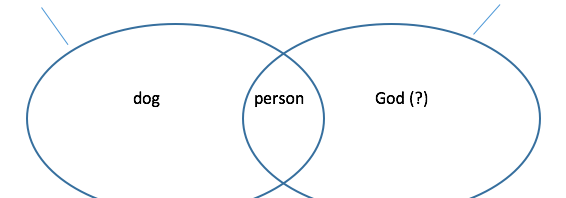
- There are two kinds of beings, those that have wants and those that don’t.
- There are two kinds of beings, those that can “reason” and those that cannot (where to reason is to have reflexive thoughts, or the ability to assess wants, desires, etc. critically).
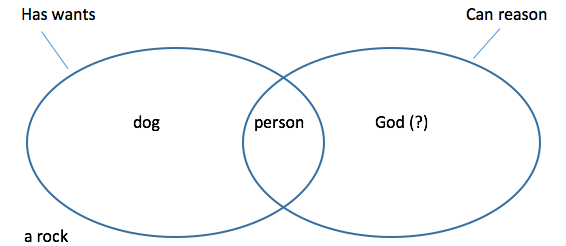
Inert objects like rocks and stars neither have wants nor can they reason. It follows that nothing is good or bad for them. All members of the animal kingdom, including human beings, have wants. That implies that some things are good and bad for each of them. Perhaps we alone are rational, in the Kantian sense. In that case, we and not animals have moral duties. But our moral duties are not only to those who are rational, but to those who have wants, which includes animals.
(I put God in the space for “can reason,” but “has [no] wants,” because I’ve been reading Spinoza this winter, and that’s his view. It’s theologically plausible that if there’s a God, God has wants. In that case, God would be in the same zone with us.)
Kant wrote:
If a man shoots his dog because the animal is no longer capable of service, he does not fail in his duty to the dog, for the dog cannot judge, but his act is inhuman and damages in himself that humanity which it is his duty to show towards mankind. If he is not to stifle his human feelings, he must practice kindness towards animals, for he who is cruel to animals becomes hard also in his dealings with men.
Korsgaard is a major Kantian, but in her Tanner Lectures on “Fellow Creatures: Kantian Ethics and Our Duties to Animals” (2004) and subsequent work, she disagrees with Kant’s reasoning here. What is wrong with shooting the dog is not that the man somehow neglects his duties to other humans. He has done wrong by mistreating the dog. Just like the man, the dog has desires, and there are things that are good for the dog. The man has negated the dog’s good in his own interest.
It is likely that dogs do not have the capacity to reflect on or change what they want. Therefore a dog does not have the right or obligation to participate in creating moral norms that are binding on itself or the man. It “cannot judge” in the way that a person can. We don’t blame it (or genuinely esteem it) for acting like a dog; that is simply its nature. But the man’s duty to reflect on his own desires is precisely the duty to take others’ desires into account. It doesn’t matter whether the others can judge; it matters whether they have desires and goods. Likewise, our duties to other human beings are not contingent on their acting like Kantian rational subjects.
See also: latest thoughts on animal rights and welfare and my evolving thoughts on animal rights and welfare.