Category Archives: philosophy

the lack of diversity in philosophy is blocking its progress

I’m on vacation this week and most of next, so I’m not blogging. However, a piece of mine has just appeared in Aeon, entitled “The lack of diversity in philosophy is blocking its progress.” It begins:

Philosophy is a remarkably un-diverse discipline. Compared with other scholars who read, interpret and assign texts, philosophers in the United States typically choose a much higher percentage of their sources (often, 100 per cent) from Europe and countries settled by Europeans. Philosophy teachers, too, look homogeneous: 86 per cent of new PhD researchers in philosophy are white, and 72 per cent are male. In the whole country, only about 30 African-American women work as philosophy professors.

pragmatism and the problem of evil

Discussing Dewey in the Summer Institute of Civic Studies yesterday, I (and, I think, several colleagues) had the sudden recognition that American pragmatists tend not to deal with evil very persuasively. In The Public and its Problems, Dewey writes:

Nevertheless, the current has set steadily in one direction: toward democratic forms. That government exists to serve its community, and that this purpose cannot be achieved unless the community itself shares in selecting its governors and determining their policies, are a deposit of fact left, as far as we can see, permanently in the wake of doctrines and forms, however transitory the latter. They are not the whole of the democratic idea, but they express it in its political phase. Belief in this political aspect … marks a well-attested conclusion from historic facts. (p. 146)

Dewey’s idea is that we can’t justify processes like electing leaders a priori. There is no natural right to vote; it doesn’t depend on a social contract. Rather, it’s a “deposit of fact” left from human learning over many centuries. Voting exists because we have learned to vote. Fortunately, that process is progressive and beneficial: the current has steadily flowed toward democracy. It is crucial not to fetishize any given process or right, because we will come up with better ones later. When we think of documents like the Constitution, Dewey says, “the words ‘sacred’ and sanctity’ come readily to our lips” (pp. 169-70), interfering with our critical reasoning and our ability to learn from experience.

These words were published in 1927. About 14 million people were sentenced to the Gulag from 1929 to 1953. Auschwitz opened in 1940. The current was not exactly steady in the direction of democracy. Robert Zaretsky has a beautiful piece in today’s Times about how not being occupied during World War II made Americans–probably white Americans more than others–“stupid.”  According to Zaretsky, Czeslaw Milosz was fairly indulgent of our stupidity, although he diagnosed it clearly. It is precisely the kind of foolishness suggested by the first sentence in Dewey’s quotation above.

What if we said the following instead? Human beings torture each other, enslave each other, carpet-bomb each other, and intentionally wipe out whole communities. This happens often. Enough: it has to stop. Translated into constitutional terms, “thou shalt not torture people” turns into a right to due process and rule of law. We must do our best to make such rights sacred and nonnegotiable. They are not literally sacred, in the sense that God or nature decreed them. But they are bulwarks against cruelty, which is the worst of us, to paraphrase Judith Shklar’s Liberalism of Fear. When everything is left open to experimentation and learning, people may spend hundreds of years “learning” that they can own other people or that Jews are blood-sucking parasites. We should rather treat as sacred and unamendable such passages as Article One of the German Constitution:

(1) Human dignity shall be inviolable. To respect and protect it shall be the duty of all state authority. (2) The German people therefore acknowledge inviolable and inalienable human rights as the basis of every community, of peace and of justice in the world.

I think that there are pragmatist replies to this kind of liberalism, but I can’t be satisfied with them unless they explicitly invoke and address the problem of evil. I’m worried about this kind of theme in Dewey (ably summarized by John M. Savage in John Dewey’s Liberalism):

Dewey

I’m all for cultivating democratic habits, but that’s not the only bulwark against tyranny. It’s also helpful to ban tyranny and to make that prohibition permanent.

an alternative to Moral Foundations Theory

Jonathan Haidt’s Moral Foundations Theory is one of the most influential current approaches to moral psychology and it exemplifies certain assumptions that are pervasive in psychology more generally. I have been working lately with 18 friends and colleagues to “map” their moral views in a very different way, driven by different assumptions. As part of this small pilot project, I gave the 18 participants Haidt et al’s, Moral Foundations Questionnaire. Although my sample is small and non-representative, I am interested in the contrasting results that the two methods yield.

Haidt’s underlying assumptions are that people form judgments about moral issues, but these are often gut reactions. The reasons that people give for their judgments are post-hoc rationalizations (Haidt 2012, pp. 27-51; Swidler 2001, pp. 147-8; Thiele 2006). “Individuals are often unable to access the causes of their moral judgments” (Graham, Nosek, Haidt, Iyer, Koleva, & Ditto 2011, p. 368). Hence moral psychologists are most interested in unobserved mental phenomena that can explain our observable statements and actions.

Haidt et al ask their research subjects multiple-choice questions about moral topics. Once they have collected responses from many subjects, they use factor analysis to find latent variables that can explain the variance in the answers. (Latent variables have been “so useful … that they pervade … psychology and the social sciences” [Bollen, 2002, p. 606]). The variables that are thereby revealed are treated as real psychological phenomena, even though the research subjects may not be aware of them. Haidt and colleagues consider whether each factor names a psychological instinct or emotion that 1) would have value for evolving homo sapiens, so that our ancestors would have developed an inborn tendency to embrace it, and 2) are found in many cultures around the world. Now bearing names like “care” and “fairness,” these factors become candidates for moral “foundations.”

Because Haidt’s method generates a small number of factors, he concludes that people can be classified into large moral groups (such as American liberals and conservatives) whose shared premises determine their opinions about concrete matters like abortion and smoking. “Each matrix provides a complete, unified, and emotionally compelling worldview” (Haidt 2012, p. 107). In this respect, Haidt’s Moral Foundations theory bears a striking similarity to Rawls’ notion of a “comprehensive doctrine” that “organizes and characterizes recognized values to that they are compatible with each other and express an intelligible view of the world.”

In contrast, I have followed these steps:

  1. I recruited people I knew. These relationships, although various, probably influenced the results. I don’t entirely see that as a limitation.
  2. I asked each participant to answer three open-ended questions: “Please briefly state principles that you aspire to live by.” “Please briefly state truths about life or the world that you believe and that relate to your important choices in life.” “Please briefly state methods that you believe are important and valid for making moral or ethical decisions.”
  3. I interviewed them, one at time. I began by showing each respondent her own responses to the the survey, distributed randomly as dots on a plane. I asked them to link ideas that seemed closely related. When they made links, I asked them to explain the connections, which often (not always) took the form of reasons: “I believe this because of that.” As we talked, I encouraged them to add ideas that had come up during their explanations. I also gently asked whether some of their ideas implied others yet unstated; but I encouraged them to resist my suggestions, and often they did. The result was a network map for each participant with a mean of 20.7 ideas, almost all of which they had chosen to connect together, rather than leaving ideas isolated.
  4. We jointly moved the nodes of these networks around so that they clustered in meaningful ways. Often the clusters would be about topics like intimate relationships, views of social justice, or limitations and constraints.
  5. I put all their network maps on one plane and encouraged them to link to each others’ ideas if they saw connections. That process continues right now, but the total number of links proposed by my 18 participants has now reached 1,283.
  6. I have loosely classified their ideas under 30 headings (Autonomy, Authenticity/ integrity/purpose, Balance/tradeoffs, Everyone’s different but everyone contributes, Community, Context, Creativity/making meaning, Deliberative values, Difficulty of being good, Don’t hurt others, Emotion, Family, Fairness/equity, Flexibility, God, Intrinsic value of life, Justice, Life is limited, Maturity/experience, Modesty, No God, Optimism, Peace/stability, Rationality/critical thinking, Serve/help others, Relationships, Skepticism/human cognitive limitations, Striving, Tradition, Virtues). Note that some of these categories resemble Moral Foundations, but several do not. The ones that don’t tend to be more “meta”–about how to form moral opinions.

My assumptions are that people can say interesting and meaningful things in response to open-ended questions about moral philosophy; that much is lost if you try to categorize these ideas too quickly, because the subtleties matter; and that a person not only has separate beliefs but also explicit reasons that connect these beliefs into larger structures.

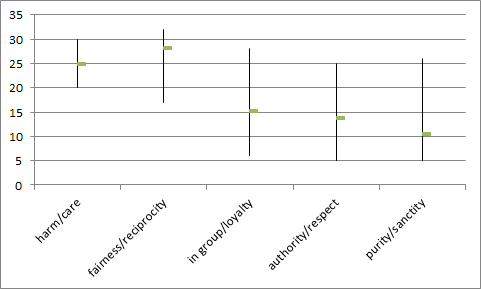
Since I also gave participants the Moral Foundations Questionnaire, I am able to say some things about the group from that perspective. This graph shows the group means and the range for their scores on the five Moral Foundations scales. For comparison, the average responses of politically moderate Americans are 20.2, 20.5, 16.0, 16.5, and 12.6. That means that my group is more concerned about harm/care and fairness/reciprocity than most Americans, and not far from average on other Foundations. But there is also a lot of diversity within the group. Two of my respondents scored 5 out of 35 on the purity scale, and two scored 20 or higher. The range was likewise from 6 to 28 on the in-group/loyalty scale.

MoralFoundations

You might think that this diversity would somehow be reflected in the respondents’ maps of their own explicit moral ideas and connections. But I see no particular relationships. For instance, one of the people who rated purity considerations as important–a self-described liberal Catholic–produced a map that clustered around virtues of moral curiosity and openness, friendship and love, and a central cluster about justice in institutions. She volunteered no thoughts about purity at all.

This respondent scored 20 on the purity scale. A different person (self described as an atheist liberal) scored 9 on that scale. But they chose to connect their respective networks through shared ideas about humility, deliberation, and justice.

The whole group did not divide into clusters with distinct worldviews but overlapped a great deal. To preserve privacy, I show an intentionally tiny picture of the current group’s map that reveals its general shape. There are no signs of separate blocs, even though respondents did vary a lot on some of the “Foundations” scales.

moralmap

A single-word node that appears in five different people’s networks is “humility.” It also ranks fourth out 375 ideas in closeness and betweenness centrality (two different measures of importance in a network). It is an example of a unifying idea for this group.

Many of the ideas that people proposed have to do with deliberative values: interacting with other people, learning from them, forming relationships, and trying to improve yourself in relation to others. Those are not really options on the Moral Foundations Questionnaire. They are important virtues if we hold explicit moral ideas and reasons and can improve them. They are not important virtues, however, if we are driven by unrecognized latent factors.

One way to compare the two methods would be to ask which one is better able to predict human behavior. That is an empirical question, but a complex one because many different kinds of behavior might be treated as outcomes. In any case, it’s not the only way to compare the two methods. They also have different purposes. Moral Foundations is descriptive and perhaps diagnostic–helping us to understand why we disagree. The method that I am developing is more therapeutic, in the original sense: designed to help us to reflect on our own ideas with other people we know, so that we can improve.

[References: Bollen, Kenneth A. 2002. Latent Variables in Psychology and the Social Sciences. Annual Review of Psychology, vol. 53, 605-634; Graham, Jesse, Nosek, Brian A., Haidt, Jonathan, Iyer, Ravi, Koleva. Spassena, & Ditto, Peter H. 2011. Mapping the Moral Domain. Journal of Personality and Social Psychology, 101:2; Haidt, Jonathan. 2012. The Righteous Mind: Why Good People Are Divided by Politics and Religion. New York: Vintage; Swidler, Ann. 2001. Talk of Love: How Culture Matters. Chicago: University of Chicago Press; Thiele, Leslie Paul. 2006. The Heart of Judgment: Practical Wisdom, Neuroscience, and Narrative Cambridge University Press.]

who says that binary thinking is Western?

I often hear that binary oppositions are typical of Western thought. The implication is that “we” should strive to avoid being trapped by such oppositions.

To be sure, certain distinctions (white/non-white, male/female, Christian/non-Christian) are the basis of injustices. Those distinctions have been important in Western Europe and have been used to justify oppression. As a result, some people are moved to challenge what they call Western dualism. But the problem isn’t dualism–after all, the whole point is to promote justice over its opposite, injustice–nor is it helpful to introduce a binary distinction between the West and the rest. It seems odd to invent a very simple and global binary in order to criticize dualism.

I’m skeptical of the very notion of the West, because it encompasses so much diversity and has overlapped with so many other parts of the world for so long that I don’t know how to define it. But one thing the West has not been consistently is dualistic.

Christianity is surely a Western phenomenon, and a core Christian idea is that Jesus is both divine and human, both a person and one with the persons of God and the Holy Spirit. Another orthodox Christian assumption is that nature/the world is good and is solely God’s creation, yet it is not identical with God. Many of the thinkers who have been formally condemned as heretics by Christianity have been banned for adopting dualistic views either of Christ or of nature.

Nobody could be more dualist than George Boole, the inventor of Boolean logic (in which all values are reduced to TRUE or FALSE). Apparently Boole was deeply influenced by classical Indian logic, which is rife with sharp distinctions. Taoism is also described as fundamentally dualist. All of which is to say that binary oppositions don’t seem to be particularly “Western” to me.

Jacques Derrida is cited as the source of the view that Western thought is binary, although it would surprise me if he really caused it to be so widespread. Besides, Derrida says things like this: “Doubtless Western metaphysics constitutes a powerful systematization of this illusion, but I believe it would be an imprudent overstatement to assert that Western metaphysics alone does so.”* Three points to notice about this sentence: 1) Derrida is talking about a specific tradition of philosophical thought (“metaphysics,” as Heidegger would define it), not about Western culture, more broadly. 2) He is not criticizing binary thinking per se but certain specific binaries, especially text versus reference. And 3) He doubts that Western metaphysics alone suffers from this “illusion.”

See also: to whom do the ancient Greeks belong?Jesus was a person of coloravoiding the labels of East and Westwhen East and West were oneon modernity and the distinction between East and West.

*Derrida, Positions, translated by Alan Bass (1982), p. 33

aphorisms, proverbs, maxims, and the purpose of this blog

If you search the Internet for “aphorisms,” you’ll find a mix of authors, from Lao Tze to Jean Baudrillard.

Some are literary figures who are eminently quotable–good at writing short, memorable passages that stand on their own even if they were originally composed for longer poems or continuous narratives. Oscar Wilde, Dorthy Parker, and Emerson are just a few examples of people called “aphorists” because they are pithy and witty.

Other books of aphorisms are lists of sentences or very short passages that are intended to be serious and wise. The biblical books of Proverbs and Ecclesiastes, the Greek collections of accumulated sayings attributed to Pythagoras and the Delphic Oracle, and the sutras of the Hindu tradition are examples. When these statements take the form of imperative sentences (“Enter not into the path of the wicked, and go not in the way of evil men”), they can be called maxims. When they sound more like generalizations about the world (“To every thing there is a season, and a time to every purpose under the heaven”), they are better named proverbs.

A philosophy professor friend of mine once disclosed his profession to the person sitting next to him on an airplane. “Oh, you are a philosopher,” the neighbor said. “What are your sayings?” He was thinking of traditions in which philosophy means explicit wisdom, and wisdom is succinct and quotable. Needless to say, that is not what professional philosophy is today.

Once collections of short, pithy sayings are treasured as wisdom (a thesaurus means a “treasury”), it becomes possible to write collections that look like proverbs but are more idiosyncratic, personal, and perhaps ironic or subversive. La Rochefoucauld exploits the subversive potential of the genre when he writes in the format of the biblical Book of Proverbs but gives advice like, “If we had no faults we should not take so much pleasure in noting those of others.”  Erasmus collects real wisdom in some of his books (Adagia, Apophthegmata), but he puts strings of quotable falsehoods in the mouth of the Fool in the Praise of Folly. It is never clear where the author stands. James Geary collects current examples of aphoristic writers in this tradition.

By the way, the root of “aphorism” is the Greek verb for dividing, defining, or setting limits (ultimately from horos, boundary). In the New Testament, the verb aphorizo is used for dividing the damned from the saved and for excommunicating sinners. I think “aphorism” means division because each one is disconnected from the next (not because their content is necessarily about distinctions). In contrast, the Sanskrit word sutra means “string” or “thread.” Both traditions refer to distinct fragments of text that are loosely strung together without explicit transitions. The Greek word emphasizes the distinction among these items; the Sanskrit stresses their connectedness.

Francis Bacon and Friedrich Nietzsche epitomize a different tradition. They are highly critical empiricists who use the aphoristic form to shake their readers’ assumptions and demand their readers’ creative attention.

Bacon begins his book Novum Organum (“or, true suggestions for the interpretation of nature”) by decrying two categories of thinkers. On one hand, some have “presumed to dogmatize on Nature,” inventing or borrowing a theory, trying to explain everything in terms of that theory, and “bringing others to their [preconceived] opinion.” On the other hand, some have succumbed to the “despair of skepticism” and are known only for their “complaints and indignation at the difficulty of inquiry.” The third course is to observe and experiment with nature, one piece at a time, striving always to challenge our prior assumptions. Having proposed that course, Bacon then offers a series of numbered “Aphorisms on the Interpretation of Nature and the Empire of Man.”

Why aphorisms? Arguably, because Bacon is highly suspicious of grand theories that organize everything neatly and prevent us from noticing what is actually happening. So he is suspicious of the logical connective tissue that would turn individual propositions into larger arguments. He prefers to list specific propositions and encourage the reader to consider each one on its merits and to put them together only tentatively. We must stop to think about the logical relationship, if any, among Bacon’s thoughts. The form thus befits its substance.

Nietzsche’s earliest works are essays distinguished by their highly quotable passages yet also connected into rhetorically powerful wholes, with beginnings, transitions, and conclusions. With Human All Too Human (1878) Nietzsche shifts to a new genre that then occupies almost all of his energy for the rest of his life: collections of aphorisms. Like all his later books except ZarathustraHuman All Too Human is a set of numbered passages that range from a single sentence to a few pages in length.

Although Nietzsche’s style is influenced by aphoristic authors after Bacon (La Rochefoucauld, whom he cites in aphorism #35; Pascal; Lichtenberg, and others), the opening of Human, All Too Human takes us back to Bacon. Nietzsche, too, wants to shake his readers out of their “habitual opinions and approved customs.” He too is fascinated by people’s cognitive biases and limitations and suspicious of generalizations. In the very first aphorism of his first aphoristic volume, Nietzsche writes: “in fact, I myself do not believe that anybody ever looked into the world with a distrust as deep as mine.” I think he is hinting why his book will not offer a connected argument. A string of distinct ideas avoids the pretentiousness or naïveté implied by a larger whole.

Here Nietzsche almost sounds like one of the skeptics whom Bacon decries for dropping the effort to understand nature because they understand our limits all too well. But they are just complainers. Nietzsche, echoing the distinctions of Novum Organum, insists that he takes “pleasure in externals, superficialities, the near, the accessible, in all things possessed of color, skin and seeming.” That is not the same as Bacon’s path–striving to understand the phenomena–but Nietzsche sees it as the next step. He is moving beyond Baconian empirical science into his own “gay science.” (And in Ecce Homo, Nietzsche insists, “We do not know half enough about Lord Bacon—the first realist in all the highest sense of the word—to know what he did, what he willed and what he experienced in his inmost soul.”)

A final tradition consists of authors who have left collections of numbered and loosely connected passages–string-like sutras–because death or some other contingency prevented them from pulling these fragments into more coherent works. An inspiration for Bacon may have been Hippocrates, the ancient physician who called for close observation. Hippocrates’ writings (other than the Hippocratic Oath) read like aphorisms for a contingent reason: he didn’t write them. They are collections of fragmentary Greek texts about medicine wrongly attributed to him.

I am not sure to what degree Novalis wanted to write connected arguments, but we have his fragmentary notes in the condition that he left them when he died of consumption; both his tragic youthful death and his aphoristic style seem to match the content of his thought. A century later, Kafka also died of TB, leaving 109 aphorisms on philosophical topics.

And then there’s Wittgenstein, all of whose major works consist of short numbered passages without explicit connections. After he died, Elizabeth Anscombe and Georg Henrik von Wright published

a collection of fragments made by Wittgenstein himself and left by him in a box-file. They were for the most part cut from extensive typescripts of his, other copes of which still exist …

Often fragments on the same topic were clipped together; but there were also a large number lying loose in the box. …

We … came to the the conclusion that this box contained remarks which Wittgenstein regarded as particularly useful and intended to weave into finished work if places for them should appear. Now we know that his method of composition was in part to make an arrangement of such short, almost independent pieces as, in the enormous quantity that he wrote, he was fairly satisfied with.

They published this book under the title Zettel, which I think it an unpretentious work for snippet or cutting. But a cutting is also what an aphorism is. A clipped-together packet of snippings from typescript also bears a distant resemblance to a string of beads, a sutra. 

The word “cutting” could also have a more organic sense. In his 1948 poem “Cuttings,” Theodore Roethke evokes their generative potential:

Sticks-in-a-drowse over sugary loam,
Their intricate stem-fur dries;
But still the delicate slips keep coaxing up water;
The small cells bulge;

One nub of growth
Nudges a sand-crumb loose,
Pokes through a musty sheath
Its pale tendrilous horn.

To be sure, Roethke wrote a much darker second poem with the same title, emphasizing the pain of growth and rebirth. April is the cruelest month, and all. But I’d like to stress the latent promise of things that are clipped and piled together in conditions favorable to regeneration. In fact, that hope explains why I have been moved to write 3,123 posts on this blog (which is yet another word to compare with aphorism, sutra, maxim, and the others cited here). If I believe anything, it’s that we are too strongly influenced by grand conceptions that simplify and block our progress, yet we do need ambitious ideas. So let’s let them emerge from close, responsive, joyful engagement with people and their creations, taken one at a time.