Category Archives: philosophy

defining state, nation, regime, government

As a political philosopher by training, and now political scientist by appointment, I have long been privately embarrassed that I am not sure how to define “state,” “government,” “regime,” and “nation.” On reflection, these words are used differently in various academic contexts. To make things more complicated, the discussion is international, and we are often dealing with translations of words that don’t quite match up across languages.

For instance, probably the most famous definition of “the state” is from Max Weber’s Politics as Vocation (1919). He writes:

Staat ist diejenige menschliche Gemeinschaft, welche innerhalb eines bestimmten Gebietes – dies: das „Gebiet“, gehört zum Merkmal – das Monopol legitimer physischer Gewaltsamkeit für sich (mit Erfolg) beansprucht.

[The] state is the sole human community that, within a certain territory–thus: territory is intrinsic to the concept–claims a monopoly of legitimate physical violence for itself (successfully).

Everyone translates the keyword here as “state,” not “government.” But this is a good example of how words do not precisely match across languages. The English word “government” typically means the apparatus that governs a society. The German word commonly translated as “government” (“der Regierung“) means an administration, such as “Die Regierung von Joe Biden” or a Tory Government in the UK. (In fact, later in the same essay, Weber uses the word Regierung that way while discussing the “typical figure of the ‘grand vizier'” in the Middle East.) Since “government” has a wider range of meanings in English, it wouldn’t be wrong to use it to translate Weber’s Staat.

Another complication is Weber’s use of the word Gemeinschaft inside his definition of “the State.” This is a word with such specific associations that it is occasionally used in English in place of our vaguer word “community.” A population is not a Gemeinschaft, but a tight association can be. Thus to translate Weber’s phrase as “A state is a community …” is misleading.

For Americans, a “state” naturally means one of our fifty subnational units, but in Germany those are Länder (cognate with “lands”). The word “state” derives from the Latin status, which is as “vague a word as ratio, res, causa” (Paul Shorey, 1910) but can sometimes mean a constitution or system of government. Cognates of that Latin word end up as L’État, el Estado and similar terms that have a range of meanings, including the subnational units of Mexico and Brazil. In 1927, Mussolini said, “Tutto nello Stato, niente al di fuori dello Stato, nulla contro lo Stato (“Everything in the State, nothing outside the State, nothing against the State”). I think he basically meant that he was in charge of everything he could get his hands on. Louis XIV is supposed to have said “L’État c’est moi,” implying that he was the government (or the nation?), but that phrase may be apocryphal; an early documented use of L’État to mean the national government dates to 1799. In both cases, the word’s ambiguity is probably one reason it was chosen.

“Regime” can have a negative connotation in English, but political theorists typically use it to mean any government plus such closely related entities as the press and parties and prevailing political norms and traditions. Regimes can be legitimate, even excellent.

If these words are used inconsistently in different contexts, then we can define them for ourselves, as long as we are clear about our usage. I would tend to use the words as follows:

  • A government: either the legislative, executive, and judicial authority of any entity that wields significant autonomous political power (whether it’s territorial or not), or else a specific group that controls that authority for a time. By this definition, a municipality, the European Union, and maybe even the World Bank may be a government.

(A definitional challenge is deciding what counts as “political” power. A company, a church, a college, an insurgent army, or a criminal syndicate can wield power and can use some combination of legislative, executive, and/or judicial processes to make its own decisions. Think of canon law in the Catholic Church or an HR appeals processes inside a corporation. Weber would say that the fundamental question is whether an entity’s power depends on its own monopolistic use of legitimate violence. For instance, kidnapping is a violent way to extract money, but it does not pretend to be legitimate and it does not monopolize violence. Taxation is a political power because not paying your taxes can ultimately land you, against your will, in a prison that presents itself as an instrument of justice. Not paying a private bill can also land you in jail, but that’s because the government chooses to enforce contracts. Your creditor is not a political entity; the police force is. However, when relationships between a government and private entities are close, or when legitimacy is controversial, or when–as is typical–governments overlap, these distinctions can be hard to maintain and defend.)

  • A state: a government plus the entities that it directly controls, such as the military, police, or public schools. For example, it seems most natural to say that a US government controls the public schools, but not that a given school is part of the government. Instead, it is part of the state. Likewise, an army can be in tension with the government, yet both are components of the state.
  • A regime: the state plus all non-state entities that are closely related to it, e.g., political parties, the political media, and sometimes the national clergy, powerful industries, etc. We can also talk about abstract characteristics, such as political culture and values, as components of a regime. A single state may change its regime, abruptly or gradually.
  • A country: a territory (not necessarily contiguous) that has one sovereign state. It may have smaller components that also count as governments but not as countries.
  • A nation: a category of people who are claimed (by the person who is using this word) to deserve a single state that reflects their common identity and interests. Individuals can be assigned to different nations by different speakers.
  • A nation-state: a country with a single functioning and autonomous state whose citizens widely see themselves as constituting a single nation. Some countries are not nations, and vice-versa. People may disagree about whether a given country is a nation-state, depending on which people they perceive to form a nation.

See also: defining capitalism; avoiding a sharp distinction between the state and the private sphere; the regime that may be crumbling; what republic means, revisited etc.

Analyzing Political Opinions and Discussions as Networks of Ideas

This is a talk that I have prepared for the Universidad Carlo III in Madrid tomorrow. It is a summary of recent work that I have been conducting with colleagues at Northeastern, Wisconsin, and Oxford and that I’m beginning to develop into a book manuscript.

In the model that I present, an individual holds potentially connected beliefs about political or moral issues, which we can represent with nodes and links (an “idiodictuon”). Whether and how the various ideas are linked in the person’s network influences that individual’s actions and opinions. When people discuss political or ethical issues, they share portions of their respective networks of which they are conscious at the time and may bring ideas from their interlocutors into their own idiodictuons.

Some network structures are better than others for discussion: overly centralized or scattered networks are problematic. Individuals tend to demonstrate similar network structures on different issues, so that having a proclivity for a certain form of network is a character trait.

People, with their respective networks of ideas, are also embedded in social networks. An idea is more likely to spread depending on features of both the social network and the idea networks of the people who interact. Specifically, the odds that an idea will spread from a given person depend on how many people receive communications from that person and how much they trust the communicator. It is reasonable to take into account the trustworthiness of a source when assessing an idea.

As a whole, a population may develop a shared network structure. An idea that is widely shared and frequently central in individuals’ networks becomes a norm. Such norms play important roles in institutions. A community or a culture is a single network or phylodictuon that encompasses disagreement. Ultimately, all such networks interconnect to form a network of human ideas.

does doubting the existence of the self tame the will?

I like the following argument, versions of which can be found in many traditions from different parts of the world:

  1. A cause of many kinds of suffering is the will (when it is somehow excessive or misplaced).
  2. Gaining something that you desire does not reduce your suffering; you simply will something else.
  3. However, one’s will can be tamed.
  4. Generally, the best way to manage the will is to focus one’s mind on other people instead of oneself. Thus,
  5. Being ethical reduces one’s suffering.

In some traditions, notably in major strands of Buddhism and in Pyrrhonism, two additional points are made:

  1. The self does not actually exist. Therefore,
  2. It is irrational to will things for oneself.

Point #7 is supposed to provide both a logical and a psychological basis for #4. By realizing that I do not really exist, I reduce my attachment to my (illusory) self and make more space to care about others, which, in turn, makes me happier.

Point #6 is perfectly respectable. Plenty of philosophers (and others) who have considered the problem of personal identity have concluded that an ambitious form of the self does not really exist. (For instance, David Hume.)

But if the self doesn’t exist, does it really follow that we should pay more attention to other people? We might just as well reason as follows:

  1. The self does not really exist. Therefore,
  2. a. Other people do not really exist as selves. Therefore,
  3. a. It is irrational to be concerned about them.

Or

  1. The self does not really exist. Therefore,
  2. b. It is impossible for me to change my character in any lasting way. Therefore,
  3. b. There is no point in trying to make myself more ethical.

Striving to be a better or happier person is not a sound reason for doubting the existence of the self. This doubt may do more harm than good. If there actually is no self, that is a good reason not to believe in one. But then we are obliged to incorporate skepticism about personal identity into a healthy overall view. The best way might be some version of this:

  1. The self does not really exist. Nevertheless,
  2. c. I would be wise to treat other people as if they were infinitely precious, durable, unique, and persistent things (selves).

I think it is worth getting metaphysics right, to the best of our ability. For example, it is worth trying to reason about what kind of a thing (if anything) a self is. However, I don’t believe that metaphysical beliefs entail ways of life in a straightforward way, with monotonic logic.

Any given metaphysical view is usually compatible with many different ways of being. It may even strongly encourage several different forms of life, depending on how a person absorbs the view. Thus I am not surprised that some people (notably, thoughtful Buddhists) have gained compassion and equanimity by adopting the doctrine of no-self, even though the same doctrine could encourage selfishness in others, and some people may become more compassionate by believing in the existence of durable selves. In fact, many have believed in the following argument:

  1. Each person (or sentient being) has a unique, durable, essential being
  2. I am but one out of billions of these beings. Therefore,
  1. It is irrational to will things for myself.

The relationship between an abstract idea and a way of being is mediated by “culture,” meaning all our other relevant beliefs, previous examples, stories, and role-models. We cannot assess the moral implications of an idea without understanding the culture in which it is used. For instance, the doctrine of no-self will have different consequences in a Tibetan monastery versus a Silicon Valley office park.

We cannot simply adopt or join a new culture. That would require shedding all our other experiences and beliefs, which is impossible. Therefore, we are often in the position of having to evaluate a specific idea as if it were a universal or culturally neutral proposition that we could adopt all by itself. For instance, that is what we do when we read Hume and Kant (or Nagarjuna) on the question of personal identity and try to decide what to think about it. This seems a respectable activity; I only doubt that, on its own, it will make us either better or worse people.

See also: notes on religion and cultural appropriation: the case of US Buddhism; Buddhism as philosophy; how to think about the self (Buddhist and Kantian perspectives); individuals in cultures: the concept of an idiodictuon. And see “The Philosophic Buddha” by Kieran Setiya, which prompted these thoughts.

how the structure of ideas affects a conversation

According to the “interactionist” theory of Mercier & Sperber 2017 (which I discussed on Monday), human beings evolved to make smart decisions in groups, and that requires us to exchange reasons. We naturally want to express reasons for our intuitions and critically assess other people’s reasons for their beliefs. It matters how well we perform these two tasks.

One familiar kind of person frustrates discussion by constantly linking every belief that he endorses back to one foundational principle, whether it is a constitutional right to individual freedom, God’s will, or equality for all. The problem is not the core belief itself but the way his whole network of beliefs is structured; it prevents reasoning around his core idea if you don’t happen to share it. 

A different familiar figure is the person who offers many ideas but cannot provide a reason for most of them. If we think of a reason as a link between two ideas, then this person’s network has no links. Whereas the first network was too centralized, the second is too disconnected.

We don’t literally possess networks of beliefs; rather, a network graph is a way of representing our reasoning. I conjecture that the formal features of such a network can predict whether the person will deliberate well. To illustrate (but not to prove) that conjecture, I will discuss two Kansas State students who participated in an online discussion as part of the research that led to Levine, Eagan & Shaffer 2022.

Before discussing how socioeconomic factors affect health, all the students in this study wrote short passages describing their personal views. Adèle and Beth are pseudonyms for white undergraduate KSU women, aged 21 and 22, whose mothers had not attended college.

Adèle wrote:

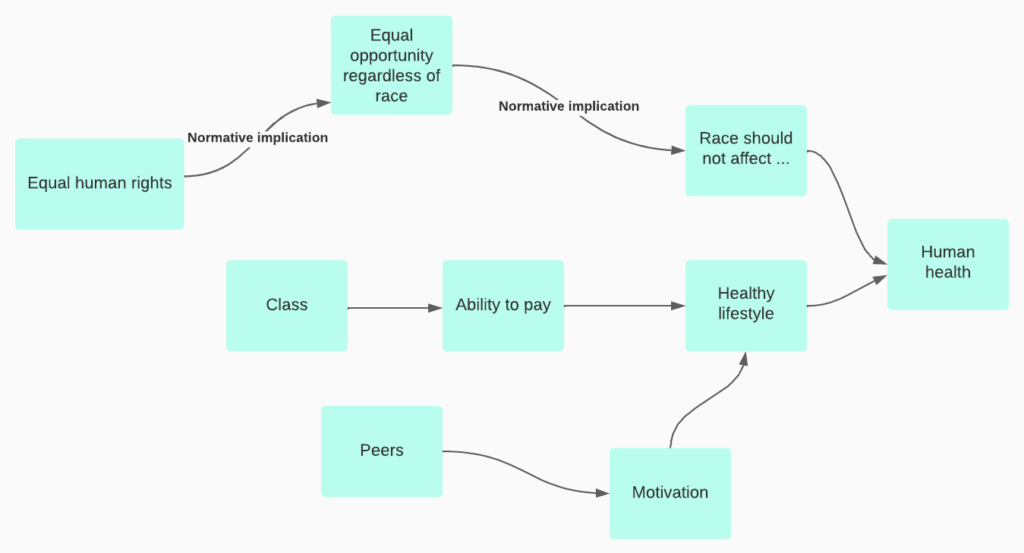
In my opinion, race should not influence the human health and well-being because every person should have an opportunity to succeed no matter what race they are. Social class influences the health because a healthy lifestyle is more expensive, but also a healthy lifestyle means physical activity and that does not depend on the social class, it depends on individual motivation. A social factor would be the people that we surround ourselves with. If we interact with people that live a healthy lifestyle, we can get influenced and borrow some of their habits. But is also true that for the lower class is the hardest to live a healthy lifestyle because they cannot afford one.

I think we could informally diagram her view with the graph below. The nodes are her stated beliefs. The arrows are her causal claims, except where I’ve denoted them as normative implications. This graph does not explain why Adèle formed her intuitions (i.e., why these beliefs formed in her mind) but rather represents the explicit reasons that she offers to explain her beliefs to others.

Beth wrote:

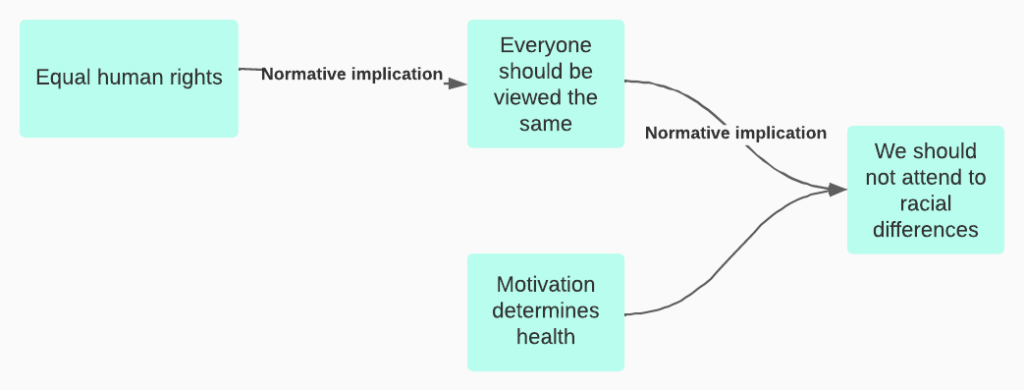
My thoughts on the impact of race, class and social factors on determinants on human health and wellbeing are that no matter what your race or social class is, you should be treated equally because the color of a person’s skin should not affect the way you view them. Both a black and white person can put in the same amount of hard work and effort to be able to reap the benefits of a happy healthy life. However, with that being said, there are some people who do not work as hard and that puts them in a lower social class than others. possibly making their overall health and wellbeing less than someone who is up in a higher social class.

I think we could informally diagram Beth’s view like this:

I propose that Adèle will be a better conversation-partner than Beth, not because her beliefs are superior but because of the structures represented by these two graphs.

Adèle has generated several independent intuitions (moral and empirical) that push in somewhat different directions. They are all connected to the idea of health, because that is the assigned topic, but there is some wiggle room between her beliefs, and she has identified several causes of the same outcomes. Adèle and I could talk about several of her intuitions. I could ask her to offer reasons for each one, and we could turn to another issue if we found that we disagreed on that point.

Meanwhile, Beth only offers reasons for one conclusion: that people should not pay attention to racial differences. I would worry that we couldn’t engage once she had made that point. Her sentence that begins, “However, with that being said,” does not actually present a conflicting point but elaborates on her main argument.

When asked whether “Everyday people from different parties can have civil, respectful conversations about politics,” Adèle agreed, but Beth strongly disagreed. Adèle also rated the online discussion more highly than Beth did as a learning experience. This is suggestive evidence that Adèle was more deliberative (in this context) than Beth.

Beth did participate in the online discussion four times and explicitly referred to previous commenters with openings that look civil, such as: “Although I agree with everything you have said, I think. …” However, all four of her contributions were variations on her basic point that success is due to hard work.

In contrast, when Adèle saw a post in the online discussion that recounted a story about a white woman who had succeeded in life due to her own hard work, she responded deliberatively, trying to connect to the previous writer’s ideas. She began: “I saw you talked about how hard work and effort can help you achieve a better lifestyle and I agree with it.” She had expressed this belief in her personal statement prior to the discussion, and it is represented in the first graph above.

She added, “But we also need to have in mind the people that grow up in less fortunate families and have different aspirations that some people have.” Here she introduced another belief that she had already held. She supported it with reasons: “For some of us, going to college is a thing that we knew it’s going to happen in our lives and we never question if we might go or no. But for some people they do not have this opportunity to afford college. … I believe that some people even if they are willing to put hard work and effort, not all of them are guaranteed to succeed.” She then acknowledged a criticism and addressed it: “Of course, there are people who succeeded but I believe that there are a lot of them who did not. And for a person who is less fortunate is not too easy to live a healthy lifestyle.”

My claim is not that Adèle formed better beliefs by reasoning. She may have developed her beliefs intuitively, as we generally do. Nor is there evidence that she revised her beliefs in response to objections, any more than Beth did. My claim is that Adèle contributed better to the group’s discussion because the structure of her reasons permitted more interaction.

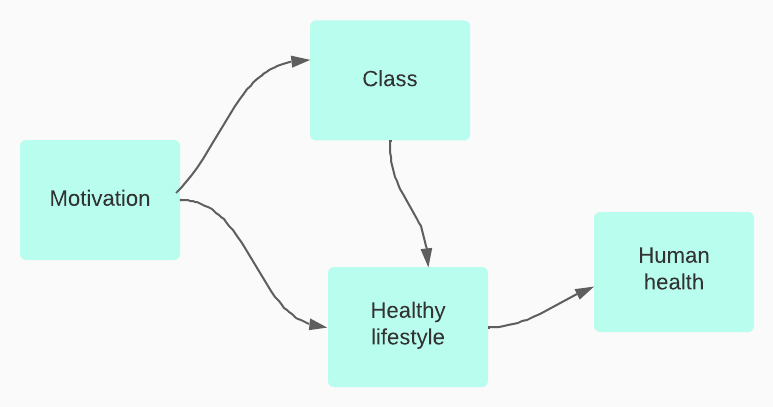
(Two limitations of this post: First, I chose the examples to illustrate my main point. That does not prove the general pattern. Second, my diagrams could be biased. For instance, Beth’s belief that “motivation determines health,” which I depicted above as one node in her network, could be unpacked to look like this:

Adding those four nodes to her map would make her whole graph look almost as complex as Adèle’s. I am still looking for less subjective approaches to mapping text. In a lot of my current work, I elicit network structures by asking people multiple-choice questions, rather than graphing their open-ended statements, because the quantitative data seems more reliable for making interpersonal comparisons.)

Sources: Mercier, Hugo and Dan Sperber, The Enigma of Reason, Cambridge, MA: Harvard University Press 2017; Levine, Peter & Eagan, Brendan & Shaffer, David. (2022). Deliberation as an Epistemic Network: A Method for Analyzing Discussion. 10.1007/978-3-030-93859-8_2. See also modeling a political discussion; individuals in cultures: the concept of an idiodictuon; and how intuitions relate to reasons: a social approach.

how intuitions relate to reasons: a social approach

We might like to think that when we form a belief, it comes after we have reviewed reasons. We canvass all the relevant reasons (pro and con), evaluate each of them, weigh and combine them, and choose the belief that follows best. In that case, our reasons cause our beliefs, whether they are about facts or about about values. We might also like to think that when someone offers a strong critique of our reasons, we will be motivated to change our beliefs.

A wealth of empirical evidence suggests that this process is exceedingly rare. Much more often, each of us forms our beliefs intuitively, in the specific sense that we are not conscious of reasons. It feels as if we just have the beliefs. Then, if someone asks why we formed a given belief, we come up with reasons that justify our intuition. We may even ask ourselves for reasons when we wonder why we had a thought.

This process is retrospective. We did not already have reasons. We find them to justify or rationalize our intuitions to ourselves or to other people (Graham, Nosek, Haidt, Iyer, Koleva, & Ditto 2011, p. 368; Haidt 2012, pp. 27-51; Swidler 2001, pp. 147-8; Thiele 2006).

This theory is concerning. For one thing, if you are already sure of any belief, then you can probably find a plausible reason to justify it and a plausible rebuttal to any critique. We don’t sound like very rational or reasonable creatures, ones who are good at assessing and combining reasons and drawing appropriate conclusions. We sound like lawyers in our own defense, finding grounds to justify what we merely assumed even when the evidence is weak.

Further, all the explicit discourse that we observe around us–all those meetings and articles and legal briefs and speeches and sermons–begins to seem like a foolish waste of effort. It’s the noise of people rationalizing what they already thought.

Some would add that intuitions about moral and political matters often seem to reflect self-interest. The rich are intuitively favorable to markets; men are biased for patriarchy; Americans, for the USA. In that case, reasoning is moot. The causal pathway runs from interests to intuitions and from there to justifications, and the justifications accomplish very little.

This highly skeptical view of reason results from focusing on individual human beings at the moment (or within a short timeframe) when they form beliefs. When we look outward from such moments, we find human beings meaningfully exchanging reasons that matter.

First, let’s look before the moment of intuition. Where did it come from? Let’s consider, for example, a person who hears about a proposed new federal program and has a strong intuition against it. This person may not explicitly consider reasons for and against federal intervention; the intuition may arise automatically. But before the moment of intuition, this person had probably heard many explicit critiques of government. Maybe a parent made a memorable complaint about the government when this person was still a child, and that attitude was reinforced by speeches, articles, stories, and other forms of intentional discourse. This individual may also have had direct, personal experiences, such as facing a burdensome regulation or having an unpleasant encounter with a bureaucrat. However, we must interpret such experiences using larger categories (such as “regulation” and “bureaucrat”) that we get from other people.

This process of forming an attitude that then generates an intuition may be more or less reasonable. The attitude might be wise and well-substantiated or else a mere prejudice. My point is not that people reason well but that discourse is often prior to intuition (cf. Cushman 2020). People’s intuitions about matters like government programs are influenced by the prevailing discourses of their communities. It matters whether you came of age in a neoliberal market economy, under collapsing state communism, in a stable social democracy, or in a Shiite theocracy. In this sense, reasons influence intuitions, but they may not be reasons that an individual explicitly considers before forming a belief. Rather, reasons circulate in the discourse of a community.

Now let’s look after the moment of intuition, to the time when a person answers the question: Why? For instance, why are you–or why am I–against this government program? The individual begins to generate reasons for the original intuition: Government never works well. Taxes are already too high. It’s not fair that lazy people should get a free ride — etc. These reasons were not in the person’s head prior to the intuition, and they did not cause it, yet they matter in several ways.

First, as intensely social creatures, we use reasons to establish our value to groups. People who can offer reasons that sound plausible, consistent, or even insightful emerge as respected and have influence. Sometimes, glib sophists gain respect with reasons that shouldn’t impress others, but to a significant extent, we judge other people’s reasons well (Mercier & Sperber 2017). We did not evolve to be magnificently rational thinkers who reach our individual judgments solely on the basis of evidence, but we did evolve to be remarkably perceptive social mammals who are pretty good at judging each other.

Hugo Mercier and Dan Sperber write:

Whereas reason is commonly viewed as a superior means to think better on one’s own, we argue that it is mainly used in our interactions with others. We produce reasons in order to justify our thoughts and actions to others and to produce arguments to convince others to think and act as we suggest. We also use reason to evaluate not so much our own thought as the reasons others produce to justify themselves or to convince us (Mercier & Sperber 2017, pp. 7-8).

Because we want to be respected for our judgments, we will go to considerable effort to rationalize our intuitions. That effort can take the form of skillful defense-lawyering: cleverly finding tendentious grounds for our positions. But it can also lead us to revise our beliefs because we do not want to be caught with inconsistencies, selfish biases, or blatant factual errors. Revision is less common than we would assume if people were ideally rational, but it occurs because we care about our reputations (Mercier & Sperber 2017, p. 146).

We are also motivated to find and express good reasons because doing so affords influence. For one thing, we can shape other people’s intuitions later on. The parent who told her child not to trust the government was trying to influence that child’s intuitions, as were other people who spoke on both sides of the issue later in the same person’s life.

Human beings can assess the cogency of other people’s explicit reasons, not with perfect reliability, but often pretty well. That means that if you have an intuition that you want other people to share, a good strategy is to come up with coherent reasons that support it. Good reasons may not overcome bias against you or favoritism for others. They may not overcome raw power, money, or lies. But they raise one’s odds of being influential, which is a source of power. Whether valid reasons persuade depends on how well our institutions are designed, and properly deliberative institutions are ones that reward the giving of good reasons (Habermas 1962, 1973).

Finally, when reasons are widely expressed and rarely opposed, they become norms, and norms are crucial for cooperation. For instance, in large swaths of an advanced liberal society, there are now explicit norms against gender discrimination. These norms are compatible with: 1) privately held explicit sexist opinions, 2) unrecognized or implicit sexist biases, 3) blatantly sexist subcultures, and 4) bad reasoning, such as neglecting to consider gender when reaching a conclusion about a policy. Nevertheless, the norm against gender discrimination exists and matters. Official policies are measured against it, and bodies like courts and school systems are affected by it. In turn their policies affect people’s mentalities over time.

Norms have the additional advantage that they do not have to be stated. This is crucial because we are not able to express all the premises of our arguments. In justifying what we believe, every point we can make depends on other points, which depend on others, pretty much ad infinitum; and we cannot address that whole web. Instead, we must assume agreement about most of the context. In Paul Grice’s terminology, we “implicate” beliefs that we assume others share (Grice 1967).

You can recognize the power of implicature when it goes wrong because the speaker’s belief is not working as a norm. For example, the phrase “Black Lives Matter” implicates the (true) premise that black lives have not been valued and that black people face pervasive discrimination and violence. Surveys show that a majority of white Americans do not believe this and even think the opposite, that whites face more discrimination. I suspect that at least some of them really don’t hear the implicature. They take “Black Lives Matter” to mean that only black lives should matter.

This is a troubling example at several levels, but it does not suggest that we lack norms entirely. On the contrary, our discourse is pervaded with shared assumptions, many of which developed over time as a result of intentional argumentation and persuasion. We can now implicate that violence is undesirable or that nature is precious even though both beliefs were widely rejected a century ago. Again, the norm that violence is bad can coexist with much implicit and hypocritical support for violence and with subcultures that openly promote violence. But it still has power as a belief that most people in many contexts can assume most other people publicly endorse, i.e., as a norm.

In turn, forming and shaping norms is a matter of grave significance, and reasons are tools for influencing norms. The paradigmatic case of reasoning is not an individual who identifies reasons and reaches an appropriate conclusion, but a community that shifts its norms when they are explicitly contested in public speech.

As Mercier and Sperber write:

Invocations and evaluations of reasons are contributions to a negotiated record of individuals’ ideas, actions, responsibilities, and commitments. This partly consensual, partly contested social record of who thinks what and who did what for which reasons plays a central role in guiding cooperative or antagonistic interactions, in influencing reputations, and in stabilizing social norms. Reasons are primarily for social consumption (Mercier & Sperber 2017, p. 127).

This is basically an empirical account of what the species homo sapiens does when we offer what we call “reasons.” It does not tell us how good this process is, in other words, whether it is a procedure that generates sound or valid results. Assessing human reasoning feels increasingly urgent now that we also have machines that generate sentences that convey reasons by using different procedures from ours.

Assessing our activity of reasoning requires epistemology, not empirical psychology alone. Fortunately, we have a sophisticated philosophical account of reasoning that is broadly consistent with the empirical account of Mercier and Sperber (Fenton 2019).

Robert Brandom argues that any claim (any thought that can be expressed in a sentence) has both antecedents and consequences: “upstream” and “downstream” links “in a network of inferences.” For instance, if you say, “It is morning,” you must have reasons for that claim (e.g., the alarm bell rang or the sun is low in the eastern sky) and you can draw inferences from it, such as, “It is time for breakfast.” (This is my example, not Brandom’s.) Reasoning is a matter of making these connections explicit. When making a claim, we propose that others can also use it “as a premise in their reasoning.” That means that we implicitly promise to divulge our own reasons and implications. “Thus one essential aspect of this model of discursive practice is communication: the interpersonal, intra-content inheritance of entitlement to commitments.” In sum, “The game of giving and asking for reasons is an essentially social practice.”

For Brandom, the same logic applies to “ought” claims and other normative sentences as to factual claims: whenever we make a statement, including a value-judgment, we owe a discussion of its reasons and implications. Brandom suggests that communication can be inward: we can reason in a “hypothetically” social way by thinking in our heads. But I would add—based on a safe empirical generalization about human beings—that we are quite bad at seeing the reasons for and the implications of our judgments about ethical and political matters that affect other people. Therefore, we badly need actual social reasoning: giving reasons and listening to the real reactions from other people (Brandom 2000, Kindle locs. 1733, 1746-7, 1767-9, 2060, 1799).    

See also opinion is dynamic and relational; in defense of (some) implicit bias. Sources: Cushman, Fiery. “Rationalization is rational.” Behavioral and Brain Sciences 43 (2020); Graham, Jesse, Nosek, Brian A., Haidt, Jonathan, Iyer, Ravi, Koleva. Spassena, & Ditto, Peter H. 2011. Mapping the Moral Domain. Journal of Personality and Social Psychology, 101; Fenton, William (2019), “On the Philosophy and Psychology of Reasoning and Rationality,” Kent State MA thesis; Grice, Paul, “Logic and Conversation” (1967), in Grice, Studies in the Ways of Words (Harvard, 1989), pp. 22-44; Habermas, Jürgen. (1962) 1991. The Structural Transformation of the Public Sphere: An Inquiry into a Category of Bourgeois Society. Translated by Thomas Burger. Cambridge, MA: MIT Press; Habermas, Jürgen. (1973) 1975. Legitimation Crisis. Translated by Thomas McCarthy. Boston: Beacon Press; Haidt, Jonathan. 2012. The Righteous Mind: Why Good People Are Divided by Politics and Religion. New York: Vintage; Mercier, Hugo and Dan Sperber, The Enigma of Reason, Cambridge, MA: Harvard University Press 2017; Swidler, Ann. 2001. Talk of Love: How Culture Matters. Chicago: University of Chicago Press; Thiele, Leslie Paul. 2006. The Heart of Judgment: Practical Wisdom, Neuroscience, and Narrative Cambridge University Press.