Category Archives: contemporary ethics

Kieran Setiya on midlife: reviving philosophy as a way of life

I read Kieran Setiya’s Midlife (Princeton, 2017) not only because I have that condition and am sometimes troubled by its complaints, but also because I appreciate the style of thought that Pierre Hadot named “philosophy as a way of life.” Practitioners of this style acknowledge that it is important to develop and test arguments. The philosophical life is one of critical reason. However, arguments should have a purpose: to improve a life. And we must remember that people are habitual and affective creatures. Therefore, arguments—no matter how valid and rigorous—will not change us. We also need practices or mental disciplines to accompany our arguments. But a mental habit or practice can lead us away from the findings of our critical reason. We may train ourselves to be foolish or selfish. So we need habits that are at least consistent with the best arguments, and, ideally, habits that actually include argumentation.

That is exactly the combination offered by the Hellenistic Schools (Stoicism, Epicureanism, Skepticism) and by the classical Indian traditions. It has been relatively weak in the modern West. Setiya shows that it can be practiced today.

He is a professional philosopher in the Anglophone, analytic tradition. A clue that he is trying something different in Midlife is the book’s grammar. Setiya often writes in the second-person singular: “You should …” (as in “You should not prefer to rewind time, erase your son, and try again.”) He also sometimes uses the first-person singular or plural: “I wish …”; “We think …” Midlife reads like a conversation that reports Setiya’s real efforts to combat his ennui in order to improve your life, too.

Midlife is almost free of jargon. But one person’s jargon is another’s helpful terminology, and Setiya makes occasional use of specialized words. His distinctive stylistic move is not his informal vocabulary but his shift to the second-person, which implies a stringent test that can be applied to each sentence and chapter: would an actual “you” find this text useful?

Another clue that Setiya is working in the tradition of philosophy as a way of life is that he recommends repeated practices, habits, or meditative exercises at the conclusion of each chapter. These are meant to turn the arguments of the chapter into therapies that might change our mental habits.

Many of Setiya’s recommendations are drawn from the history of ethics, not original to Midlife. Of course, that is fine; it is useful to review and revive others’ points. But some of his arguments are novel, and I will mention two.

Continue reading

Korsgaard on animals and ethics

(Northern Virginia) I made some comments about animal rights and welfare at one of the Tisch Talks in the Humanities last week. I have contributed no original scholarship on this topic, nor even followed the vast literature closely. But in the course of a quick lit. review, I came across the line of argument that Christine Korsgaard has developed, and it struck me as persuasive. I’d put a central point like this:

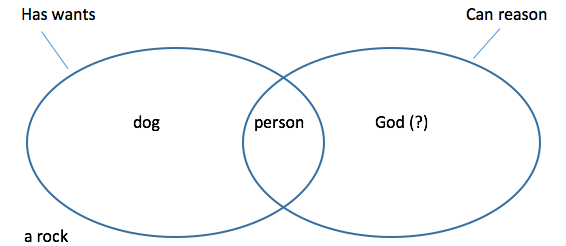
  1. There are two kinds of beings, those that have wants and those that don’t.
  2. There are two kinds of beings, those that can “reason” and those that cannot (where to reason is to have reflexive thoughts, or the ability to assess wants, desires, etc. critically).

Screen Shot 2016-02-11 at 1.23.50 PM

Inert objects like rocks and stars neither have wants nor can they reason. It follows that nothing is good or bad for them. All members of the animal kingdom, including human beings, have wants. That implies that some things are good and bad for each of them. Perhaps we alone are rational, in the Kantian sense. In that case, we and not animals have moral duties. But our moral duties are not only to those who are rational, but to those who have wants, which includes animals.

(I put God in the space for “can reason,” but “has [no] wants,” because I’ve been reading Spinoza this winter, and that’s his view. It’s theologically plausible that if there’s a God, God has wants. In that case, God would be in the same zone with us.)

Kant wrote:

If a man shoots his dog because the animal is no longer capable of service, he does not fail in his duty to the dog, for the dog cannot judge, but his act is inhuman and damages in himself that humanity which it is his duty to show towards mankind. If he is not to stifle his human feelings, he must practice kindness towards animals, for he who is cruel to animals becomes hard also in his dealings with men.

Korsgaard is a major Kantian, but in her Tanner Lectures on “Fellow Creatures: Kantian Ethics and Our Duties to Animals” (2004) and subsequent work, she disagrees with Kant’s reasoning here. What is wrong with shooting the dog is not that the man somehow neglects his duties to other humans. He has done wrong by mistreating the dog. Just like the man, the dog has desires, and there are things that are good for the dog. The man has negated the dog’s good in his own interest.

It is likely that dogs do not have the capacity to reflect on or change what they want. Therefore a dog does not have the right or obligation to participate in creating moral norms that are binding on itself or the man. It “cannot judge” in the way that a person can. We don’t blame it (or genuinely esteem it) for acting like a dog; that is simply its nature. But the man’s duty to reflect on his own desires is precisely the duty to take others’ desires into account. It doesn’t matter whether the others can judge; it matters whether they have desires and goods. Likewise, our duties to other human beings are not contingent on their acting like Kantian rational subjects.

See also: latest thoughts on animal rights and welfare and my evolving thoughts on animal rights and welfare.

on philosophy as a way of life

(San Antonio, TX) Here I briefly introduce schools of thought–Indian and European–that have combined introspective mental exercises with reasoning about moral principles and critical analysis of social systems. I contrast their integrated approach to forms of philosophy that construct comprehensive models of ethics by using reasons alone. This essay will be the introduction to a book on mapping moral networks, which is a new introspective exercise.

–“I should have given that man some change. He looked hungry.”
–“He would have used it for drugs or alcohol.”
–“Maybe he has that right—it’s his life!”
–“If you’re going to try to help the homeless, you should donate to the Downtown Shelter. They spend the money on real needs. Plus, it’s tax-deductible.”
–“That’s not realistic advice. While I am talking to a homeless person, I have homelessness on my mind. Once I get back home, the thought is gone. I’d never remember to mail off a check.”
–“Perhaps we should set aside some time every day to practice compassion and remember people who are suffering.”
–“Yes, I guess I’m for compassion—but handing someone money seems to create the wrong kind of relationship. What did Emerson write? ‘Though I confess with shame I sometimes succumb and give the dollar, it is a wicked dollar which by and by I shall have the manhood to withhold.’”
–“Maybe we should think about why some people are homeless in the first place and what policies would end that situation.”

This little dialog shows a pair of human beings doing several valuable things. They display emotions, some expressed with enthusiasm and some with regret. They exchange reasons. But they know that their reasons may not actually influence them deeply because they have habits that they would have to counteract by altering their regular routines. They cite rules—such as the tax deduction for charity and the shelter’s ban on alcohol—that are meant to improve and regulate people’s behavior. Finally, one speaker (perhaps showing off) cites an influential thinker from the past whose argument seems relevant.

Each of these modes of thought can be practiced at a high level. Instead of quickly asserting moral beliefs, we can develop whole arguments: chains of reasons that carry from a premise to a conclusion. If the argument persuades, it joins the list of things you believe, and you have been changed. Anyone who is serious about being a good person must struggle to get the reasons right and then act according to the conclusions.

But because our wills are weak, we also need enforced rules that guide or constrain us. And just as we can reason about our own choices (“Should I give a dollar to this homeless person?”), so we can reason about laws, regulations, social norms, and institutions. We can ask whether the rules that are in place are acceptable and, if not, how they should change. As Alexander Hamilton wrote on the first page of the Federalist Papers, laws are meant to arise from “reflection and choice” rather than “accident and force.” Political thinkers have often offered elaborate arguments about how institutions should be designed to improve people’s behavior.

Meanwhile, we can learn reflective practices such as confession, memorization, visualization, meditation, autobiographical reflection, and prayer. These methods are more personal than arguments, for they work directly on an individual’s beliefs, emotions, and habits. They are less coercive but more individualized than rules and laws, for we enforce these practices on ourselves. They tend to require practice and repetition to achieve their goals. You can read an argument once in order to evaluate it, but you must repeat a mental exercise for it to affect your psychology. In the 1500s, Michel de Montaigne observed, “Even when we apply our minds willingly to reason and instruction, they are rarely powerful enough to carry us all the way to action, unless we also exercise and train the soul by experience for the path on which we would send it” (II.6). But self-discipline without reason is blind, potentially turning us into worse rather than better people. Think of terrorists who have overcome their habits of peacefulness and tolerance to make themselves into killers; their fault is not a lack of discipline but a poor choice of means and (often) ends.

Finally, we can take the interpretation of other people’s thoughts to high levels of sophistication and rigor. Instead of just quoting a snippet of Emerson, we can make a full study of his ideas in their context. Cultural critique and intellectual history help us understand where we come from and what influences us. After all, we believe what we do in large measure because other people have formed and shaped our thoughts. No one invents her whole worldview from scratch. Since we begin with the traditions that have developed so far, it is important to understand them. Reasoning or self-discipline requires a critical understanding of the materials with which we construct our thoughts, which are ideas that our predecessors have invented.

It makes sense to put these modes together because we are reasonable creatures (capable of offering and sharing reasons for what we do), but we are also emotional and habitual creatures (requiring either external rules or mental discipline and practice to improve ourselves), political creatures (living in communities structured by laws and norms that people make and change), and historical creatures (shaped by the heritage of past thought).

In some periods, it has been common to combine argumentation about personal choices and social institutions, mental exercises, and the critical study of past thinkers. In other times–including our own–these elements have come apart. Here I will offer a very short and suggestive review of that history to support the thesis that now is a time to put the pieces back together. Continue reading

on modernity and the distinction between East and West

I think the following information has tremendous, even global significance. It comes from David Shluman’s review of Pankaj Mishra’s From the Ruins of Empire:

As Velcheru Narayana Rao has eloquently shown for southern India, a form of awareness that can be characterized as modern emerged naturally and organically in the Telugu- and Tamil-speaking parts of the subcontinent toward the end of the fifteenth century.1 It had nothing whatever to do with Western influence or the arrival of Vasco da Gama in Calicut in 1498. Highly original thinkers and poets, writing in all the languages of the south, discovered, or invented, a series of interlocking notions that together comprise a novel anthropology.

Thus we find, with particular prominence, the concept of an autonomous, subjective individual, responsible for his or her fate; a new theory of romantic love; the development of literary fiction as a privileged literary technique; a vogue for skepticism and realism, seen as informing the pragmatics of everyday life; the emergence of a cash economy and the conceptual revolution that rapid monetarization entails; the appearance of a bold, full-throated, unfettered female voice; and a new concept of nature as a rule-bound domain, separate from the human and amenable to disciplined observation and extrapolation. An innovative economic model of the mind, centered on the imaginative faculty, came to define the meaning of being human.2

With this shift in incorrigible assumptions there arose a new kind of state, which we call “Nayaka,” founded by a recently recruited elite of self-made men who had cut free from their ascriptive caste and family backgrounds and who saw themselves as free agents in a world of hitherto unknown opportunities.

I resist generalizations about “the West” because it encompasses too much diversity to be a meaningful category. What do such “Westerners” as Saint Teresa of Ávila, Oscar Wilde, Daniel Boone, Lenin, William Penn, Cole Porter, Thomas Edison, Martin Heidegger, Andy Warhol, Donald Trump, Emily Dickinson, and Hernán Cortés have in common? There is also, of course, tremendous internal diversity in other parts of the world–witness the ancient tradition of materialistic and hyper-individualistic thinkers from India, which is supposedly the home of mysticism and communitarianism.

Also, the borders of any area that we might call “the West” have been too vague and too porous for too long. Did you know that Menander I was a Buddhist Greek king of part of India in the second century BC, named after the Athenian comic playwright, whose coins bore Greek inscriptions on one side and Pali (the language of the Buddhist scriptures) on the other? He and successor kings, with names like Strato I and Theophilos, often depicted themselves as Greek gods in Buddhist poses and called themselves Dharmaraja or “King of the Dharma.” Was this the East or the West?

But I did used to think that the West could be distinguished from the rest of the world on one specific dimension. During the 19th century, in some parts of some European countries or countries settled predominantly by Europeans, two phenomena developed:

Modernity: a social order in which great masses of people are governed by laws and markets more than personal ties; in which few traditions and norms are seen as natural or inevitable and society is understood as an artifact; in which contract has replaced status as an organizing principle; in which individuals are primarily interested in their own personal attributes and rights; and in which technology pervasively mediates individuals’ relationship with nature.

Modernism: a set of intellectual and cultural movements that emerge in modernity, that describe modernity, and that bring modernity into the realm of ideas by renouncing aesthetic or intellectual traditions; instead, the ideal artist invents a new “contract” for each work.

Everywhere that modernity and modernism arrived, even in Paris and New York, they were perceived as new and problematic phenomena that caused distress. But the experience felt different in the West. This was also the age of European imperialism, of gunboats, missionaries, and the East India Company. And it was an age of race-consciousness, in which some people saw themselves as “white” and were seen that way by others. If you lived in a country where people were predominantly white and Christian (“the West”), then modernity and modernism seemed like indigenous changes. “We” were changing–for better or worse. If you lived elsewhere, modernity and modernism seemed to arrive with the imperialists, whether they came as conquerors or traders.

Thus modernists outside of Europe were pro-Western; anti-modernists were typically also anti-Western. In contrast, modernists in America or Europe (perhaps excepting Russia) were simply the progressives within those countries. The distinction was temporal in the West and spatial elsewhere. It was about “us” in the West and about “them and us” elsewhere.

Regardless of our views of modernism/modernity and of European global influence, we often equate the two. For instance, when a group of us viewed graphic art from the Johannesburg-based Artist Proof Studio last summer, the debate was whether young Black South African artists had been “Westernized.” See Leroye Malaton’s linotype “Zoey” below as an example:


Johannesburg is a modern city, and the contributors to Artist Proof Studio are modernists (or post-modernists, which I take to be just a stage in modernism). Authors like Shulman and Rao are asking us to drop the identification of modernity and modernism with the West. If the same social structures and intellectual responses also developed in Southern India in the 15th century, then they may have popped up in many other places as well. They are best understood not as Western inventions but as responses to a certain logic of development and scale. Then modernity and modernism are as much the property of Black South African artists as of (say) contemporary Germans. Neither invented modernity; both contribute to it; both must deal with it. Thinking that way would not solve any of the dilemmas of modern life, but it would make the dialogue healthier and more productive.

Vaclav Havel

I think my fondness for the late Vaclav Havel (1936-2011) can be explained partly in generational terms. He became world-famous when I was young–the Velvet Revolution occurred the year I graduated from college as a student of political philosophy–and Prague turned into the European destination for young Americans, supplanting Paris. Images of the president of Czechoslovakia walking to his office in the Prague Castle in jeans, leather jacket, and backpack were icons matched only by photographs of Nelson Mandela from the same years.

Havel in 1990, visiting the prison where he had been incarcerated, via Columbia Journalism Review

I was going to write some substantive comments about Havel’s political thought, but I find that I’ve already noted the main points here. In short, his genius was to understand that politics need not be about trying to reach some kind of outcome that matches your values or interests and that can be codified in laws and politics. (He called that a “technological” understanding of politics, taking the terminology from Heidegger.) The alternative is politics as open-ended dialogue and caring interaction with other people, moving not toward a known goal but rather embodying an authentic community.

The limit of Havel’s thought was his inability to bring that kind of “antipolitics” with him into power. The dissidents who opted out of Communist society constructed an authentic community–because they had no ability to make decisions binding on others. Once Havel was thrust, like some fairy-tale character, into the Castle made famous by Kafka, regular politics took over and the magic was gone. His country literally split in half against his wishes, and the “other Vaclav,” Vaclav Klaus, steered the rump Czech Republic in a neoliberal direction. But Havel never lost his personal compass nor his sense of irony, humor, and compassion.

If we could learn how to preserve the ethic of a dissident movement after it achieves power, we would find the key to the deepest afflictions of modernity. Meanwhile, we should salute Havel as one of the few who courageously and skilfully tried.

(By the way: Vaclav is pronounced VATZ-lav. It sounds better that way and it’s correct. Fittingly, it means Wenceslas: the Good King and the quasi-legendary father of the Czech people.)