Category Archives: nonviolence

Options for responding to a Trump Administration

strategizing for civil resistance in defense of democracy

In July, Heritage Foundation President Kevin Roberts said, “We are in the process of the second American Revolution, which will remain bloodless, if the left allows it to be.” His statement reflected some bluster and hype, and Trump distanced himself from Heritage. Nevertheless, Roberts expressed a mood that will be shared by many–perhaps more than 1,000–new White House staff, senior federal appointees, allied members of Congress and staff, and ideological lobbyists. They will all be thinking hard about what to do to advance their “revolution.”

To plan a response, we should imagine what such people will do. Here is a SWOT (Strengths, Weaknesses, Opportunities, and Threats) assessment of the situation from the perspective of the second Trump Administration:

  • Strengths: Ability to make appointments, issue executive orders, negotiate with foreign governments, and command attention. Immunity from prosecution for all official acts and the power to pardon people who follow illegal orders. A compliant congressional GOP, a friendly Supreme Court, and some fawning media platforms. A claimed mandate from the election, and tens of millions of actual supporters.
  • Weaknesses: At this moment, the House remains in play. Democratic control would mean no laws or budgets without Democratic support. Even if Democrats lose the House, they will be able to filibuster legislation in the Senate. The economy looks healthy right now, but Trump’s tariffs and other economic proposals would cause inflation and/or contraction. MAGA true-believers will be tempted to introduce bills that are clearly unpopular.
  • Opportunities: Picking fights to establish dominance, discourage opposition, motivate supporters, and dare opponents to promote positions that many voters consider radical. If the opposition looks radical, many voters will perceive that politics is polarized, not that the president is extreme, and they may accept authoritarianism to “restore order.”
  • Threats: Trump voters include substantial subgroups who don’t really share his ideology but who believe that he is competent to deliver prosperity and order. (According to the exit polls, 31% of voters chose the economy as their top issue, and of those, 78% voted for Trump.) If he causes chaos and controversy, and many voters abandon him, he will become toxic for GOP candidates looking toward 2026. If a small group of GOP defectors in Congress join the Democrats, they can block Trump. If he loses the appearance of influence and momentum, he could quickly become a lame-duck (especially if he continues to display cognitive decline). If momentum swings strongly to the opposition, there will be opportunities to make the Supreme Court and other institutions more democratic, rather than less so.

Next, we might brainstorm specific moves that Trump may make in the early stages of his administration and think about counter-moves.

Their most pragmatic option would be to avoid prominent controversies while turning the quieter processes of the executive branch against immigrants and environmental programs. If Trump took that path, he might be able to avoid an energetic resistance and claim credit for the positive economy that he will inherit. He could play golf and retire in four years. But he and his people will be tempted to take riskier actions:

  1. Appoint numerous radical supporters to senior positions. Perhaps give them all “acting” titles and not even request Senate confirmation, thus defeating the norm that political appointees require approval. They will cancel grants and contracts, slow-walk appropriations, fire civil servants, and direct funds to friendly groups and legislative districts. Much of this activity will be unreported, since the executive branch gets little coverage.
  2. Negotiate privately with Putin, without a readout or meaningful public declaration. Offer Russia free scope in Ukraine and promise to block or sabotage US aid. Likewise, communicate privately with Netanyahu and encourage Israel to operate without limits in both the West Bank and Gaza.
  3. Pardon all the January 6th insurrectionists. Convene them on the White House lawn. Possibly deputize them as federal agents or at least encourage them to organize as a private militia. If any of them commit violent crimes against protesters, journalists, or residents, immediately pardon them again. Deploy them to break up marches and demonstrations and to patrol the capital.
  4. Order federal law enforcement and perhaps state national guards to detain immigrants in large numbers, hold them, and physically move them across the southern border.

Some counter-moves:

  • Large, regular, orderly marches that, as Bayard Rustin would recommend, are aimed at winning mass public support. At first, the main message should not be that Trump is illegitimate, since he won the election. Nor is this an opportunity to advance progressive policies, including those that I passionately support. Rather, the message should be opposition to specific things that Trump does that are both unpopular and illegal. The aim is to establish a legitimate counter-force in support of the Constitution and the rule-of-law. The priority is to preserve a system within which progressives (and others) are able to advocate their goals, not to accomplish those goals immediately. The larger and more diverse the protests, the better.
  • A mass walkout like the one that defeated the Kapp Putsch in Berlin in 1920 and preserved German democracy for more than a decade. That story makes important reading right now. I could envision Trump provoking a self-coup, much like the Kapp Putsch, even if he doesn’t really plan to do so. This could begin to happen if armed MAGA supporters exercise violent control in DC, perhaps in reaction to peaceful marches. However, a similar attempt failed in 1920 when Berliners refused to work in the face of a coup, the city shut down, and civilian resistance spread to regular military units. The Berlin work-stoppage did not begin with a formal strike but happened organically when frightened Berliners just stayed home.
  • Building organizations that allow many Americans to take concrete steps to protect democracy in a coordinated fashion.

Finally, some points about the movements that should form:

There should be no expectation that the opposition will coalesce into one big organization. For one thing, the Democratic Party will constitute part of the opposition, but not everyone will want to–or be able to–coordinate with any party. Besides, diversity and choice are valuable. We should expect opponents of Trump to hold diverse beliefs, from radical leftist ideals to genuinely conservative or libertarian values. It is important for people to be able to find groups in which they can feel reasonably comfortable.

On the other hand, the opposition will be weak if it consists of lots of evanescent, hyper-local, voluntary groups that have loose and shifting memberships. Such groups simply cannot accomplish much. In turn, a grassroots opposition will quickly lose momentum and confidence unless it enlists many Americans in tangible work that accomplishes victories.

The middle ground between one big organization and lots of ad hoc meetings is a widespread commitment to organize at medium scales. People need templates for forming small organizations that function and survive, including processes for selecting accountable leaders, making concrete decisions, and recruiting new members. Leaders of small groups should then seek each other out and form coalitions that, in turn, make decisions and elect accountable leaders for larger scales.

A healthy, broad-based nonviolent resistance movement will have leaders, but not just one or a few. It will be “leaderful,” and its best-known representatives will demonstrate some diversity.

I am in the camp that says that Kamala Harris ran a nearly flawless campaign, and she will make a plausible case to be renominated in 2028. But she cannot be the leader of a whole broad-based movement, if only because she is a potential presidential candidate. I would not be surprised to see a range of people from various sectors and walks of life gain prominence as part of a civil resistance. There is no need for them to agree in detail, but we will benefit if they communicate and come together at key moments.

As I have argued, successful movements need scale (lots of people), unity (the ability to coalesce), depth (some activists who develop impressive skills and networks), and pluralism (disagreement and dissent about many issues).

SPUD is hard to attain because combining unity with pluralism requires tolerance and patience within the movement; and combining scale with depth means finding ways for committed activists and peripheral supporters to collaborate. Nevertheless, good movements build SPUD.

One pitfall to avoid right now is debating whether Kamala Harris lost because she didn’t stand for what you believe–whatever that may be. Maybe you’re right (although it is always hard to prove such counterfactuals). If you’re planning a partisan political campaign for 2026 and 2028, you should think about why Trump won this time. But retrospective arguments will not help to build a citizens’ pro-democracy movement that includes people who both agreed and disagreed with Harris on key points.

To put it more bluntly: it’s alienating to be told that Trump won because Harris took a stance that one agrees with, and why alienate people whom we need? This was an election season of shifting “vibes,” and now we need the vibe to shift to unified resistance.

When brainstorming concrete actions for people to take, one option that is always worth considering is to send everyone out to conduct one-to-one meetings. In the tradition of relational organizing, these are not mainly about persuading individuals to endorse, support, or join the group. They are about genuine listening: learning what a range of people believe, experience, and care about. That said, whenever anyone demonstrates enthusiasm for the organization’s current vision, that person should be recruited to join.

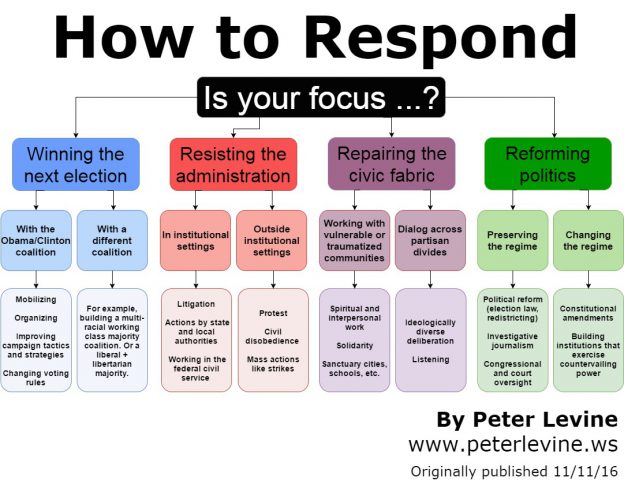
I posted the graphic that accompanies this post immediately after the 2016 election, and it went a bit viral. (Thanks to my colleague Alberto Medina for improving its appearance.) Although the name “Obama” should be changed to “Biden,” and some other minor tweaks might apply, I think the diagram remains pertinent and is perhaps even more urgent today.

See also: learning from Robert’s Rules?; a flowchart for collective decision-making in democratic small groupstools for the #resistance; preparing for a possible Trump victory (Nov. 15 2023); and Maria Avila et al., Building Collective Leadership for Culture Change: Stories of Relational Organizing on Campus and Beyond
on the current crisis

Almost every day, I am in conversations about protests on US college campuses. Some of these encounters take place at Tufts (in committees or one-on-one with students and colleagues), but I have also been part of discussions at Stanford, Harvard, and Providence College, and in DC–just to mention events during April.

In decades past, I would have posted frequent reflections here. These days, I am relatively quiet. I hear the argument that people in positions like mine should speak out more. I think I disagree, for four reasons.

First, although taking positions can be appropriate, or even obligatory, it can create challenges if one wants to facilitate open discussions in settings like classrooms or if one wants to advise and help people who have divergent views. I am privileged to receive requests for advice from people with almost the full range of positions on Israel/Palestine, and my interpretation of my own professional role is that I ought to try to help them all.

Second, I often find myself wrestling with what individuals have said in various settings. Sometimes I am moved, challenged, and educated, and sometimes I am somewhat appalled. However, these tend to be confidential statements that are not suitable for public assessment.

Third, although I believe that everyone has a right to form and express opinions, there is also value in talking when you have a solid basis for your views and listening when you don’t. Restraint is especially important for people in my kind of position (as a full professor and associate dean)–people whose opinions may have more weight than they deserve. Just because I teach Civic Studies does not mean that anyone needs to listen to me about Israel/Palestine.

Fourth, there are other people who should be heard: those whose views are well-informed, complex, and challenging in various ways. I feel an obligation to find and share those voices but not to compete with them. (Just as one example: “Najwan Darwish on living in doubt.”)

For whatever it may be worth, my views on Israel/Palestine would probably align best with “What being pro-Palestine means to me / my platform” by Ahmed Fouad Alkhatib. He is sharply critical of both Hamas and the Israeli government. My views on campus speech and civil disobedience are libertarian, with a strong tilt toward countering speech with speech instead of banning or punishing it. (And yes, that does also apply to really nasty speech.) In thinking about movement tactics and strategy, I’d go back to Bayard Rustin’s “From Protest to Politics” (1965). I’d interpret nonviolence not as a set of restrictions (i.e., don’t cause physical harm) but as a powerful repertoire of strategies that can accomplish political goals while increasing the odds that the activists themselves will be wise. (Please join this summer’s Frontiers of Democracy conference for more discussion of that topic.) Finally, I would support efforts to promote dialogue and listening across differences, but not to the exclusion of adversarial rhetoric, which is also essential in a democracy.

The previous paragraph was something of a disclosure, and I will regret making it if it discourages people who disagree with any of it from engaging with me.

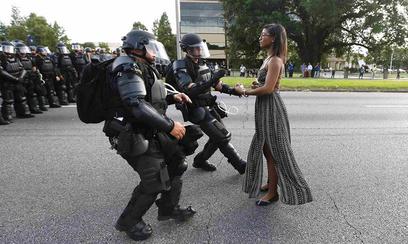
"Taking a Stand in Baton Rouge" Ieshia Evans stands in front of a line of police in Baton Rouge 2016. Jonathan Bachman/Reuters https://en.wikipedia.org/wiki/Taking_a_Stand_in_Baton_Rouge

nonviolence in a time of political unrest

The next few years will indicate whether American history has entered a phase of political unrest or instability. This development is not inevitable–and it’s certainly not desirable–but now is the time to plan, educate, organize, and train for it.

To be sure, there has always been political violence in the USA, often focused on the most vulnerable Americans. However, a substantial increase in the scale and scope of political violence would challenge our already fragile constitutional order and pose dangers for the rest of the world. We will know that we are in that situation if the daily news often includes reports of violent clashes, dubious arrests and prosecutions, threats, firings or resignations connected to politics, and occasional assassinations and politically-motivated mass murders.

I believe we need broad-based nonviolent social movements to get us through any unrest and ideally to bring us to a better place. Such movements will generate protest actions, some of which will involve reported violence–if only as a result of hostile responses by other groups or police. Thus we should be striving for a high ratio of nonviolence to violence.

Just in the last few days, I have heard confident statements that nonviolence doesn’t work and that violence is always necessary for achieving rights. This is false. Nonviolent struggles have a much better record of success. In any case, Americans must understand nonviolent strategies, so that they at least have this option.

On Dec. 1, 1967, Martin Luther King, Jr. said that the Poor People’s Campaign, which he was organizing at the time, “is a search for an alternative to riots. This is kind of a last, desperate demand for the nation to respond to nonviolence.” Here he used the prospect of social unrest to demand change. But he did not believe that violent strategies would actually benefit Black people or poor people. He saw violence as lose/lose. Although he warned privileged people that they would pay a price if violence prevailed, he never advocated it, partly because he thought it would harm disadvantaged people as much or more than anyone else.

In his final book, King expressed strong doubts that violence could generate “any concrete improvement” and defended nonviolence “as the most potent weapon.” This book was Where Do We Go From Here: Chaos or Community? Since the 1950s, “chaos” had been King’s word for the fruits of violence. For instance, in a lecture at Brandeis, he had forecast “an endless rain of meaningless chaos” unless nonviolence prevailed. Those words sound prophetic today.

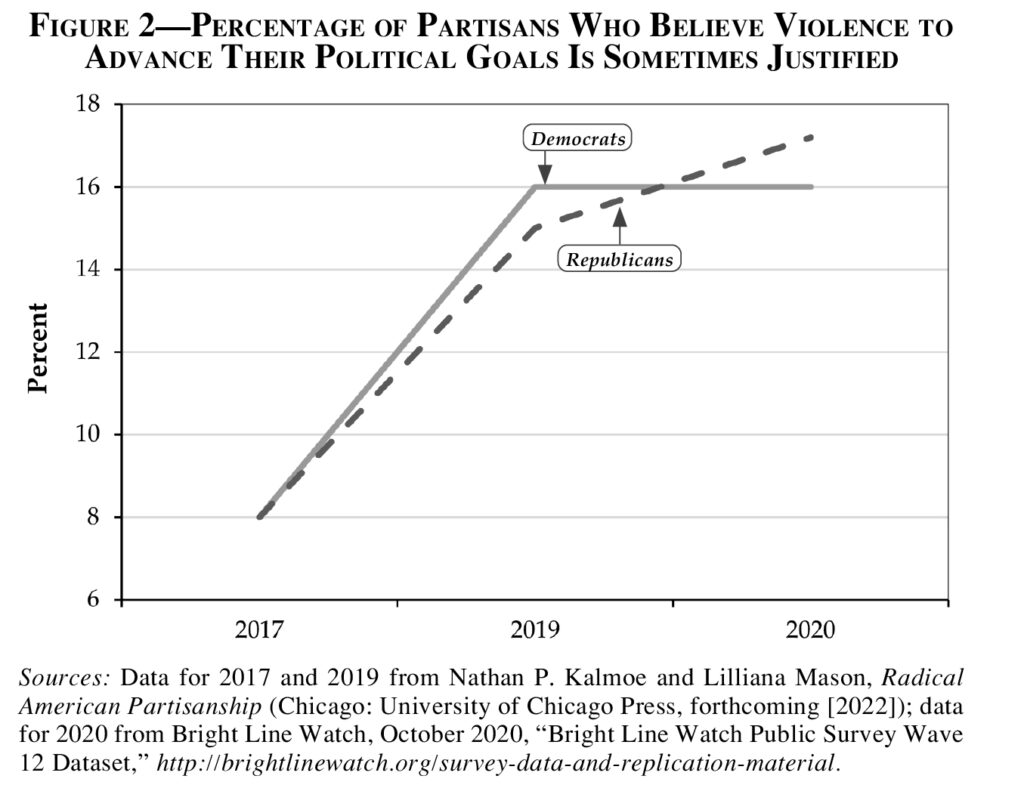
Most of the political violence in the USA is coming from the hard right. According to Rachel Kleinfeld, the Global Terrorism Database identified more than 50 violent attacks by the extreme right in the USA in 2019, versus about 5 attacks from the extreme left. However, that disparity is a recent phenomenon, not a long-term one, and there is much potential for violence on all sides (including the middle). Kleinfeld’s fig. 2 (below) shows that Republicans are somewhat more favorable to political violence than Democrats are. But support has risen rapidly on both sides–albeit from very low baseline–and the partisan gap is small. This graph makes me worry that almost any group can rapidly shift to supporting violence.

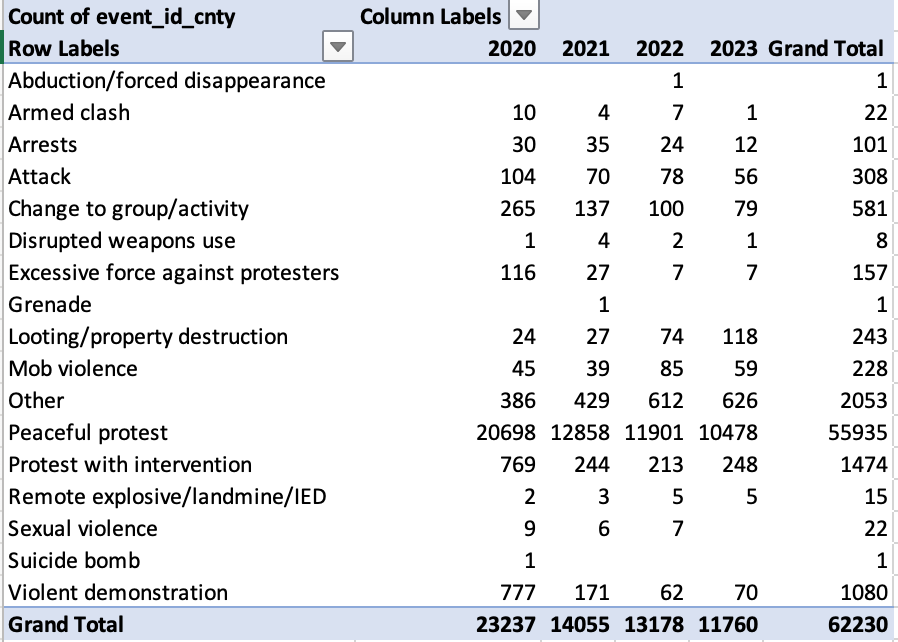
As we navigate the next several years, it will be helpful to track the level and extent of unrest so that we can tell what we are dealing with. The Armed Conflict Location & Event Data Project (ACLED) is helpful for this purpose. Its raw data include brief and–to my eye–balanced summaries of each event that they track. Here is my summary of all US events from their global database*:

US data from The Armed Conflict Location & Event Data Project (ACLED)

ACLED includes nonviolent protests. Although we should monitor them, I generally assume that they are good rather than dangerous. I would be happy to see the “grand total” in the table above rise, as long as peaceful protests represent a larger share. (Note that the rate of nonviolent protest has halved since 2020.)

Perceptions are important. In What Should We Do? A Theory of Civic Life, I discuss Black Lives Matter (BLM) as a major nonviolent social movement, citing evidence from Erica Chenoweth and others that violence was extraordinarily rare in BLM events and was prevented by careful planning and training. Indeed, BLM was less violent than the classical Civil Rights Movement had been. However, BLM has been widely reported as violent. Even some supporters perceive it as violent and justify it as such. This impression then contributes to a general sense that our times are violent, which may motivate tit-for-tat responses.

Nonviolence needs forthright and even passionate advocacy, as well as much painstaking training and organizing work.

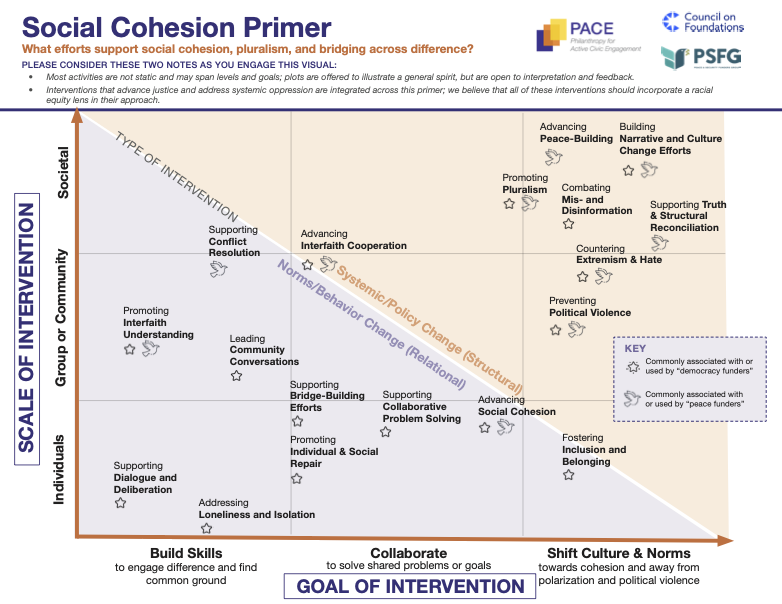
Nonviolence relates to and complements other necessary strategies, such as civic education, dialogue and deliberation, political reform, defense of civil rights, voter registration, and the efforts to enhance “social cohesion” that Philanthropy for Active Civic Engagement (PACE) has mapped (see below). However, nonviolence is a category of its own that needs special attention today.

Photo: “Taking a Stand in Baton Rouge” by Jonathan Bachman, showing Ieshia Evans. See also: the case for (and against) nonviolence; Rev. James Lawson, Jr on Revolutionary Nonviolence; preparing for a possible Trump victory; introduction to Gandhi

*The suicide bombing noted here took place in Nashville on December 25, 2020, when “a man detonated a bomb inside a recreational vehicle,” injuring 31. The grenade attack occurred in Pittsburgh on Jan. 3, 2021, with unknown perpetrators and motives and no injuries. Most of the incidents categorized as “sexual violence” are rapes of prisoners by corrections or police officers, which are understandably treated as political acts, although the motives may vary.

preparing for a possible Trump victory

I make no predictions about the 2024 election. It is still far away, and all kinds of dramatic shifts could occur between now and then. But there is a clear chance that Donald Trump will win. One of several paths to that outcome leads through a recession during the next six months.

I am also reluctant to predict what Trump will do if elected; I suspect he doesn’t know himself. But we should take seriously the possibility that he would do what he has been talking about lately, including directly ordering the prosecution of political opponents, invoking the Insurrection Act, building mass camps for immigrants, purging the civil service, and even attacking Mexico.

I disagree with Hillary Clinton that these events “would be the end of our country as we know it.” On the contrary, they would mark the beginning of a new phase with highly uncertain outcomes. Much would depend on how opponents respond. Now is the time to prepare for this contingency.

Trump would have significant support, including a popular base. Certain organizations and institutions would take his side, perhaps including at least one house of Congress.

But he would also face mass resistance from segments of the population and from important organizations and institutions–notably, from some state and local governments. He would quickly encounter roadblocks, which would frustrate him and his supporters. Some of his efforts might go forward, at least temporarily, which would enrage his opponents.

The result would be intense conflict, not only in Congress and courts but also potentially on the streets. I don’t think a literal civil war is likely, if only because the US military and security services would refuse to be drawn in, and it’s extraordinarily difficult to create an army from scratch. But it is common around the world to see periods of political conflict, typically labeled “unrest,” “instability,” or “disorder.” We might expect:

  • constant debates about whether various institutions should make statements about recent incidents, with repercussions for members of these institutions who disagree;
  • frequent crises that are permitted by existing laws, such as government shutdowns and even a debt default;
  • politically motivated pardons, amnesties, and blocked prosecutions;
  • prominent dismissals and resignations;
  • bans and purges of ideological minorities within institutions such as universities, corporations, and publications;
  • overt refusals to follow constitutionally permissible directives (e.g., state governors might resist federal mandates);
  • temporary closures of schools and colleges that are political hotbeds;
  • attempts to declare martial law and states of emergency at various levels;
  • arrests of questionable legality;
  • illegal orders that are either accepted or refused;
  • Increasingly flagrant displays of weapons;
  • paramilitary and revolutionary organizations, with training programs, uniforms, insignias and the like;
  • large and frequent protests, some of which may involve clashes with counter-protesters or the police;
  • frequent threats of violence;
  • politically motivated assaults and homicides of various kinds (not only assassinations, but also quasi-accidental deaths).

I’d expect similarities to periods like the Years of Lead in Italy or The Troubles in Northern Ireland–among many other examples. In fact, we may already have entered a period like that.

I would anticipate passionate and fraught disagreements within the potential resistance to Trump. For example:

  • Should the objective be to restore and protect the constitutional system as it has been, or was that system already flawed (and responsible for the present crisis) so that it needs to be changed? If it requires change, how basic and radical must that be?
  • Is the Democratic Party a worthy vehicle of resistance, or even the main opposition, or is it part of the problem? This debate will be especially fraught if it looks as if Biden would have won without third party presidential candidates in 2024.
  • How broad should the coalition be? It’s easy to say “As broad as possible,” but the hard questions arise when activists must consider whether to defer causes that they consider important in order to collaborate with people who are ideologically dissimilar. For instance, imagine that it is possible to draw businesses into a pro-democracy movement, but at the cost of delaying strong action on climate. Many people would balk at that tradeoff. But what if strong federal environmental action seems impossible, anyway? Would it then be worth submerging environmental goals to expand the pro-democracy movement?
  • What means are appropriate–or necessary–to combat authoritarian tendencies and street-level violence?

I think the response should be massively nonviolent, and we should eschew concrete, physical violence even in the face of institutionalized injustice. Nonviolent direct action is a powerful strategy with a strong record of success. It is particularly likely to draw broad participation and to yield a stable democracy as its outcome.*

There may be times when violence is appropriate: George Washington, Abraham Lincoln, and Franklin Roosevelt all commanded armies that fought for freedom. And sometimes it is a mistake to criticize acts of violence even if you wouldn’t endorse them. In response to the Detroit riots of 1967, Dr. Martin Luther King Jr. walked a careful line. He said that crimes committed during the riots were “deplorable” but also “derivative.” He explained, “If the soul is left in darkness, sins will be committed. The guilty one is not he who commits the sin, but he who causes the darkness.” Nevertheless, King continued to defend nonviolence because he believed that it was the most powerful option, with the greatest chance of creating a better society. That argument will be even stronger under conditions of social unrest and escalating, tit-for-tat violence. Apart from anything else, as Bayard Rustin argued, political success requires the support of a substantial majority, and violence alienates people.

Nonviolence takes skill, discipline, and values, all of which that can be taught and practiced in advance of a crisis. Now is the time for practice and training.

I am discussing a threat that comes from the extreme right. This threat is not symmetrical. However, intimidation and violence may be reciprocated, and ugly behavior may spread across the spectrum; this common pattern must be resisted.

It will be crucial to promote dialogue and listening. People will need ways to exit extremist movements and be reintegrated. And we need to hear about legitimate grievances from all quarters so that they can be addressed.

Anyone who is knowingly involved in violating civil rights should ultimately be held accountable. But tens of millions of people will vote for each major party’s nominee in the 2024 election, and voters on both sides are members of our national community. As the risk of violent conflict rises, so does the need for empathy and curiosity across partisan differences.

*See also: the case for (and against) nonviolence; Why Civil Resistance Works; tools for the #resistance; timely quotes from Bayard Rustin (1965)

introduction to Gandhi

This is a lecture that I pre-recorded for Introduction to Civic Studies this semester. It provides some background about the life and fundamental ideas of Mohandas K. Gandhi.

Students will also read these texts:

  • Ramachandra Guha, Gandhi: The Years that Changed the World (2018), chapter 16 (on the Great Salt March)
  • Gandhi, Satyagraha (Ahmedabad: Navajivan Publishing Co., 1951): excerpts
  • Gandhi, Notes, May 22, 1924 – August 15, 1924, in The Collected Works of Mahatma Gandhi, New Delhi, Publications Division Government of India, 1999, 98 volumes,  28, pp. 307-310

In class we will will discuss such questions as these: How (if at all) can one organize voluntary collective action at a sufficient scale to bring about change in Gandhi’s preferred ways? Is Gandhi right to demand sacrifice and to see sacrifice as intrinsically meritorious? How can Gandhi know whether his stance is correct when he finds himself in conflict with other idealists, such as B.R. Ambedkar? And is it fair for Gandhi to claim that he only knows the means, not the result, of the struggle, if the end is actually predicable?

See also: Gandhi: The Years That Changed the World, 1914-1948 by Ramachandra Guha; Gandhi versus Jinnah on means and ends; Gandhi on the primacy of means over ends; notes on the metaphysics of Gandhi and King; Rev. James Lawson, Jr on Revolutionary Nonviolence; etc.