Category Archives: advocating civic education

the public wants us to teach facts, not skills of citizenship

A perfect citizen would know an enormous range of facts, concepts, and skills, from macroeconomics to how to chair a meeting, from the contents of the Federalist Papers to the principles of statistics. (See my list in this HuffingtonPost article.) In practice, schools must decide what is most important to teach in the limited hours available to them. I value facts about politics and government and related academic concepts, but my highest priority would be the arts and habits of association that De Tocqueville thought were the basis of successful democracy in America. Unless citizens can successfully manage projects and groups, we are left to the mercies of the state and market. Further, by co-managing our own associations, we develop reasonable ideas about how to address larger public issues.

I find good news and bad news in a new American Enterprise Institute report entitled Contested Curriculum: How Teachers and Citizens View Civics Education. Good news: teachers, especially in public schools, generally share my goals and priorities. Bad news: American citizens do not.

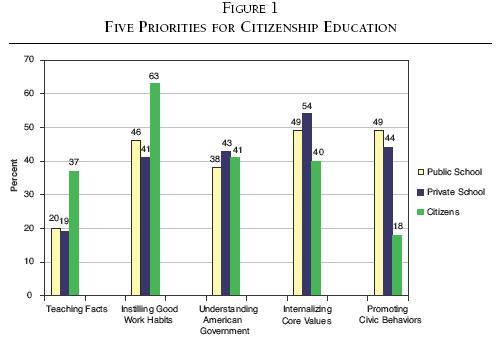
In the following graph, snipped from that report, “Public School” means the opinions of social studies teachers in public schools. “Private School” refers to social studies teachers in private schools. “Citizens” means a representative sample of 1,000 adult Americans. The bars bear simplified labels. For example, “Teaching facts” is short for: “It is absolutely essential [for students] to know facts (e.g., the location of the 50 states) and dates (e.g., Pearl Harbor).”

Look at the last cluster of columns, showing that while teachers think it is important to promote civic behaviors, citizens do not.

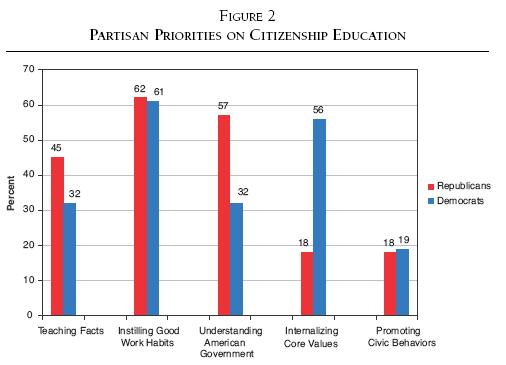
That first graph reveals one political obstacle for people who share my priorities: we are in the minority. Another–equally familiar–problem is the partisan split. Basically, Republicans are considerably more supportive of facts and academic concepts than Democrats are. But Democrats are more sympathetic to values. For instance, teaching students “To be tolerant of people and groups who are different from themselves” (one component of the bar shown below as “Internalizing core values”) seems “absolutely essential” to 31% of Republicans and 69% of Democrats.

Standards (official guidelines for what should be taught) tend to include all of the above priorities. That is the path of least resistance for policymakers: just add everything to the list. But the emphasis in classrooms is not determined by standards; it is much more shaped by tests. To the extent that states require tests of civics, almost all the content involves facts and academic principles.

In short, citizens, and especially Republican citizens, are getting an educational policy closer to what they want than to what teachers (and I) would prefer.

Massachusetts kids fight for civic ed

(In DC for a Bringing Theory to Practice conference. This item also appears on the Huffington Post)

Here is news that may shake your stereotypes. Urban students from several Massachusetts cities (in a coalition called Teens Leading The Way) have chosen to fight for a statewide civic education requirement. Today, they will testify in the state capitol in favor of Senate bill # S00183 (which they wrote) to require a civics course.

Isn’t “civics” boring and despised by kids? Aren’t today’s youth slackers, obsessed by celebrity culture but apathetic about politics? And aren’t kids from Boston, Lowell, Worcester, and other urban school systems especially “at risk” for dropping out–not champions of extra academic requirements?

The answer to each of these questions is no. Young people volunteer in their communities at higher rates than their parents did and voted at near-record levels in 2008 (though not so much in 2009 and 2010). Many youth are notably idealistic, concerned about serious public issues, and eager to learn more.

To be sure, young people’s knowledge of political and civic issues is not impressive. In this year’s National Assessment of Education Progress (NAEP) in civics, only 24 percent of high school seniors scored at “proficient” or higher, demonstrating solid understanding of the topic. Many young people are critical of their own civic and political knowledge, and that is one explanation they offer for why they don’t vote. But they favor educational experiences and requirements that would boost what they know. In a national poll we conducted almost a decade ago, two thirds of young Americans favored a new mandatory civics requirement for high school graduation.

Urban students have an impressive record of constructive civic engagement, as shown by Lowell kids’ sustained effort to get the voting age lowered to 17 in their city, and many other projects. Like young people everywhere, they respond exceptionally well when given opportunities to contribute to their communities. Youth who enroll in programs like Lowell’s United Teen Equality Center (UTEC) or YouthBuild flourish and succeed because they are treated as assets and challenged to do serious work for their communities, not viewed as chronic problems.

Finally, “civics” need not be boring but is often quite engaging. The word “civics” summons a scene of a teacher diagramming the three branches of government on a chalkboard for rows of silent students. Young people do need to understand the structure of their government. But effective civics teachers introduce the facts as part of interactive discussions and projects on issues that matter to kids. For instance, if students discuss crime in their neighborhood and develop effective, research-based recommendations for reducing it, then the relationship between the city council and the police department will matter to them and they will be eager to learn about it.

That is why the young people in Teens Leading The Way are supporting legislation to require the study of government, history, and civil rights along with opportunities to use such knowledge to create community change through service and community-action projects. Service, when tied to classroom work, has been found to boost students’ graduation rates and college attendance, probably because they gain positive motivations and skills.

These elements of effective civic education have been demonstrated to work in rigorous research. They are already offered by excellent teachers in some of our schools, but many kids never experience them. That is why the students are fighting for “civics” on behalf of themselves and their generation.
Five Strategies to Revive Civic Communication

(Chicago) I am here to release my white paper, “Civic Engagement and Community Information: Five Strategies to Revive Civic Communication,” at an Aspen Institute round-table.

In brief, the recommendations of the report are:

  • Take advantage of the large and growing infrastructure of national and community service programs by requiring all service participants to learn civic communications skills and by creating a new Civic Information Corps—mainly young people who will use digital media to create and disseminate knowledge and information and connect people and associations.
  • Take advantage of the nation’s vast higher education sector by changing policies and incentives so that colleges and universities create forums for public deliberation and produce information that is relevant, coherent, and accessible to their local communities.
  • Take advantage of the growing practice of community-wide deliberative summits to strengthen democracy at the municipal level by offering training, physical spaces, and neutral conveners and by passing local laws that require public officials to pay attention to the results of these summits.
  • Take advantage of new tools for mapping networks and relationships to make transparent the structures of our communities and to allow everyone to have the kind of relational knowledge traditionally monopolized by professional organizers.
  • Take advantage of the diverse organizations concerned with civic communications to build an advocacy network that debates and defends public information and knowledge.

(cross posted on Huffington/Post Chicago)

the movement to badges in education, and what it means for democracy

The idea of giving badges to people who can demonstrate specific skills is taking off rapidly.  A “badge” is shorthand for a portable credential, rather like the merit badges traditionally used in Scouting. (See the Boy Scouts’ badge for backpacking as an example.) In the modern, adult world we could have badges for being able to schedule meetings of more than four people, being able to write an effective op-ed piece, or being able to set up a social network.

Mozilla (which builds Firefox and other prominent software tools), the MacArthur Foundation, and Peer 2 Peer University have launched an explicit “badges” project. Meanwhile, the US. Commerce Department is leading a federal effort to promote digital literacy that may, I am told, soon generate recognized credentials that are similar to badges.

As the old song says, “This could be the start of something big.” We are used to credentials that come only with the completion of whole courses of study. For instance, a high school diploma signifies that you have successfully completed four years of high-school-level courses (or the equivalent). That system creates dilemmas:

  • You can obtain the credential without necessarily knowing anything relevant or useful: it can just measure years spent in the institution. Or …
  • Its value can be more “objectively” measured by means of some kind of high-stakes test, such as an exam that is required for graduation. But heavy use of tests encourages test-prep instead of real education. Also …
  • If we want to know whether a prospective employee or student can do something specific (such as participate effectively in a meeting), the available standardized test scores may be of no use.
  • Many people fail to obtain general credentials. About a third of our young people reach age 19 without a high school diploma. A substantial majority reach age 25 without a bachelors degree. Yet many possess particular skills that would have market value if they were recognizable.
  • You can develop valuable concrete skills in school or on the job and (if the institution works well) can be recognized for your skills while there. But no one in a different school or job will know what skills you have: they aren’t portable. Recommendation letters are devices for transmitting information about skills, but they are highly imperfect.

Hence the idea of defining specific skills and providing portable credentials to people who can demonstrate them. The main advantages are solutions to the dilemmas noted above, i.e., better measurement, better incentives for learning, more portability, and less waste of skills that people already have.

But there’s also a practical opening here for anyone who thinks we haven’t been teaching the right things. I, for example, believe that we haven’t been teaching the skills and arts of association–of group-membership and collective action–that de Tocqueville saw as the foundation of democracy in America. We can advocate for those skills to be included in our curriculum requirements or standardized tests, but all the above-mentioned dilemmas stand in the way. Instead, I am tempted to jump on the “badges” bandwagon and advocate for civic badges (at all levels).

This is a supply-side strategy: trying to increase the number of people who have civic skills by providing relevant credentials. We could also pursue a demand-side strategy: persuading admissions offices and employers to seek individuals who possess specific badges. For example, the federal government will need to find 91,000 new employees each year for jobs defined as “mission-critical.” Imagine if they sought employees who had civic badges, like interviewing fellow citizen to determine their values and needs; or moderating public meetings. Advertising a need for those badges would have a powerful effect on curriculum.

By the way, I am very far from believing that the only objective of education is a set of concrete skills to which we can award badges. A liberal education is supposed to result in a coherent mentality that encompasses a sensitive appreciation of a wide variety of perspectives, moral grounding, aesthetic appreciation, and analytical rigor. But that is the outcome that a diploma ought to signify. By reserving badges for more concrete attainments, perhaps we can restore the appropriate meaning to degrees.

increasing the odds of success for young people’s civic work

My favorite civic education courses and programs are ones that ask kids to discuss local issues, deliberate about what to do, act together, and then reflect. This seems the best pedagogy, but it presents a consistent challenge.

Middle-class, suburban kids tend to identify problems that they can address effectively within a finite amount of time. For example, they might note that there’s always a traffic jam in the high school parking lot at 3 pm, come up with an alternative traffic plan, and offer it to a principal who is delighted to adopt it. They learn skills, gain confidence, and feel great. Meanwhile, their low-income, urban peers are identifying homicide or the dropout rate as their key concern. They either fail to address such problems or they realize that they will fail and shift to some other objective. Often they decide to raise awareness among their peers, knowing that “awareness” is ultimately not very useful. As a result, their sense of political self-confidence (or “efficacy,” in the jargon) often declines as a result of their work. For evidence, see:

I think this is the great issue in the field. Some possible solutions  include: 1) careful, guided selection of topics for students’ projects, which Fehrman and Schutz recommend; 2) very skillful preparation and reflection, including constructive reflection on the barriers that students encounter (which Ferhman and Schutz also recommend); and/or 3) not starting over with new projects every semester or course. I would advocate more experimentation with cumulative civic projects, in which students are asked to build on what their predecessors began. That reduces their power to choose issues and strategies, but it also gives them more chance of success. After all, most adult community projects don’t start and end within 14 weeks; we build on previous work.