Category Archives: advocating civic education

games, digital badges, and alternative assessments in civics

Badges are portable credentials that demonstrate that someone possesses a specific skill. They differ from diplomas, which signify the completion of a whole course of study. Critics worry that adopting badges widely would undermine the holistic value of a traditional degree, which is supposed to stand for more than the sum of its parts. That’s a valid concern, but I see huge advantages to badging for civics. For one thing, civics is now very poorly served by curricular mandates and tests; at best, students are required to learn and demonstrate very low-level, individual academic knowledge, rather than the interactive skills we need from citizens. But adding more elaborate assessments would just put new burdens on students and schools. Meanwhile, some young people do obtain advanced civic skills; but without specialized qualifications, they can’t demonstrate their abilities to college admissions officers, prospective employers, or citizens’ groups that might be looking for leaders.

To explore the pros and cons, CIRCLE’s Felicia Sullivan has written “New and Alternative Assessments, Digital Badges, and Civics: An Overview of Emerging Themes and Promising Directions” (published yesterday). She’s also produced a Prezi presentation to summarize the key themes:

(See also “the movement to badges in education, and what it means for democracy,” “badges for civic skills,” “the controversy over badges,” and Peter Levine, “Education for Civil Society,” in David Campbell, Meira Levinson, and Frederick M. Hess [eds.], Civics 2.0: Citizenship Education for a New Generation [Cambridge, MA: Harvard Education Press, 2012], pp. 37-56.)

the Pledge of Allegiance

I will be talking to a reporter later about the Pledge of Allegiance, which is apparently disappearing from California schools. I recognize that this is a classic hot-button issue because deliberately removing the Pledge is seen as an attack on God and country (both named in the modern text). That supports a broader narrative in which patriotism and faith are seen as threatened by secular critics who use the machinery of the state, especially public schools, to push their vision.

Well, I am not on that side of the debate, and I don’t agree about the trends. It’s interesting, for example, that under-30s are the least likely to see our wars in Vietnam, Iraq, and Afghanistan as mistakes–by a large margin in the case of Vietnam. It’s hard to square that with the idea that they have been educated against patriotism.

But let me turn the question around and ask it this way: If there had never been a Pledge of Allegiance and we were thinking of making one up and requiring it for all students, would that be a good idea? The following specific questions would then arise, I think:

  • Can minors make a pledge? (They cannot in legal contexts; contracts that they enter are generally considered voidable.)
  • If you solemnly pledge something, why should you repeat that daily? Isn’t a pledge a pledge?
  • What should students learn from the exercise of daily repeating some words in class? For example, if the draft text of a pledge is going to include the word “indivisible,” shouldn’t 100% of students who repeat it daily be able to explain what that word means and what it implies about state secession? More broadly, what words and ideas should they learn?
  • Assuming that the objective is for students to think certain things about the US, is repeating a short memorized statement every day the best way to accomplish that? What are the learning outcomes (for kindergarteners, for high school seniors)?
  • Who should write and approve this text, and must it be the same for every class in every school in every community of every state?
  • Can God be mentioned in a public school? What is the meaning of the phrase “under God” in the current text? Does it mean, for example, that the speaker affirms the existence of one omnipotent deity who has blessed the United States? If that’s its meaning, may non-monotheists recite the words without foreswearing themselves? May Christians, Jews, and Muslims who deny the fundamental legitimacy of the state (as Tolstoy did) recite this text? What about Christians who read Matthew 5:34-5: “But I say unto you, Swear not at all; neither by heaven; for it is God’s throne /Nor by the earth; for it is his footstool: neither by Jerusalem; for it is the city of the great King.”
  • What about the students who (for whatever reason) don’t want to pledge? The Supreme Court has ruled that individuals don’t have to stand or say the words. But was the Court right, and would the same decision be appropriate regardless of the content of the pledge? For instance, if schools merely required students to pledge not to harm each other, would a student have a right to opt out?
  • What if the parent and the student diverge on this matter? Does the child of a Jehovah’s Witness have the right to say the pledge even though his father considers it blasphemous? At what age is the choice up to the parent versus the child?
  • How should schools treat dissenters? Should they merely tolerate the rare individual who quietly sits through the pledge? Or should they invite discussion of the pros and cons?
  • May and should students who are not citizens of the United States take the pledge?
  • If you are going to pledge allegiance to something, should it be to the flag? To the republic? To the people who constitute the republic? To certain principles that underlie the republican form of government?
  • Could the government of the United States hypothetically take actions that would render the pledge void?
  • What (if anything) should students pledge to do? Is pledging allegiance enough–and is it even meaningful–if it doesn’t imply any action?

the most important thing citizens should know

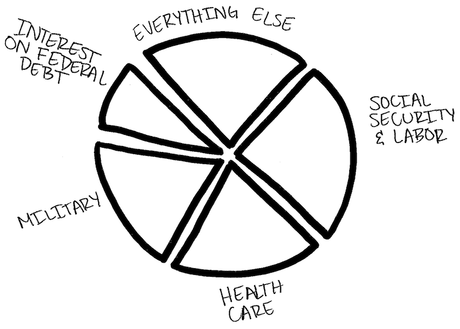
If I had to pick one thing that a citizen of the USA should know, it would be the allocation of money in the federal budget. A simple pie chart is shown below. It’s a static image from the National Priorities Project‘s website, which is rich with interactive graphs and even provides a “Build a Better Budget” simulation. Along with the pie chart, another critical graph shows the basic historical trends over recent decades.

The NPP is helping with public education, but the problem is serious. Right after the election, we asked almost 4,500 young adults, “Does the government spend more on Social Security or foreign aid?” The right answer is Social Security (by a ratio of about 26:1, if we define “aid” as economic assistance, or about 20:1, if we include military assistance). A majority (51.3%) of the young adults chose the wrong answer–foreign aid–and just 29% got the question right.

This is not a youth problem only. In 2011, CNN and the Opinion Research Corporation asked adults how much of the budget the federal government allocates to various programs. The median estimate was 20% for Social Security (which is close to the correct proportion), but 10% for foreign aid (which is far too high).

It’s hard to have a debate about what should happen if people don’t understand what is happening. We don’t teach this kind of material in schools, the mass media don’t explain it regularly or helpfully, and politicians have incentives to obfuscate.

what to do about k-12 civic education

(Chicago) These are my remarks for tonight’s Illinois Civic Mission Coalition “Annual Convening.” 

When Americans turn their attention to civic education in k-12 schools, very frequently they make the following claims:

  1. Kids today don’t know anything about government and civics!
  2. Kids today don’t vote!
  3. Schools today don’t teach civics the way they used to when I was a kid. What happened to civics classes!?

A couple of additional assumptions are buried under those claims. Civics is seen as the name of a course in high school, rather than a broader set of opportunities. And success in that course is defined as knowing some information (the kind that we test) and acting in particular ways, above all, by voting

I see the political value of this argument—it is easy for people to grasp, it fits into their preconceived ideas that civics is in decline, and it grabs attention. When the United States Department of Education released the 2011 National Assessment in Education Progress (NAEP) Civics results, the New York Times story was entitled “Failing Grades on Civics Exam Called a ‘Crisis.’”  The story began, “Fewer than half of American eighth graders knew the purpose of the Bill of Rights.”

Maybe getting that story was a win for the civics field.

But I want to complicate matters a bit. All the claims I started with are at least a bit inaccurate and misleading—just as factual matters. From a strategic point of view, they are problematic, too. Since they present the wrong diagnosis, they naturally lead to the wrong cure. Adults are liable to say: Let’s require a year of civics in high school and test kids on the US Constitution! But that is not a good reform plan, as I’ll explain.

Continue reading

soft skills for the 21st century workplace: empowered teamwork or emotional labor?

In the New Republic, Timothy Noah describes how the restaurant chain Pret a Manger forces its workers to be cheerful:

Pret keeps its sales clerks in a state of enforced rapture through policies vaguely reminiscent of the old East German Stasi. A “mystery shopper” visits every Pret outlet once a week. If the employee who rings up the sale is appropriately ebullient, then everyone in the shop gets a bonus. If not, nobody does. This system turns peers into enthusiasm cops, further constricting any space for a reserved and private self.

Noah cites Arlie Hochschild’s notion of “emotional labor.” Whereas factory owners merely purchase their workers’ labor, managers of nursing homes, boutiques, and even fast-food franchises now buy their employees’ moods and attitudes. This is a creepy idea, easily bringing to mind the Stasi. In fact, the East German secret police probably tolerated a certain amount of grouchiness that would get you fired at Pret a Manger.

Meanwhile, we read that 21st century employers need more advanced and challenging interpersonal skills than factory-owners once required. Today’s employees work in diverse groups to analyze problems and invent original solutions. They are no longer assigned to durable and hierarchical teams, but navigate and build shifting networks. This may be stressful, but it is also empowering and challenging. During work-hours, the traditional firm was a dictatorship, but the post-industrial workplace is more democratic–even a “directly deliberative polyarchy” in the words of Michael C. Dorf and Charles F. Sabel.

Which is the more pervasive trend? There is evidence that “soft skills,” “interpersonal skills,” or “people skills” are worth more now, and hard skills are worth less. The boss can teach you the latest hardware and software on the job, but good employees must be able to work together. Thus Borghans et al. (2006) find that the labor-market value of “people skills” has increased rapidly in Britain, Germany and the US since 1970. Their measures of “people skills” include, for example, a preference for work that requires contact with people and a “preference for working for the presumed good of people.”

The tricky part is that these “people skills” include capabilities that are part of a good and rewarding life (such as deliberating about goals, or genuinely caring for other people) as well as creepy invasions of private life (such as always smiling at clients and coworkers).

If employers want the former, then work skills converge with democratic or civic skills. Education can become empowering and experiential; we can teach children to be ethical problem-solvers in all aspects of their lives. But if employers want workers to perform Hoschschild’s “emotional labor” (cheering up their clients or patients by always displaying a sunny attitude), then work skills sharply diverge from civic skills. Then education becomes a matter of disciplining kids to be “positive,” and the boss can grab a bigger part of your soul.

By the way, it’s not so easy to tell when it’s bad for workers to display positive attitudes. Noah writes, “Emotional labor is not itself new. Prostitutes have faked orgasms for millennia. With greater sincerity (one hopes), undertakers calm the grieving, nurses comfort the sick, and migrant nannies lavish on other people’s children the love they aren’t present to furnish back home.” He argues that what is different about Pret a Manger is the absence of valid emotional needs in a fast-food restaurant. “The only imperatives typically addressed in a Pret shop are hunger and thirst. Why must the person who sells me a cheddar and tomato sandwich have ‘presence’ and ‘create a sense of fun?”

I don’t think that’s how to draw the distinction between acceptable and creepy forms of “emotional labor.” People seem to want smiles along with their sandwiches. Why is that desire illegitimate when it’s fine to prefer a sympathetic undertaker? We used to prefer the jolly grocer or miller to the grouchy one, and for similar reasons, we may like to shop at Pret more than McDonalds because of the smiles. In my view, the important question is the underlying power dynamic. If you own your own funeral home and you adopt a posture of sympathy toward your grieving clients, that’s both commendable behavior and good for business. If you’re a famous actor and you feign joy or love, that deserves applause. But if you work for a hospital, a nanny service, a pimp, or an upscale sandwich chain and you have to act cheerful to keep your job, that represents a loss of freedom.

I’ll end with the implications for education, although education is certainly not the only tool we can use to address the problems of 21st century work. Schools should not just teach people to be good employees; instead, they should develop those interpersonal skills that are both intrinsically worthy and valuable in the marketplace. Let employers figure out what to do if their workers have “bad attitudes.” The job of schools is to make people free, although in ways that are compatible with their earning a living. In other words, there is an overlap between what 21st century employers want and what good educators should teach, but their objectives are not identical.

See: Borghans, L., ter Weel, B., & Weinberg, B. A. “People people: Social capital and the labor-market outcomes of underrepresented groups (2006); Dorf, M.C. and Sabel, C.F. “A Constitution of Democratic Experimentalism,” Columbia Law Review, vol. 98, no. 2 (March 1998);  Hochschild, A.R., The Managed heart: Commercialization of Human Feeling, 20th anniversary edition (Berkeley: University of California Press, 2003).