Category Archives: advocating civic education

podcast on civic education and engagement in Catholic communities

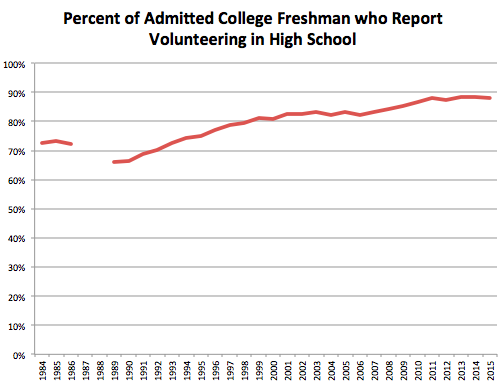
Here, starting at minute 39, is my recent conversation with Msgr. Kevin Sullivan, Executive Director of Catholic Charities, New York, on his SiriusXM Radio Show, “Just Love.” We talked about why Millennials volunteer so much (I named a combination of idealism and structured opportunities and expectations), why civic education seems to work well in Catholic schools, why the media is biased against Millennials, why Obama ’08 and Sanders ’12 drew youth support, the difference between service and social change, and the argument for expanding service opportunities.

“Explainer” on civic education

Over at The Conversation, I have a new article that’s meant to be a short overview of civic education today. It begins:

Any election demands knowledge, attention and wisdom from the whole electorate. When a campaign season does not seem to be going well, there’s often angst about whether the public has been sufficiently educated.

Anxious eyes turn to our public schools.

For instance, writing in The Atlantic recently, Jonathan Zimmerman, professor of education and history at New York University, decried the incivility of the 2016 campaign and named “a flaw with civic education.” He wrote: “Put simply, schools in the United States don’t teach the country’s future citizens how to engage respectfully across their political differences.”

I have studied and advocated civic education for almost two decades. I believe civic education must be improved in the United States. First, though, it’s important to understand the condition of America’s civic education.

new article: “Join a club! Or a team – both can make good citizens”

This new article explores reasons that k-12 athletics may boost civic engagement, as well as some important differences between sports and civic life. Student associations in general teach civic skills, and sports are best understood as examples of associations. Indeed, high school teams should be more like standard school clubs, in which participation is voluntary and the students are primarily responsible for managing the group.

Citation: Peter Levine, “Join a club! Or a team – both can make good citizens,” Phi Delta Kappan, vol. 97, no. 8 (May 2016), pp 24-27

the question each citizen must ask

(New York City) “The Question Each Citizen Must Ask” is my new piece in Educational Leadership, the magazine for k-12 school administrators (vol. 73, no. 6, March 2016, pp. 30-34. It begins:

When universal public education was invented in the United States, visionary proponents like Horace Mann believed they were building the first large-scale democracy in the history of the world. They realized that citizens would have to be educated to play their parts in a system that depended on millions of wise and active participants. They made a courageous bet that children could be taught to make democracy work.

I argue that civic education must equip students to ask the citizen’s core question, and I explain what that is and what pedagogies are most promising. (The article is also available via academia.edu).

teaching online civic engagement

For several years, Joe Kahne and his colleagues have been conducting intensive research on young people’s use of digital media for politics and what that means for education. Their research has taken the form of large-scale youth surveys, interviews, and experiments. The following is a broad and detailed new article that pulls together much of their research and provides concrete examples of classroom practice:

Joseph Kahne, Erica Hodgin & Elyse Eidman-Aadahl, “Redesigning Civic Education for the Digital Age: Participatory Politics and the Pursuit of Democratic Engagement,” Theory & Research in Social Education, Volume 44, Issue 1, 2016, pp. 1-35 (open access)

The authors address two concerns that I have raised in previous work. First, “Many efforts to produce and circulate content will confront what Levine has termed ‘the audience problem’ (2008, p. 129). Simply put, many blogs or other digital content may get relatively few views and little or no response.” I would add that this is almost a logical inevitability because there aren’t enough eyeballs to allow millions of content-producers all to reach large audiences. As I can testify from years of experience, the median blog or video reaches just a few. The authors reply:

Of course, many off-line political activities also fail to engage many members of the public. We would classify a blog that addresses a political issue but has few readers an act of participatory politics just as we would classify a protest that people ignore as a political activity. That said, clearly, the power of public voice is diminished if one fails to reach a public. This reality highlights the need for educators to help set realistic expectations and to support and scaffold activities so that youth can more effectively produce and circulate political content.

Second, “a number of scholars (Levine, in press; Sifry, 2014) have detailed ways that individuals’ and non-institutionalized groups’ efforts to achieve greater voice by leveraging the power of the digital media often fail to prompt institutional change. Expressing caution, Milner (2010) wrote, ‘[youth who] turn their backs on [institutional] politics in favor of individual expression will continue to find their priorities at the top of society’s wish list–and at the bottom of the ‘to do’ list”(p. 5).” Here I would add that loose online movements are frequently defeated by disciplined organizations, such as corporations, armies, and security agencies. But the authors reply:

one might note that a wide range of significant change efforts ranging from #BlackLivesMatter, to the DREAMer movement, to the protests against SOPA, to the push for marriage equality have employed digital media in ways that changed public attitudes and that these changes have enabled new legislation. Still, the concern remains. Watkins (2014) noted, for example, that when it comes to digital media, youth are often “power users” (frequent users), but they are not necessarily “powerful users” (influential users). In order for youth to realize the full potential of participatory politics, they will frequently need to both understand and connect their efforts to institutional politics. Helping youth identify ways to build bridges from voice to influence is vitally important.

These are just two of many issues discussed in this extensive and deeply researched survey article.